
How to Pronounce the Russian Ы Sound (The One That Doesn't Exist in English)
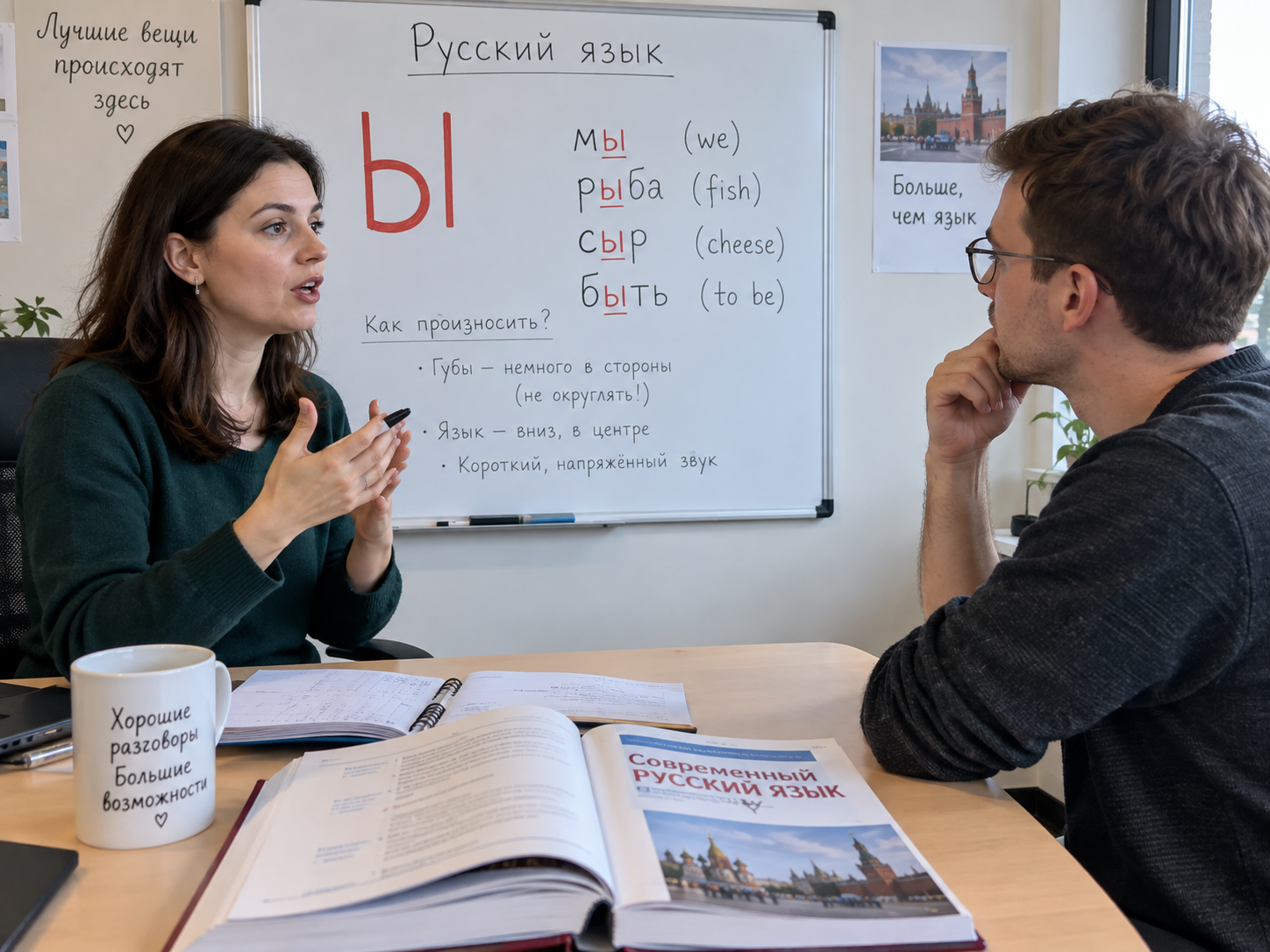
Russian beginners often recognize the letter Ы before they can produce the sound. It looks unusual, appears in very common words, and is frequently introduced with an unhelpful instruction such as “It is somewhere between ee and oo.” That description gives a learner almost nothing to do with the mouth.
The useful starting point is simpler: Ы is a high central-to-back unrounded vowel. English does not have the same vowel as a stable phoneme, so your goal is not to find an English word that already contains it. You have to learn a new tongue position.
Start from И, then move the tongue back
Say Russian И, approximately like the vowel in English machine, but usually shorter and less exaggerated. Notice that the front of your tongue is high and fairly far forward.
Now keep your lips relaxed and unrounded. Do not make an “oo” shape. Move the body of the tongue backward while keeping it relatively high. The sound should become darker and more central. That is the neighborhood of Ы.
A teacher listening to English speakers often hears one of two substitutions. Some learners stay too far forward and pronounce мы almost like ми. Others pull the tongue back and round the lips, producing something closer to “moo.” Russian Ы requires the back movement without the lip rounding.
The consonant before Ы matters
In Russian, Ы normally follows a hard consonant. That relationship is part of why the vowel feels so unfamiliar. English speakers often soften the preceding consonant because they are unconsciously moving toward an ee-like vowel.
Compare:
ми — the consonant м is soft before И
мы — the consonant м is hard before Ы
The contrast is not only the vowel. The entire transition from consonant to vowel changes.
Try saying м with the tongue in a neutral, hard position, then move directly into Ы: м-ы, мы. Do the same with в-ы, вы and б-ы, бы. This is often easier than trying to pronounce an isolated Ы first.
Practice with words you will actually use
Start with short, frequent words:
мы — we
вы — you (plural or polite singular)
был — was, masculine
сыр — cheese
дым — smoke
сын — son
Do not rush. A slow, accurate contrast helps more than repeating the word twenty times with the same English substitute.
A useful pair is мил versus мыл. The first contains И and a soft м; the second contains Ы and a hard м. Even if these particular words are not central to beginner conversation, the pair trains the physical contrast you need for common words such as мы and вы.
Do not add a hidden “uh” before the sound
Another common problem is inserting an extra vowel. A learner sees Ы and produces something like “uh-ee.” This happens because the mouth is searching for a path into an unfamiliar position.
Russian speakers do not hear two vowels there. The goal is one continuous vowel quality. Record yourself saying мы slowly. If you hear a little break after the consonant, try again with a smoother transition.
Do not obsess over an isolated perfect Ы
It is possible to spend so much time trying to make the “perfect” vowel alone that the sound never becomes usable in words. Pronunciation is contextual. Your Ы in сыр may improve before your isolated Ы does because the surrounding consonants give the tongue a route.
Teachers often get better results by moving among three levels: isolated sound, syllable, real word.
Try this sequence:
ы
мы, вы, бы
мы были (“we were”)
Вы были там? (“Were you there?”)
Now the sound is doing grammatical work instead of existing as a pronunciation stunt.
Use contrast, not endless repetition
The brain learns categories through differences. Alternate Ы and И:
мы — ми
бы — би
ты — ти
Some of the second forms may not be useful standalone Russian words, but the contrast helps you feel the movement between hard-plus-Ы and soft-plus-И.
Then return to real words. Record a short line such as Мы были в Москве (“We were in Moscow”). Listen specifically to мы and были. Are your lips staying neutral? Does the vowel sound like a single dark vowel rather than “ee” or “oo”? Is the preceding consonant hard?
A five-minute Ы routine
For several days, spend one minute moving from И to Ы without rounding the lips. Spend one minute on мы, вы, бы. Spend another on был, сыр, дым, сын. Then record two short sentences and compare them with native audio. Finish by repeating the sentences without looking at the page.
The sound usually becomes less mysterious once the learner stops asking, “Which English vowel is this?” There is no exact English answer. The more productive question is, “Where is my tongue, and what is the consonant doing before the vowel?”
In Polyglottist Language Academy’s Russian classes, pronunciation work is tied to real words and conversation for exactly this reason. A new sound becomes useful only when it survives inside normal speech.
Ы is strange at first, but it is not random. Keep the lips neutral, move the tongue body back from И, maintain a hard consonant before it, and practice contrasts in real words. That physical pattern is much more reliable than hunting for an English imitation.