
Learning Tagalog to Speak With Family: A Guide for Heritage Learners
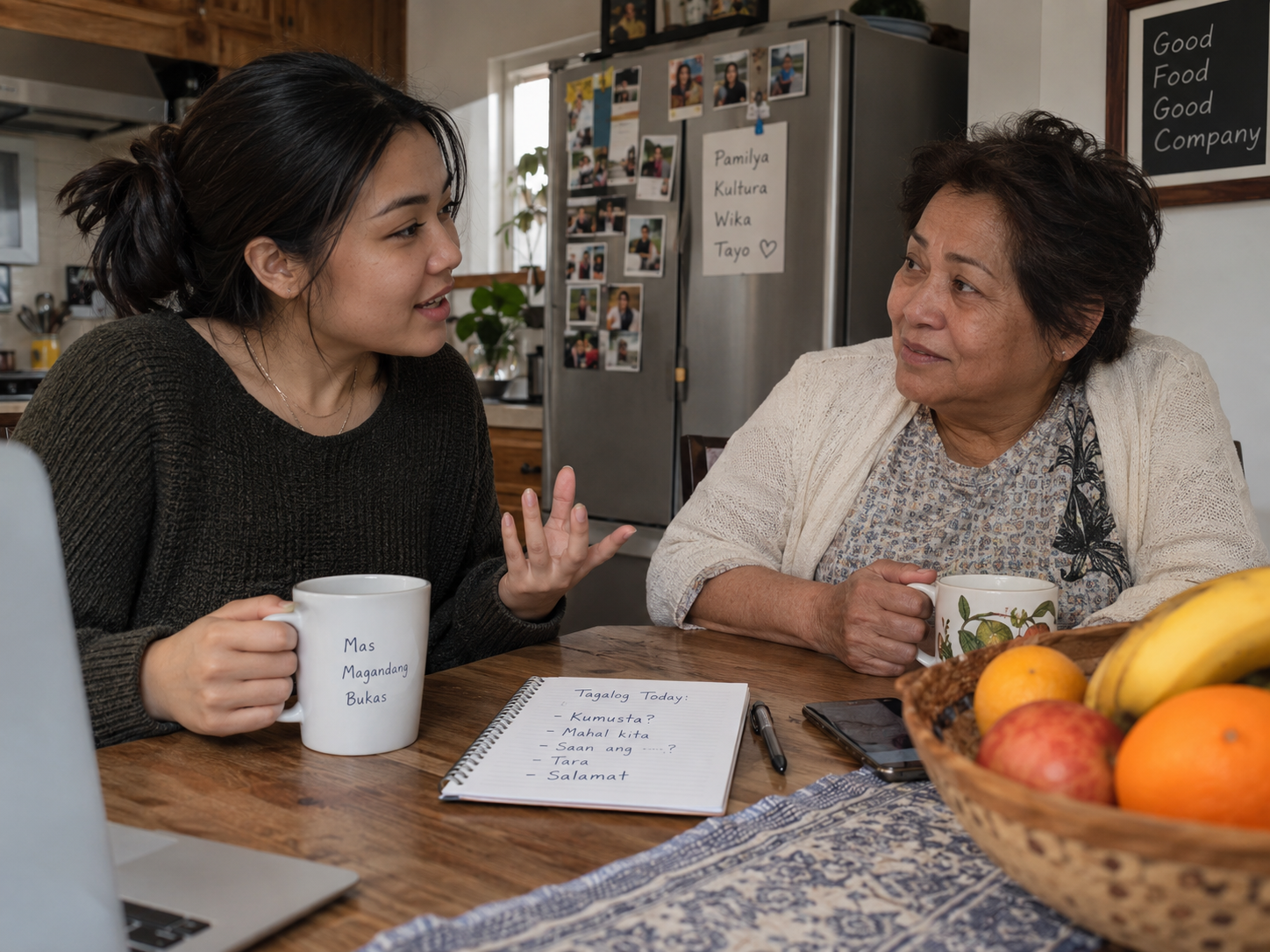
A heritage learner can understand an entire family conversation in Tagalog and still freeze when someone asks, Ikaw, anong masasabi mo? — “What do you think?” That gap can be confusing. If you understand so much, why is speaking so difficult?
Because understanding and producing a language are different skills, and heritage learners often develop them unevenly. Many grew up hearing Tagalog at home while replying in English. Others can speak casually but cannot read. Some pronounce words naturally yet have large gaps in grammar. A few know the vocabulary of childhood—food, relatives, household instructions—but not the vocabulary needed to discuss work, relationships, politics, health, or adult life.
None of those profiles fits neatly into “beginner” or “fluent.”
Family Tagalog is a real language environment, but a narrow one
A child who hears Kumain ka na? (“Have you eaten?”), Halika dito (“Come here”), or Nasaan ang sapatos mo? (“Where are your shoes?”) thousands of times can understand those patterns effortlessly. Yet that same person may never have needed to explain why they changed jobs or what they think about a film.
This creates a vocabulary map shaped by family life. Words connected to food, affection, discipline, relatives, and household routines can be strong. Abstract vocabulary may be weak. Grammar may be partly intuitive but difficult to control when the sentence becomes longer.
The solution is not to dismiss what you know and start from page one. It is to identify the missing domains.
Receptive knowledge needs deliberate activation
If you understand your relatives but answer in English, the first goal is usually not “learn more Tagalog.” It is “turn passive knowledge into active speech.”
That requires tolerating slow, imperfect output. A heritage learner may know instantly that a relative’s sentence sounds natural but need several seconds to build a reply. This can feel embarrassing precisely because family members assume you understand more than a classroom beginner would.
One useful exercise is to retell familiar family interactions aloud. Instead of memorizing isolated vocabulary, take something you already understand and rebuild it from your side. If a parent asks Kumain ka na?, practice several answers beyond oo or hindi: what you ate, when, with whom, whether you are still hungry.
The language already exists in your ear. The task is to create retrieval paths for your own speech.
Your pronunciation may be stronger than your grammar
Heritage learners often have an advantage that is hard to reproduce later: early exposure to the sound system. Even learners who speak little Tagalog may have a natural feel for rhythm, vowels, or common expressions.
That does not guarantee perfect pronunciation, especially if English has dominated for years, but it can make speaking sound more natural than the learner’s grammar level would predict.
This creates an unusual placement problem. In a standard beginner class, pronunciation drills may feel easy while verb forms are genuinely challenging. A heritage learner should not be placed solely by accent or by the number of words they understand.
Verb focus is often the hidden gap
Tagalog verbs are where many heritage learners discover that intuition is not enough. A learner may recognize kumain, kainin, kinakain, and kakain in context but struggle to explain why one form belongs in a particular sentence.
That is normal. Home exposure often teaches patterns implicitly. Formal study makes the system visible.
The point is not to replace intuition with grammar terminology. It is to connect the two. When a teacher explains why a familiar sentence uses one verb form rather than another, heritage learners often experience a useful moment of recognition: “I know that sentence. I just never knew why it worked.”
Your family may speak a particular kind of Tagalog
Families preserve regional, generational, and individual habits. A grandparent may use expressions that sound old-fashioned to younger speakers. A household may mix Tagalog with another Philippine language. A family in the United States may code-switch with English more heavily than relatives in the Philippines.
A course should not teach you that your family speaks “wrong.” It should broaden your range. You can learn a more widely understood standard form while keeping the expressions that belong to your family.
This matters emotionally as well as linguistically. Heritage study works best when it adds options instead of correcting identity.
Code-switching is not failure
Many Filipino families move naturally between Tagalog and English. Heritage learners sometimes assume that “real Tagalog” means eliminating English completely. In actual conversation, code-switching can be normal and socially meaningful.
The better goal is control. Can you choose more Tagalog when you want to? Can you complete a thought without switching because you lack one key verb? Can you follow relatives who use less English than your immediate family?
That is a much more useful measure than linguistic purity.
How to choose the right level
If you can understand common family conversations but barely speak, a complete-beginner course may still be too slow in listening and pronunciation while being useful in grammar. If you speak comfortably but cannot read, you may need literacy work more than beginner conversation. If you can chat with family but cannot explain opinions or tell stories, an intermediate class may expose the real gaps.
A good placement process should look at several skills separately: listening, speaking, reading, pronunciation, and grammar. “How much Tagalog do you know?” is too blunt a question.
Polyglottist Language Academy’s Tagalog classes can be useful for heritage learners because placement can focus on those uneven strengths and gaps rather than assuming everyone begins from the same point.
The most satisfying progress often appears in ordinary moments. A learner stays in Tagalog for two minutes longer than usual. A grandparent tells a story without switching to English. A family joke lands before someone has to translate it. Those changes are small, but they represent something more precise than “becoming fluent”: the family language is becoming available to you as your own speaking language.