
Vietnamese Culture in the Bay Area: Where Language Learners Can Experience It
A language learner can study Vietnamese for months without encountering the part of the language that explains why an aunt is addressed one way, why a menu uses a regional food name, or why a family in California may talk about Sài Gòn rather than Hồ Chí Minh City.
The Bay Area is especially rich in the cultural context that textbooks struggle to provide. Vietnamese communities in Oakland and San Jose have built institutions, neighborhoods, festivals, religious organizations, restaurants, shops, and museums over generations. For a learner, these places can deepen language study—but only if they are approached as communities first and “practice opportunities” second.
Oakland’s Little Saigon: language in neighborhood life
Oakland’s Vietnamese community is concentrated particularly around the Eastlake area and International Boulevard. In 2025 the city formally recognized Little Saigon as a cultural and economic center, acknowledging the history and presence of Vietnamese and Southeast Asian residents.
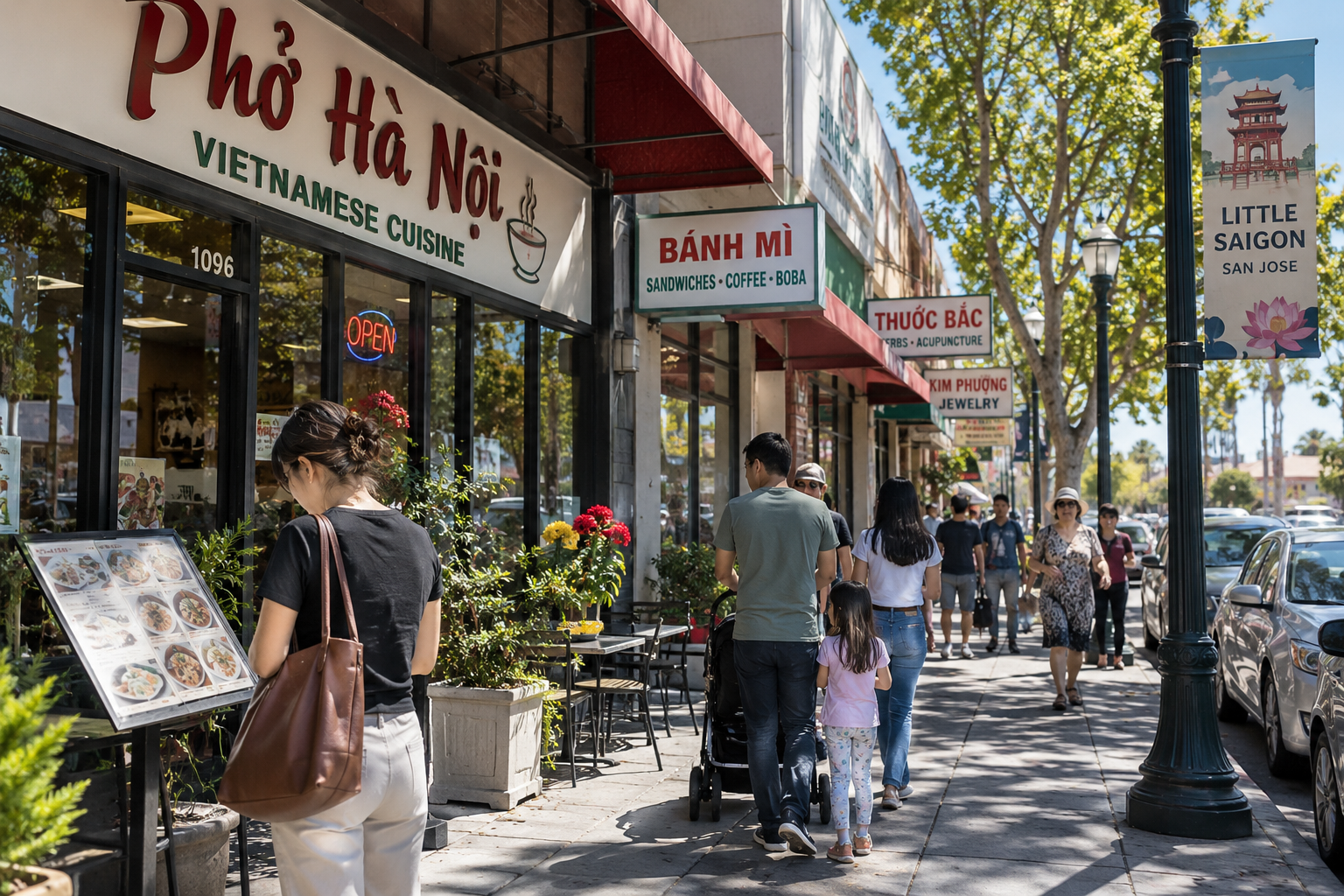
For a language learner, a neighborhood gives you repeated everyday vocabulary that a lesson cannot manufacture. Store signs use food, beauty, financial, medical, and service language. Restaurant menus show regional dishes and abbreviations. Community posters reveal date formats, honorifics, holidays, and formal written Vietnamese.
The important thing is to observe before trying to perform. If you recognize bánh mì or phở, look for the modifiers that follow. If a sign includes chợ (market) or nhà hàng (restaurant), notice how it combines with a name.
Small acts of noticing build reading fluency.
Hướng Việt: heritage preservation in the East Bay
Hướng Việt Community Center has served Vietnamese families in the East Bay since the late 1980s and operates a Vietnamese language school in Oakland for youth. It also supports lion dance, cultural dance, and celebrations of Vietnamese holidays.
For adult learners, its significance is less about signing up for a conventional evening class and more about seeing how language preservation works in a diaspora community. Heritage education is not simply teaching vocabulary. It connects children to history, music, holidays, family relationships, and a written language they may hear at home but use less often themselves.
If you are a heritage learner, that model may feel familiar. Language loss rarely happens because a family suddenly stops valuing Vietnamese. More often, English gradually takes over school, friendships, work, and sibling conversation while Vietnamese remains strongest with older relatives.
San Jose’s Little Saigon: the Bay Area’s largest Vietnamese cultural landscape
San Jose has one of the largest Vietnamese communities outside Vietnam, and Little Saigon is the most visible place to experience that presence. Vietnam Town and Grand Century Mall bring together restaurants, food shops, services, and community life in an environment where Vietnamese appears alongside English throughout the public space.
For learners, this is a good place to understand that “Vietnamese culture” is not one category. Northern, central, and southern food and speech traditions coexist. Generations differ in language use. A business serving older immigrants may use Vietnamese differently from a café aimed at younger bilingual customers.
Listen for code-switching. Read signs. Notice which words stay Vietnamese even inside English sentences. That is diaspora language in real time.
The Việt Museum adds history that language apps cannot
The Việt Museum at History Park in San Jose focuses on Vietnamese refugee history and the Vietnamese American experience. Its collections and programs provide context for the post-1975 migration that shaped much of the Vietnamese population in Northern California.
This history matters linguistically. Migration influences which regional accents are prominent, which political terms carry emotional weight, how place names are used, and how older generations describe events that younger Vietnamese Americans may have learned about in English.
A learner does not need to adopt any family’s political interpretation. The value is understanding why some vocabulary is historically charged and why diaspora identity cannot be reduced to food and festivals.
The Vietnamese American Cultural Center: community life beyond festivals
San Jose’s Vietnamese American Cultural Center, located within the Shirakawa Community Center, provides educational, health, family, senior, and cultural programming. It also hosts traditional events including Lunar New Year, the Hùng Kings commemoration, and Moon Festival activities.
Community centers reveal a register of Vietnamese that learners often miss: public-service vocabulary, elder address, family workshops, educational terminology, and the practical language of immigrant community life.
Even when a specific program is conducted in English, the setting helps learners see what topics matter locally and what kinds of bilingual communication are needed.
Tết is one of the best times to understand cultural vocabulary
Tết vocabulary is not merely a seasonal list. It reflects family relationships, food, luck, ancestors, visiting customs, age, and wishes for the new year.
Oakland’s Little Saigon held a community Tết festival in February 2026, and Vietnamese New Year celebrations take place across the Bay Area each year. A learner who prepares beforehand will understand far more than someone arriving with only the word Tết.
Learn expressions such as Chúc mừng năm mới (Happy New Year), food names, and basic family vocabulary. Watch how children address adults and how adults address elders. Notice when Vietnamese gives way to English and when it does not.
Mid-Autumn celebrations show another side of Vietnamese culture
Tết Trung Thu, the Mid-Autumn Festival, has a strong family and children’s dimension in Vietnamese tradition. San Jose’s 2026 Moon Festival programming includes Vietnamese arts, food, games, calligraphy, and performances.
For a learner, this is a useful reminder that vocabulary is connected to practices. Đèn lồng is not simply “lantern” in a flashcard deck when you have seen lanterns carried at a festival. Bánh trung thu is more memorable when it is attached to taste, packaging, family gifting, and seasonal advertising.
Restaurants are cultural spaces, but employees are working
Vietnamese food is one of the easiest ways to encounter the language regularly in the Bay Area. Use menus as reading material. Learn ingredients. Compare regional versions of dishes. Notice whether a restaurant uses Vietnamese names, English descriptions, or both.
Speak Vietnamese when it is natural and appropriate, but avoid turning a service interaction into an oral exam for the employee. A simple order and thank-you can be meaningful practice. If the restaurant is busy, that may be enough.
Respectful language learning is partly knowing when not to demand a conversation.
Bring cultural observations back into class
The most productive pattern is circular. Study a language feature, encounter it in the community, then return to your teacher with questions.
Why did one person call an older woman cô and another use bác? Why did a menu spell a dish one way when your textbook used another term? Why does your teacher from Hanoi pronounce a word differently from a family you heard in San Jose?
These questions are where culture and language become inseparable.
Polyglottist Language Academy’s live Vietnamese classes give Bay Area adults a structured place to work on pronunciation, grammar, and conversation while using the cultural environment around them as additional input.
The Bay Area offers much more than “authentic Vietnamese food.” It contains a living Vietnamese American history and a multilingual present. For a language learner, the most rewarding approach is to participate with curiosity, learn enough context to notice differences, and remember that the community is not a classroom created for your benefit. It is the reason the language is locally alive in the first place.