
In-Person vs. Online Vietnamese Classes for San Francisco Learners
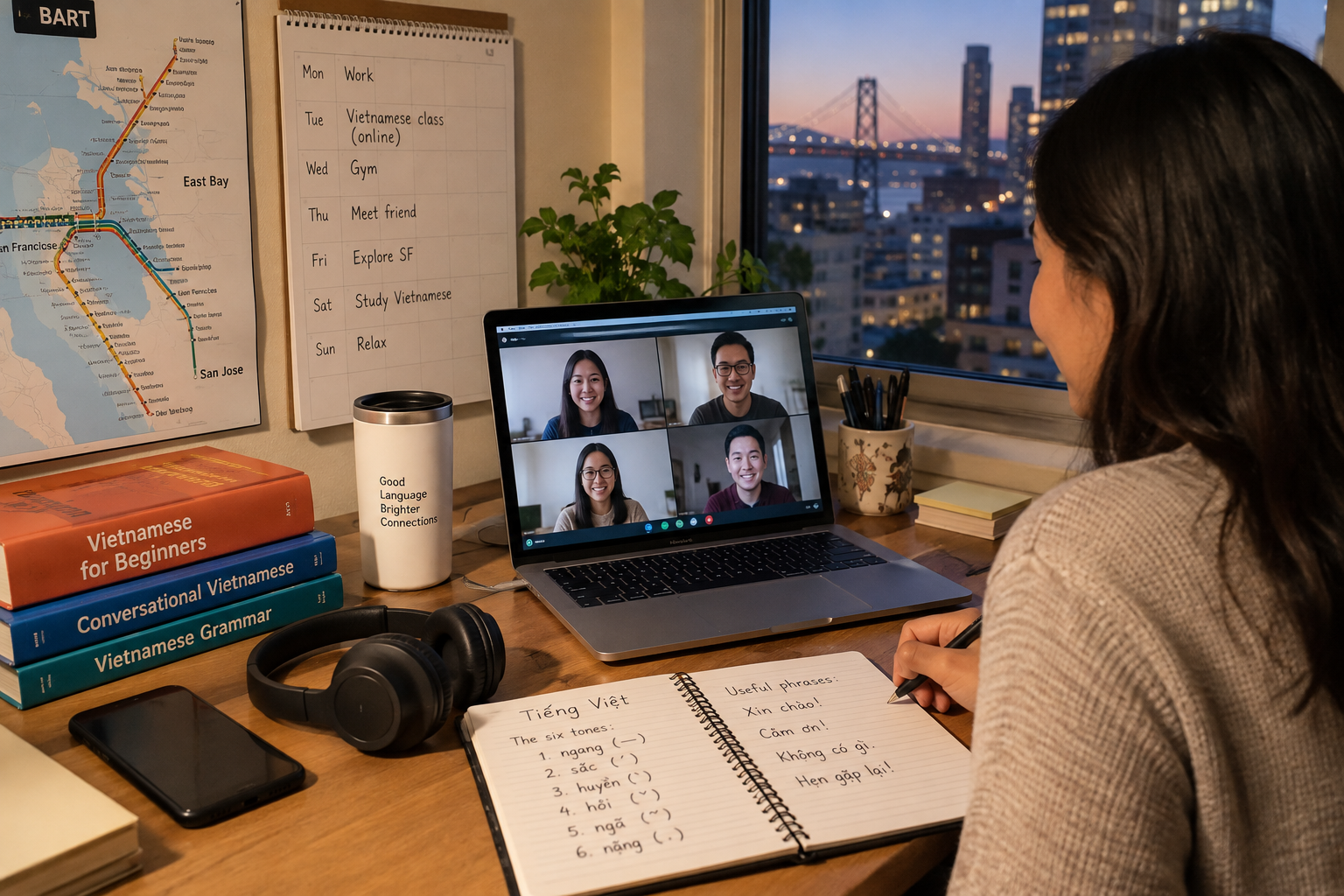
For a San Francisco adult choosing a Vietnamese class, “in person or online?” sounds like a question about learning style. In the Bay Area, it is also a question about geography.
A class in Berkeley, Palo Alto, or San Jose may be excellent, but getting there after work can turn a one-hour lesson into a three-hour weekly commitment. An online class removes the commute, but only helps if it is genuinely live and interactive enough to correct pronunciation.
Vietnamese makes the choice more specific than it would be for some subjects. You need someone to hear you.
In-person Vietnamese has one major advantage: the room itself creates focus
When you travel to a class, sit with the same people, and spend an hour speaking Vietnamese, the language has a physical place in your week. Phones are less tempting. Pair work happens naturally. You hear classmates from different angles and at different speaking speeds.
Instructors can also read facial expressions and hesitation quickly. They may notice that you are producing a tone incorrectly even when you think the problem is vocabulary.
For learners who work from home and spend much of the day online, the social separation can be valuable. An evening language classroom feels different from another video meeting.
But “in person” is not automatically better pronunciation training
A large university classroom can contain many students. A tiny Zoom group can contain four.
For Vietnamese, the amount of individual speaking and correction often matters more than whether teacher and student are physically in the same room. If an in-person course gives you two minutes of speech per class while a small online group gives you fifteen, the online format may provide more useful pronunciation practice.
Ask about class size before deciding based on format.
Live online instruction is not the same thing as learning from an app
Some learners say they “tried online Vietnamese” when they mean they used self-paced exercises or prerecorded videos.
A live online class is different. The teacher can hear your tone, ask follow-up questions, interrupt an inaccurate vowel, put students into pairs, and adapt the pace when the group is confused.
The strongest online classes use the convenience of Zoom without turning the lesson into a lecture.
For San Francisco residents, this also expands teacher choice. You are not limited to instructors located within a practical commute. That can be especially important if you care about regional pronunciation or need a teacher experienced with heritage speakers.
Vietnamese pronunciation should be the first test of any format
The Roman alphabet makes Vietnamese look deceptively accessible. Beginners can read a word, recognize every letter, and still say it in a way that native listeners do not identify immediately.
Tones matter. Vowel quality matters. Final consonants matter. The difference between northern and southern pronunciation matters.
Before registering, ask how pronunciation is taught. Does the instructor give individual feedback? Do students repeat in isolation only, or use tones inside sentences? Is listening included from the first weeks?
A course that postpones pronunciation while racing through vocabulary is building on unstable foundations.
In-person classes make community easier to build
Classmates often become part of the motivation. People arrive early, talk afterward, share restaurants, and occasionally attend cultural events together.
That social layer is harder online, though not impossible. Small recurring groups can become comfortable enough for real conversation, especially when the teacher avoids spending the entire hour sharing slides.
If community is one of your main goals, in-person study deserves extra weight.
Online classes win on consistency
Consistency is underestimated in adult language learning.
Imagine two courses. The first is a wonderful in-person class requiring 45 minutes of travel each way. You miss one meeting when work runs late, another because of rain and transit delays, and a third because you simply cannot face the commute.
The second class is live online. It is slightly less atmospheric, but you attend 95 percent of the sessions.
After six months, the second course may have done more for your Vietnamese.
For San Francisco learners, commute friction is not a minor inconvenience. It is a pedagogical variable.
Heritage learners should choose the teacher before the format
If you grew up hearing Vietnamese, your needs may not align neatly with a standard beginner course. You may understand normal family conversation but lack literacy. You may speak a southern family variety confidently but want more formal vocabulary. You may read but hesitate to speak.
In that situation, the instructor’s experience with heritage learners is more important than whether the lesson is in person.
Ask how placement works. If the school only offers “Beginner 1” based on textbook chapters, you may spend weeks reviewing language you already know while your real weaknesses remain untouched.
What about university classes near San Francisco?
The Bay Area has substantial Vietnamese programs at UC Berkeley and Stanford, and South Bay community colleges also offer Vietnamese. These can be excellent choices for eligible learners who want academic depth.
But university schedules are built around students, not around a San Francisco professional finishing work at 5:30 p.m. The commute and enrollment structure need to be evaluated as seriously as the syllabus.
A course is not truly accessible to you just because it exists within the Bay Area.
A simple decision test
Choose in person if you have a genuinely convenient class, value classroom community, and know that physically going somewhere improves your concentration.
Choose live online if the commute would make attendance unreliable, you want access to a particular instructor or regional variety, or you need an evening small group that fits around work.
Choose private instruction if your goal is highly specific: heritage-language repair, partner/family communication, professional vocabulary, or rapid pronunciation work.
Whichever format you choose, ask the same five questions: How many students are in the class? How much will I speak? How is pronunciation corrected? What happens after this level? Does the schedule fit my real life for the entire term?
Why a small live online group can work particularly well for Vietnamese
Polyglottist Language Academy offers live online Vietnamese classes for adults in small groups. For San Francisco learners, the format removes cross-Bay travel while preserving the part that matters most: a real instructor hearing and responding to your speech.
It also makes it easier to continue from one level to the next without reorganizing your commute each term.
In-person classes still have advantages, and for some learners they are decisive. The mistake is assuming that physical proximity guarantees interaction or that online study means solitary app work.
For Vietnamese, the best format is the one that gives you repeated listening, enough speaking time to make mistakes, and a teacher who can hear those mistakes clearly enough to help you fix them.