
Japanese vs Chinese: Which Is Harder for English Speakers?
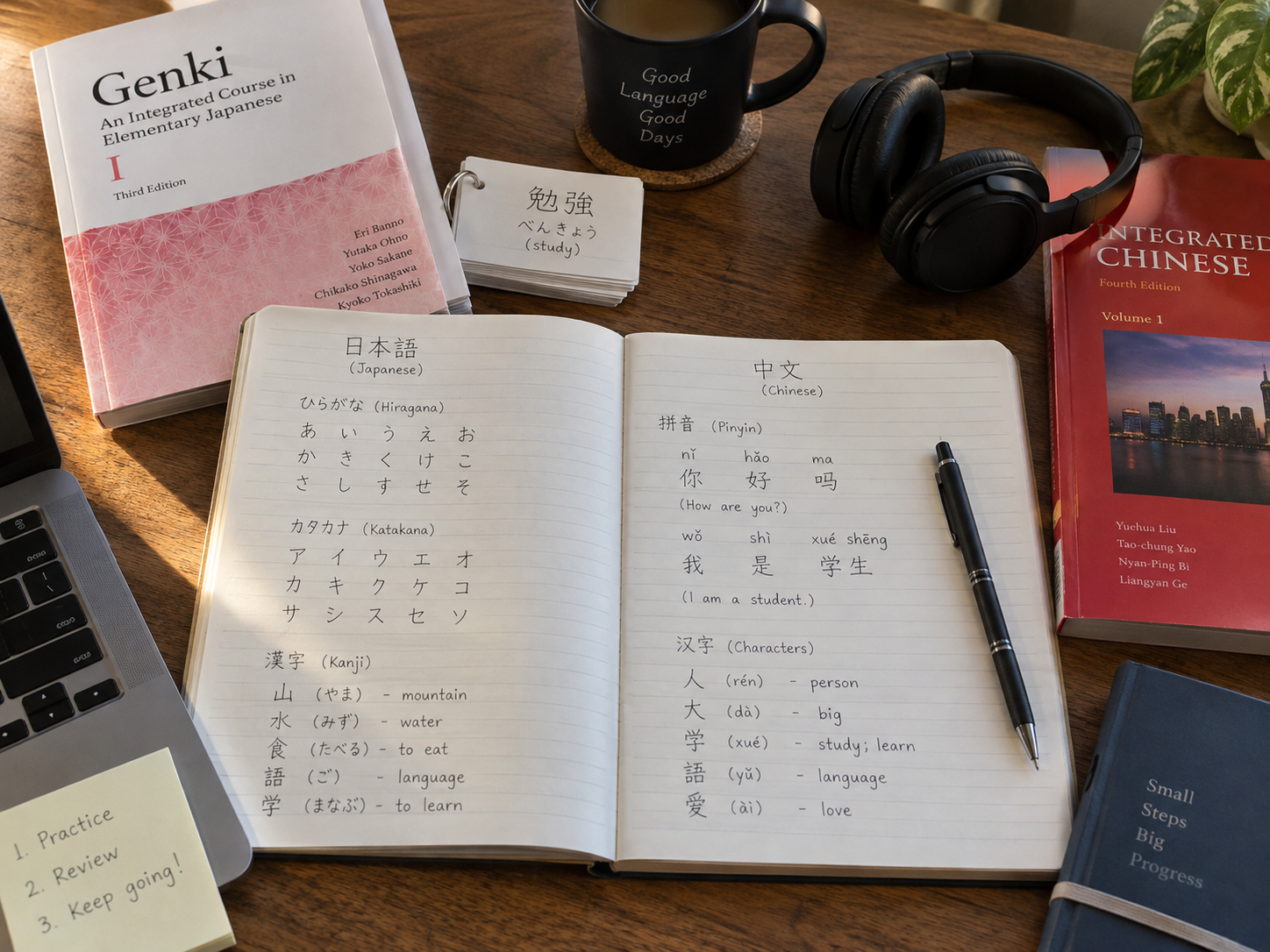
“Which is harder, Japanese or Chinese?” sounds like a straightforward question until you ask what the learner means by harder. Harder to pronounce? Harder to read? Harder to form a basic sentence? Harder to reach an advanced level?
Mandarin Chinese and Japanese challenge English speakers in different places. A learner who hates memorizing verb patterns may find Mandarin refreshingly direct. A learner who struggles to hear tones may prefer Japanese. Someone interested mainly in speaking may judge the languages differently from someone who wants to read novels.
Mandarin makes grammar look deceptively friendly
Early Mandarin grammar can feel surprisingly approachable. Verbs do not conjugate for person the way they do in many European languages. There is no grammatical gender system like French or Russian, and basic word order often resembles English more closely than Japanese does.
“I drink coffee” can be built in a familiar subject-verb-object order. Beginners therefore reach usable sentence patterns quickly.
The difficulty arrives elsewhere. Mandarin relies heavily on word order, particles, aspect markers, measure words, and context. The absence of verb conjugation does not mean the absence of grammar. It means grammar is organized differently.
Tones make Mandarin pronunciation a meaning problem
Mandarin uses lexical tones, so pitch pattern helps distinguish words. English uses pitch for emphasis and emotion, but not normally to create different dictionary words in the same systematic way.
That makes pronunciation more than an accent issue. A poorly produced tone can change the word a listener perceives. Beginners must learn not only consonants and vowels but a pitch contour attached to each syllable.
This is one reason Mandarin can feel harder to hear than its grammar suggests. In continuous speech, tones interact, and learners must recognize familiar syllables at natural speed.
Japanese pronunciation is easier, but sentence structure is farther from English
Japanese has no lexical tone system comparable to Mandarin, though pitch accent still affects naturalness. Its sound inventory is relatively compact, syllable structure is predictable, and beginners can usually pronounce written kana with reasonable consistency.
Grammar is the larger adjustment. Japanese uses particles, frequently places the verb at the end, omits subjects when context makes them obvious, and builds meaning through verb and adjective endings.
A beginner must become comfortable with sentences that do not map word-for-word onto English. This often makes early Japanese grammar feel heavier than early Mandarin grammar.
Both languages have serious literacy demands, but not the same ones
Mandarin uses Chinese characters, generally called hanzi. Learners must connect each character to meaning and pronunciation. Japanese uses kanji derived historically from Chinese characters, but combines them with hiragana and katakana.
Japanese therefore requires learning three scripts. Kana can be acquired relatively quickly, but kanji often have multiple readings depending on the word. A character may be pronounced one way in one compound and another way elsewhere.
Mandarin characters also require long-term memorization, but the relationship between character and spoken reading is often more stable than the many-reading problem of Japanese kanji.
The result is not that one writing system is “easy.” Mandarin asks you to build character literacy from the beginning. Japanese gives you phonetic scripts early but then adds a complicated kanji-reading system on top.
Vocabulary offers few free gifts in either language
English speakers benefit from cognates when learning Spanish or French. Japanese and Mandarin provide fewer immediately recognizable core words.
Japanese has many English-derived loanwords written in katakana, which can help with modern vocabulary: コンピューター, ホテル, レストラン. Mandarin also borrows international terms, but often through translation or sound adaptation that may be less obvious to an English speaker.
At higher levels, both languages require large amounts of vocabulary that must simply be learned.
Listening difficulty arrives in different forms
Mandarin listeners must identify tones, syllables, and many homophones within context. Japanese listeners must cope with omitted subjects, reduced speech, particles, contractions, and long stretches where the key verb arrives late.
Students sometimes choose a language based on how easy the first few lessons sound. That can be misleading. The better question is which type of difficulty you are willing to practice for years.
So which is harder?
For many English speakers, Mandarin pronunciation is harder at the beginning because tones are unfamiliar and meaning-bearing. Japanese pronunciation is usually more approachable.
Japanese grammar is typically more structurally distant from English and involves more conjugation and social register. Mandarin grammar can feel lighter early on.
Literacy is demanding in both. Japanese adds the complication of three scripts and multiple kanji readings; Mandarin requires character knowledge for ordinary literacy without a parallel kana system carrying most native vocabulary.
Those tradeoffs make a single verdict unhelpful.
If your goal is living in Tokyo, working with Japanese colleagues, reading manga, or engaging deeply with Japanese culture, Japanese is the obvious choice regardless of difficulty. The same applies to Mandarin if your interests connect you to China, Taiwan, Chinese-speaking communities, family, or work.
Language teachers usually see motivation outperform abstract ease. A language you genuinely want to use is easier to sustain than a supposedly easier language you do not care about.
Polyglottist Language Academy offers structured Japanese instruction for adults, and the same principle applies when choosing any language course: pick the language whose difficult parts you are willing to keep encountering because the destination matters to you.