
Learning Japanese for Anime: Is It Worth It? (A Realistic Assessment)
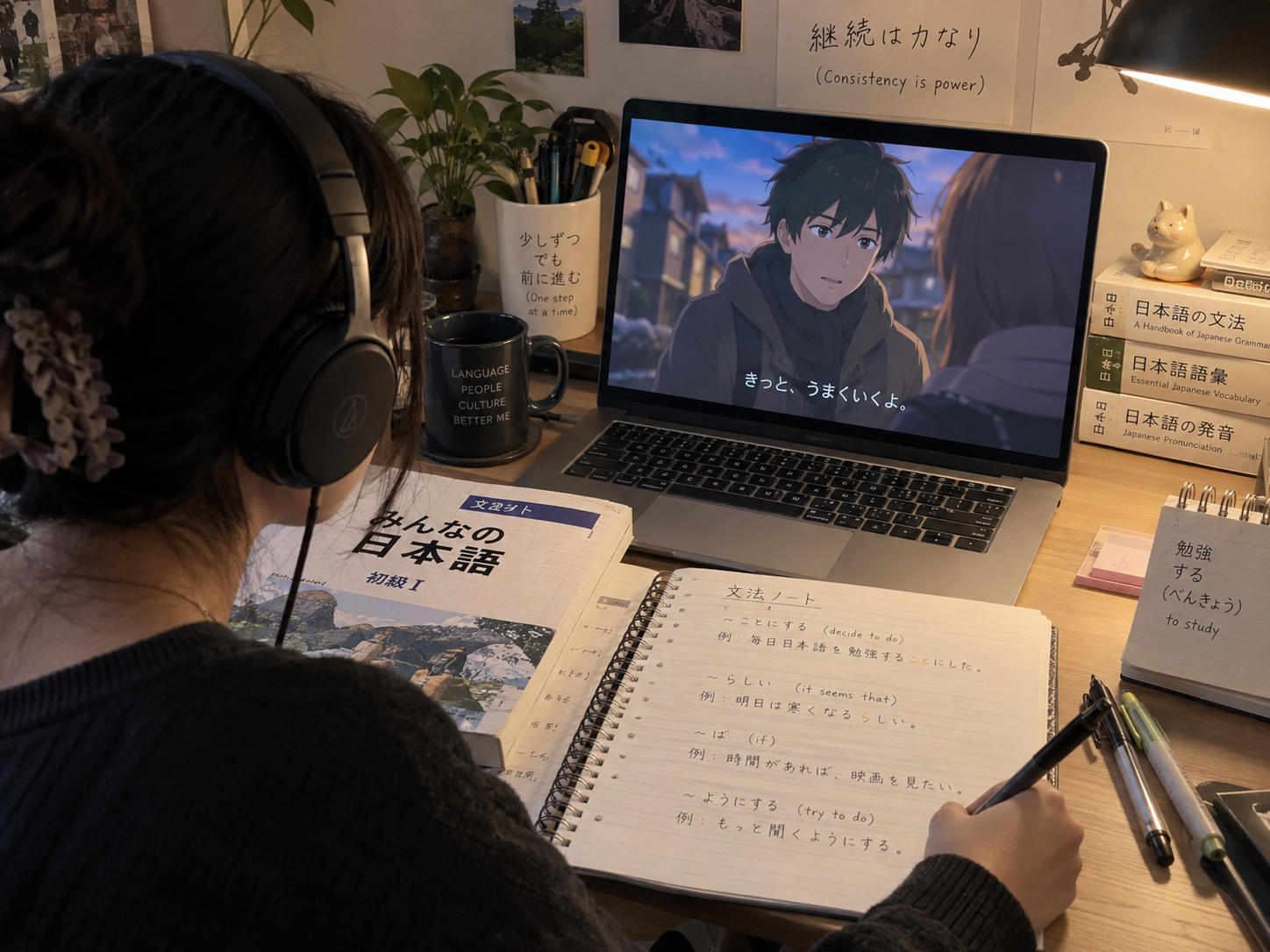
Anime is a perfectly good reason to start learning Japanese. It is not, by itself, a particularly good Japanese course.
That distinction matters because anime gives beginners an unusual feeling of progress. Before studying formally, many fans already recognize words such as ありがとう, 大丈夫, すごい, 先生, or 先輩. Once they learn hiragana and a little grammar, familiar dialogue suddenly becomes more transparent. The experience can be motivating enough to keep someone studying for years.
The problems begin when recognition is mistaken for general proficiency.
Anime trains your ear, but not always for ordinary conversation
Japanese animation contains a huge range of speech styles. A quiet contemporary drama may use fairly natural everyday language. A historical fantasy, battle series, school comedy, or exaggerated character show may use vocabulary and sentence endings chosen partly to signal personality.
Characters may sound unusually rough, old-fashioned, childish, aristocratic, masculine, feminine, regional, or theatrical. Those choices are meaningful to Japanese viewers. A learner who copies them without understanding the social register can produce sentences that are grammatically correct but socially strange.
This is why teachers sometimes hear students use expressions they learned accurately from a character but would rarely hear from an ordinary adult in the same situation.
Subtitles create an illusion of listening ability
When English subtitles are on, the brain is very good at combining partial Japanese recognition with the meaning already supplied on screen. You may feel that you “understood” a line when you actually caught one noun and the emotional tone.
A useful test is to replay a short scene without subtitles. Can you identify where one phrase ends and another begins? Can you write down even part of what you hear? Do you know who is doing what to whom?
If not, the scene is still valuable exposure, but it is not yet comprehensible input in the strongest sense.
You still need kana, grammar, and eventually kanji
Some anime-focused learners try to postpone reading because their goal is listening. That works only for a while. Japanese grammar resources, dictionaries, subtitles, transcripts, and vocabulary tools become much easier to use once you know hiragana and katakana. Kanji then becomes increasingly important because Japanese vocabulary contains many homophones that are easier to distinguish in writing.
You do not need to master thousands of characters before enjoying the language. You do need to accept that literacy is part of learning Japanese rather than an optional side project.
Anime vocabulary can be highly useful — or extremely niche
A slice-of-life series may teach vocabulary for school, meals, family, weather, and daily routines. A medical drama can expose you to hospital language. A fantasy adventure may give you a surprisingly large vocabulary for swords, magical powers, feudal titles, and defeating enemies.
None of that vocabulary is “bad.” The issue is frequency. Beginners have limited study time, so high-frequency verbs, adjectives, particles, numbers, time expressions, and everyday nouns usually deserve priority.
The most efficient approach is to let a structured course determine your core vocabulary and let anime add memorable extras.
When should you start using anime actively?
Immediately, if it keeps you interested — but adjust the task to your level.
At the beginning, listen for words you already know. Once you have basic grammar, choose a short scene and try to identify verb endings, particles, and casual forms. Later, use Japanese subtitles rather than English ones and compare what you hear with the written line.
A two-minute scene studied carefully can teach more than an entire episode watched passively “for Japanese.”
Shadowing can help, but choose the right character
Shadowing means listening to a line and repeating it with the speaker's timing and rhythm. It can improve pronunciation and listening speed, but the model matters.
Choose a character whose speech is relatively natural and socially neutral. If the character's voice is deliberately stylized, you may become very good at reproducing a register you would never intentionally use in real life.
What progress is realistic?
After several months of consistent study, many learners begin hearing grammar they previously only recognized on paper. Familiar phrases become easier to segment, and Japanese subtitles stop looking like an uninterrupted wall of text.
That does not mean you will suddenly watch any anime without subtitles. Native media is created for native speakers and often contains rapid speech, cultural references, jokes, names, slang, and specialized vocabulary.
Reaching the point where you can follow an episode comfortably without translation is a substantial language goal, not a beginner milestone.
A practical anime-based study routine
Use a real Japanese course or textbook as the backbone. Study a small amount most days. Then choose one series you genuinely like and reuse it rather than constantly switching.
Watch an episode for enjoyment first. Later, select one short scene. Listen without subtitles, then with Japanese subtitles if available, then check meaning. Save only a handful of useful expressions. Repeat the scene and shadow one or two lines.
The goal is not to convert entertainment into homework. It is to make the entertainment reinforce what you are already learning.
Polyglottist Language Academy's Japanese classes are designed for adults who want structured progression but often come to the language through anime, travel, manga, or other cultural interests. Those interests are useful because motivation matters. They simply work best when paired with a system that fills in the grammar and vocabulary anime does not teach in sequence.
So, is learning Japanese for anime worth it? Yes, if anime is strong enough motivation to keep you studying the parts of Japanese that are less glamorous. The reward is not only dropping subtitles. It is gradually noticing jokes, speech styles, names, and small choices that translation inevitably smooths over. Anime becomes more interesting precisely because Japanese stops being a stream of familiar-sounding phrases and becomes a language you can actually analyze.
Explore Japanese Classes at Polyglottist Language Academy