
Learning Japanese in Alameda: Local Classes, Online Options, and Tips for Beginners
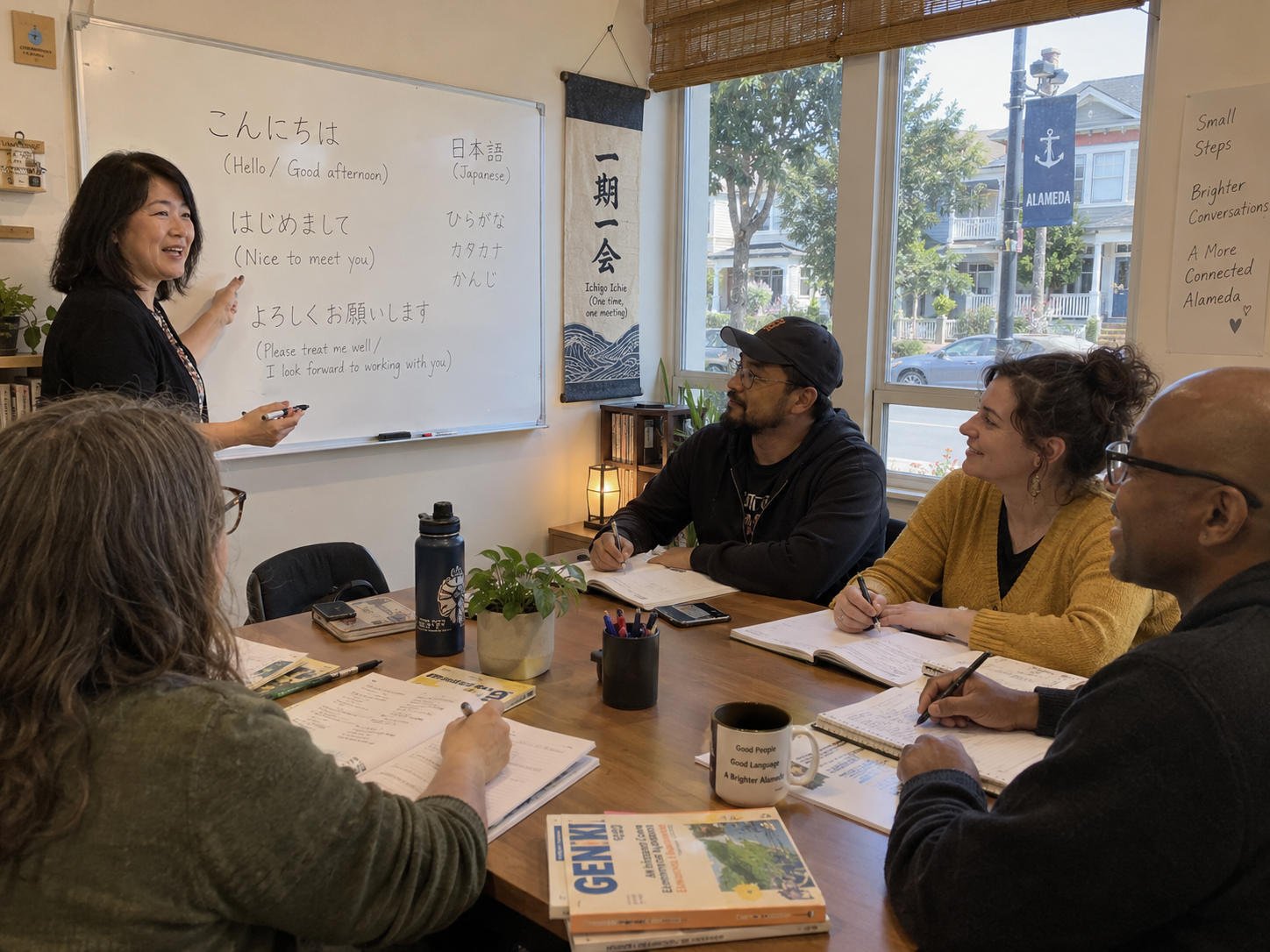
Alameda is one of the few East Bay cities where an adult can search for Japanese classes and find a language school physically on the island. That makes the starting point easier than in many neighboring cities, but it does not automatically answer the bigger question: what kind of class will actually help you progress?
A complete beginner, a returning college learner, and someone who mainly wants travel conversation may all need different formats.
A local option in Alameda
Bay Language Academy, located on High Street in Alameda, lists Japanese among its language programs and offers adult classes. For residents who value a nearby classroom, this is the obvious place to investigate first.
When contacting any local language center, ask about the current adult Japanese level, class size, schedule, textbook, and whether the course is group or private. Smaller schools often adjust offerings according to enrollment, so the website's language list may be broader than the exact group schedule running this month.
Berkeley is close enough to be a real alternative
Alameda and Berkeley are geographically close, but getting between them can still take time depending on traffic and where you live on the island. Polyglottist Language Academy in downtown Berkeley offers small-group Japanese classes for adults as well as online classes. For Alameda learners who want a structured group and do not mind the trip, Berkeley can be a practical alternative.
UC Berkeley also offers intensive academic Japanese. As with other university courses, the pace and weekly workload are much higher than in most adult evening programs.
San Francisco options are possible, but commute matters
The Japan Society of Northern California offers Japanese group classes and workshops, including online courses and in-person sections in San Francisco and San Mateo. From Alameda, San Francisco can be surprisingly accessible at some times via ferry, but an evening class that ends late may make the return trip less convenient.
This is why the best class on paper is not always the best class in practice. An adult who spends two additional hours commuting each week may study less outside class and eventually stop attending.
Online Japanese has a strong case in Alameda
Online classes remove the island's transportation issue while preserving live instruction. They work especially well for students who already spend significant time commuting or who have irregular evening schedules.
The weakness of online study is not that it is inherently less effective. The weakness is that some students become passive on screen. A good online class should require frequent responses, pair work or direct conversation, and visible participation rather than functioning like a webinar.
What beginners should learn during the first term
A complete beginner should expect to learn greetings, self-introductions, basic question patterns, numbers, time, daily routines, likes and dislikes, and essential particles. Hiragana should begin early, followed by katakana and introductory kanji.
The writing system can look intimidating, so beginners sometimes try to rely on romaji. That becomes a trap. Romaji is useful for the first few days, but students who depend on it too long often have to relearn vocabulary once Japanese script becomes unavoidable.
A phrase such as すしが好きです is much more useful when you can hear it, say it, and read it than when you only remember “sushi ga suki desu” in Latin letters.
Do you need a native-speaking teacher?
Native fluency can be valuable, but teaching ability matters more. A strong instructor knows how to explain what a beginner is misunderstanding, how much correction to give, and how to create speaking practice that is challenging without becoming chaotic.
Some excellent non-native teachers are particularly good at explaining grammar because they have consciously learned the same system their students are learning.
How much should you study outside class?
For a once-a-week adult course, short daily review is more effective than cramming. Ten to twenty minutes of vocabulary, kana, or listening on most days can keep the material active enough that the next class feels like continuation rather than relearning.
If you can add one longer weekly session for homework and reading, progress becomes much more noticeable.
Use the Bay Area around you
Even if your formal class is online, the Bay Area offers Japanese cultural organizations, bookstores, restaurants, festivals, and events. These should not be treated as substitutes for language instruction, but they help keep Japanese connected to actual people and culture.
The best option depends on what you can sustain
An Alameda resident can choose a local language center, commute to Berkeley or San Francisco, or study online. The right choice is the one that matches your level and survives contact with your real schedule.
If you know you will avoid a 45-minute drive after work, do not choose a class that requires it simply because you like the school. If you know you focus better in a physical classroom, a nearby Alameda or Berkeley option may be worth the extra effort.
Japanese takes time. The most effective program is usually the one that lets you keep showing up long enough for the language to accumulate.
Explore In-person Japanese Classes in Berkeley and Online Classes at Polyglottist Language Academy