
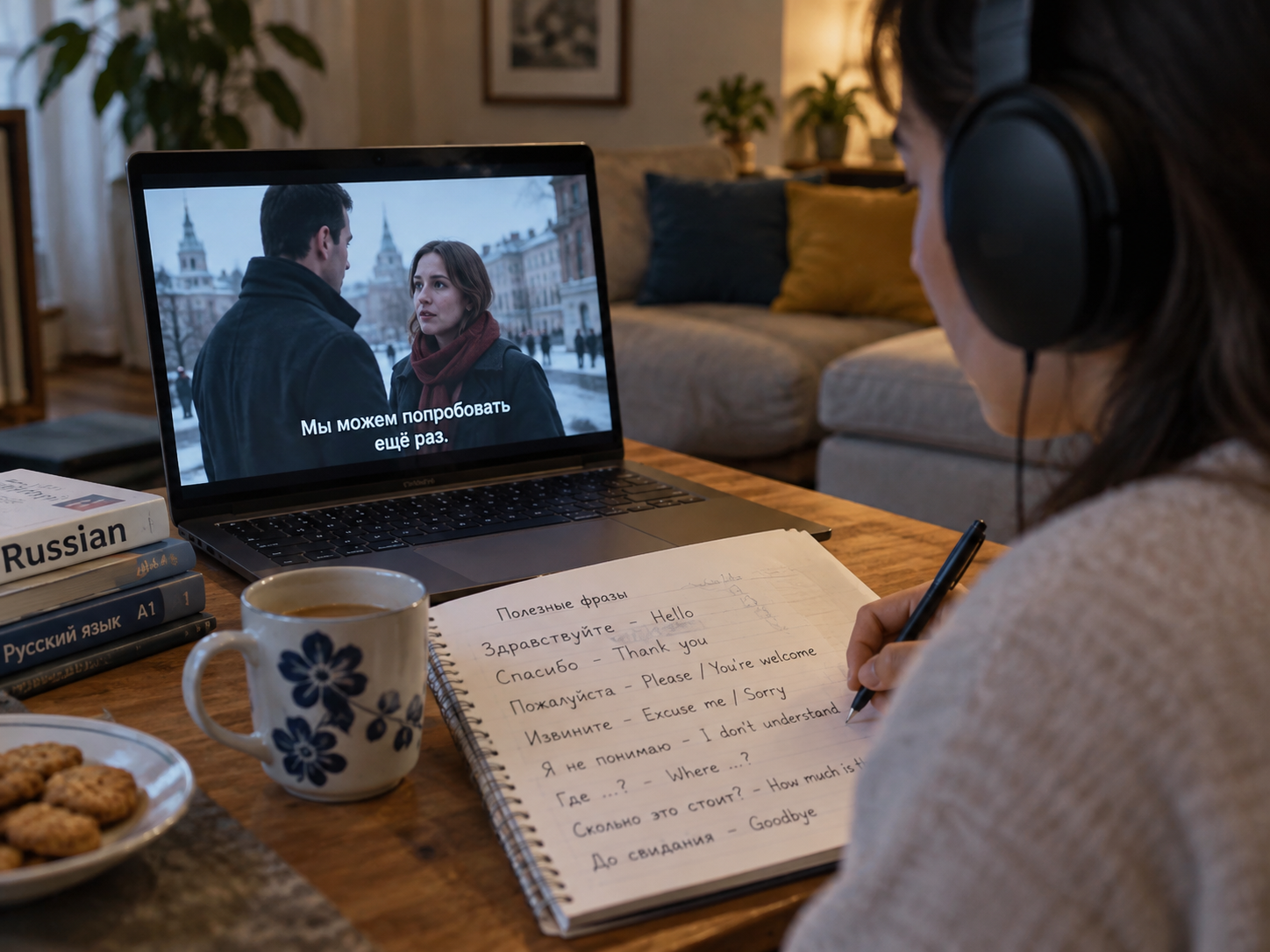
Russian learners are often told to “watch Russian movies,” as if putting on a two-hour film automatically teaches the language. In practice, the wrong film can be almost useless: actors mumble, historical vocabulary overwhelms the dialogue, and English subtitles pull your attention away from Russian completely.
The best screen material for learning is not always the most famous. It has recurring characters, everyday speech, clear situations, and scenes you can rewatch without getting lost.
Streaming rights change frequently, so the availability notes below reflect services checked in September 2026. For older Soviet films, Mosfilm’s official YouTube channel is unusually valuable because it legally hosts many classics, often with subtitle options.
1. Moscow Does Not Believe in Tears — intermediate
This 1980 drama follows three women over many years in Moscow. For learners, its value lies in ordinary adult conversation: work, relationships, family, social expectations, and city life.
The speech is more natural than textbook dialogue but generally clearer than in many contemporary crime dramas. Because the story is character-driven, you can follow emotional context even when vocabulary escapes you.
Where to watch: Mosfilm’s verified official YouTube channel hosts the film. Availability and subtitle languages can vary by upload and region.
2. The Irony of Fate — high beginner to intermediate with subtitles
Few films are as culturally useful for understanding Russian New Year as Ирония судьбы, или С лёгким паром! The plot depends on nearly identical Soviet apartments, a drunken New Year trip, and a stranger who ends up in the wrong city but opens “his” apartment with the same key.
The dialogue includes domestic vocabulary, polite and impolite conversation, arguments, songs, and holiday expressions. It is long, so learners should work scene by scene rather than trying to “study” the entire film at once.
Where to watch: commonly available through Mosfilm’s official YouTube channel.
3. Office Romance — intermediate
Служебный роман is useful because so much of its comedy happens at work. Learners hear formal address, workplace hierarchy, gossip, awkward compliments, and shifts between professional and personal speech.
The language is older, but not archaic. It can be especially good for students who want to hear how tone changes when characters move from formal distance to familiarity.
Where to watch: Mosfilm’s official YouTube channel carries the film in authorized form.
4. Ivan Vasilyevich Changes His Profession — intermediate
This comedy mixes modern Soviet life with Ivan the Terrible’s era, so not every line is practical beginner Russian. Yet the repeated situations and visual humor make it highly watchable even when comprehension is incomplete.
It is best used as a cultural film with selected scenes rather than a source of everyday vocabulary from beginning to end.
Where to watch: Mosfilm’s official YouTube channel.
5. The Diamond Arm — intermediate
Бриллиантовая рука is packed with quotations that entered popular culture. That makes it rewarding for learners who already understand basic Russian and want to recognize phrases Russians still reference.
The comedy includes rapid exchanges and wordplay, so beginners may find it harder than the plot suggests. Use Russian subtitles when available and pause for recurring expressions rather than translating every joke.
Where to watch: Mosfilm’s official YouTube channel.
6. Ekaterina — intermediate to advanced
This historical series about Catherine the Great is not the place to learn how to order coffee, but it is useful for sustained listening because a television series gives you the same voices across many episodes. Once you adjust to each actor, comprehension usually improves.
Expect historical and political vocabulary, formal registers, and court language. It is better for learners interested in Russian history than for someone seeking only practical conversation.
Where to watch in the U.S. as checked in late August 2026: JustWatch listed Ekaterina on Tubi and The Roku Channel for free with ads. Streaming rights can change, so verify before publishing or watching.
7. To the Lake — advanced or confident intermediate
Эпидемия, internationally distributed as To the Lake, gives learners contemporary speech, family conflict, urgency, and a modern vocabulary base, though the thriller setting adds slang and fast emotional exchanges.
Because tension drives the story, context helps. It works well once you can understand the main idea of a scene without translating every sentence.
Where to watch: Netflix carries To the Lake in multiple markets; catalog availability differs by country, so check your local Netflix listing.
What about Kitchen and Silver Spoon?
Two frequently recommended modern Russian series are Кухня (*The Kitchen*) and Мажор (*Silver Spoon*). Both are excellent learning material: Kitchen gives fast workplace and relationship dialogue; Silver Spoon offers contemporary urban speech and police/crime vocabulary.
The problem is access. In September 2026, JustWatch did not list either series as currently streaming in the United States. They remain available on services in some other countries. Rather than telling readers to hunt for unofficial copies, it is better to check a legal availability service such as JustWatch in your region.
How to watch so the Russian actually improves
On the first viewing of a scene, use subtitles only as much as necessary to understand what is happening. On the second, switch to Russian subtitles if available and notice which words you already heard. Then replay one or two minutes without subtitles.
Do not stop for every unknown word. Choose a small number of recurring expressions. If a character says Да ладно, Ничего страшного, or Ты серьёзно? several times, those are worth learning because you are hearing how real speakers use them.
A film becomes language practice when you return to it. One carefully rewatched five-minute scene can teach more than three hours of passive viewing.
For learners who want help connecting screen Russian to structured grammar and conversation, Polyglottist Language Academy’s Russian classes provide the systematic side that movies cannot supply on their own.
Russian cinema is especially useful because it gives you language and cultural references at the same time. The goal is not to understand every subtitle-free line. It is to build enough familiarity that the language begins to arrive as speech rather than as a translation exercise.