
Learning Tagalog in Fremont and Milpitas: A South Bay Guide
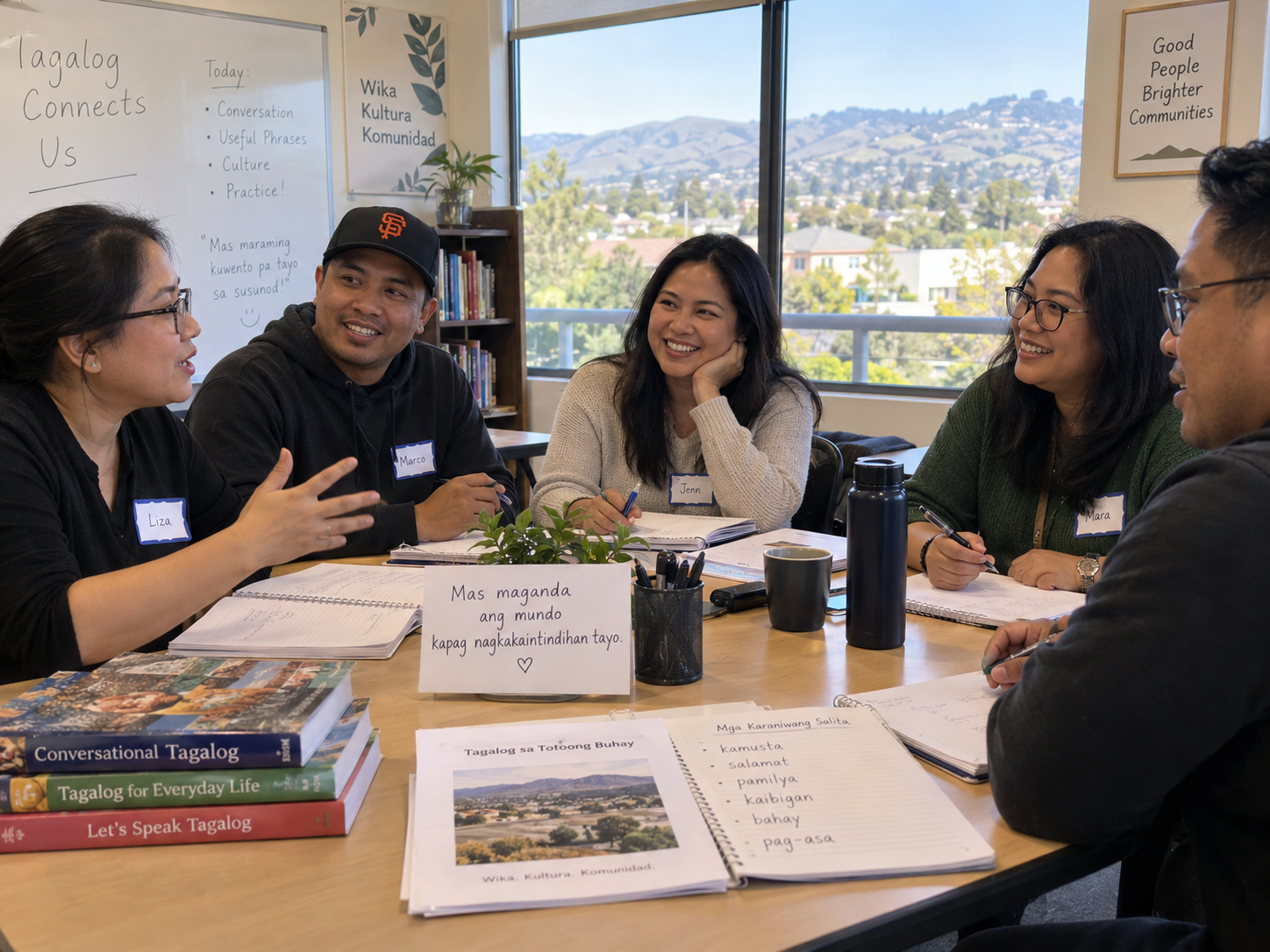
Someone looking for Tagalog classes in Fremont or Milpitas can run into an odd mismatch: there is a visible Filipino community, plenty of opportunities to encounter Filipino food and culture, and many families in which Tagalog is spoken, yet adult language courses are not listed as routinely as Spanish, Mandarin, or ESL.
That does not mean there are no good ways to learn. It means the most realistic South Bay plan may combine structured online instruction with local community exposure rather than depend on finding a conventional evening Tagalog school five minutes from home.
The local adult-school route is limited right now
As of September 2026, the current program pages for Fremont Adult and Continuing Education and Milpitas Adult Education emphasize ESL, citizenship, high-school completion, career programs, and related adult education. Neither currently lists Tagalog as a standard adult language course.
That is useful information because adults often assume every city with a substantial Filipino community will automatically have a public evening Tagalog sequence. Language offerings depend on staffing, enrollment, and institutional priorities, so they can be surprisingly uneven.
If you are specifically looking for a weekly adult Tagalog class, checking those local catalogs is still sensible because community education offerings can change. Just do not build your entire learning plan around the assumption that a local public course must exist.
Fremont and Milpitas still offer something a remote learner cannot create alone
Language learning is not only about where the formal class happens. The South Bay gives learners access to Filipino churches, community groups, restaurants, family networks, and cultural events where Tagalog or Taglish may appear naturally.
Fremont has active Filipino community institutions, including Filipino ministry and parish communities. Milpitas has also hosted city cultural events such as Milpitas Fiesta celebrating Filipino music, dance, food, and community life.
These are not substitutes for language instruction. A festival will not teach you verb focus. A church gathering will not automatically explain markers such as ang, ng, and sa. What they can do is make the language socially real. A phrase you studied in class suddenly has a speaker, a setting, and a reason to exist.
Complete beginners and heritage learners should not choose the same class automatically
Two Fremont residents can both say, “I’m a beginner in Tagalog,” while having completely different abilities.
A complete beginner may know salamat, kumusta, and perhaps a few food words. A heritage learner may understand a parent or grandparent quite well, recognize jokes and familiar expressions, and still answer almost entirely in English.
The heritage learner’s problem is not necessarily lack of exposure. It may be retrieval, grammar, adult vocabulary, or confidence speaking outside family routines.
A good class should recognize that difference. Complete beginners usually need a clear introduction to sentence patterns, pronouns, markers, and verbs. Heritage learners often need placement based on what they can actually understand and produce, not simply how many years they have heard Tagalog at home.
Live online classes make unusual sense in the South Bay
In a region where commuting can turn a one-hour lesson into a three-hour commitment, live online small-group classes can be more practical than chasing an in-person option across the Bay Area.
The important distinction is live versus self-paced. A recorded course can teach vocabulary and explain grammar, but it cannot force you to retrieve language in front of another person. A live class gives you an instructor, classmates, scheduled speaking practice, and corrections.
Polyglottist Language Academy currently offers live online Tagalog classes for adults in small groups, including complete-beginner options accessible from Fremont, Milpitas, San Jose, and the rest of the Bay Area.
For many working adults, that arrangement solves the local availability problem without giving up the interaction that makes a language class useful.
Private instruction can work well for uneven skills
A private teacher is especially useful if your Tagalog does not fit a standard level.
Perhaps you understand everyday family conversation but cannot explain what you did at work. Perhaps your pronunciation is natural because you heard Tagalog as a child, but your grammar is intuitive and inconsistent. Perhaps you are learning because your partner’s family speaks Tagalog and you want a practical speaking-first course.
One-to-one instruction can target those exact gaps. The disadvantage is that you lose the unpredictability of group conversation, so a learner who studies privately should deliberately add other speaking opportunities.
Use local Filipino life as practice, not as a test
Heritage learners sometimes place too much pressure on themselves when speaking with relatives. Every mistake feels as though it carries cultural meaning. Complete beginners can feel equally self-conscious using Tagalog with a fluent speaker who could easily switch to English.
A better approach is to create small, repeatable tasks.
Order one item using a Tagalog phrase. Ask a relative one question in Tagalog and keep the answer in the language for as long as you can. Learn how to greet older family members politely. Practice introducing yourself before trying to sustain a twenty-minute conversation.
The goal is not to prove that you “really speak Tagalog.” It is to make active use of the language ordinary.
What to look for in a South Bay Tagalog course
For an adult learner, the strongest course will usually include speaking from the beginning, clear explanation of sentence structure, explicit work with verbs and markers, listening practice, and cultural context that goes beyond a few holiday facts.
Ask what “beginner” means. Ask whether the class is designed for complete beginners, heritage learners, or both. Ask how many students are in the group and how much actual speaking happens during an hour.
Apps and videos can support all of this, especially for vocabulary review, but they are much less useful when you need someone to explain why your sentence is understandable but structurally unnatural.
Fremont and Milpitas may not offer a dense menu of adult Tagalog courses at every moment, but the area is still a good place to learn because the language has a community around it. The most effective strategy is often to separate two jobs: use a structured class for progression and correction, then use South Bay Filipino life to give what you are learning a real social setting.