
Where to Learn Russian in Pittsburgh
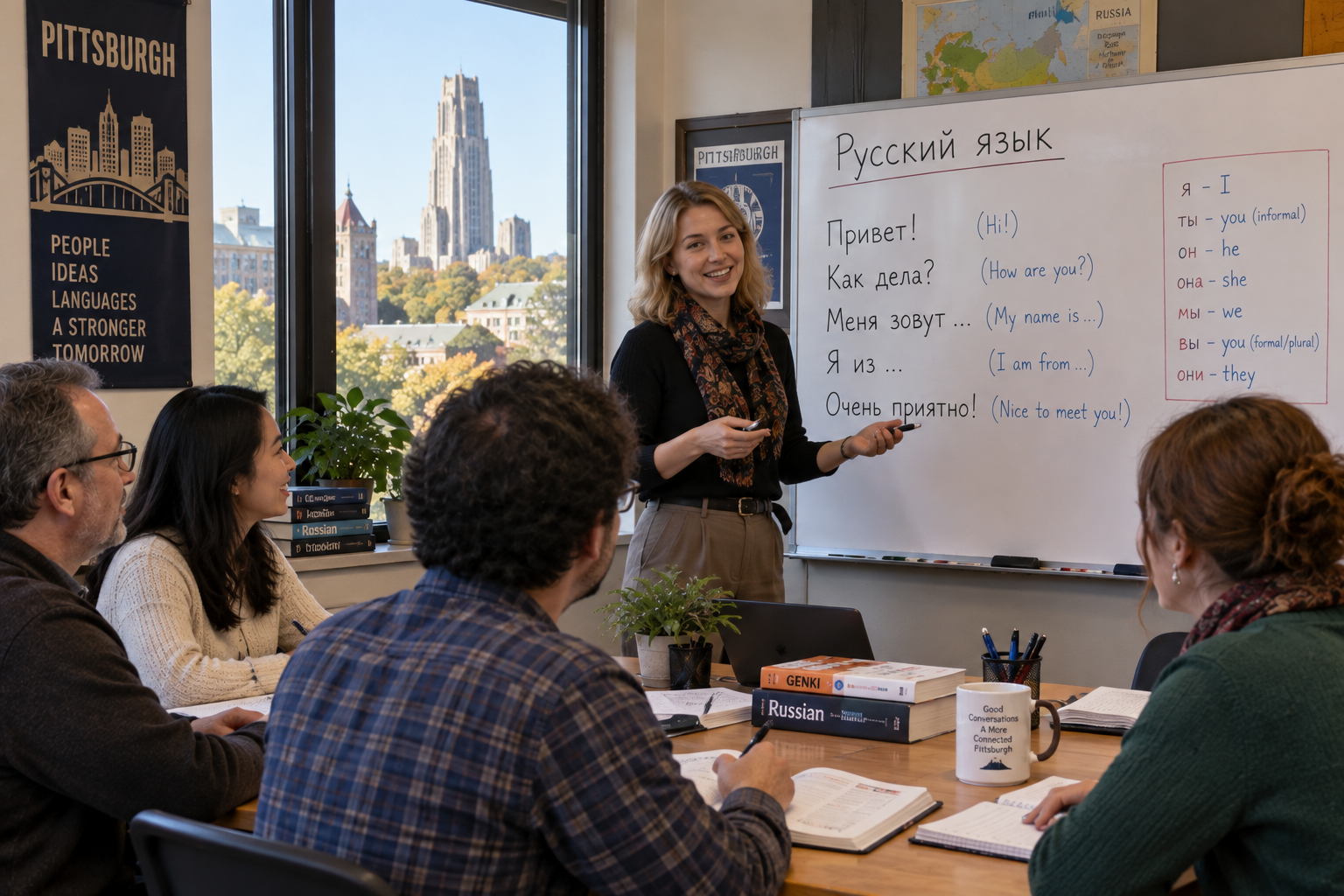
Pittsburgh is not a city where Russian classes appear on every adult-school calendar, but it has something more important: two universities with serious Russian language programs and a long-standing Slavic studies infrastructure.
For an adult learner, that creates strong possibilities — and a little confusion. University courses may be excellent but too intensive, unavailable to casual community students, or scheduled in the middle of a workday. The best place to learn Russian in Pittsburgh therefore depends heavily on how much structure and time you want.
University of Pittsburgh: the city's strongest Russian-language ecosystem
The University of Pittsburgh's Department of Slavic Languages and Literatures maintains a full Russian program and a well-established Summer Language Institute. The department offers Russian at multiple levels and has a strong record of intensive language study.
The Summer Language Institute is especially notable because many participants come from outside the University of Pittsburgh system. Intensive summer study compresses a large amount of material into a short period, making it appropriate for students who need rapid progress for academic, professional, or personal reasons.
The trade-off is intensity. An intensive language institute is not the same as an evening enrichment course. Expect significant daily study and a schedule built around language learning rather than fitted around a normal workweek.
Carnegie Mellon University
Carnegie Mellon also offers Russian through its Department of Languages, Cultures & Applied Linguistics. Its current offerings include Elementary Russian and an Intensive Russian course that covers a year of elementary material in one semester.
The intensive course description gives a useful sense of the pace: students develop foundational grammar, work toward an active vocabulary of roughly a thousand words, and practice speaking, reading, and understanding Russian in communicative contexts.
For degree students, this is a strong option. Adults outside the university should contact the department or registrar to ask about guest, non-degree, or special enrollment rather than assuming a standard community registration process.
University Russian versus adult evening Russian
Academic Russian courses tend to move faster than many private language-school programs. They often meet several times per week, assign frequent homework, and test reading, grammar, listening, and writing systematically.
That can be ideal for a learner who wants rapid progress and enjoys formal study. It can be a poor fit for someone who works full time and mainly wants conversation for travel or family.
The problem is not difficulty. It is sustainability.
What should a beginner Russian class include?
A strong beginner course should teach Cyrillic quickly without spending weeks treating the alphabet as the main obstacle. Most adults can learn to decode Cyrillic much faster than they expect.
The real work begins afterward: noun gender, case endings, verb conjugation, motion verbs, aspect, and pronunciation patterns. Beginners should also start speaking immediately with useful structures such as:
Меня зовут… — My name is…
Я живу в Питтсбурге. — I live in Pittsburgh.
Мне нравится… — I like…
Я хочу… — I want…
Teachers often notice that students who delay speaking become good at filling in grammar exercises but struggle to retrieve forms in real time.
Private tutors and online classes
If university schedules are unrealistic, a live online group or private teacher may be the better choice. Online Russian has a particular advantage in cities where adult community classes are limited: you can choose your level rather than taking whatever happens to be offered locally.
Private lessons are most useful when you have a specific goal — heritage-language gaps, travel, professional vocabulary, pronunciation, or an unusual schedule. Group classes usually offer better value and more varied speaking partners.
Polyglottist Language Academy offers live online Russian classes for adults at several levels. For a Pittsburgh learner who wants a weekly evening format rather than an intensive university sequence, that kind of program can fill a real gap.
Pittsburgh's academic environment is an advantage even if you study elsewhere
A learner does not have to be enrolled at Pitt or Carnegie Mellon to benefit from living in a city with active Slavic scholarship. Public lectures, film events, cultural programming, and university-sponsored activities can deepen the context around the language.
Russian becomes easier to sustain when it is connected to literature, history, film, music, or current cultural questions rather than existing only as a list of endings.