
Japanese vs Russian: Which Language Is More Difficult?
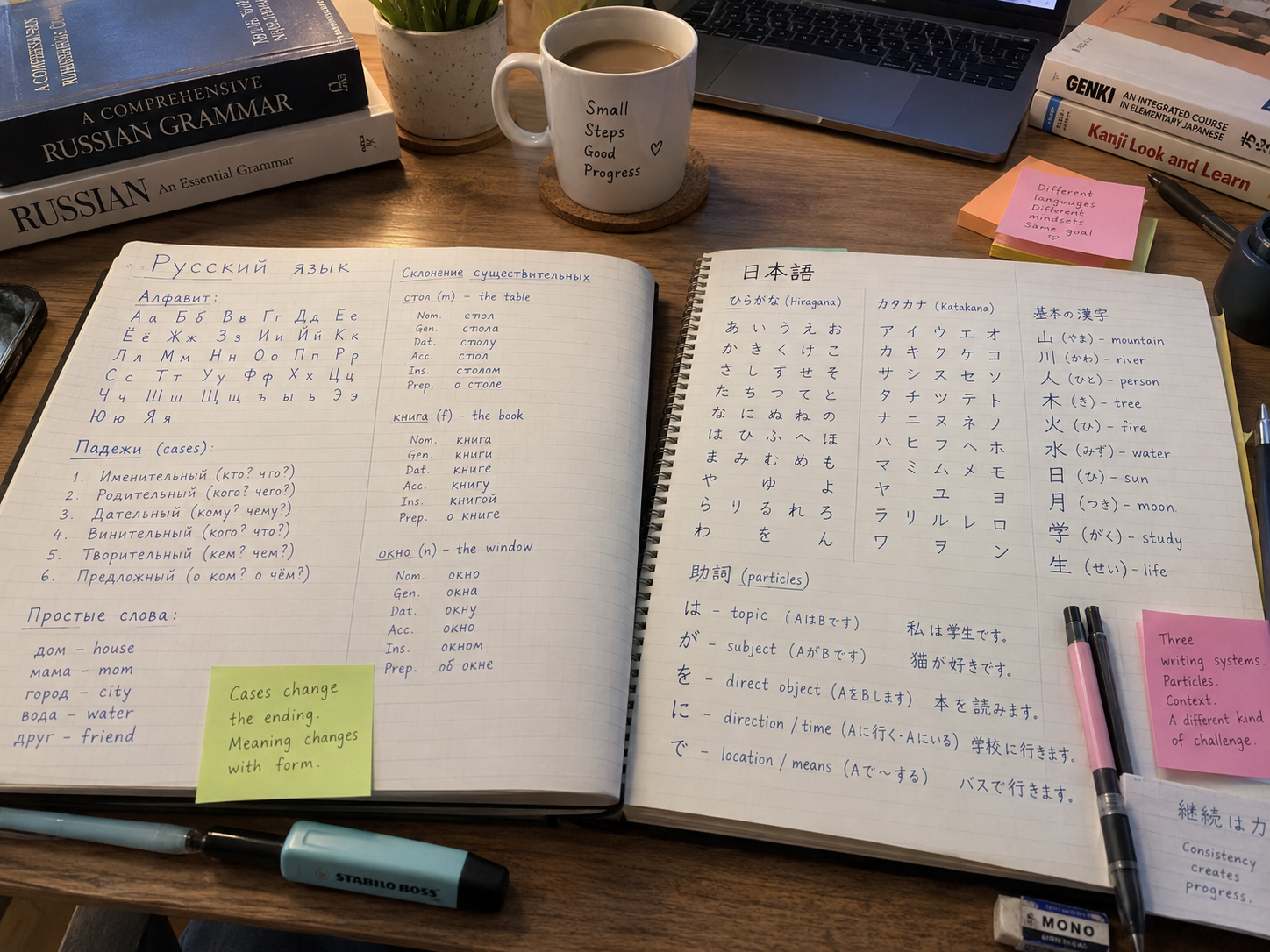
Russian often feels harder during the first few months. Japanese usually becomes the larger long-term project.
That is the shortest useful answer for an English speaker, but it hides the interesting part. The two languages are difficult in almost opposite ways. Russian introduces grammatical complexity early while using an alphabet that can be learned quickly. Japanese begins with relatively approachable pronunciation and some regular grammar, then asks the learner to build literacy across hiragana, katakana, and a large kanji system while also mastering levels of politeness and a sentence structure far removed from English.
Writing system: Japanese is the bigger commitment
Russian uses Cyrillic. Several letters look unfamiliar, and a few resemble Latin letters but represent different sounds, which creates confusion at first. Still, the system is an alphabet. Most motivated learners can begin reading simple Russian words after a few hours and become reasonably comfortable with Cyrillic within weeks.
Japanese uses two phonetic syllabaries — hiragana and katakana — plus kanji. Hiragana and katakana are finite and learnable. Kanji is the long-term challenge because a single character may have multiple readings and appears in thousands of words.
If literacy matters to your definition of “learning the language,” Japanese demands much more sustained memorization.
Pronunciation: Japanese is generally friendlier at the beginning
Japanese has a relatively small sound inventory and a consistent relationship between kana and pronunciation. English speakers still struggle with vowel length, doubled consonants, the Japanese r sound, rhythm, and pitch accent, but basic intelligibility is often achievable fairly early.
Russian pronunciation has more friction. Consonant clusters, palatalized consonants, vowel reduction, and unpredictable word stress all create problems. A word's spelling does not always tell a beginner exactly how it will sound in normal speech.
Russian can therefore feel more physically difficult to pronounce even though the alphabet itself is simpler.
Grammar: Russian hits early
Russian nouns and adjectives change according to case, gender, and number. Verbs conjugate, and verb aspect becomes increasingly important. A beginner quickly encounters sentences in which several word endings change at once.
For an English speaker, that creates an early shock because English relies much less on inflection.
Japanese nouns do not decline through a comparable case system, and verbs do not change for person or number. In that sense, Japanese grammar can initially look cleaner.
But Japanese grammar is not “easy.” It uses particles to mark grammatical relationships, puts verbs at the end, omits subjects freely when context makes them clear, and encodes social relationships through levels of formality. Sentence organization can feel less intuitive to an English speaker even when the morphology is regular.
Word order: Russian is flexible; Japanese is structurally distant
English is strongly subject-verb-object. Japanese is typically subject-object-verb, although topics and omitted subjects complicate that formula.
私は本を読みます。 literally follows the pattern “I — book — read.”
Russian can often use subject-verb-object too:
Я читаю книгу. — I am reading a book.
But because Russian endings mark grammatical roles, word order can move for emphasis:
Книгу я читаю. puts unusual emphasis on the book.
Japanese requires the learner to become comfortable waiting for the verb. Russian requires the learner to notice how changing order changes information structure.
Vocabulary: both are far from English
Neither language offers English speakers the kind of vocabulary transparency they get in French or Spanish. Russian has some international vocabulary and recognizable loanwords; Japanese has many English-derived loanwords written in katakana.
Those Japanese loanwords can be deceptive. コンセント (konsento) means electrical outlet, not “consent,” and マンション (manshon) usually refers to an apartment/condominium building, not a mansion.
Both languages therefore reward learners who resist guessing too confidently.
Politeness and social register: Japanese is more structurally demanding
Russian distinguishes informal ты and formal/plural вы, uses patronymics in formal contexts, and has many subtle choices in address.
Japanese goes further. Plain and polite verb forms are fundamental, and honorific/humble language adds another layer. Learners must not only know what they want to say but also choose a form appropriate to the social relationship.
This is one reason advanced Japanese can remain difficult even when a learner's grammar is strong.
Listening: different kinds of difficulty
Russian listening is often difficult because unstressed vowels reduce, words link together, and familiar forms sound different at conversational speed.
Japanese listening can be difficult because subjects and objects are omitted, sentence endings carry social nuance, and similar-sounding words depend heavily on context. Native conversation also includes contractions and fillers that textbooks introduce gradually.
Which language gets easier faster?
Russian often gives learners an early period of frustration followed by growing structural clarity. Once case patterns, conjugations, and aspect become familiar, the same systems repeat across the language.
Japanese often gives learners a smoother beginning in pronunciation and basic grammar, followed by the realization that reading and advanced register require years of accumulated exposure.
So which one is harder?
For an English-speaking learner who wants balanced speaking, listening, reading, and writing, Japanese is usually the larger total time commitment, primarily because of literacy and linguistic distance from English. Russian is often harder in the beginner and lower-intermediate grammar stage because so many forms must be controlled early.
Individual background can reverse that experience. Someone who speaks another Slavic language may find Russian dramatically easier. Someone who knows Chinese characters may have an advantage in Japanese reading. A person deeply immersed in Japanese media may tolerate the long literacy process better than a learner with no cultural connection.
The more useful choice is not “Which language is objectively easier?” but “Which difficult language am I willing to spend enough time with?” Motivation does not erase grammar or kanji, but it changes whether the necessary repetition feels sustainable.
At Polyglottist Language Academy, both Japanese and Russian students often discover that their original fear was aimed at the wrong feature. Russian beginners worry about Cyrillic when cases become the real challenge. Japanese beginners worry about pronunciation when long-term reading is the larger task. Understanding that difference early helps learners prepare for the difficulty that actually matters.