
Where to Learn Japanese in Marin County: A Guide for Adult Language Learners
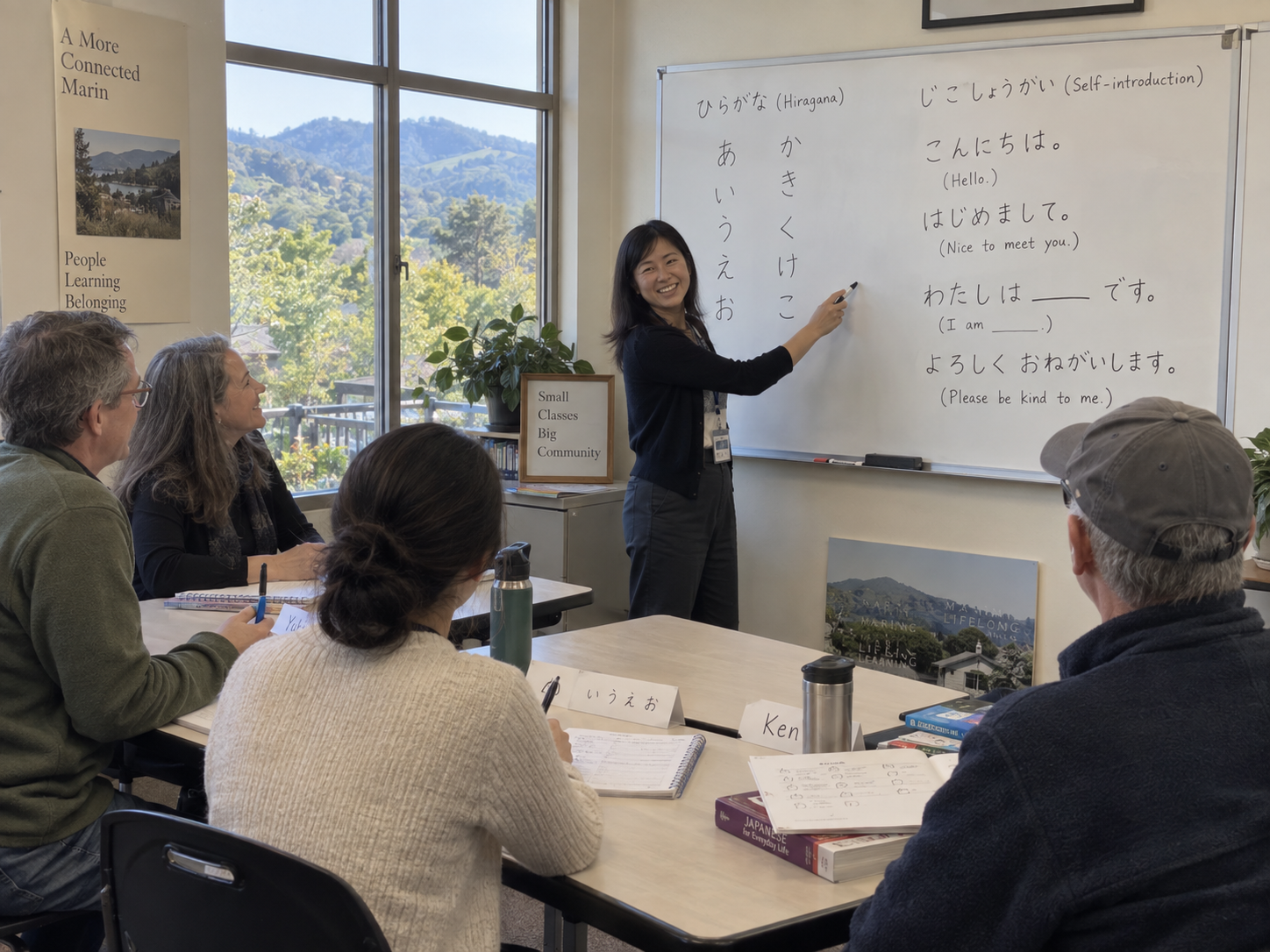
Marin County adults searching for Japanese classes have one advantage that learners in many suburban areas do not: a real college-level Japanese course is available locally.
For Fall 2026, College of Marin lists two sections of JPNS 101: Elementary Japanese I at its Kentfield campus, meeting twice a week in the late afternoon. That gives Marin residents a serious in-person starting point without crossing the Golden Gate Bridge.
The main question is whether a college course matches the way you want to study.
College of Marin: the strongest local structured option
College of Marin's Japanese program is designed to develop speaking, reading, writing, and cultural understanding. Elementary Japanese I is a credit-bearing course, which means it is more systematic than a casual conversation workshop and generally comes with regular assignments, assessments, and attendance expectations.
For an adult who wants accountability and can attend twice a week around 4:10 p.m., this can be an excellent option.
The schedule is also the main limitation. Many full-time professionals cannot leave work early enough to reach Kentfield for a late-afternoon class. A locally available course is only convenient if the time fits your life.
Credit classes versus community education
College of Marin also operates a Community Education program for short-term, noncredit enrichment. Its offerings change by term. If a Japanese course appears there, the format may be more flexible for working adults than a semester-long credit class.
Do not assume that “College of Marin Japanese” always refers to the same program. Check whether you are looking at a credit academic course or a community education offering, because the registration process, pace, homework, and cost structure can be different.
San Francisco is close geographically and far in commuting time
Marin learners have access to the broader Bay Area Japanese ecosystem, but the bridge changes the calculation. An evening class in San Francisco can be perfectly reasonable from southern Marin on a good day and exhausting when traffic, parking, or transit connections go wrong.
The Japan Society of Northern California offers Japanese group classes from beginner through advanced levels, including online instruction and in-person sections in San Francisco and San Mateo. For a Marin learner, the online option may be more practical than physically attending a class across the bridge.
Berkeley is another possibility, but location matters within Marin
Polyglottist Language Academy offers small-group adult Japanese classes in downtown Berkeley and online. For someone in eastern or northern Marin, the Richmond–San Rafael Bridge can make Berkeley plausible, though traffic still matters. For someone in southern Marin, San Francisco may be easier.
This is one of those cases where “nearby” cannot be measured only in miles.
What should a true beginner choose?
If you enjoy academic structure, can attend twice weekly, and want a strong foundation across all four skills, College of Marin is hard to overlook.
If you work a conventional schedule, a weekly evening or online course may be more sustainable. You can still progress quickly if you review Japanese briefly on most days.
Private tutoring makes sense when your schedule is irregular or your goals are highly specific, such as preparing for a trip, returning to Japanese after years away, or focusing heavily on speaking.
What does a good first semester look like?
A beginner should expect to learn hiragana early, start katakana soon afterward, and gradually encounter basic kanji. Speaking should begin immediately rather than waiting for literacy to develop.
By the end of a first course, a learner should be able to do more than recite memorized greetings. They should be able to build simple sentences about themselves, daily routines, preferences, places, time, and plans.
Teachers often notice that adult students overestimate how much grammar they need before they can speak. Japanese beginners can communicate quite a lot with a limited set of structures if those structures are practiced repeatedly.
Use Marin's schedule to your advantage
One benefit of studying locally is that the time saved on commuting can become study time. A learner who spends twenty minutes reviewing kanji after dinner four nights a week may progress more than a learner attending a theoretically better class that requires hours of driving.
If you choose online instruction, try to preserve a physical study routine: the same desk, a notebook, handwritten kana practice, and regular speaking aloud. Online learning becomes less effective when it turns into passive screen time.
Culture matters, but it is not a substitute for instruction
Japanese cultural events, food, film, art, and community organizations can reinforce motivation and vocabulary. They are most useful when you already have a structured course that explains what you are noticing.
The language itself takes repetition. There is no local event that replaces learning particles or practicing verb forms.
A practical decision
Marin County learners have three sensible routes: College of Marin for a rigorous local academic course, Bay Area language organizations for group study, and live online classes for maximum schedule flexibility.
For complete beginners, the strongest choice is usually the one that combines a clear progression with a schedule you can maintain for more than one term. College of Marin makes Japanese unusually accessible locally; the broader Bay Area fills in the gaps when the college schedule or pace is not right.
That is a better situation than many adults realize when they first search “Japanese classes near me” and assume they will have to commute to San Francisco for everything.