
Can You Learn Russian From Music? The Best Russian Songs for Language Learners
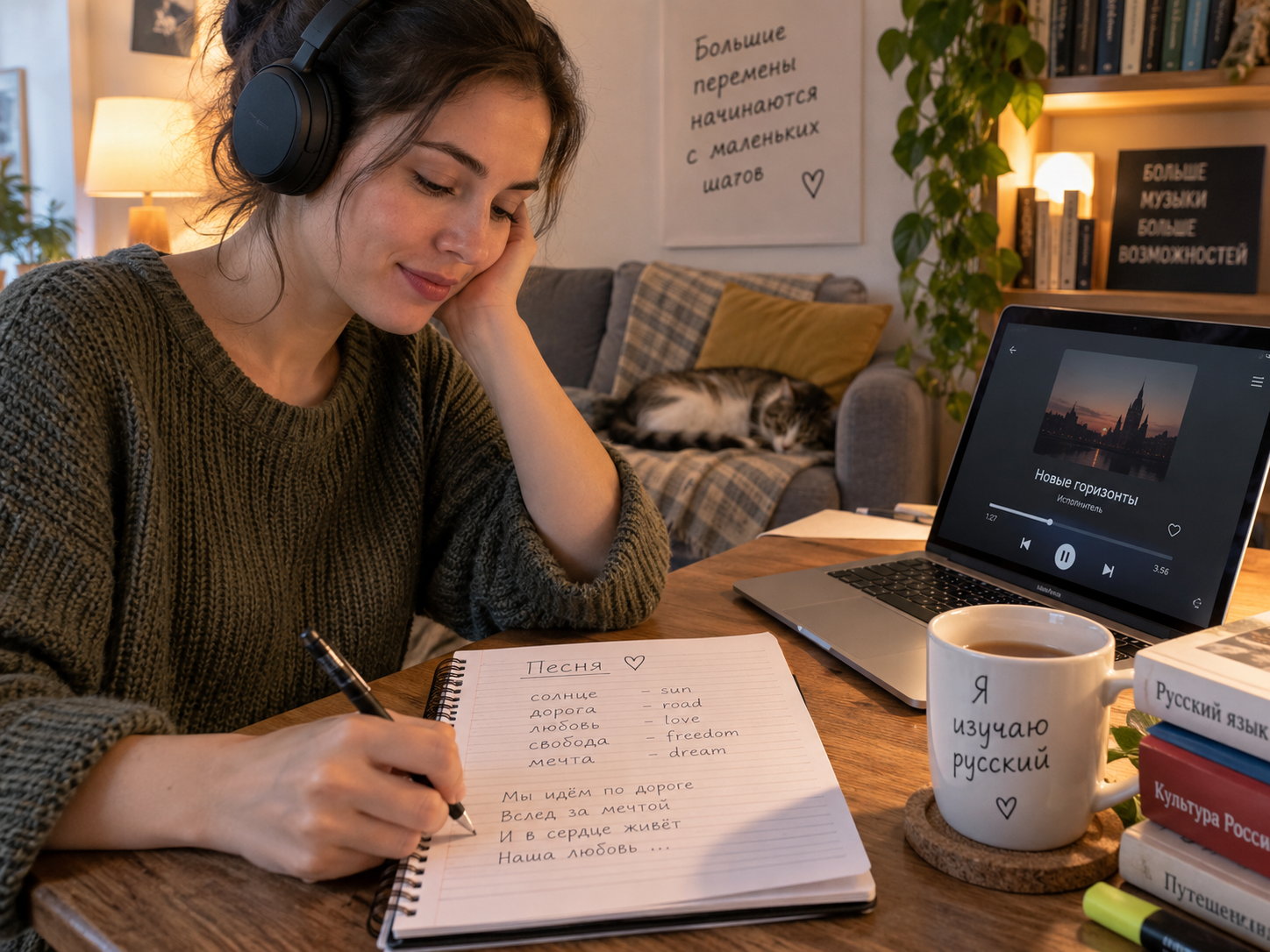
A song can make a Russian phrase stick in your memory for years, but it can also teach you a pronunciation that no one would use in ordinary conversation. That is the paradox of learning through music. Songs are powerful because melody, rhythm, and repetition strengthen memory; they are imperfect because singers stretch vowels, drop sounds, bend stress, and choose poetic word order.
Used deliberately, Russian music is one of the best supplements to a course. It is not a substitute for one.
What music teaches well
Music is particularly good for sound recognition. A learner who repeatedly hears the same chorus begins to recognize word boundaries that seemed invisible in normal speech. Songs also make short phrases memorable and expose you to emotion, metaphor, diminutives, slang, and cultural references.
What music teaches poorly is conversational pacing. You should not assume that a sung vowel length or dramatic intonation belongs in normal speech. Grammar may also be compressed for rhyme.
The useful method is to learn from the song, then check the phrase in ordinary spoken Russian.
1. “Прекрасное далёко” — good for beginners
This well-known song from Soviet children’s television has relatively clear diction, a memorable melody, and repeated vocabulary. The language is poetic but not syntactically chaotic.
Beginners can listen for adjective endings, repeated future-oriented ideas, and the sound of unstressed vowels. Because many Russian speakers know the song, it also carries cultural recognition beyond the vocabulary itself.
2. “Катюша” — beginner to lower intermediate
“Катюша” is one of the most internationally recognizable Russian songs. The vocabulary includes landscape, distance, love, and military separation. Its pronunciation is usually clear in traditional performances.
It is useful for hearing case endings in a memorable context, but learners should remember that some of its vocabulary is literary and historical rather than daily conversational Russian.
3. “Я шагаю по Москве” — lower intermediate
The title means “I walk through Moscow,” and the song is associated with the 1963 film of the same name. The mood and vocabulary are accessible, and the phrases give learners a feel for ordinary verbs and movement without the density of many modern pop songs.
It is also a good example of how a song can teach a city’s cultural image rather than only vocabulary.
4. “Хочешь?” by Zemfira — intermediate
Zemfira is valuable for learners because her songs sound unmistakably modern compared with Soviet standards, yet her diction can still be followed with repeated listening. “Хочешь?” revolves around a very common verb—“Do you want?”—inside highly emotional, poetic language.
The grammar is useful, but the imagery is not everyday conversation. Treat it as listening and cultural study, not a phrasebook.
5. “Маршрутка” by IOWA — intermediate
The word маршрутка refers to a route minibus, a piece of everyday urban vocabulary that immediately locates the song in ordinary post-Soviet life. Contemporary songs like this help learners hear modern pronunciation and colloquial rhythm.
The challenge is speed. Use the song after you can already follow slow spoken Russian.
6. “Группа крови” by Kino — intermediate
Viktor Tsoi and Kino are essential to late-Soviet rock culture. “Группа крови” is memorable, rhythmically direct, and full of vocabulary connected with identity, risk, conflict, and fate.
The song is not beginner material in meaning, but the repeated structure makes it easier to re-enter after the first listen. It is a good bridge from textbook Russian to cultural Russian.
7. “Миллион алых роз” — lower intermediate
This song became closely associated with Alla Pugacheva and remains widely recognized. Its story structure helps learners because the song is not only a collection of abstract images: there is a narrative to follow.
That makes it useful for practicing past-tense verbs and building comprehension through context.
8. “Подмосковные вечера” — beginner to lower intermediate
Known in English as “Moscow Nights,” this song is slow and clear in many recordings. Its vocabulary is lyrical but pronunciation-friendly, which makes it useful for shadowing.
Learners can focus on consonant softness and the reduction of unstressed vowels without fighting a fast beat.
A better way to study one song
First listen without reading anything. Ask only what mood, repeated sounds, and familiar words you can catch. Then read a legal lyric source or captions while listening again. Look up no more than five to ten useful words.
Next, speak a short section as prose instead of singing it. This reveals which sounds were distorted by melody. Finally, listen again and notice how much more arrives automatically.
Avoid memorizing an entire song before you understand it. The goal is not performance. It is to make Russian sound patterns and vocabulary easier to retrieve.
Streaming platforms such as Spotify, Apple Music, and YouTube make most of these songs easy to find, though specific recordings and regional availability vary. Choose versions with clear vocals before moving to remixes or live performances.
Polyglottist Language Academy’s Russian classes can provide the grammar and speaking structure that music lacks. Songs then become much more useful because you begin recognizing forms you have already studied.
Music will not teach you Russian by itself. It can, however, make Russian harder to forget—and that is a substantial advantage.