
Tagalog Classes in Los Angeles: A Guide for Adult and Heritage Learners
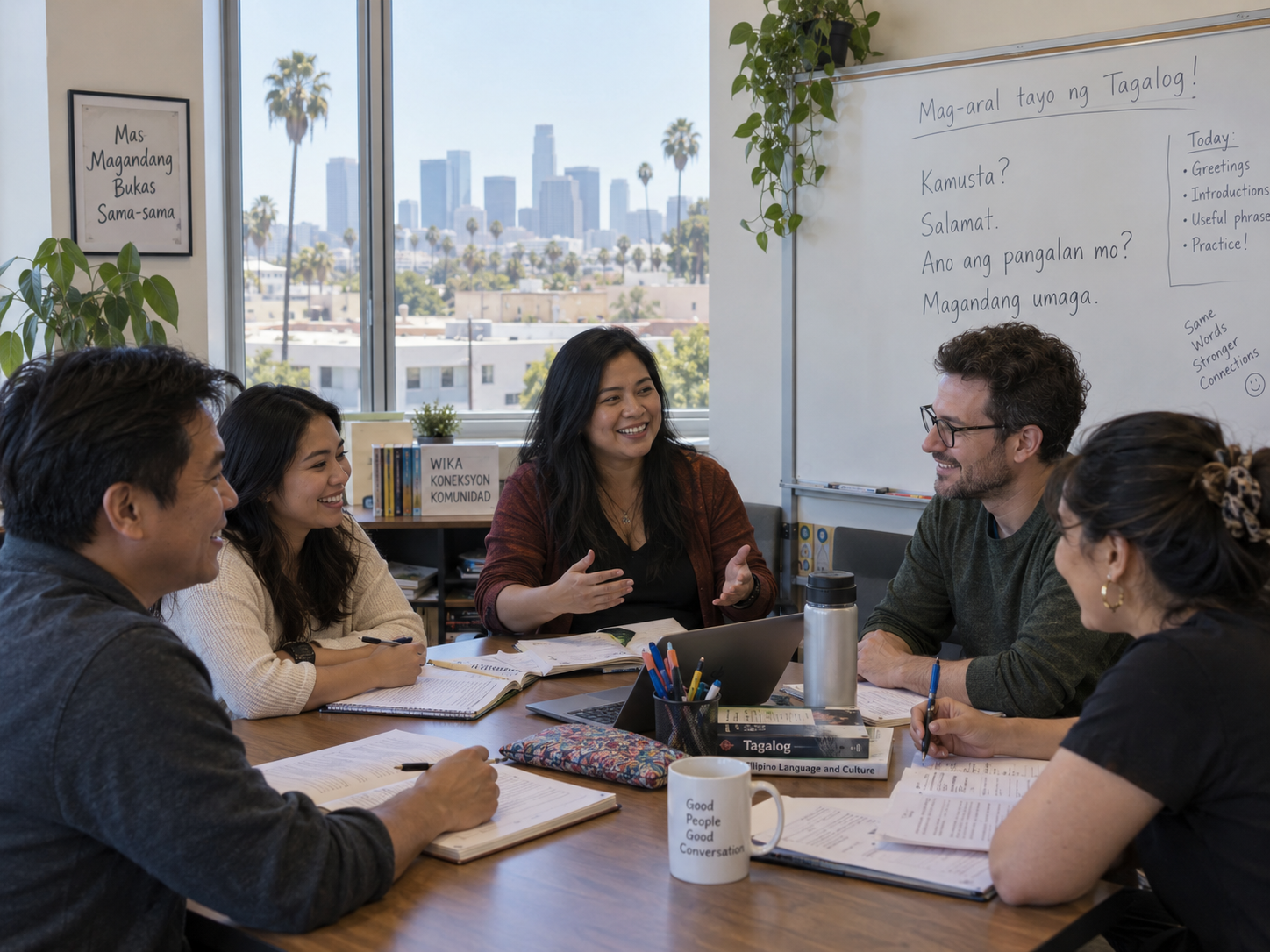
Los Angeles is one of the easier American cities in which to encounter Filipino culture and one of the more confusing cities in which to answer a simple question: “Where can an adult actually take Tagalog?”
There are real academic programs. There are cultural organizations, community events, private teachers, online courses, and heritage learners speaking Taglish with family across the region. What Los Angeles does not offer is one single obvious path that fits every adult.
The right option depends heavily on whether you are a complete beginner or someone who grew up hearing the language.
UCLA offers serious Filipino language study
UCLA has an established Filipino language curriculum covering introductory and intermediate study, with attention to speaking, listening, reading, writing, and grammar. Its catalog also includes an intensive elementary Filipino course offered in summer.
For a learner who wants university-level structure, substantial weekly contact hours, and academic depth, that is an important Los Angeles resource.
The qualification is practical: a university course is not automatically an evening community class. Enrollment rules, tuition, prerequisites, quarter schedules, and daytime meeting times may make it a better fit for enrolled or extension-eligible students than for a working adult who simply wants one hour a week after work.
Check the current schedule and eligibility before treating a catalog listing as a casual public option.
CSU Long Beach currently teaches Filipino too
California State University, Long Beach lists Fundamentals of Filipino in its current 2026 schedule, and the university’s Asian and Asian American Studies curriculum includes foundational Tagalog/Filipino courses.
That makes CSULB another substantial option in the larger Los Angeles region, particularly for students interested in combining language with Filipino American or Asian American studies.
Again, the same caution applies: university classes are built around academic calendars and credit-bearing requirements. They can be excellent, but they solve a different problem from a six-week adult conversation course.
Los Angeles gives heritage learners a strong cultural environment
Organizations such as FilAm Arts and Kayamanan Ng Lahi maintain active Filipino cultural programming through arts, performance, workshops, and community events. Historic Filipinotown and the wider Southern California Filipino community create many opportunities to hear Filipino languages and engage with cultural life.
A learner should not confuse cultural programming with formal language instruction, but the distinction can work in your favor. A structured class can teach the mechanics; community participation can make those mechanics meaningful.
For heritage learners, that social setting can be especially important because many already possess passive knowledge. You may understand a relative discussing food, family, or errands but struggle to describe your own work, opinions, or plans in Tagalog. Cultural participation gives you more reasons to expand beyond “home vocabulary.”
Heritage learners need placement, not assumptions
The phrase “heritage speaker” covers an enormous range of ability.
One person may understand almost everything and speak hesitantly. Another may speak fluidly but never learned to read formal Filipino. Another may understand only the variety used by grandparents and find younger Taglish-heavy conversation easier or harder depending on experience.
That is why heritage learners should be cautious about enrolling automatically in a complete-beginner course. The alphabet and basic greetings may be unnecessary, while verb structure, markers, reading, or vocabulary gaps may still require systematic instruction.
A good school will assess what you can do rather than decide your level from your family background.
Complete beginners need a different kind of foundation
A complete beginner benefits from explicit explanation early on. Tagalog pronunciation is relatively approachable for English speakers, and the Latin alphabet makes reading possible from the first lesson. Grammar is where the language begins to feel less familiar.
Markers such as ang, ng, and sa do not map neatly onto English articles or prepositions. Verbs change according to patterns that express focus and aspect. Sentence order is more flexible than English, but not random.
A strong beginner course should explain these systems before the student accumulates dozens of memorized phrases without knowing how to build new ones.
Online classes solve a very Los Angeles problem
In Los Angeles, the distance between “technically nearby” and “realistically attend every Tuesday at 6:30” can be enormous.
A learner in Glendale, Culver City, Long Beach, the Valley, or the South Bay may find an excellent program on paper and then discover that traffic makes consistent attendance unrealistic.
Live online instruction avoids that commute while preserving a teacher, classmates, and scheduled speaking practice. Polyglottist Language Academy offers live online Tagalog classes for adults, including complete beginners, in small groups.
For adults whose main alternative is driving across the county after work, that format can be less of a compromise than it first appears.
What to compare before registering
Do not choose a course based only on the word “Tagalog” in the title. Ask what students actually do during class.
How much time is spent speaking? Does the instructor explain grammar or mostly present vocabulary? Are heritage learners placed separately? Is the class primarily academic, conversational, or culture-focused? What variety of Filipino/Tagalog does the instructor teach? How large is the group?
Apps can supplement any of these options, but they rarely diagnose why an English-influenced sentence sounds unnatural or why a verb form changes when the grammatical focus shifts.
Los Angeles gives learners more resources than many American cities, but that variety makes matching the program to the learner more important, not less. The UCLA student seeking advanced reading, the Filipino American who understands grandparents but answers in English, and the complete beginner learning for a partner’s family may all be searching for “Tagalog classes in Los Angeles.” They should not necessarily end up in the same classroom.