
50 Essential Russian Phrases for Travelers (Pronunciation Guide Included)
A traveler can memorize fifty Russian phrases and still freeze at a train station if those phrases were learned as isolated sound bites. The useful question is not simply, “What does this sentence mean?” but “When would a Russian speaker actually say it, and what is the shortest version I can produce under pressure?”
For English speakers, Russian pronunciation looks more intimidating than it usually is. You do not need a perfect accent to be understood, but you do need to pay attention to stress. Unstressed vowels change noticeably, and a word can sound unfamiliar if the stress falls in the wrong place. In the guide below, the stressed syllable is shown in CAPS inside the transliteration when it is especially helpful.
Four pronunciation habits worth learning before the phrases
Russian р is tapped or rolled, but a light tap is enough. Russian х is a rough sound similar to the “ch” in Scottish loch. The letter ы has no exact English equivalent; for travel purposes, imitate a short, deep “i” while keeping the tongue pulled slightly back. Finally, do not over-pronounce every written o. In an unstressed syllable, it often moves toward an “a” sound.
One more practical point: Russian uses formal вы with strangers, service staff, older people, and in most travel interactions. The phrases below therefore default to polite forms.
First contact and basic courtesy
1. Здравствуйте. — ZDRAST-vuy-tye. — Hello. This is the safest formal greeting.
2. Доброе утро. — DO-bra-ye OO-tra. — Good morning.
3. Добрый день. — DO-bryy dyen’. — Good afternoon / hello.
4. Добрый вечер. — DO-bryy VYE-cher. — Good evening.
5. До свидания. — da svee-DA-ni-ya. — Goodbye.
6. Пожалуйста. — pa-ZHA-lus-ta. — Please / you’re welcome.
7. Спасибо. — spa-SEE-ba. — Thank you.
8. Большое спасибо. — bal-SHO-ye spa-SEE-ba. — Thank you very much.
9. Извините. — eez-vee-NEE-tye. — Excuse me / sorry.
10. Я не говорю по-русски. — ya nye ga-va-RYOO pa-ROOS-kee. — I don’t speak Russian.
A common beginner mistake is to use привет with everyone because apps teach it early. Привет is useful, but it is informal. With a hotel receptionist, older stranger, or ticket clerk, здравствуйте is the better default.
Asking for help and understanding
11. Вы говорите по-английски? — vy ga-va-REE-tye pa-ang-GLIY-skee? — Do you speak English?
12. Я немного говорю по-русски. — ya nye-MNO-ga ga-va-RYOO pa-ROOS-kee. — I speak a little Russian.
13. Я не понимаю. — ya nye pa-nee-MA-yu. — I don’t understand.
14. Повторите, пожалуйста. — paf-ta-REE-tye pa-ZHA-lus-ta. — Please repeat.
15. Говорите медленнее, пожалуйста. — ga-va-REE-tye MYED-len-nee-ye pa-ZHA-lus-ta. — Please speak more slowly.
16. Что это значит? — shto EH-ta ZNA-chit? — What does this mean?
17. Как это сказать по-русски? — kak EH-ta ska-ZAT’ pa-ROOS-kee? — How do you say this in Russian?
18. Напишите, пожалуйста. — na-pee-SHEE-tye pa-ZHA-lus-ta. — Please write it down.
These are high-value phrases because they keep a conversation alive. Travelers often spend too much time memorizing nouns and not enough time learning how to repair a conversation when something goes wrong.
Directions and getting around
19. Где метро? — gdye mye-TRO? — Where is the metro?
20. Где вокзал? — gdye vak-ZAL? — Where is the train station?
21. Где остановка автобуса? — gdye a-sta-NOF-ka af-TO-boo-sa? — Where is the bus stop?
22. Как пройти к…? — kak pray-TEE k…? — How do I walk to…?
23. Как доехать до…? — kak da-YE-khat’ da…? — How do I get to… by transport?
24. Это далеко? — EH-ta da-lee-KO? — Is it far?
25. Это близко? — EH-ta BLEEZ-ka? — Is it close?
26. Налево. — na-LYE-va. — To the left.
27. Направо. — na-PRA-va. — To the right.
28. Прямо. — PRYA-ma. — Straight ahead.
29. Мне нужно сюда. — mnye NOOZH-na syu-DA. — I need to go here. Extremely useful while showing a map or address.
30. Остановите здесь, пожалуйста. — a-sta-na-VEE-tye zdyes’ pa-ZHA-lus-ta. — Please stop here.
Notice the distinction between пройти and доехать. English often uses the vague “How do I get there?” Russian tends to distinguish walking from traveling by vehicle. You do not have to master motion verbs before a trip, but learning these two frames makes directions much easier.
Tickets, trains, and transport
31. Один билет до…, пожалуйста. — a-DEEN bee-LYET da… pa-ZHA-lus-ta. — One ticket to…, please.
32. Во сколько отправление? — va SKOL’-ka at-praf-LYE-ni-ye? — What time is departure?
33. С какой платформы? — s ka-KOY PLAT-far-my? — From which platform?
34. Этот поезд идёт в…? — EH-tat PO-yezd ee-DYOT f…? — Does this train go to…?
35. Когда мы приедем? — kag-DA my pree-YE-dem? — When will we arrive?
Hotels
36. У меня бронь. — oo mye-NYA bron’. — I have a reservation.
37. На имя… — na EE-mya… — Under the name…
38. Можно заселиться раньше? — MOZH-na za-sye-LEET-sa RAN’-she? — Can I check in earlier?
39. Во сколько выезд? — va SKOL’-ka VY-yezd? — What time is checkout?
40. У меня проблема с номером. — oo mye-NYA pra-BLYE-ma s NO-me-ram. — I have a problem with the room.
The construction у меня… literally resembles “at me there is,” but in practice it is one of the most useful Russian structures for expressing possession or describing your situation: У меня бронь (I have a reservation), У меня вопрос (I have a question), У меня проблема (I have a problem).
Restaurants and cafés
41. Можно меню, пожалуйста? — MOZH-na mye-NYOO pa-ZHA-lus-ta? — May I have the menu, please?
42. Что вы рекомендуете? — shto vy rye-ka-myen-DOO-ye-tye? — What do you recommend?
43. Я буду это. — ya BOO-doo EH-ta. — I’ll have this. Useful while pointing.
44. Без мяса, пожалуйста. — byez MYA-sa pa-ZHA-lus-ta. — Without meat, please.
45. У меня аллергия на… — oo mye-NYA a-LYER-gee-ya na… — I’m allergic to…
46. Счёт, пожалуйста. — schyot pa-ZHA-lus-ta. — The bill, please.
Shopping and money
47. Сколько это стоит? — SKOL’-ka EH-ta STO-it? — How much does this cost?
48. Можно оплатить картой? — MOZH-na a-pla-TEET’ KAR-tay? — Can I pay by card?
49. У вас есть меньше / больше? — oo vas yest’ MYEN’-she / BOL’-she? — Do you have a smaller / larger one?
When something is wrong
50. Помогите, пожалуйста. — pa-ma-GEE-tye pa-ZHA-lus-ta. — Please help me.
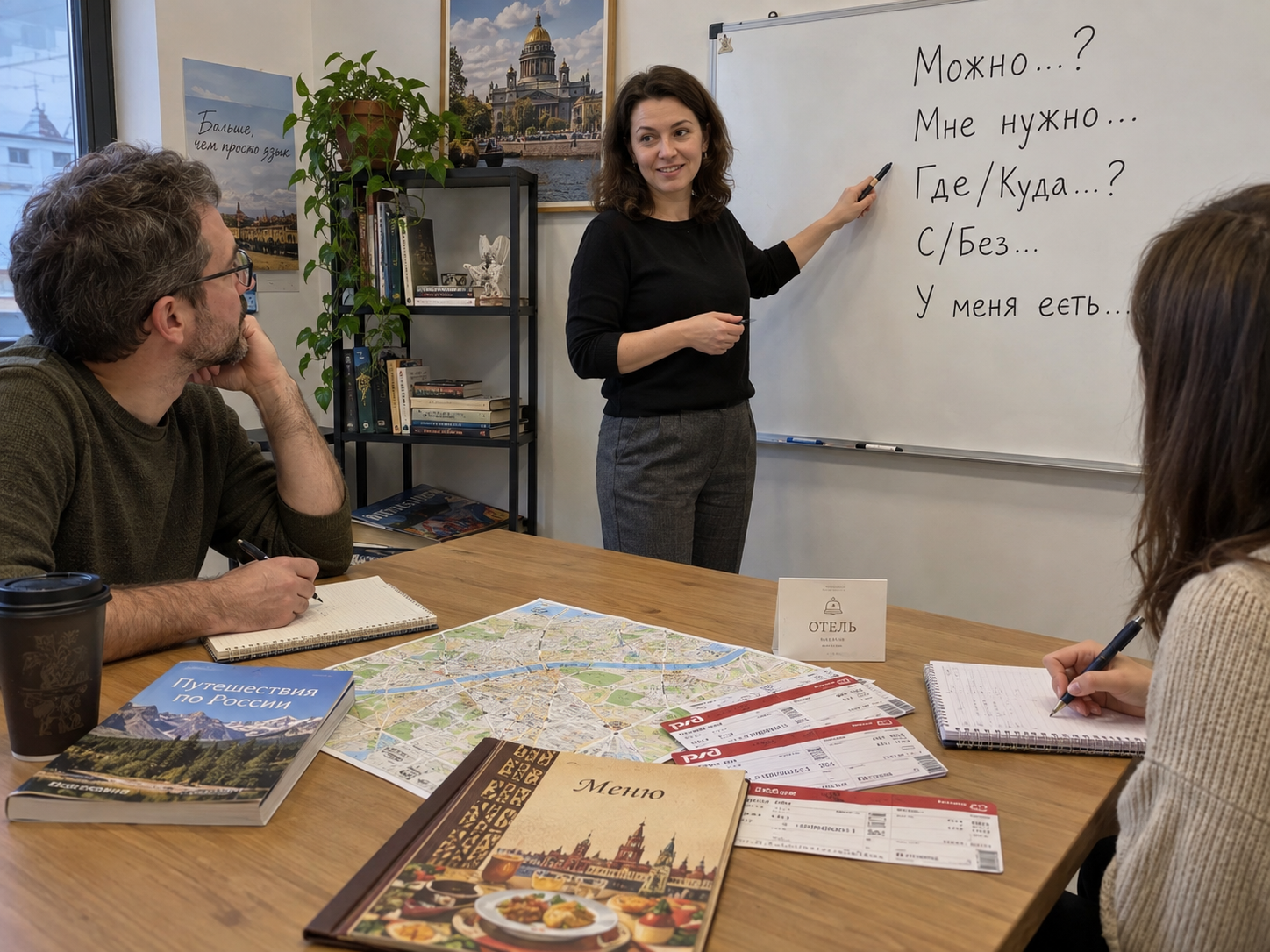
For an actual trip, the best strategy is not to memorize all fifty phrases equally. Learn about fifteen so well that you can produce them without looking at your phone, then keep the rest in a note you can search quickly. The most transferable structures are Где…?, Можно…?, Мне нужно…, У меня…, Без…, and Сколько…? Once those become familiar, you can build dozens of new travel sentences from vocabulary you already know.
Polyglottist Language Academy’s Russian classes are designed around that kind of usable structure: learners practice grammar inside real exchanges rather than collecting disconnected phrases. A traveler does not need advanced Russian to make a trip easier, but a small amount of Russian that comes out reliably is much more useful than a large phrase list that stays on the page.