
How to Learn Kanji Without Losing Your Mind: The Best Methods Compared
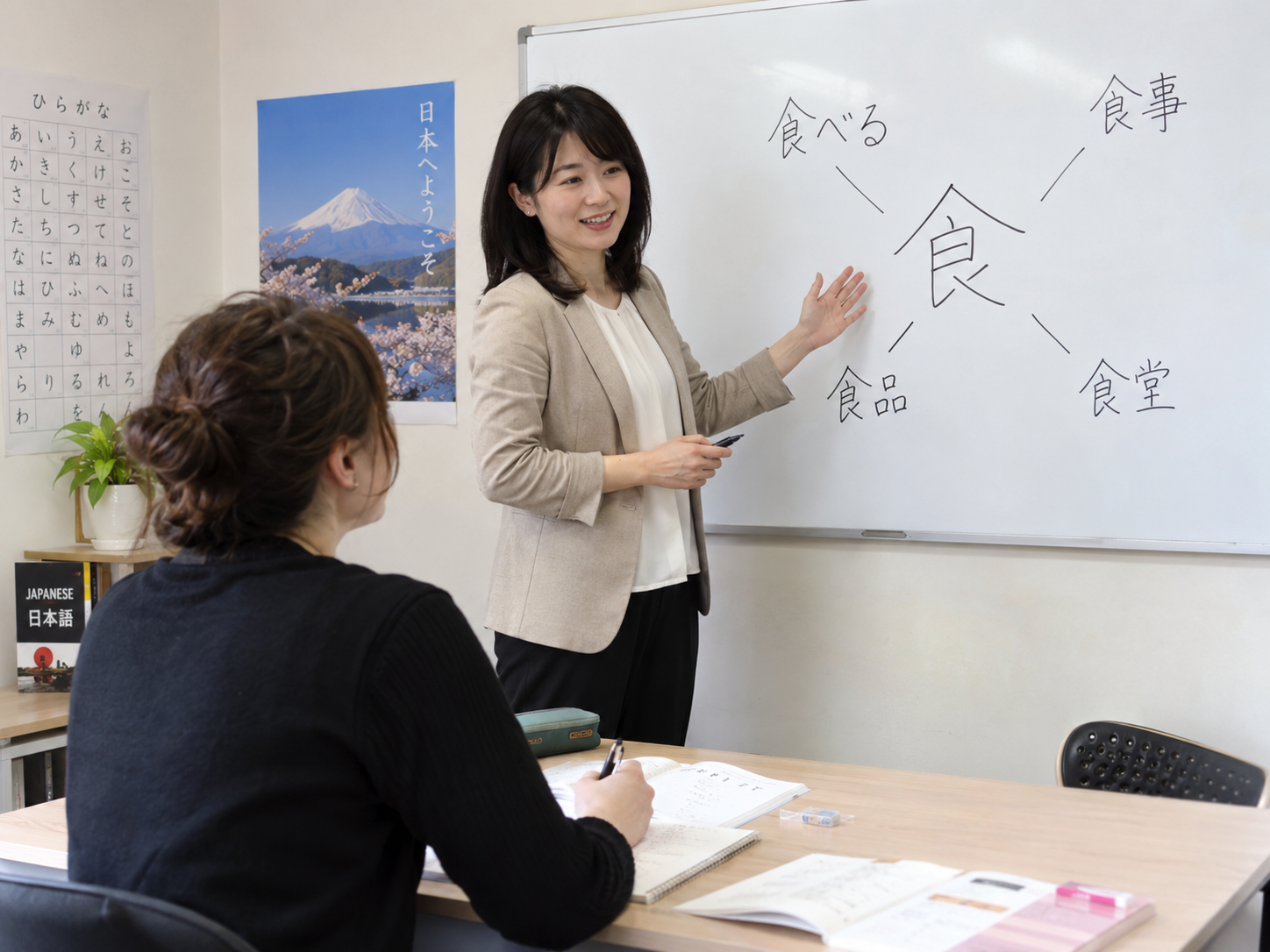
Kanji becomes miserable when a learner treats every character as a miniature picture with a pronunciation and an English definition attached. That sounds efficient. It is also how people end up with hundreds of flashcards they can recognize in an app but cannot read in a sentence.
The difficulty is that a kanji is not really one unit of knowledge. To “know” 食, for example, you may need to recognize its shape, understand that it is connected with eating and food, read it as しょく in 食事 (shokuji, meal), read it as た in 食べる (taberu, to eat), and recognize it quickly enough that a sentence does not grind to a halt. Different study methods target different pieces of that problem.
Method 1: Learn components and radicals
Breaking a complex character into recurring visual parts is one of the best ways to reduce the feeling that kanji is random. A learner who sees every character as a unique drawing has to remember thousands of unrelated shapes. A learner who recognizes familiar components begins to see structure.
This approach is excellent for visual discrimination. It helps with easily confused characters and makes new kanji less intimidating. The weakness is that component knowledge alone does not tell you how a word is pronounced or used. Knowing that 言 is associated with speech does not automatically teach you 言う (iu, to say), 言葉 (kotoba, word/language), or 方言 (hōgen, dialect).
Best for: beginners building visual literacy; learners who constantly confuse similar characters.
Method 2: Mnemonics and stories
Mnemonic systems assign memorable stories to components. For many adults, this is the fastest way to get an initial foothold. A strange image is often easier to retrieve than a list of strokes.
The problem appears later if the story becomes more memorable than the Japanese. Teachers often meet learners who can explain an elaborate English mnemonic for a character but hesitate when asked to read an ordinary word containing it. Mnemonics are scaffolding. If they work, use them; as recognition becomes automatic, let the story disappear.
Best for: initial memorization and characters that refuse to stick.
Method 3: Spaced repetition systems
Spaced repetition is powerful because forgetting is predictable. A good SRS shows you an item around the time you are likely to forget it, which is far more efficient than repeatedly reviewing everything.
The danger is letting review become the entire course. A learner can maintain a beautiful streak and still be unable to read because flashcards strip away context. If every card asks “What does this kanji mean?”, you train that exact task. Real reading asks something different: recognize this word, in this sentence, immediately.
A better card usually contains a word, not an isolated character. Instead of only drilling 生, study words such as 学生 (gakusei, student), 生まれる (umareru, to be born), and 生ビール (nama bīru, draft beer). That is slower at first but much closer to real Japanese.
Best for: long-term retention when paired with vocabulary and reading.
Method 4: Handwriting
Writing by hand is often discussed as if you must either write every kanji perfectly or abandon handwriting altogether. Both extremes miss the point.
Handwriting can sharpen attention. When you write a character, you notice proportions, recurring components, and stroke order in a way that tapping the correct flashcard does not require. For learners who mix up visually similar kanji, limited handwriting practice can be extremely useful.
What most adult learners do not need is to spend hours copying a character fifty times unless handwriting itself is a personal goal. Typing and recognition are more important for many modern uses of Japanese.
Best for: learners who need stronger visual memory or who want to write by hand.
Method 5: Learn kanji through vocabulary
For practical language use, this is the method teachers tend to keep pulling students back toward. Japanese is read in words. The character 会 behaves differently in the learner’s mind once it is attached to 会う (au, to meet), 会社 (kaisha, company), and 会話 (kaiwa, conversation).
Vocabulary-first study also prevents one of the most common kanji errors: trying to memorize every possible reading of a character. Many kanji have multiple readings, but beginners do not need a disconnected list of all of them. Learn the readings as they occur in words you actually need.
Best for: nearly everyone; especially learners who want reading ability rather than kanji trivia.
Method 6: Graded reading
Reading is where kanji stops being a deck of cards and becomes language. Graded readers, easy news, learner stories, and familiar manga with appropriate support force the brain to recognize characters at conversational speed.
The frustration is that reading feels inefficient at first. You may encounter only a few target kanji in ten minutes. Yet those encounters are richer: the character appears with grammar, neighboring vocabulary, tone, and meaning. Repeated contextual exposure is what turns slow recall into recognition.
Best for: converting study knowledge into actual reading skill.
Method 7: Keyword systems such as Heisig-style study
Keyword systems deliberately separate character meaning from Japanese readings. Learners associate each kanji with an English keyword and a mnemonic, often covering a large number of characters quickly.
This can be excellent for someone whose main obstacle is visual overload. It can also be misleading if the learner concludes, “I know 1,500 kanji,” when they actually know 1,500 English prompts. The system is strongest when understood as a first layer, followed by Japanese vocabulary and reading.
Best for: highly systematic learners who enjoy a large, organized project and understand what the method does not teach.
What usually works best: a hybrid
A sustainable adult plan is less dramatic than most kanji systems promise. Learn a small set of recurring components. Add new kanji mainly through high-frequency vocabulary. Use mnemonics only where they help. Review words with spaced repetition. Write difficult characters a few times. Then read material easy enough that you can encounter those words again.
A reasonable weekly rhythm might look like this: introduce five to ten new kanji through vocabulary, review them briefly each day, write the confusing ones, and spend several sessions reading something below your maximum level. The reading is not an optional reward after “finishing” kanji. It is part of learning kanji.
Another teacher observation is worth taking seriously: learners who progress steadily often know fewer facts about each character than stalled learners, but they recognize more words automatically. They are not constantly asking, “What are all the readings of this kanji?” They are asking, “What word is this?”
If you study Japanese in a structured class, kanji is easier when it remains tied to grammar, vocabulary, and actual sentences. Polyglottist Language Academy’s Japanese courses can provide that integration: the goal is not to conquer a character list but to make written Japanese progressively less effortful.