
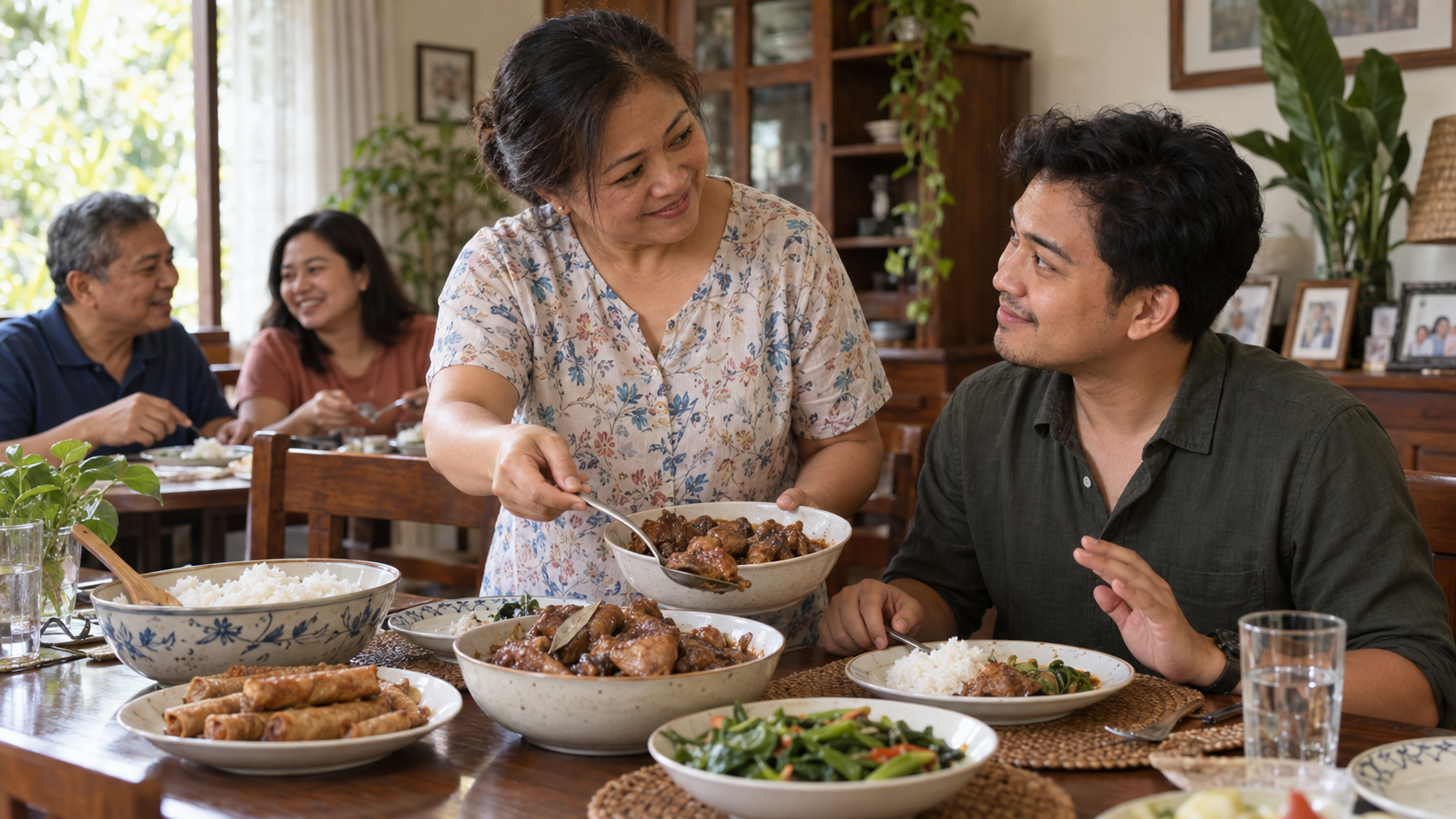
A Filipino friend turns down praise with a laugh and quickly changes the subject. Someone hesitates to ask for help even when they clearly need it. A student knows the answer but does not want to risk saying it in front of the group. A family member avoids doing something that might embarrass not only themselves, but everyone connected to them.
From the outside, these moments can look like shyness, modesty, pride, or fear of judgment.
Sometimes they are. But often there is another idea underneath them: hiya.
Hiya is one of those Filipino cultural concepts that is easy to translate badly.
It is often rendered as “shame,” but that English word is too harsh and too narrow. Hiya can involve embarrassment, modesty, social sensitivity, self-restraint, concern for reputation, and awareness of how one's behavior affects other people.
It is less a single emotion than a social instinct.
Understanding hiya helps explain a wide range of Filipino behaviors, from the reluctance to impose on others to the importance of maintaining dignity in public. It also helps language learners recognize why certain requests, refusals, compliments, and corrections can feel more delicate in Filipino contexts than they might in the United States.
What does hiya actually mean?
The Tagalog word hiya can refer to shame, embarrassment, or a sense of propriety.
But in ordinary cultural discussion, it often means something closer to an awareness of what would be socially embarrassing or improper.
Someone described as:
mahiyain
is shy or reserved.
The phrase:
Nakakahiya.
can mean:
“That’s embarrassing.”
“It’s shameful.”
“I’d be embarrassed to do that.”
“It would be awkward.”
Which English translation works depends entirely on the situation.
That flexibility is important.
A person might say nakakahiya because they made a serious mistake. But they might also say it because someone bought them an unexpectedly expensive gift, paid for dinner, or went to too much trouble on their behalf.
In that second situation, nobody has behaved disgracefully.
The discomfort comes from receiving too much, imposing too much, or becoming the center of an unequal social exchange.
That is where translating hiya simply as “shame” begins to break down.
Hiya is social, not just personal
English speakers often think about embarrassment as an internal emotion.
“I feel embarrassed.”
“I made myself look foolish.”
Hiya is often more relational.
The question is not only:
How do I feel about what I did?
It can also be:
How will this affect the other person?
Will I appear demanding?
Will my family look bad?
Will this create awkwardness?
Am I putting someone in a difficult position?
That makes hiya closely connected to social awareness.
In many Filipino settings, a person is expected to sense what is appropriate without requiring every boundary to be stated openly.
Someone who ignores those expectations may be described as having:
walang hiya
literally, “without hiya.”
This is much stronger than saying someone is not shy.
Walang hiya can imply that a person is shameless, inconsiderate, brazen, or lacking proper social restraint.
That tells us something important: hiya is not simply fear.
It can also be understood as a socially valued capacity to know when restraint is appropriate.
The difference between hiya and ordinary shyness
Because mahiyain is often translated as “shy,” learners may assume hiya is basically introversion.
It is not.
A very outgoing Filipino can still have a strong sense of hiya.
Someone may be lively with friends, comfortable speaking in public, and highly sociable, yet hesitate to:
ask someone for money
return a gift that feels too generous
openly criticize an older relative
contradict a boss in front of others
admit financial difficulty
accept an invitation they feel they cannot reciprocate
draw attention to their own accomplishments
These are not necessarily signs of a shy personality.
They are situations involving exposure, obligation, hierarchy, or social balance.
An American may interpret the hesitation as unnecessary.
A Filipino may interpret the American's directness as lacking sensitivity.
Neither person is necessarily behaving badly. They are making different assumptions about what a considerate person is supposed to notice.
Why praise can become awkward
Compliments are a good example of hiya in everyday life.
In American English, a confident response to praise is often encouraged:
“That presentation was excellent.”
“Thank you, I worked really hard on it.”
There is nothing strange about accepting the compliment directly.
In Filipino settings, especially among people who value modesty, the response may be more deflective.
A person might laugh, minimize the achievement, redirect the compliment, or say that others helped.
This does not mean Filipinos never accept compliments. Plenty do.
But conspicuous self-promotion can create discomfort, particularly when it seems to place the individual above the group.
The issue is not simply modesty as a moral virtue.
It is also relational positioning.
How much attention is appropriate to claim for oneself?
That question sits very close to hiya.
Hiya can shape the way people ask for help
One of the most practical consequences of hiya is that people may avoid making requests directly.
Imagine someone needs a ride.
An American approach might be:
“Can you drive me to the airport tomorrow?”
A Filipino speaker who feels hiya about imposing may circle around the request.
They might mention that they are having trouble finding transportation.
They might ask what time the other person is free.
They might say:
Nakakahiya naman humingi ng favor.
“It’s embarrassing to ask a favor.”
or more naturally:
“I feel bad asking you for a favor.”
The important point is that the discomfort may not be theatrical.
The person may genuinely feel that asking creates an obligation or burden.
This can sometimes frustrate people from more direct cultures. They may think:
“If you need something, just ask.”
But from the perspective of hiya, the direct request itself can be the socially difficult part.
Why refusing can also become indirect
Hiya does not only affect requests.
It can affect refusals too.
Directly saying “no” can risk embarrassing the other person.
This is especially true when the invitation comes from someone older, more senior, or socially important.
Instead of an explicit refusal, someone may say:
Tingnan natin.
“We’ll see.”
or:
Baka hindi ako makapunta.
“I might not be able to come.”
or simply give a reason that implies the answer.
An English speaker may hear uncertainty.
The intended meaning may already be fairly clear.
This overlaps with another Filipino cultural value, pakikisama, which concerns maintaining smooth interpersonal relationships and getting along with the group.
Hiya and pakikisama are different ideas, but they often reinforce one another.
If a blunt refusal risks making someone lose face, a softer answer may feel more considerate.
Public correction can be especially uncomfortable
Suppose someone makes a mistake in a meeting.
In some American workplaces, a direct correction can be treated as efficient:
“That number is wrong. It should be 42 percent.”
The content may matter more than the social discomfort.
In Filipino settings, correcting someone publicly can be more sensitive, especially if the person is older or higher in status.
The correction itself may be necessary.
The question is how to deliver it without creating unnecessary embarrassment.
A private message later may be preferred.
A softer phrase may be used.
The speaker might present the correction as uncertainty:
“Could it possibly be 42 percent?”
rather than:
“You’re wrong.”
This is not uniquely Filipino, of course. Tact matters everywhere.
The difference is often in how much weight is placed on preserving another person's public dignity.
That concern is closely related to hiya.
Hiya and family reputation
In strongly individualistic settings, embarrassment is often treated as personal.
If an adult child behaves badly, that is mainly their problem.
In Filipino families, individual behavior can be felt as reflecting on a larger network.
A person's actions may affect:
parents
siblings
extended relatives
family friends
the family's reputation in a community
This does not mean every Filipino family is deeply concerned with public reputation. Families vary enormously.
But the idea that one person's conduct reflects on others remains culturally important.
A parent saying that something is nakakahiya may mean more than:
“You should be embarrassed.”
The implication can be:
“This reflects badly on us.”
For Americans accustomed to strong boundaries between the individual and the family, this can feel intrusive.
From the Filipino perspective, the individual may never have been imagined as quite so separate in the first place.
Hospitality can create hiya too
One of the more surprising forms of hiya appears in situations involving generosity.
Suppose a Filipino host brings out far more food than expected.
The guest may initially refuse:
Huwag na, nakakahiya.
“No, it’s okay, I feel bad.”
This does not always mean the guest genuinely wants nothing.
The initial hesitation can be part of acknowledging the host's generosity.
Likewise, someone receiving an expensive gift may protest that it is too much.
This is not necessarily a rejection of the gift.
It may signal:
“I recognize that you have gone out of your way for me, and I do not take that lightly.”
This dynamic can confuse people from cultures where saying “no” is interpreted literally.
Context matters.
Repeatedly forcing something on someone who truly does not want it is not good etiquette either.
The useful insight is simply that an initial refusal may sometimes express hiya rather than a definitive rejection.
Is hiya a good thing or a bad thing?
Both interpretations exist.
Hiya can encourage:
modesty
courtesy
restraint
sensitivity to others
awareness of social consequences
respect for relationships
Those are not trivial qualities.
But hiya can also become burdensome.
Someone may avoid asking for help when help is necessary.
A student may remain silent rather than risk giving a wrong answer.
An employee may avoid raising a problem with a manager.
A person may stay in an unhealthy situation because discussing it would feel embarrassing.
A family may conceal financial, emotional, or personal difficulties because exposing them feels shameful.
That is why romanticizing hiya as simply “Filipino respect” misses half the story.
Cultural values often have advantages and costs.
Hiya can make social interactions considerate and graceful.
It can also prevent honest communication.
Both can be true.
The phrase “walang hiya” tells you what the culture values
If hiya were merely an unpleasant emotion, having less of it would presumably be desirable.
But Filipino has the powerful insult:
Walang hiya!
“Shameless!”
Someone described this way may be seen as having crossed a social boundary without proper concern for others.
They may have acted selfishly, brazenly, rudely, or without any sense of propriety.
This reveals an important distinction.
The cultural ideal is not necessarily to feel ashamed all the time.
It is to possess the social awareness that prevents behavior likely to create justified shame or embarrassment.
In that sense, hiya is closer to a social conscience than simple shyness.
What Americans often misunderstand about hiya
American culture tends to value assertiveness.
People are encouraged to:
advocate for themselves
speak up
ask directly
accept compliments
promote their achievements
set boundaries clearly
disagree openly when necessary
These habits can be extremely useful.
But they are culturally learned habits, not universal signs of healthy communication.
From a Filipino perspective, some forms of American assertiveness can look self-centered or socially insensitive.
From an American perspective, Filipino restraint can look passive or evasive.
The risk is that each side judges the other using the wrong standard.
A Filipino colleague who does not openly challenge a bad idea may not lack opinions.
An American who makes a direct request may not be deliberately imposing.
Understanding hiya helps explain the intention behind the behavior rather than stopping at the behavior itself.
Hiya is changing, especially among younger Filipinos
No cultural value remains fixed.
Urbanization, overseas work, social media, changing family structures, and exposure to global workplace norms have all influenced how Filipinos think about self-expression and social restraint.
Younger Filipinos may be more comfortable:
discussing mental health
challenging authority
promoting themselves professionally
establishing boundaries with relatives
speaking openly about relationships and identity
At the same time, hiya has not disappeared.
It may simply appear in different situations.
Someone who is outspoken online may still hesitate to contradict a grandparent.
A young professional may advocate confidently at work but feel uncomfortable asking a family member to repay money.
Cultures do not usually replace one set of values cleanly with another.
People learn to move between them.
Hiya in Filipino language learning
Cultural concepts become particularly useful when they help explain the language itself.
Consider:
Nakakahiya.
A dictionary might give:
“embarrassing.”
That is correct, but incomplete.
Depending on context, it can communicate:
“I feel awkward accepting this.”
“I’m embarrassed.”
“That would be inappropriate.”
“I feel bad making you do this.”
“That reflects badly on us.”
The vocabulary is simple.
The cultural interpretation is not.
This is one reason learners of Tagalog benefit from studying common expressions inside real situations rather than treating every phrase as an English equivalent.
The same sentence can carry very different social weight depending on who says it, to whom, and why.
Useful words and expressions connected with hiya
Hiya
hiya
Shame, embarrassment, modesty, or a socially conditioned sense of propriety.
Mahiyain
mahiyain
Shy, reserved, or easily embarrassed.
Mahiyain siya.
“He/She is shy.”
Nakakahiya
nakakahiya
Embarrassing, shameful, awkward, or something one feels bad about doing.
Nakakahiya naman.
“That’s embarrassing,” or “I feel bad about this.”
The exact translation depends heavily on tone and context.
Huwag kang mahiya
Huwag kang mahiya.
“Don’t be shy.”
This is commonly used to encourage someone to relax, participate, eat, ask, or make themselves comfortable.
Walang hiya
walang hiya
Shameless; without proper social restraint.
This can be a serious insult depending on tone.
When learning about hiya, avoid turning Filipinos into a stereotype
It is easy to learn one cultural concept and suddenly see it everywhere.
A Filipino person is quiet: hiya.
They refuse an invitation: hiya.
They avoid confrontation: hiya.
They dislike a compliment: hiya.
Real people are more complicated.
Personality matters.
Age matters.
Class matters.
Region matters.
Family culture matters.
The Philippines is linguistically and culturally diverse, and not everyone relates to Filipino cultural values in exactly the same way.
Hiya is useful because it gives outsiders one more possible explanation for behavior.
It should not become a universal explanation.
A better way to recognize hiya
Instead of asking whether a person “has hiya,” it is more useful to notice the kinds of situations that activate it.
Hiya often becomes visible when there is a risk of:
imposing on someone
appearing boastful
being publicly corrected
drawing unwanted attention
failing to reciprocate generosity
embarrassing a family member
challenging hierarchy
appearing ungrateful
making someone else lose face
Once those situations become familiar, Filipino interactions start to make more sense.
What initially appears to be hesitation may actually be consideration.
What appears to be excessive modesty may be a way of keeping the relationship balanced.
And what appears to be indirectness may be an attempt to protect someone else's dignity.
At Polyglottist Language Academy, our Tagalog classes for adults place expressions like these in their cultural context rather than teaching them as isolated vocabulary. Polyglottist offers live online language classes and selected in-person classes in Berkeley, California, with an emphasis on understanding how people actually communicate.
Learning that nakakahiya means “embarrassing” takes a few seconds.
Learning when a Filipino speaker says it sincerely, playfully, politely, or as a warning takes much longer.
That second kind of understanding is where language starts becoming culture.
Frequently asked questions about hiya
What does hiya mean in Filipino culture?
Hiya refers broadly to shame, embarrassment, modesty, social sensitivity, and awareness of what is considered proper or improper in relation to other people. No single English word captures the full concept.
Is hiya the same as being shy?
No. Shyness can be part of it, but hiya is more strongly connected to social expectations, reputation, propriety, and concern about embarrassing oneself or others.
What does nakakahiya mean?
It can mean “embarrassing,” “shameful,” or “I feel bad/awkward about this,” depending on context.
What does walang hiya mean?
Literally “without hiya,” it usually means “shameless” and can imply that someone is brazen, inconsiderate, or lacking proper social restraint.
Is hiya still important among younger Filipinos?
Yes, although its expression is changing. Younger Filipinos may be more direct in some areas while still showing strong sensitivity to family expectations, hierarchy, and social embarrassment in others.
Is hiya always positive?
No. It can encourage consideration and modesty, but it can also discourage people from asking for help, speaking up, admitting problems, or challenging authority when doing so would be useful.