
Filipino Hospitality: What Visitors Often Notice First
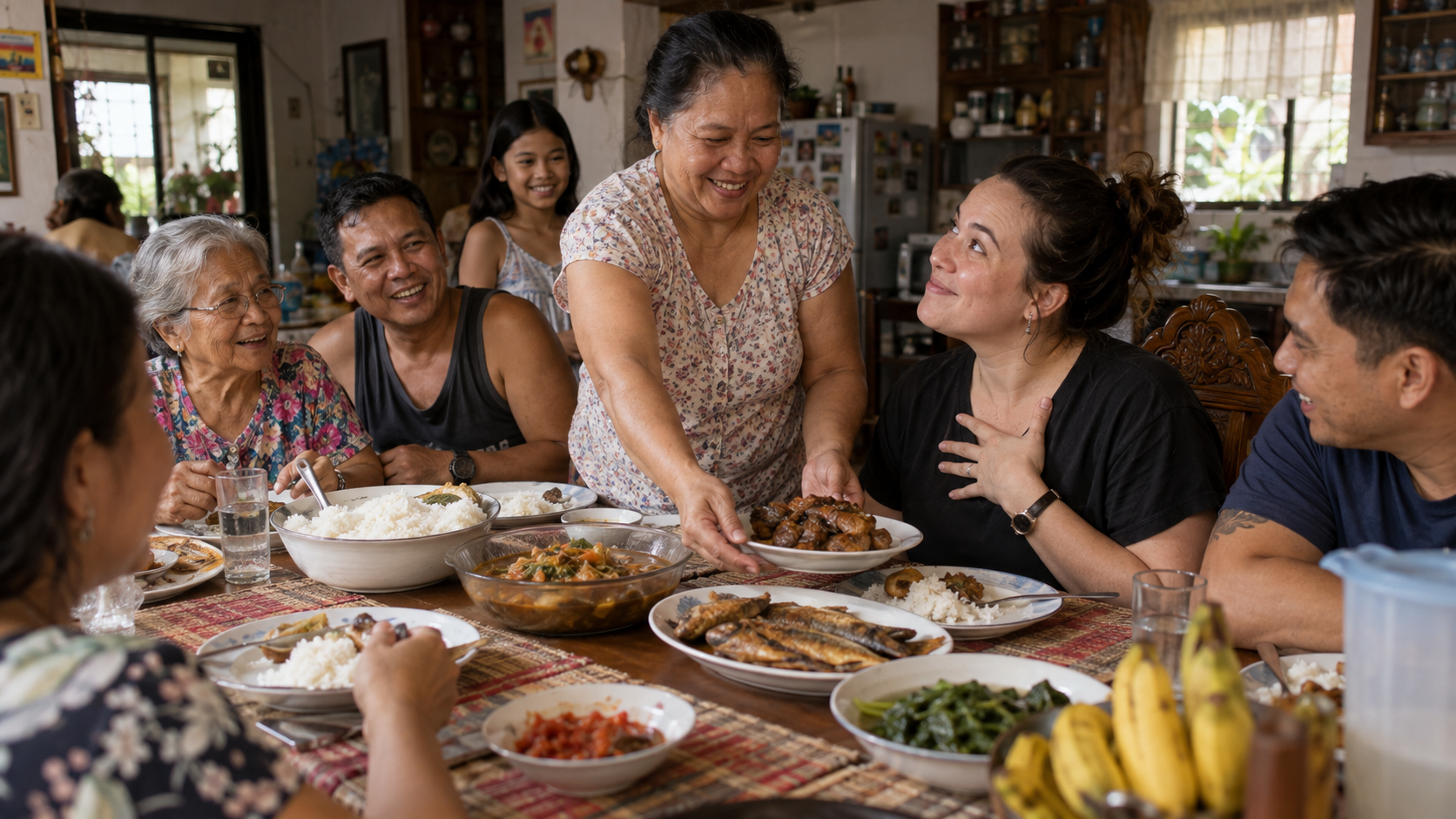
A visitor to a Filipino home may say they are not hungry and still find a plate of food in front of them a few minutes later. Someone may ask “Kumain ka na?”—“Have you eaten?”—even when the answer does not seem especially important. Another person may already be looking for coffee, fruit, or something sweet while the guest is still insisting that they do not need anything.
For someone from a culture where one polite refusal usually ends an offer, this can be confusing. Was the first offer serious? Are you supposed to keep saying no? Is accepting immediately too eager, or is refusing again ungracious?
These small moments explain Filipino hospitality better than broad claims about Filipinos being warm or friendly. Hospitality is often expressed through ordinary actions: feeding someone, making space for them, checking whether they are comfortable, including them in conversation, helping with transportation, or making sure they do not have to manage everything alone.
The Philippines is far too diverse for any single pattern to describe every family or community. Customs vary by region, generation, social setting, and household. Still, certain forms of hospitality appear often enough that first-time visitors tend to notice them quickly.
Food is often the first language of hospitality
In many Filipino homes, offering food is one of the first things that happens when a guest arrives. It does not necessarily matter whether the visit falls at mealtime. There may be fruit, bread, snacks, coffee, leftovers, or something that can be prepared without much warning.
A visitor may hear “Kain tayo,” literally “Let’s eat,” even when other people have already eaten. The phrase can do more than announce the availability of food. It can also be a way of drawing someone into the group.
The same is true of “Kumain ka na?”—“Have you eaten?” Sometimes the speaker genuinely wants to know whether a meal is needed. In other situations, the question carries a broader sense of concern. Asking about food is also a way of checking that someone has been looked after.
There is no exact English equivalent, but it helps to think about expressions whose social function extends beyond their literal wording. “How are you?” is still a question about how someone is doing, yet in everyday English it can also be a greeting. Kumain ka na? can work in a similarly layered way depending on the relationship and situation.
Once food is on the table, the offering may continue. A guest may hear “Kain pa,” meaning “Have some more,” or “Tikman mo,” meaning “Try it.” The host may point out a dish the visitor has not sampled or add another serving after the guest thought the meal was finished.
This can feel excessive to someone who is used to a first refusal being taken literally. From the host's side, though, one offer may not always feel sufficient. Repeating it can reassure the guest that the food is genuinely theirs to take and that they are not imposing by accepting.
A guest may also refuse once out of politeness and accept later. There is no need for visitors to turn this into an etiquette puzzle or pretend to want something they do not. If you are full, a warm and clear refusal is perfectly reasonable. It simply helps to know that the second offer may be part of the welcome rather than evidence that your first answer was ignored.
The guest's comfort can become a group concern
Food is only one part of what visitors notice. Practical details can attract just as much attention.
If the guest looks hot, someone may turn on a fan. If the chair seems uncomfortable, another seat appears. If the visitor asks how to get somewhere, the answer may turn into an offer to accompany them rather than a set of directions. Later, someone may ask how they are getting home or tell them to message when they arrive.
A guest may also be served first, given the better portion of a dish, or offered a more comfortable place to sleep than the host would normally use. None of this necessarily happens ceremonially. Often it is done casually, as though there were nothing remarkable about it.
Visitors sometimes find this uncomfortable precisely because they can see that the host is making an effort. Someone from a culture that places a high value on not inconveniencing others may think, “Please don't do all of this for me,” while the host may feel that leaving a guest to struggle would be the greater discomfort.
Hospitality can also spread beyond the person who issued the invitation. One relative introduces another, a cousin joins the conversation, a neighbor stops by, and before long several people are giving advice about where to go, what to eat, or how to get there.
This is one reason people often describe being “treated like family” in the Philippines, though the phrase can become meaningless if it is left unexplained. In practice, it may mean being included in meals, introduced to relatives, invited to another gathering, checked on afterward, or drawn into plans that originally sounded much smaller.
It can also mean being asked a surprising number of questions.
Where are you staying? How long will you be here? Are you married? Do you have children? What do you do for work? Have you eaten?
For some visitors, especially those from cultures with stronger boundaries around personal information, the conversation can suddenly feel much more intimate than expected.
Privacy and friendliness are not defined in exactly the same way everywhere
Questions about age, relationships, family, work, or children may feel intrusive to an American or Northern European visitor, particularly when they come from someone recently met. In many Filipino settings, the same questions can simply be part of getting to know where someone fits socially.
That does not make every question appropriate in every conversation, and people in the Philippines differ as much as people anywhere else in how private or direct they are. What matters is that the line between “friendly” and “personal” is not drawn in exactly the same place in every culture.
Seen in that light, “Kumain ka na?” is a particularly useful example. The literal question concerns food, but in context it may also carry the sense of “Are you okay?” or “Has someone taken care of you?”
For people learning Tagalog, this is a reminder that understanding vocabulary is only part of understanding a language. A phrase can be grammatically simple and still make much more sense once you understand what it is doing socially.
Pakikisama, inclusion, and being part of the group
One Filipino concept that can help make sense of these interactions is pakikisama. It is sometimes translated so narrowly that it sounds like conformity, but in everyday social life it can involve maintaining good relationships, participating in a group, and making an effort to get along with others.
It does not explain every act of hospitality, but it sheds light on the importance of inclusion. Leaving a guest sitting alone while everyone else eats may feel awkward. Allowing someone to struggle with a practical problem when help is readily available can feel equally strange.
The social unit is not always the individual. The question may be less “What does this person independently want?” and more “How are all of us doing together in this situation?”
That difference can show up in plans as well. A quick meal can become a longer gathering, more people may be invited, and an evening that seemed straightforward may gradually expand. For some visitors, this spontaneity and openness are part of what makes time in the Philippines memorable. Others may find it tiring, especially if they prefer fixed plans or need more time alone.
The same applies to hiya, another term that often appears in discussions of Filipino social life. Translating it simply as “shame” misses much of its range. Depending on context, it can involve embarrassment, propriety, social sensitivity, or discomfort at putting oneself or someone else in an awkward position.
A guest may hesitate to take the last piece of food. A host may feel uneasy if a visitor appears neglected. Someone may avoid asking directly for something because they do not want to impose. These examples are useful not because they reveal a hidden rule behind every interaction, but because they show how concern for social comfort can shape seemingly small decisions.
Generosity is relational
Filipino hospitality is sometimes described as though the host gives and the guest simply receives. Actual relationships are less one-sided.
A visitor does not need to calculate the cost of every meal or immediately repay each favor. Reciprocity tends to appear more naturally: bringing dessert when visiting, offering to contribute, returning an invitation later, remembering a person who helped, or bringing something small back from a trip.
Often the most important response is simply to notice the effort. If someone has rearranged plans, prepared food, picked you up, or gone out of their way to make the visit easier, sincere thanks carries real weight.
Seen this way, generosity is not best understood as a national trait detached from social life. It is one of the ways relationships are created and maintained.
That also explains why being included can gradually change the visitor's role. Someone who has eaten with a family several times, met relatives, and been helped with practical problems is no longer interacting as a completely anonymous guest. The relationship itself has become part of the hospitality.
When hospitality feels like too much
Not every visitor experiences intense hospitality in the same way. One traveler may love arriving at a house and immediately being offered several dishes, while another finds it difficult to refuse without feeling guilty. Meeting cousins, grandparents, neighbors, and family friends in one afternoon can feel wonderfully welcoming or socially exhausting.
Being helped can create similar mixed feelings. If someone insists on driving a guest across town, paying for a meal, or giving up a room, the visitor may worry that they are creating trouble rather than receiving kindness.
Much of this comes down to different ideas about independence. In some cultures, respecting a guest means giving them space, avoiding pressure, and allowing them to handle things themselves. In another setting, leaving someone to manage alone may feel less considerate.
Visitors do not need to abandon their own boundaries to understand the difference. It is perfectly possible to appreciate the gesture while saying, “Thank you, but I really am full,” or “That's very kind, but I can get there on my own.” Cultural awareness is most useful when it makes these moments easier to interpret rather than turning them into obligations.
A family home and a hotel are different kinds of hospitality
Travelers may also encounter unusually attentive service in hotels, resorts, restaurants, and other parts of the Philippine tourism industry. That experience should not automatically be treated as the same thing as being welcomed into a family or social circle.
A hotel employee helping a guest and an aunt sending someone home with food belong to very different relationships. Professional hospitality is shaped by work, training, and expectations in the service industry, while personal hospitality creates obligations and connections of a different kind.
Even so, travelers sometimes notice familiar patterns across both settings: concern for comfort, easy conversation, and a willingness to offer practical help rather than simply provide information.
The distinction matters because the deeper social meaning of hospitality usually becomes clearest outside the commercial setting, when nobody is being paid to make the guest feel welcome.
How to respond without overthinking it
There is no complicated script for being a good guest. If food is offered and you want it, accept it. If you genuinely do not want more, say so warmly and clearly. A small contribution such as fruit or dessert is often appreciated when visiting a home, but there is no need to turn every invitation into an exchange of equal value.
It also helps to remain somewhat flexible. An invitation may become more social than expected, and the people present may not be exactly the people you thought you were meeting. If someone makes a real effort on your behalf, show that you noticed.
For learners of Tagalog, everyday situations like these are one reason culture matters alongside vocabulary and grammar. In a Tagalog class, phrases such as Kain tayo and Kumain ka na? become more useful when students understand not only what they mean literally, but how they are actually used between people.
A visitor who says they are not hungry may still find food appearing in front of them, and the offer may come more than once. After spending more time around Filipino families and communities, that interaction often becomes easier to read. The second offer is not always about whether you need another serving; sometimes it is simply part of making sure that, while you are there, you feel looked after.
For learners who want to understand these everyday interactions more deeply, Polyglottist Language Academy offers Tagalog classes for adults, where students can build speaking and listening skills while also learning how common expressions are actually used in Filipino social life.