
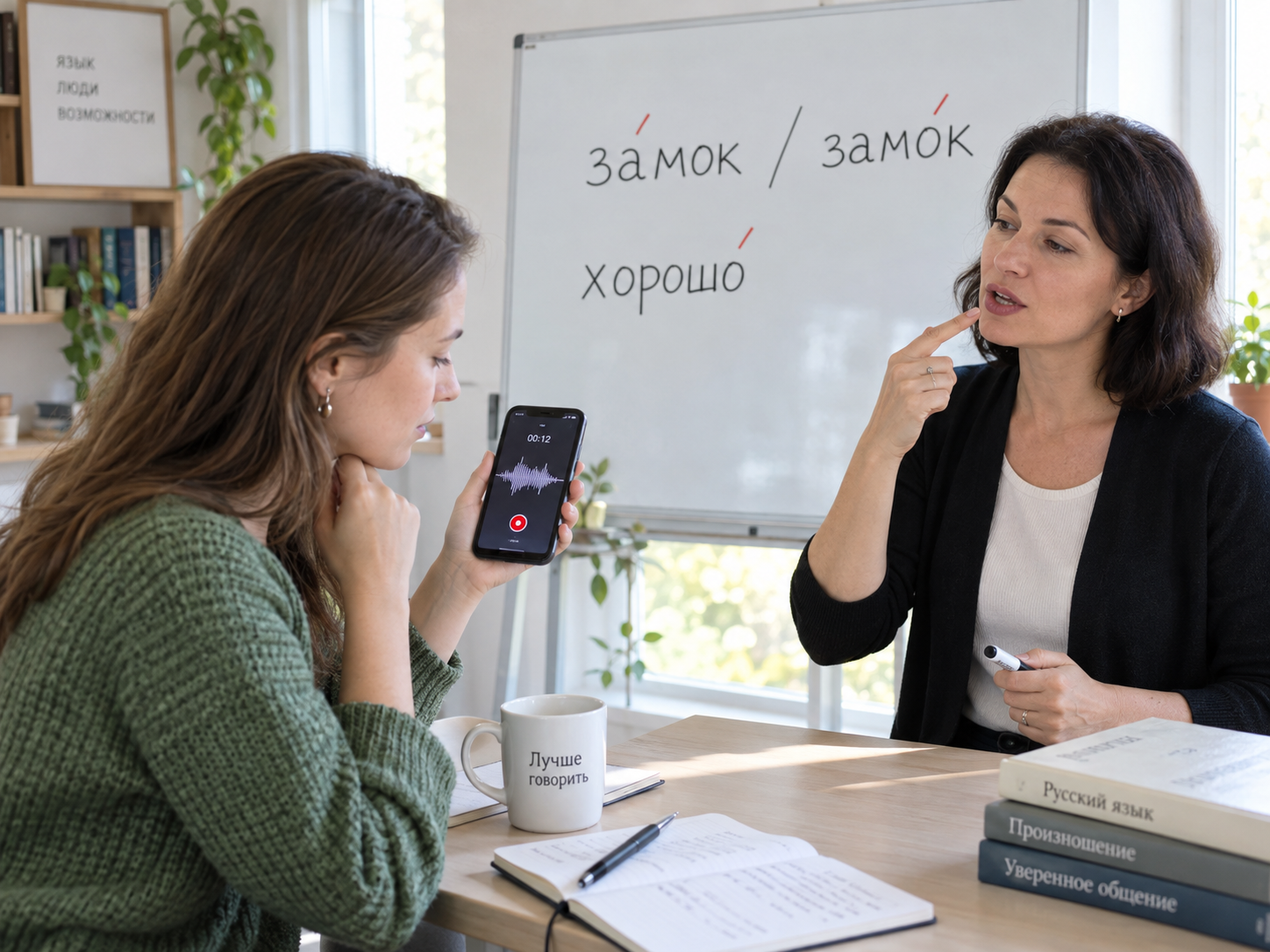
A beginner can pronounce every consonant in a Russian word correctly and still sound difficult to understand because the stress is wrong.
That surprises English speakers. We are used to stress being important, but Russian makes it especially visible because stress changes how vowels sound. Put the stress on the wrong syllable and you may not merely sound foreign; you may make a familiar word temporarily unrecognizable.
The frustrating news is that there is no single rule that tells you where Russian stress always goes.
The useful news is that you can stop guessing.
Russian stress is not fixed
In some languages, stress is predictably tied to a particular syllable. Russian is not one of them.
Stress can fall on different syllables in different words:
ма́ма — mother
рабо́та — work
молоко́ — milk
It can also move when the word changes form.
го́род — city
города́ — cities / of the city, depending on context and form
Or:
рука́ — hand
ру́ки — hands / of the hand
That movement is one reason memorizing a noun's base form is not always enough. Advanced accuracy requires learning how stress behaves in common forms too.
Stress changes the vowels you actually hear
The most famous example is Russian о.
When о is stressed, it sounds like a clear [o]. When it is unstressed, especially before the stressed syllable, it often moves toward an [a]-like sound in standard pronunciation.
That is why хорошо́ does not sound like a careful sequence of three English-style o vowels. A learner who pronounces every written о with the same full sound will sound unusually deliberate and may struggle to recognize the word when a native speaker says it naturally.
The letter е also changes in unstressed positions, and Russian vowel reduction more broadly means that spelling and sound are not one-to-one.
This is why stress belongs to pronunciation, not merely vocabulary trivia.
Stress can distinguish words
Sometimes the same sequence of letters represents different words depending on stress.
му́ка — torment
мука́ — flour
за́мок — castle
замо́к — lock
Context usually prevents disaster, but these pairs make the larger point clearly: stress is part of the word.
If your vocabulary notes contain only the letters, they are incomplete.
Ё gives you a clue — when it is actually written
The letter ё is always stressed.
So:
всё — everything
ребёнок — child
идёт — goes / is going
The problem is that Russian texts often print е instead of ё unless the distinction is needed for clarity, children, learners, dictionaries, or special cases. A word may therefore appear without the visual clue a learner would prefer.
This is one reason dictionaries and learner materials are so useful at the beginning.
Why “just listen more” is not enough
Listening matters enormously, but adults are good at hearing what they expect to hear. If you learned a word with the wrong stress, you can listen to it many times and unconsciously reinterpret the native pronunciation through your existing version.
It helps to make stress visible while you are learning.
Write stress marks:
маши́на — car
учи́тель — teacher
интере́сный — interesting
понима́ть — to understand
You do not need to mark stress forever. You need to mark it long enough for the correct rhythm to become attached to the word.
A better vocabulary habit
When you learn a new Russian word, learn four things together when relevant:
meaning, pronunciation, stress, and an example form or phrase.
Instead of storing:
работать = to work
store:
рабо́тать — to work
Я рабо́таю дома. — I work at home.
Now the stress is tied to an actual spoken sentence.
For nouns with mobile stress, add an important plural or case form when it is likely to surprise you.
Do not invent stress from spelling
English speakers naturally try to create rules from visual patterns: "Words ending in this must be stressed here" or "longer words probably stress the second-to-last syllable."
Those guesses work often enough to become dangerous. You gain confidence without gaining accuracy.
When you do not know the stress, check it. A learner dictionary, a reputable pronunciation source, or audio from a native speaker is faster than unlearning the wrong version later.
Shadowing helps because stress lives in rhythm
One useful practice is to repeat a short phrase immediately after a native recording, copying the rhythm rather than focusing on individual letters.
For example, take a sentence of five or six words and notice which syllables carry the weight. Record yourself. Compare. Repeat.
This trains something that a written stress mark cannot: how stressed and unstressed syllables behave together in connected speech.
Which stress mistakes matter most?
A tiny difference in emphasis does not ruin every sentence. Communication is resilient.
The bigger problems occur when the incorrect stress combines with unreduced vowels and unfamiliar consonants. Then the entire word acquires a shape native speakers do not expect.
Teachers often correct stress early for exactly that reason. If a learner practices a word incorrectly fifty times, the error becomes fluent.
Stop treating stress as an extra feature
Russian learners sometimes learn spelling first and pronunciation second, as though stress can be added later.
It is more efficient to treat the stressed syllable as part of the word from day one.
In a structured Russian class, this means writing stress marks in new vocabulary, hearing the word before using it, repeating it in phrases, and receiving correction before the wrong version becomes automatic.
There is no magic stress rule to memorize. The strategy is simpler: learn the stress with the word, check unfamiliar forms, and pay attention to how unstressed vowels change. Once you do that consistently, Russian stops feeling like a language in which every word is a stress gamble.