
What Is a Tea Ceremony? Japan's Most Iconic Ritual Explained
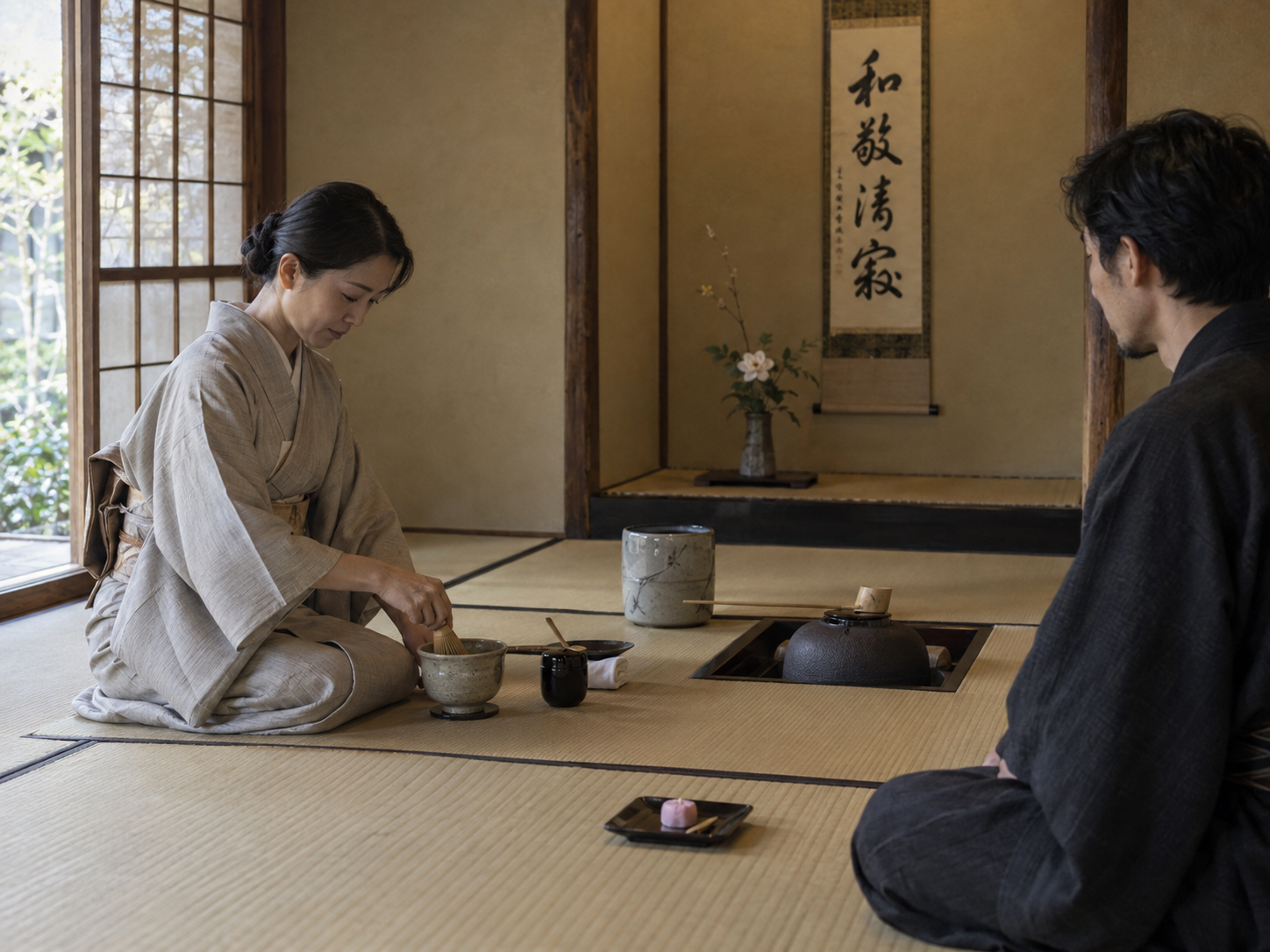
The first surprise about the Japanese tea ceremony is how little tea there seems to be.
A guest may spend several minutes watching a host wipe a bamboo scoop, rinse a bowl, fold a silk cloth, position a whisk, lift a ladle, and replace each object exactly where it belongs.
Eventually, perhaps, someone drinks a few mouthfuls of matcha.
If the purpose were simply to make tea, this would be spectacularly inefficient.
But that is precisely the point.
What English usually calls the Japanese tea ceremony is not really a complicated method for preparing a beverage. It is a carefully constructed encounter between host and guest in which architecture, ceramics, food, flowers, calligraphy, movement, season, conversation, and tea are brought together for one particular occasion.
The Japanese terms are more revealing.
茶の湯 — chanoyu — literally “hot water for tea”
茶道 — chadō or sadō — “the way of tea”
Urasenke, one of Japan's major tea traditions, describes chadō not merely as tea preparation but as an aesthetic and spiritual discipline centered on host and guest sharing a meaningful moment over a bowl of matcha.
So when tourists spend 45 minutes in Kyoto learning to whisk matcha, they are encountering one accessible corner of something people can spend decades studying.
The tea is simple.
Everything around it is not.
“Tea ceremony” is a useful translation—and slightly misleading
The English word ceremony makes the activity sound like a performance.
There are certainly procedures.
Movements are learned carefully. Objects are handled in prescribed ways. Guests have etiquette to follow. Different schools have their own forms and details.
But describing chanoyu as a ceremony can create the impression that the host is performing a symbolic ritual while guests watch.
That misses the relationship at its center.
The guest is not an audience member.
The guest completes the occasion.
The host chooses the utensils, prepares the room, considers the season, arranges the flowers, selects the sweet, heats the water, and makes the tea with the guests specifically in mind.
The guests, in turn, notice.
They notice the bowl.
They look at the hanging scroll.
They appreciate the flowers.
They respond to the host.
They drink the tea in a particular way partly because receiving something thoughtfully is itself part of the exchange.
The Metropolitan Museum of Art describes chanoyu as a ritualized practice centered on the relationship among host, guests, and tea utensils, with the objects selected specifically for a gathering that will never occur in exactly the same form again.
That last idea is essential.
Not every Japanese tea ceremony is the same thing
A visitor books a “tea ceremony” online.
A Japanese tea practitioner says they are attending a chaji.
Those may be radically different events.
One useful distinction is:
茶会 — chakai — tea gathering
and:
茶事 — chaji — a full formal tea gathering
JNTO describes chakai as a less formal gathering and chaji as the formal form. A complete tea gathering can last several hours, while tourist experiences are commonly abbreviated so visitors can encounter the essential elements without devoting half a day to them.
A full chaji is an elaborate exercise in hospitality.
In the Urasenke tradition, a formal gathering is divided into an earlier and later portion. Depending on season, the first part includes charcoal preparation and a kaiseki meal; later come 濃茶 (koicha), thick tea, another charcoal procedure, and 薄茶 (usucha), thin tea.
That is considerably more than “whisk matcha and drink it.”
A 30- or 60-minute tea experience in Kyoto can still be meaningful.
It simply should not be confused with the full scale of the tradition.
Tea came from China; chanoyu became distinctly Japanese
Tea itself is not indigenous to Japan.
Tea drinking arrived from China centuries before anything resembling the modern tea ceremony developed. Urasenke traces tea culture in Japan to monks and travelers returning from Tang China, with tea initially consumed among limited aristocratic and religious circles. Later, during the Kamakura period, the Zen monk Eisai helped introduce the powdered-tea practices associated with Song China.
Over time, tea became entangled with elite social life.
Medieval gatherings could involve expensive imported Chinese ceramics and elaborate displays of prestigious objects.
Then something interesting happened.
Rather than continually pursuing greater luxury, influential tea practitioners began finding value in objects that appeared simpler, rougher, quieter, or less conventionally perfect.
By the sixteenth century, figures including Sen no Rikyū (1522–1591) had helped transform tea culture profoundly.
The Met notes that Rikyū and other tea masters elevated rustic Japanese and Korean ceramics alongside prestigious Chinese objects, developing an aesthetic in which austerity, apparent simplicity, and irregularity could become sources of beauty.
Rikyū did not invent Japanese tea ceremony from nothing.
But his influence became so great that almost any serious history of chanoyu eventually arrives at his name.
Sen no Rikyū made simplicity extraordinarily complicated
There is a pleasing contradiction at the center of Rikyū's legacy.
Tea became simpler.
And much harder.
Urasenke describes Rikyū as the figure who perfected a form of chanoyu based around the wabi aesthetic and elevated tea into a dō—a “way” or lifelong discipline. He favored very small, rustic tea rooms and incorporated bamboo, Raku ceramics, and even ordinary objects into settings that had previously prized far grander possessions.
The result can look effortless.
A plain clay bowl.
One flower.
A bamboo scoop.
A small room.
A kettle of water.
But producing an atmosphere that feels natural rather than theatrically minimalist demands extraordinary attention.
There is no clutter to hide behind.
If one flower is present, that flower matters.
If the bowl is rough and irregular, its texture matters.
If the only sound for a moment is water boiling in the kettle, that sound matters.
Simplicity does not mean that no choices were made.
It often means every choice becomes visible.
Wabi is not simply “imperfection is beautiful”
Like wabi-sabi, wabi has become slightly overworked in English-language lifestyle writing.
A chipped coffee mug appears online and is immediately declared Japanese philosophy.
Tea aesthetics are subtler than that.
Historically, wabi came to value restraint, humility, rusticity, simplicity, and forms of beauty that did not depend on obvious luxury or perfect polish.
But a broken object is not automatically profound.
Nor does chanoyu reject craftsmanship. Quite the opposite: tea utensils can be masterpieces created by highly accomplished ceramicists, lacquer artists, bamboo craftsmen, metalworkers, and textile makers.
What changes is the standard by which beauty is judged.
A slightly asymmetric tea bowl may invite the hands differently from a perfectly industrial one.
A bamboo flower container can be valued beside an elaborate imported ceramic.
The point is not “ugly things are secretly beautiful.”
It is that refinement does not require ostentation.
A tea room is deliberately small
Traditional tea often takes place in a 茶室 (chashitsu), a dedicated tea room.
Many are small enough that the relationship among the people and objects becomes unusually intimate.
The Met describes the traditional tea room as modeled partly on the simplicity of a hermit's hut and often sized for only a handful of people.
A traditional tea environment may also include a 露地 (roji), the garden path through which guests approach.
Before entering, guests may wash their hands and rinse their mouths at a 蹲踞 (tsukubai) stone basin, symbolically leaving some of the outside world behind. JNTO describes this purification as part of the conventional approach to a formal tea room.
Inside, the room is restrained.
The 床の間 (tokonoma) alcove might contain a calligraphic scroll and a seasonal flower arrangement.
Those are not generic decorations left there all year.
They are part of that day's gathering.
The host may spend far longer preparing than the guest spends drinking
This is one of the most important things to understand about tea ceremony.
The visible preparation is only the final stage.
Long before anyone arrives, the host has been thinking.
Which bowl suits this guest?
What sweet suits the season?
Which scroll belongs in the alcove?
Which flowers are available?
What will the weather be?
What utensils should appear together?
How should the room feel in midsummer compared with January?
Urasenke's own description of chadō emphasizes precisely this sensitivity to season, occasion, time, place, and guest. The goal is not simply a technically correct bowl of tea but a setting suited to this particular moment.
This explains why tea practitioners can continue studying for decades.
Learning how to whisk matcha is not the difficult part.
The utensils are functional objects—and also part of the conversation
A basic tea setup introduces a useful collection of Japanese words.
茶碗 — chawan — tea bowl
茶筅 — chasen — bamboo whisk
茶杓 — chashaku — bamboo tea scoop
釜 — kama — iron kettle
柄杓 — hishaku — bamboo ladle
Tea containers vary according to the type of tea and procedure.
To an inexperienced visitor, these may initially look like props.
They are not.
The tea bowl in particular can become a focus of careful appreciation. Bowls have fronts, textures, glazes, histories, names, makers, seasonal associations, and very different characters.
The Met emphasizes that tea ceramics simultaneously function as practical tools and as works of art. The host's ability to choose and combine objects appropriately is itself an important part of tea culture.
There is something rather refreshing about an art form in which one of the masterpieces eventually has tea whisked inside it.
Why does the host clean utensils that are already clean?
First-time visitors sometimes find this confusing.
The host wipes the tea container.
The scoop is purified.
The bowl is handled carefully.
Surely everything was cleaned before the guests arrived?
Of course it was.
The actions performed in front of the guests are not a substitute for kitchen hygiene.
They are part of 点前 (temae)—the prescribed procedure of preparing tea.
The movements establish order.
They allow the host and guest to move gradually into the rhythm of the gathering.
And because everyone knows the objects are already clean, the visible purification can be appreciated as an act of attentiveness rather than frantic washing.
Tea slows ordinary actions down enough that they become noticeable.
Thick tea is not the matcha latte without milk
Many introductory tea experiences serve 薄茶 (usucha), thin matcha.
This is the bright green tea most newcomers recognize: matcha whisked with hot water until lightly frothy.
A formal gathering may also feature 濃茶 (koicha), thick tea.
Koicha uses considerably more matcha relative to water and is prepared to a much denser consistency. It is not simply “stronger usucha.” Its preparation and service occupy a particularly important position in formal tea. Urasenke treats the procedures for usucha and koicha as distinct areas of study.
The flavor can surprise someone accustomed to café matcha.
There is no vanilla syrup.
No oat milk.
No strawberry cold foam.
Just concentrated tea.
Why is a sweet served before the matcha?
A Japanese sweet—和菓子 (wagashi)—is commonly eaten before the tea.
This is not simply dessert accompanying a drink.
The sequence matters.
The sweetness prepares the palate for matcha's bitterness. JNTO notes that tea sweets are typically eaten before the tea rather than simultaneously with it, creating a deliberate contrast between sweet and bitter.
The sweet may also express the season.
Spring can suggest flowers.
Summer may evoke water or coolness.
Autumn brings leaves, chestnuts, or grasses.
Winter has its own visual vocabulary.
This is one reason traditional Japanese confectionery can look so precise. It is not merely trying to be pretty.
It is locating the gathering in time.
Why do guests turn the tea bowl?
This is probably the piece of tea etiquette most tourists encounter.
The tea bowl has a front—the side the host has chosen to present toward the guest.
Rather than immediately putting that most important face to the lips, the guest turns the bowl slightly before drinking. JNTO describes this as a gesture of respect toward the bowl and host. After drinking, the bowl can be returned to its original orientation and appreciated.
The precise movements differ among tea schools and situations.
This is worth emphasizing.
There is no need to arrive at a tourist tea experience terrified that rotating the bowl 72 degrees instead of 90 will create an international incident.
Watch.
Follow the host's guidance.
Ask if uncertain.
A good tea host would generally prefer an interested guest to a perfectly choreographed but terrified one.
The four famous principles: harmony, respect, purity, tranquility
Tea is often summarized through four characters associated with Rikyū's tradition:
和 — wa — harmony
敬 — kei — respect
清 — sei — purity
寂 — jaku — tranquility
Urasenke identifies these as foundational principles underlying the Way of Tea.
They sound abstract until one sees how practical they become.
Respect means the host considers the guest—and the guest considers the host.
Purity appears in the room, utensils, garden, and movements.
Harmony involves people, objects, season, architecture, and occasion fitting together.
Tranquility is not something purchased by lighting an expensive incense candle.
It is what may emerge when everything else is handled well.
The philosophy is embedded in actions.
And then there is ichigo ichie
Another expression closely associated with tea culture is:
一期一会 — ichigo ichie
It is often translated as “once in a lifetime.”
That translation can sound much more dramatic than the idea needs to be.
The point is not necessarily that the people in the tea room will never see one another again.
They may meet next week.
But this gathering cannot be repeated.
Not these flowers.
Not this weather.
Not these exact people in these moods.
Not this conversation.
Not this bowl in this light at this moment.
Urasenke describes the host and guest as recognizing that the time they share cannot be reproduced and should therefore be approached as a unique occasion.
For a tradition famous for rigid procedures, this is an interesting paradox.
The structure is repeated precisely so that the individual moment can become more noticeable.
Tea ceremony is influenced by Zen—but it is not simply a Zen ritual
Another oversimplification deserves correcting.
Zen Buddhism profoundly influenced the development of chanoyu. Tea was used in monastic settings, important tea figures interacted with Zen institutions, and aesthetics associated with restraint and simplicity developed partly within that intellectual world.
But a modern tea gathering is not simply a Buddhist worship service.
The Met describes chanoyu as a ritualized secular practice.
People study tea for many reasons.
Aesthetics.
History.
Ceramics.
Hospitality.
Discipline.
Social connection.
Seasonality.
Personal refinement.
Or because they enjoy tea.
Reducing the whole practice to “Zen in a cup” sounds profound while explaining rather little.
There is more than one school of tea
Another thing a visitor discovers eventually: there is no single universal tea-ceremony rulebook.
Several tea traditions developed historically, with their own procedures and emphases.
Among the best known are the three Sen-family traditions commonly called San-Senke:
表千家 — Omotesenke
裏千家 — Urasenke
武者小路千家 — Mushakōjisenke
There are other schools as well.
JNTO notes that tea schools vary in details of posture, movement, preparation, and etiquette even while sharing much of the broader philosophy and structure.
This matters when someone announces online:
“In a Japanese tea ceremony, you ALWAYS do X.”
Usually, someone from another school is about to appear in the comments.
Do Japanese people regularly perform tea ceremony at home?
Generally, no.
This is an important correction to the way traditional culture is sometimes presented to foreigners.
Japanese people drink tea.
They do not all study chadō.
A household does not necessarily stop at 4 p.m. while someone performs an elaborate formal tea procedure.
Chanoyu is a specialized traditional art that people study deliberately, somewhat as people study calligraphy, classical music, flower arrangement, martial arts, or traditional dance.
It remains an active practice.
Urasenke continues to run beginner courses in Japan and maintains affiliated tea organizations internationally; its intensive Midorikai program in Kyoto requires hundreds of hours of lectures and practical training even from students who already arrive with prior tea experience.
That tells you something about the scale of the subject.
One does not “master tea ceremony” during a weekend trip to Kyoto.
One experiences an introduction.
That is enough.
What should a first-time visitor actually do?
Very little, initially.
Take off your shoes when requested.
Sit however your host instructs; many visitor-oriented experiences accommodate guests who cannot comfortably sit in 正座 (seiza) on their knees.
Watch.
Eat the sweet when directed.
Receive the bowl with care.
Follow the host's instruction about turning it.
Drink.
Look at the bowl afterward instead of immediately putting it down like a coffee mug.
And notice the room.
The scroll.
The flower.
The sound of the kettle.
The pauses.
The fact that nobody appears to be rushing.
Visitor-oriented tea experiences understand perfectly well that foreign guests have not spent five years learning tea etiquette. JNTO explicitly notes that minor mistakes are generally overlooked and that abbreviated experiences are widely offered to travelers.
Respect matters more than technical perfection.
Why does such a simple thing require years of practice?
There is a story Urasenke tells about Rikyū.
Asked to explain the Way of Tea, he supposedly gave instructions that sounded almost insultingly obvious: make satisfying tea, arrange the charcoal properly, create coolness in summer and warmth in winter, arrange flowers naturally, prepare ahead, be ready for rain, and show consideration for guests.
His listener objected that anyone could do those things.
Rikyū replied, in essence, that if the questioner could truly do all of them, Rikyū would become his student.
That story gets closer to tea ceremony than a list of rules does.
None of the individual actions is supernatural.
Heat water.
Choose a bowl.
Put out a flower.
Serve somebody.
Pay attention.
The difficulty lies in doing ordinary things with enough sensitivity that the person receiving them can feel the care without being overwhelmed by the effort.
That is much harder.
The ritual exists to make an ordinary moment harder to ignore
There is a temptation, especially when encountering traditional Japanese arts from outside Japan, to make them mysterious.
Every gesture must contain a secret philosophy.
Every crack in a bowl represents impermanence.
Every pause is Zen.
Chanoyu does not need that treatment.
Its sophistication is already there.
A host prepares for a guest.
A room changes with the season.
Objects are chosen rather than accumulated randomly.
A sweet is eaten before bitter tea.
A beautiful bowl is used instead of merely displayed.
People sit together.
For a while, everyone pays unusually close attention to something as ordinary as drinking tea.
That may be why the form survives.
At Polyglottist Language Academy, cultural concepts like chanoyu, chadō, ichigo ichie, and wabi are good reminders that translation gives learners only the first layer of a word. Polyglottist offers live Japanese classes for adults online and selected in-person classes in Berkeley, California, with an emphasis on practical communication and understanding the cultural settings in which Japanese is actually used.
Knowing that 茶道 means “the way of tea” is easy.
Understanding why someone could spend an entire lifetime studying how to make one bowl well is more interesting.
And after watching a skilled host do it, the elaborate procedure begins to look less like unnecessary complication.
For a few minutes, someone made a bowl of tea seem worth paying attention to.
That was the ceremony.
Frequently Asked Questions
What is a Japanese tea ceremony?
The Japanese tea ceremony, commonly called chanoyu or chadō, is a traditional practice centered on preparing and receiving matcha within a carefully arranged setting. It combines hospitality, etiquette, ceramics, architecture, food, flowers, calligraphy, and seasonal awareness.
What is the difference between chanoyu and chadō?
Chanoyu (茶の湯) literally means “hot water for tea” and commonly refers to the practice itself. Chadō (茶道) means “the way of tea” and emphasizes tea as a discipline or lifelong path. In ordinary English discussions, both may be called the Japanese tea ceremony.
How long does a Japanese tea ceremony last?
A full formal chaji can last several hours and may include a meal, charcoal procedures, thick tea, and thin tea. Tourist-oriented tea experiences are usually much shorter and show selected elements of the tradition.
What kind of tea is used?
Matcha, powdered Japanese green tea, is central to chanoyu. Usucha is relatively thin matcha, while koicha is prepared much more thickly and is particularly important in formal tea gatherings.
Why do you turn the bowl before drinking?
The bowl is traditionally presented with its front facing the guest. Turning it slightly avoids drinking directly from that most honored face and expresses respect for the object and host. Precise procedures vary among tea schools.
Do all Japanese people know tea ceremony etiquette?
No. Chadō is a specialized traditional art that people study. Many Japanese people have little or no formal tea training, just as speaking English does not mean someone knows formal British afternoon-tea etiquette.
Who was Sen no Rikyū?
Sen no Rikyū (1522–1591) was the most influential figure in the development of the Japanese Way of Tea. He helped establish a tea aesthetic emphasizing restraint, rusticity, thoughtful hospitality, and the use of simple spaces and objects.