
Filipino Christmas Traditions: Why the Holiday Season Starts So Early
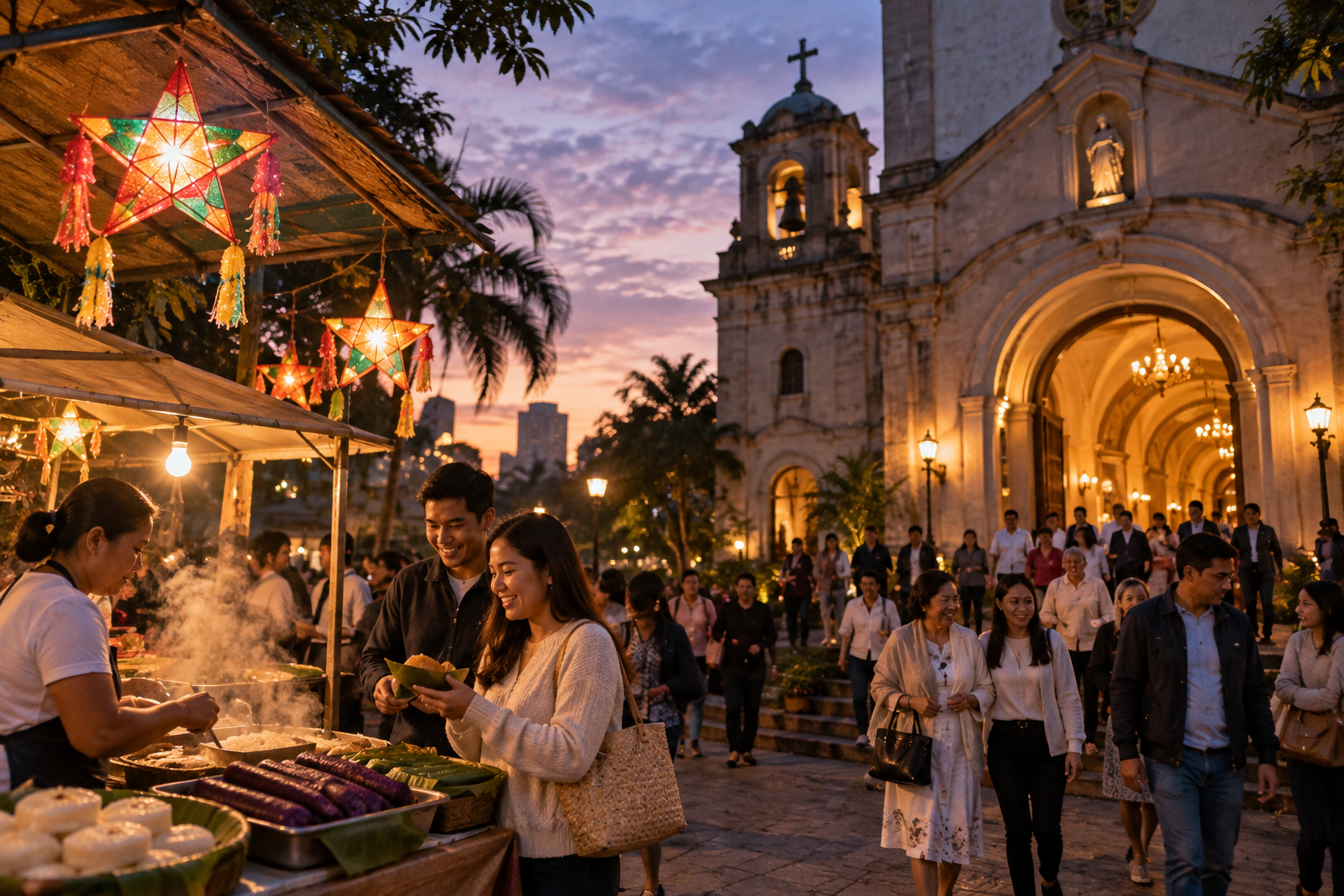
On September 1, a familiar joke begins circulating in the Philippines: Christmas has started.
The weather may still be hot. The Catholic liturgical calendar is nowhere near Christmas. Families are not necessarily sitting down to Noche Buena. Yet radio playlists begin changing, stores put up decorations, social media fills with Christmas references, and singer Jose Mari Chan reappears so reliably in memes that he has become a kind of unofficial signal that the “ber months” have arrived.
To outsiders, this can look like one extremely long holiday. In practice, Filipino Christmas unfolds in layers. September is not December. Public anticipation, religious observance, family celebration, and post-Christmas visiting each have their own rhythm.
Understanding those layers explains why the season feels so long without reducing it to “Filipinos just love Christmas more.”
The “ber months” are cultural shorthand, not a church rule
September, October, November, and December are commonly grouped as the ber months. The phrase has become part of popular Filipino Christmas culture because September marks the point when public anticipation becomes difficult to miss.
Businesses begin decorating. Holiday songs return. Television and advertising shift tone. Families start discussing travel, gifts, and reunions. For overseas Filipino workers and relatives living abroad, long-distance planning may begin well before December because flights, leave from work, and family schedules are complicated.
None of this means Christmas is formally celebrated for four months in the Catholic calendar. The long public season is a modern cultural pattern built around older religious traditions, family life, commerce, media, and the logistics of gathering extended families.
It also varies. Some households decorate early; others wait. Some are deeply religious; others treat Christmas primarily as family time. Muslim, Protestant, Iglesia ni Cristo, secular, and other Filipino communities may observe the season differently or not at all.
The parol makes Christmas visible
One of the most recognizable Filipino Christmas objects is the parol, a star-shaped lantern associated with the Star of Bethlehem.
Traditional parol designs used bamboo and paper, while contemporary versions range from simple handmade stars to elaborate electric lanterns. In some places they appear on homes, schools, streets, offices, and shopping centers long before Christmas week.
For language learners, parol is a good example of how vocabulary can carry cultural information that a direct translation misses. Calling it simply a “Christmas lantern” is accurate, but incomplete. Its shape, materials, and place in public decoration make it specifically Filipino.
Simbang Gabi gives the final days before Christmas a religious structure
The most important religious tradition in many Catholic Filipino communities is Simbang Gabi, a series of nine Masses held from December 16 through December 24.
Traditionally these are dawn Masses, also associated with the name Misa de Gallo, or “Rooster Mass.” In modern practice, some parishes also hold anticipated evening Masses to make attendance possible for people with work or school commitments.
The Cultural Center of the Philippines, for example, continues to hold a public Simbang Gabi sequence each December, including early-morning Masses leading up to Christmas Eve.
For many participants, the experience is as social as it is devotional. People arrive before sunrise, attend Mass together, and then eat breakfast foods sold nearby.
Two foods are especially associated with the season: bibingka, a rice cake traditionally cooked with heat above and below, and puto bumbong, purple rice steamed in bamboo tubes and typically served with butter or margarine, sugar, and coconut.
A learner who knows only the dictionary meaning of “rice cake” misses the point. These foods are tied to a time of day, a religious ritual, and a particular part of the calendar.
Noche Buena is about who is at the table
Christmas Eve often culminates in Noche Buena, the late-night family meal after Christmas Eve Mass or around midnight.
The menu varies enormously by household and region. Ham, queso de bola, pasta, pancit, lumpia, lechon, fruit salad, desserts, and regional specialties may all appear, but there is no universal Filipino Christmas menu.
The more consistent feature is gathering.
That helps explain why the Christmas season stretches outward in both directions. Filipino families are often geographically dispersed. Relatives may be working in another city, another island, the Middle East, North America, Europe, or elsewhere in Asia. A major family holiday becomes a scheduling project.
Christmas is therefore not only December 25. It includes the weeks of arranging who is coming home, the meals before and after, and visits to relatives who could not all fit into one evening.
Ninong, ninang, inaanak, and pamasko connect Christmas to social relationships
Gift-giving also reflects Filipino relationship vocabulary.
A ninong is a godfather; a ninang is a godmother. Their godchild is an inaanak. At Christmas, godchildren may visit godparents and receive gifts or money, often referred to in the broad idea of pamasko.
Children may greet adults with Namamasko po!, a phrase associated with asking for or playfully announcing a Christmas gift. It also appears in caroling contexts.
These relationships are not merely vocabulary items. In many Filipino families, godparents occupy an enduring social role that extends beyond the baptism or wedding ceremony in which the relationship was established.
That is why family vocabulary is so important for language learners. Social networks in Tagalog are often named more explicitly than English speakers expect.
Caroling is usually informal and communal
Filipino Christmas caroling can range from polished choir performances to groups of neighborhood children singing outside homes with improvised percussion.
The repertoire may include English songs, Tagalog songs, and regional-language Christmas music. A household may give coins or small gifts before the group moves on.
Again, there is no single national script. Urban neighborhoods, rural communities, schools, churches, and Filipino diaspora groups reproduce the tradition differently.
What remains recognizable is the social exchange: people announce the season by showing up at one another’s doors.
Christmas often continues after December 25
In many Western commercial calendars, Christmas seems to end abruptly after December 25. Decorations come down, sales begin, and normal routines return.
Filipino Christmas can feel less abrupt. Family visits continue, school and work holidays extend into the New Year period, and Catholic observance may continue through later feast days. In households where relatives have traveled long distances, nobody is in a hurry to treat December 26 as an ordinary day.
That makes the long season easier to understand. It is not one four-month party. It is a chain of anticipation, decoration, religious observance, travel, reunion, meals, gift-giving, and visiting.
Useful language appears throughout it:
Pasko — Christmas
Maligayang Pasko! — Merry Christmas!
Simbang Gabi — the series of pre-Christmas Masses
parol — star lantern
pamasko — Christmas gift / money or gift given at Christmas
ninong / ninang — godfather / godmother
inaanak — godchild
Noche Buena — Christmas Eve feast
For a language learner, these words make more sense when they are attached to practices rather than flashcards.
Filipino Christmas begins “early” because several systems reinforce one another: public culture starts building anticipation in the ber months, families need time to coordinate, businesses and media amplify the season, and religious traditions give December its own dense sequence of observances. The result is not a single custom but a long social calendar.
That is why September Christmas music can coexist with a very specific nine-day Simbang Gabi in late December. One announces that the season is coming. The other tells you that Christmas is finally close.