
Russian Classes in Denver: A Guide for Beginners and Returning Learners
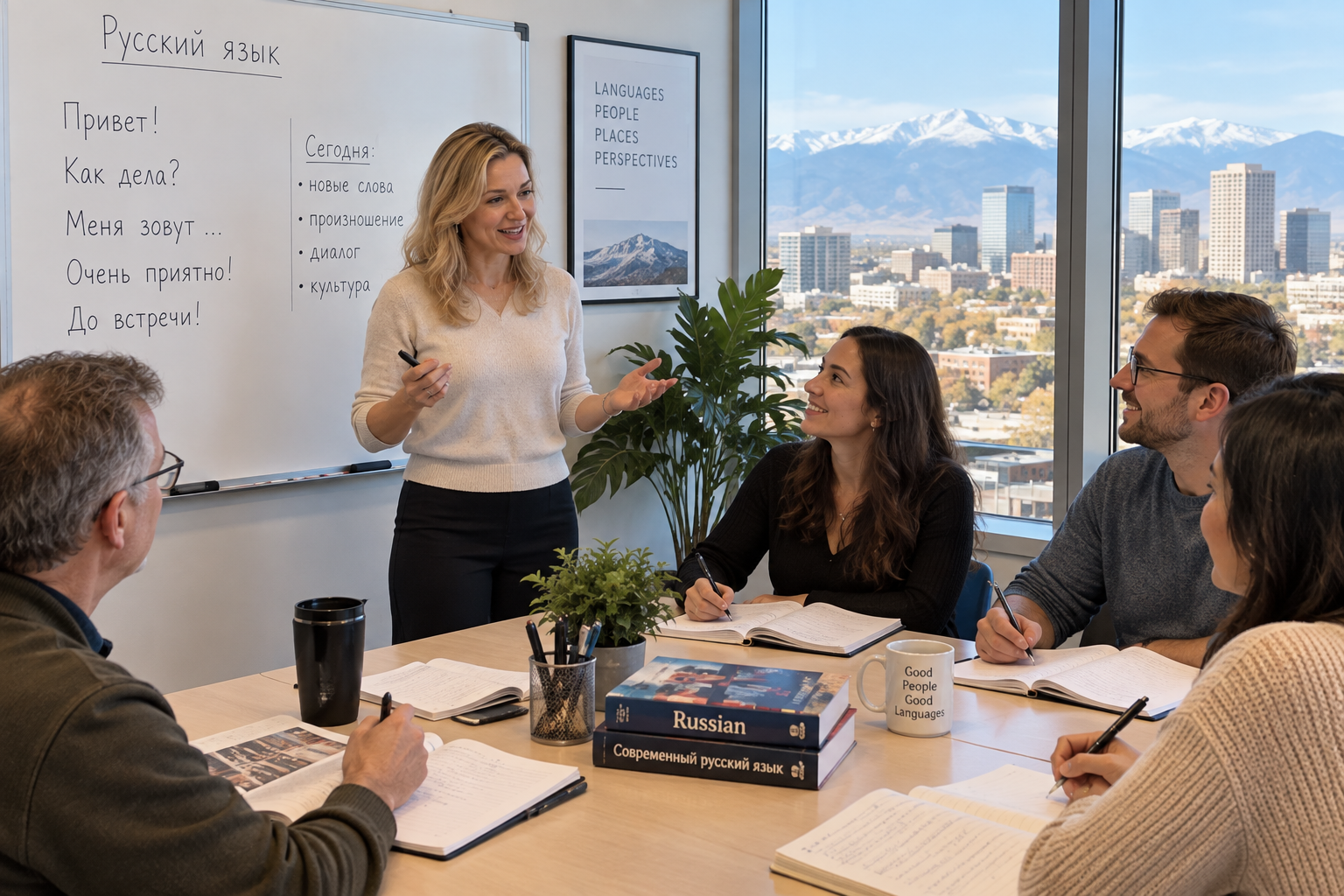
A surprising number of adults looking for Russian classes are not really beginners, even when they describe themselves that way. Someone may remember how to read Москва and Спасибо, recognize the six Russian cases when they see a grammar chart, and still freeze when asked a simple question such as Где вы живёте? (“Where do you live?”). Another learner may have spent a year on an app and accumulated hundreds of words without ever having held a five-minute conversation. A third may have studied Russian in college twenty years ago and assume that everything has disappeared, only to discover that pronunciation and basic sentence patterns return quickly.
That matters in Denver because the area has several genuinely different ways to study Russian, and the best choice depends less on whether you can call yourself “beginner” and more on what you can actually do with the language. Denver adults can choose among university-based study, non-credit courses, independent language schools, private instruction, online classes, and informal conversation practice. The options are better than many prospective students assume, but they are not interchangeable.
For a person starting from zero, the central question is usually structure: will the course give enough guidance to build pronunciation, reading, grammar, and conversation together? For a returning learner, the question is different: will the instructor recognize what you already know instead of forcing you to begin from the alphabet again?
Denver has more Russian study options than it first appears
The University of Denver maintains a substantial Russian program, including an elementary sequence beginning with RUSS 1001. Its current undergraduate catalog describes Elementary Russian as a comprehensive introduction to the language and culture, with development across listening, speaking, reading, and writing. Students who already have Russian experience are directed toward placement rather than automatically starting from the first course.
That academic program is important because it demonstrates that Russian remains an actively taught language in Denver rather than an occasional special-topic offering. For adults who are not pursuing a degree, however, the more immediately relevant University of Denver option is its Center for World Languages and Cultures. As of September 2026, the university’s continuing-education catalog lists Russian for You!, a non-credit Russian course priced at $440 with a September 14, 2026 start date. Availability changes by term, so prospective students should verify the next offering rather than assuming the same dates will repeat.
There is also a private local program, Russian Crash Course, with classes in Denver and other Colorado locations. Its current site lists adult programs from beginner through intermediate levels, generally meeting once a week for 90 minutes, and describes a sequence in which students move from an introductory conversational course into later beginner units. The program currently lists a Denver location on South Niagara Street and additional Colorado-area locations.
For people north of Denver, the same organization operates in Broomfield, which may be more practical for students coming from Westminster, Thornton, Arvada, Erie, or Boulder. Its Broomfield page describes seven-week segments and gives a Garden Center address near Highway 36. That may sound like a small logistical point, but for an adult taking an evening class after work, a difference of thirty or forty minutes of driving can determine whether a course is sustainable for eight weeks or abandoned after three.
CU Boulder also has a full Russian curriculum, from beginning Russian through advanced language, professional Russian, cultural idioms, and heritage-speaker courses. Its catalog includes both a standard first-year sequence and an intensive beginning course covering the material of two semesters. Those courses are primarily academic offerings for university students, so an adult outside the university should not assume open enrollment, but they are useful to know about if you are considering formal university study or already have an affiliation with CU.
The practical lesson is that “Russian classes in Denver” does not describe one market. There are academic sequences, continuing-education courses, independent adult programs, and online schools, and they operate on very different assumptions about pace, homework, testing, and who the student is.
If you are a true beginner, pronunciation should come before speed
Russian beginners often worry about the alphabet first. In reality, Cyrillic is one of the easier early obstacles. Most adults can learn to recognize the printed alphabet far faster than they expect, especially once they stop treating each letter as a mysterious symbol and begin associating it with actual words.
The more persistent problem is pronunciation, particularly vowel reduction and stress. Russian stress is mobile, and an unstressed о often does not sound like the clear “o” a beginner expects. The word молоко (“milk”), for example, is stressed on the final syllable, and the earlier vowels are reduced in ordinary speech. A learner who has memorized spelling without listening practice may pronounce every written vowel carefully and still sound much less natural than someone with a smaller vocabulary but better stress habits.
Teachers also notice that beginners sometimes become overly attached to transliteration. They write privet, spasibo, or khorosho beside the Russian words because it feels safer. Transliteration can help for a day or two, but it quickly becomes a crutch. Russian spelling contains information that English transliteration handles poorly, especially around softness, the letters ы, ь, ё, and the relationship between spelling and stress.
A good beginning class should therefore move learners into Cyrillic early, while also making room for listening and speaking from the first weeks. If a course spends months teaching grammar but rarely requires students to formulate their own sentences, learners can develop the peculiar experience of “knowing Russian” on paper but being unable to answer a basic conversational question.
Returning learners need placement, not assumptions
Returning learners are often harder to place than true beginners. The label “I took two years of Russian” tells an instructor surprisingly little.
One person who studied for two years may still read fluently, remember noun endings, and understand slow classroom Russian but have weak speaking skills. Another may remember almost none of the case system but have retained strong pronunciation. Someone who grew up hearing Russian from relatives may understand ordinary family conversation while having almost no formal knowledge of grammar or spelling. An app learner may know a large number of isolated words but have little control over sentence formation.
This is why a placement conversation is more useful than simply counting semesters.
A returning learner should ideally be tested in four areas: reading, listening, speaking, and grammar. The goal is not to produce a dramatic proficiency score. It is to discover where the gaps are.
Can you read a short paragraph without sounding out every word?
Can you answer Как вас зовут?, Где вы живёте?, and Что вы любите делать? without translating the question word by word?
If you see у меня есть брат, do you understand why меня appears rather than я?
Can you hear the difference between a familiar word spoken slowly by a teacher and the same word inside an ordinary sentence?
Do you remember case endings actively, or do they only look familiar when someone else supplies them?
These distinctions are especially important because Russian rewards cumulative study. A learner who once understood the accusative and genitive cases may recover them much faster than a person encountering them for the first time, but that does not mean the returning learner should immediately enter an intermediate conversation class. Sometimes the best solution is an upper-beginner course where old grammar can be reactivated while speaking catches up.
The University of Denver’s elementary program explicitly notes that students with prior Russian experience should complete placement rather than assuming that Elementary Russian I is appropriate. That is a sensible principle even outside a university.
What adults usually find difficult about Russian
The difficulty of Russian is sometimes exaggerated in ways that are not helpful. It is not true that a person must master six cases before having a conversation. It is also not true that cases are a minor detail you can simply absorb without ever studying them.
The more accurate answer is that Russian has several systems that beginners must gradually coordinate.
Cases are manageable until you have to use them quickly
A student can understand that книга becomes книгу in the accusative singular and still hesitate in conversation. The problem is not necessarily failure to understand the rule. It is retrieval speed.
Suppose someone asks:
Что ты читаешь?
“What are you reading?”
You want to say, “I’m reading a Russian book.”
The learner has to retrieve читать, conjugate it as читаю, choose the correct form of “Russian,” change книга to the accusative, and keep the sentence moving:
Я читаю русскую книгу.
That is very different from completing a worksheet in which the only task is to change книга into its accusative form.
A strong adult class therefore needs repeated production, not only explanation. Grammar becomes useful when it begins to operate quickly enough to support meaning.
Verb aspect becomes important earlier than learners expect
Russian verbs frequently come in imperfective and perfective pairs. Beginners initially meet this as a grammar category, but soon discover that aspect changes how a speaker frames an action.
Compare:
Я читал книгу.
“I was reading / I read the book” with emphasis on the process or activity.
Я прочитал книгу.
“I finished reading the book.”
The exact English translation depends on context, which is why memorizing one English equivalent per Russian verb does not solve the problem. Learners need repeated examples showing what the speaker is emphasizing.
Listening can lag behind reading
Russian is relatively phonetic once spelling conventions and stress are understood, but natural speech still compresses and reduces sounds. Beginners who can read a dialogue often struggle when the same material is spoken at normal speed.
This is one reason live classes matter. An app can replay a sentence indefinitely, but conversation requires you to recognize meaning while another person continues speaking.
Verbs of motion are a later wall
Students who make it through basic cases and verb conjugations eventually meet pairs such as идти/ходить and ехать/ездить, then prefixes such as при-, у-, в-, and вы-. The system is logical, but it encodes distinctions that English often leaves implicit.
Teachers generally do better when they introduce these verbs through situations rather than enormous charts. “I am going to the store right now,” “I go to the gym regularly,” “I arrived,” and “I left” provide a much more usable framework than memorizing twenty prefixed forms in isolation.
How the main Denver options differ
The University of Denver is the most obvious local choice for someone seeking a formal academic environment. The undergraduate Russian sequence is systematic and extends far beyond beginner study, while its current continuing-education catalog also provides a non-credit route for adults.
An independent program such as Russian Crash Course offers a different experience. Its advertised format is more explicitly conversational and adult-oriented, with shorter sessions and evening or weekend possibilities. Its current Denver program describes beginner, upper-beginner, and intermediate stages, with once-weekly 90-minute meetings.
These differences are not simply “academic versus fun.” A university course may offer more cumulative grammar, assessment, homework, and cultural material. A private adult program may be easier to combine with full-time work and may emphasize immediate speaking more heavily.
Neither format is automatically better. The correct question is what you are trying to build.
If you want a deep, multi-year academic sequence, university study may make sense.
If you want an evening course that gets you speaking and keeps a manageable weekly schedule, an adult language school may fit better.
If your work or family schedule changes constantly, an online small group or private teacher may be more realistic than crossing Denver at rush hour every week.
In-person versus online Russian in Denver
Russian benefits from live interaction, but “live” does not have to mean physically in the same room.
In-person classes have obvious advantages. You hear several classmates, pick up spontaneous comments, and are less tempted to turn off mentally when an exercise becomes difficult. A good classroom also makes pronunciation correction easier because the teacher can monitor everyone’s speech without the small delays of videoconferencing.
The downside is logistical. A 90-minute evening class can become a three-hour commitment once commuting, parking, and waiting are included. Denver-area geography matters here. Someone in central Denver may find a South Niagara location convenient, while a learner near Boulder may reasonably prefer Broomfield or online study.
Online classes remove the commute and can increase the range of available teachers and levels. They also work particularly well for grammar explanations, reading, screen-shared exercises, and small-group conversation. The weakness of online study is not the medium itself; it is that poorly designed online classes can become lectures. If the teacher talks for fifty minutes and students answer one at a time, the convenience is not worth much.
For Russian, look for a class where students actually produce language. Even beginners should be asking and answering questions, reading short passages aloud, responding to prompts, and learning to tolerate imperfect speech.
How often should you study?
Once-weekly instruction can work if Russian appears in your week more than once.
A student who attends a 90-minute class every Thursday and does nothing until the following Thursday spends most of each lesson reactivating forgotten material. A student who attends the same class but studies for fifteen or twenty minutes on several other days can progress much faster.
Short, repeated contact matters more than occasional heroic study sessions.
A realistic week might include one class, two short vocabulary reviews, one listening session, and ten minutes of reading aloud. Returning learners can add targeted review of the grammar that has become rusty instead of beginning the entire language from zero.
The purpose of homework is not to prove discipline. It is to keep Russian active enough that class time can be used for communication rather than constant re-learning.
What to ask before registering
Adults often choose classes based on the title alone: Beginner Russian, Russian I, Conversational Russian. Those labels can conceal very different courses.
Before registering, ask what students are expected to know at the beginning and what they should be able to do at the end. Ask whether Cyrillic is taught from the beginning, how much Russian is spoken during class, what textbook or materials are used, whether there is homework, and how placement works for someone with prior study.
Returning learners should describe their background honestly. Saying “I’m probably a beginner” is less useful than saying, “I studied two years in college, can still read Cyrillic, remember present-tense conjugations, but have forgotten most case endings and cannot speak comfortably.”
That information gives an instructor something concrete to work with.
A sensible starting point for Denver learners
Denver is fortunate to have more than one serious Russian-learning route. The University of Denver currently supports both academic Russian and a non-credit continuing-education option, Russian Crash Course offers adult-oriented local classes, and nearby CU Boulder maintains Russian study through advanced and heritage levels.
The important part is choosing a course that matches the learner you actually are rather than the label you think you should have.
If you are completely new, look for a program that treats pronunciation, Cyrillic, grammar, and conversation as connected skills.
If you are returning after years away, look for placement and a teacher willing to diagnose uneven strengths.
If you have studied independently, choose a course that forces passive knowledge into active speech.
Polyglottist Language Academy also offers structured Russian instruction for adults online, with small-group study designed to give learners regular speaking practice alongside grammar and vocabulary. For Denver students who want live instruction without a weekly commute, an online group can be a practical alternative to local classroom study.
The first Russian sentence you produce may be simple. The more important question is whether your course gives you enough opportunities to produce the second, the twentieth, and eventually the thousandth without translating every word in your head.