
Where to Learn Tagalog in Sacramento and Elk Grove
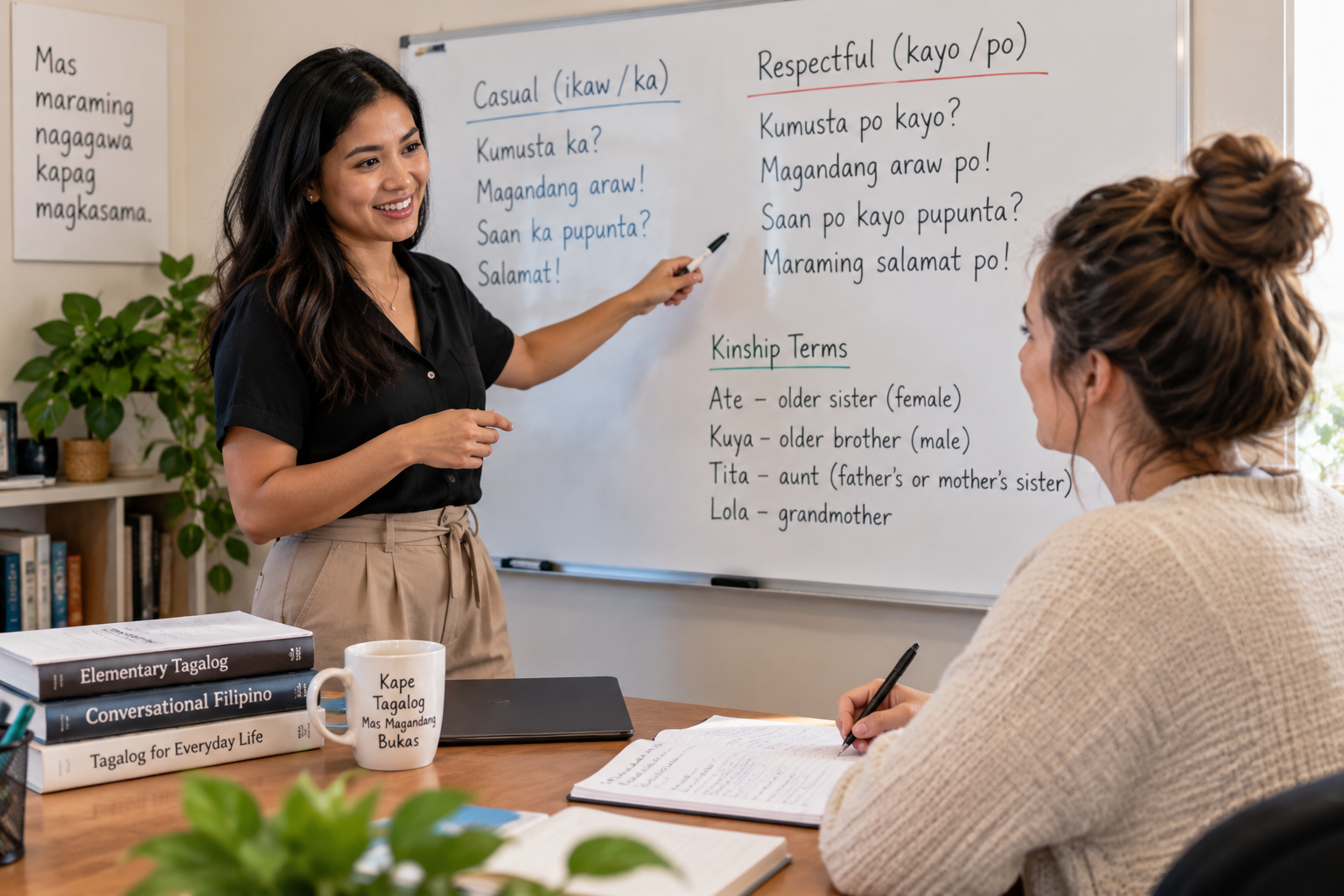
For adults in Sacramento and Elk Grove, Tagalog is no longer a language you have to study entirely on your own. There is now a clear college-level option in Sacramento, community-based cultural activity in Elk Grove, and enough live online instruction that a learner can build a serious program even when local schedules do not line up.
The key is to distinguish three things that often get mixed together in search results: a real language course, a cultural workshop that includes Tagalog, and a general Filipino community organization. All can be valuable, but they serve different goals.
Sacramento City College offers the clearest structured sequence
Sacramento City College’s 2026–27 catalog lists TGLG 401 Elementary Tagalog and TGLG 402 Elementary Tagalog.
TGLG 401 is designed for students with little or no previous exposure. The course description includes pronunciation, vocabulary, grammar, everyday sentence patterns, and the development of listening, speaking, reading, and writing within a Filipino cultural context. TGLG 402 continues that sequence with more complex phrases, readings, and cultural discussion.
For an adult who wants systematic study, this is important. Many informal Tagalog resources teach useful expressions but never build the grammar underneath them. A college sequence gives you continuity: one course assumes and extends the previous one.
The caution is availability. A course appearing in a college catalog means it is approved and part of the curriculum; it does not necessarily mean every section is offered every semester. Check the current Sacramento City College class schedule before making plans.
For learners who want transferable credit, a formal academic setting, or a defined progression, SCC is the first local place worth investigating.
Elk Grove has community-based language and culture activity
Elk Grove has a substantial Filipino community, and organizations such as Bukang Liwayway Pilipino-Amerikano Pangarap Asosasyon (BLPAPA) have promoted Filipino culture through performances, community events, educational programming, and Tagalog workshops.
That type of community learning can do something a conventional course sometimes cannot: connect vocabulary to actual relationships, food, dance, festivals, and family history. Heritage learners in particular may find that a cultural workshop activates language they already recognize but rarely use actively.
At the same time, a workshop should not automatically be treated as the equivalent of a semester language course. Ask how many sessions the program includes, whether it teaches grammar and sentence formation, and whether participants are expected to speak regularly.
If your goal is conversational confidence over several months, you may want a workshop for community connection and a separate structured course for progression.
Elk Grove Adult Education is not currently a Tagalog language school
Elk Grove Adult and Community Education offers a wide range of adult programs, but its current public class listings focus on areas such as ESL, academic completion, career training, workforce preparation, and community education. Tagalog does not appear as a regular language course in the current listings.
This is worth stating because “adult school” is often the first search people try. A learner may reasonably assume that a large adult education system in an area with many Filipino residents would have a weekly Tagalog class. At the moment, that does not appear to be a standard offering.
Programs change, so checking future community-education catalogs is still sensible. Just do not postpone learning while waiting for a class that may not be scheduled.
Heritage learners need a different kind of beginner course
Sacramento-area Tagalog learners often include second-generation and mixed-heritage adults. Someone may understand household commands, recognize food vocabulary, and know how older relatives sound without being able to create an unfamiliar sentence.
That learner can struggle in either direction. A complete-beginner class may feel painfully slow when listening is easy, but an intermediate class may assume grammar, reading, or active vocabulary the learner never formally learned.
Before registering, ask whether the instructor can place heritage speakers by skill profile rather than by one label.
A useful placement conversation should consider:
how much spoken Tagalog you understand;
whether you can answer spontaneously;
whether you read comfortably;
how much grammar terminology you know;
whether your home language is primarily Tagalog, Ilokano, Cebuano, Kapampangan, or another Philippine language.
That last point matters. Filipino identity does not automatically mean Tagalog was the language used at home.
Online study can be more practical than driving for one weekly hour
Sacramento and Elk Grove are close enough that an in-person course may be realistic, but evening traffic, work schedules, parking, and family responsibilities still affect attendance.
A one-hour lesson can become a three-hour commitment when transportation is added. If that causes frequent absences, the “local” option is not necessarily the more effective one.
Live online classes work best when they retain the things self-study usually lacks: an instructor who corrects you, classmates who force you to respond in real time, and a curriculum that keeps grammar and conversation moving together.
For an adult who wants structured Tagalog but cannot make a college timetable work, this can be a better long-term solution than waiting for an occasional workshop.
Polyglottist Language Academy offers live online Tagalog classes for adults, including complete beginners and learners with prior exposure who may need help finding the right level.
The Sacramento–Elk Grove area gives learners a useful combination: formal coursework in Sacramento, strong Filipino cultural life in and around Elk Grove, and online instruction when local schedules do not fit. The best approach may use more than one of those resources. A college course can build the language, a community event can give it social meaning, and regular conversation practice can keep it from remaining something you only recognize on paper.