
Japanese New Year (Oshogatsu): How Japan Celebrates Differently From the West
At 11:59 p.m. on December 31, much of the Western world is looking at a clock.
In Japan, someone may instead be listening to a Buddhist temple bell. The difference says quite a lot.
Western New Year's Eve tends to build toward a single dramatic moment: champagne, fireworks, music, a countdown, midnight kisses, and the sudden collective realization that nobody remembers all the words to “Auld Lang Syne.”
Japanese New Year—お正月, Oshōgatsu—has a different rhythm.
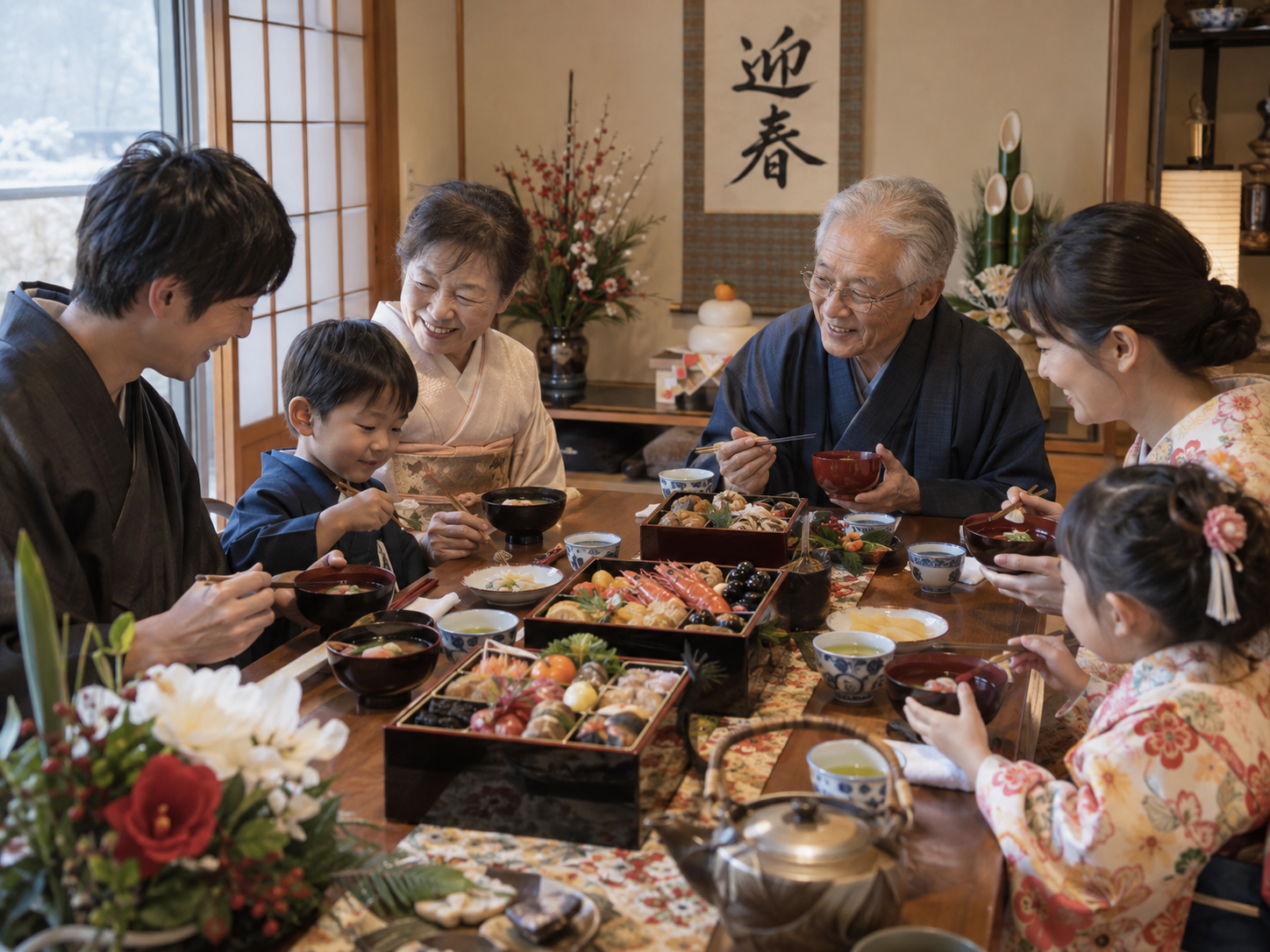
Midnight matters, but it is not necessarily the climax. The holiday extends across several days and is built around cleaning away the old year, returning home, eating highly symbolic foods, visiting shrines and temples, exchanging greetings and gifts, and paying particular attention to the first experiences of the year.
The first sunrise.
The first shrine visit.
The first dream.
Even the first shopping trip.
Japan certainly has countdown parties and modern New Year's celebrations, particularly in large cities. But traditionally, Oshōgatsu is closer to a family holiday than a night out. Japan's national tourism organization describes New Year as essentially a family occasion, when many people return to their hometowns and large parts of the country become unusually quiet.
If Christmas in much of the West is the period when everyone goes home, eats too much, exchanges gifts, and discovers that the entire transport network is full, New Year occupies much of that cultural space in Japan.
And preparations begin well before midnight.
Christmas Ends Remarkably Fast in Japan
One of the more amusing experiences of being in Japan in late December is watching Christmas disappear.
December 25 arrives with illuminated shopping streets, Christmas cakes, seasonal music, decorative trees, and romantic dinners.
Then the machinery changes overnight.
By December 26, Christmas decorations begin giving way to pine, bamboo, straw ropes, New Year displays, and zodiac imagery. JNTO notes this abrupt seasonal transformation: Japan remains commercially active through Christmas, but becomes progressively quieter as Oshōgatsu approaches.
This reflects a reversal of the Western holiday hierarchy.
Christmas in contemporary Japan is largely secular and commercial. It can be romantic, decorative, and fun, but it is not generally the major family reunion holiday.
New Year is.
That is why someone visiting Tokyo at Christmas may find restaurants packed and shops buzzing, while someone arriving on January 1 may wonder where everybody went.
Many people have gone home.
Before the New Year Comes the Great Cleaning
The psychological logic of Japanese New Year begins with a rather practical activity:
cleaning.
The traditional year-end cleaning is called 大掃除 — ōsōji, literally “big cleaning.”
Homes are cleaned thoroughly. Workplaces may be tidied. Old clutter is removed. Loose ends are dealt with.
Obviously, modern Japanese households vary enormously. Not everyone performs an epic floor-to-ceiling purification ceremony every December.
But the cultural idea remains recognizable: the new year should begin cleanly.
JNTO describes year-end preparation as involving major cleaning, settling unfinished matters, and preparing one's surroundings for a fresh start.
There is something rather different here from the Western idea of the New Year's resolution.
Western New Year often looks forward:
This year I will exercise.
This year I will save money.
This year I will finally learn Japanese.
The Japanese tradition puts considerable emphasis on properly ending what came before.
Before beginning the new year, finish the old one.
That idea appears repeatedly throughout Oshōgatsu.
Even the Office Party Is About Forgetting the Old Year
December is also the season for 忘年会 — bōnenkai.
The characters are fairly direct:
忘 — forget
年 — year
会 — gathering
A “forget-the-year gathering.”
Work colleagues, friends, clubs, and other groups may gather for food and drinks as the year closes. Modern bōnenkai can be loud affairs—the quiet, reflective image of Japanese New Year should therefore not be pushed too far backward into December. JNTO describes them as common year-end gatherings that can range from relatively civilized office dinners to considerably more enthusiastic drinking parties.
The concept is revealing.
The party is not technically welcoming the new year.
It is disposing of the old one.
Whatever went wrong, whatever workplace annoyances accumulated, whatever embarrassment happened at the company party eleven months earlier: perhaps it can be left behind.
Ideally.
Human beings being human, someone will remember.
New Year Decorations Aren't Just Winter Decorations
As Oshōgatsu approaches, particular decorations begin appearing outside houses, shops, hotels, offices, and restaurants.
One of the most recognizable is the 門松 — kadomatsu.
Usually incorporating pine and bamboo, kadomatsu are placed near entrances to welcome the New Year deities. Their exact forms and materials vary regionally.
There is also 注連縄 — shimenawa, sacred straw rope associated with Shinto purification and the marking of sacred space, and 鏡餅 — kagami mochi, stacked round rice cakes traditionally offered for the New Year.
These are not the Japanese equivalent of hanging snowflakes because winter has arrived.
They participate in an older religious understanding of the New Year.
Traditionally, Oshōgatsu involved welcoming 年神 — Toshigami, the deity or deities associated with the coming year, harvest, and ancestral blessing. Contemporary practice ranges from deeply religious to entirely habitual, but many customs still carry traces of this older framework.
JNTO describes kadomatsu, shimenawa, and kagami mochi as characteristic New Year decorations seen throughout Japan.
This is one reason Oshōgatsu can feel simultaneously domestic and sacred.
The house itself is being prepared to receive the year properly.
December 31 Is Ōmisoka
New Year's Eve is:
大晦日 — Ōmisoka
The evening tends to be considerably less centered on drinking in public than New Year's Eve in many Western cities.
That does not mean Japan lacks parties.
Tokyo, Osaka, and other cities have nightlife, countdown events, bars, concerts, and gatherings. Modern New Year in Japan contains plenty of global New Year's Eve culture alongside older traditions.
But many people spend at least part of the evening at home with family.
And one of the most recognizable meals is remarkably simple.
Noodles.
Why Eat Soba Just Before the Year Ends?
年越しそば — toshikoshi soba literally means something like “year-crossing soba.”
Buckwheat noodles are eaten around New Year's Eve, although preparations and customs vary among households and regions.
As with many holiday traditions, explanations for their symbolism overlap.
The long noodles can evoke longevity.
Their relative ease of cutting has also been associated with cutting away the hardships of the previous year.
Either way, toshikoshi soba turns the act of crossing from one year into another into something edible.
JNTO identifies the noodles as a standard New Year's Eve custom connected with longevity and passing into the new year.
There is something pleasantly unglamorous about this.
In one country, midnight may call for champagne.
In another, buckwheat noodles.
Neither has yet solved January.
At Midnight, Listen for 108 Bells
Perhaps the most atmospheric Japanese New Year's tradition is 除夜の鐘 — joya no kane, the ringing of Buddhist temple bells on New Year's Eve.
Traditionally, the bell is struck 108 times.
The number is connected to Buddhist ideas about human worldly desires or attachments—煩悩, bonnō—that cause suffering.
The ringing symbolically helps leave those impurities behind as the old year ends.
At some temples, 107 strikes take place before midnight and the final one after the year changes; practice can vary. JNTO describes the 108 strikes as representing the worldly desires from which people seek release as they enter the new year.
This creates a midnight experience quite unlike a fireworks display.
A huge temple bell does not sound festive in the conventional Western sense.
It resonates.
The sound travels, fades, and leaves silence behind.
Then it happens again.
The emphasis is less “HERE COMES THE NEW YEAR!” than “the old year has now passed.”
Of course, this contrast should not become a caricature. Japan has fireworks elsewhere in the calendar and modern countdown parties at New Year.
But the fact that the traditional midnight sound is a Buddhist bell rather than an explosion is culturally revealing.
The First Shrine Visit: Hatsumōde
Once the year begins comes one of Japan's most visible Oshōgatsu traditions:
初詣 — hatsumōde
初 — hatsu means “first.”
詣 — mōde refers to visiting a shrine or temple.
So hatsumōde is the year's first religious visit.
Millions of people visit Shinto shrines and Buddhist temples during the first days of January. Some go around midnight. Others wait until January 1, 2, or 3. Some visit enormous famous sites; others simply go to a neighborhood shrine.
People pray for health, success, family wellbeing, school admissions, relationships, safe travel, business prosperity, or whatever happens to concern them that year. Fortune slips called おみくじ — omikuji may be drawn, and new protective amulets—お守り, omamori—are purchased.
JNTO describes hatsumōde as one of the central events of Japanese New Year, with both shrines and Buddhist temples receiving large crowds during the opening days of January.
Interestingly, the modern mass form of hatsumōde is not as ancient as people sometimes imagine. JNTO notes that the modern custom developed in the late nineteenth century, helped considerably by railway companies promoting travel to famous temples and shrines.
Tradition and modern transportation apparently make perfectly good partners.
Japan Has a Remarkable Obsession With “Firsts”
Once one notices it, New Year in Japan is full of words beginning with 初 — hatsu, “first.”
初詣 — hatsumōde
first shrine or temple visit
初日の出 — hatsuhinode
first sunrise
初夢 — hatsuyume
first dream
初売り — hatsuuri
first sale of the year
There are other “firsts” depending on activity and tradition.
This linguistic pattern reflects something deeper.
A new year is not only a change in number.
It is a reset in which ordinary actions become symbolically significant because they are happening for the first time.
The sunrise on January 1 is physically no different from the sunrise on December 31.
But it is the first sunrise of the year, and therefore worth waking up for.
People travel to beaches, mountains, observation decks, and other scenic places to watch hatsuhinode.
JNTO specifically identifies first sunrise, first dream, first shrine visit, and first sales among Japan's cluster of New Year “firsts.”
The same ordinary world has restarted.
That is the point.
New Year's Morning Means Ozōni—and No Two Families Agree on It
If one wanted to start an unexpectedly complicated conversation with Japanese people, one could ask what goes into proper お雑煮 — ozōni.
It is a New Year's soup containing mochi.
Beyond that, certainty deteriorates quickly.
Broth varies by region.
Some versions are clear.
Others use miso.
The vegetables change.
The mochi can be round or rectangular.
It may be grilled before entering the soup or cooked directly in it.
JNTO notes that ozōni's flavors and ingredients vary substantially across Japan.
This makes ozōni culturally interesting in a way that standardized “national dishes” often are not.
It is both Japanese and intensely local.
A person's childhood version can feel like the obvious version until they meet someone from another prefecture and discover that the other person's family has apparently been making it incorrectly for three generations.
Holiday food is good at producing this kind of certainty everywhere.
Osechi: A Meal Where Almost Everything Means Something
The most visually distinctive Japanese New Year's meal is おせち料理 — osechi ryōri.
Osechi consists of an assortment of prepared dishes traditionally arranged in stacked lacquer boxes called 重箱 — jūbako.
The foods are chosen partly because they keep well over the holiday period and partly because many carry auspicious meanings based on appearance, wordplay, agricultural symbolism, or cultural association.
For example:
黒豆 — kuromame, black soybeans, are associated with diligent work and health.
数の子 — kazunoko, herring roe, with its many eggs, symbolizes descendants and family prosperity.
海老 — ebi, shrimp, whose curved shape suggests an elderly person, is associated with long life.
栗きんとん — kuri kinton, sweet chestnut and sweet potato, has a golden appearance associated with prosperity.
昆布巻き — kobumaki, rolled kelp, participates in a word association with yorokobu, “to rejoice.”
Not every family interprets every food exactly the same way, and contemporary osechi has become extremely varied.
Department stores and restaurants now sell elaborate osechi sets ranging from traditional Japanese versions to combinations incorporating Western and Chinese dishes. For many families, buying osechi has replaced making everything at home.
That itself is part of the holiday's evolution.
The tradition survives.
The labor arrangement changes.
JNTO notes both the symbolic meaning attached to individual osechi foods and the modern tendency to purchase prepared sets rather than spending days making them at home.
The Food Was Also Designed to Give Someone a Rest
There is a practical theory behind osechi worth noticing.
Many dishes were prepared in advance and could keep for several days.
Traditionally, that reduced the amount of cooking required during the New Year holiday.
Who particularly benefited from this?
Historically, largely the women responsible for household cooking.
JNTO describes this preservation function directly: strongly seasoned New Year foods could last through the holiday and allow the household cook some respite.
Modern refrigerators change the practical necessity.
Convenience stores and department stores change it further.
But behind the ornate box is a very ordinary holiday ambition:
perhaps nobody should spend January 1 cooking all day.
Children Know a Particularly Good New Year Tradition
Japanese children may receive:
お年玉 — otoshidama
Money.
Usually cash is placed in small decorative envelopes and given by parents, grandparents, relatives, and sometimes family friends.
The amounts vary according to family, age, and circumstance.
The practical result is that a child making the family rounds over New Year can finish the holiday in a considerably stronger financial position than they began it.
Western children may naturally wonder why this excellent custom has not achieved wider international adoption.
JNTO includes otoshidama among the characteristic customs of Japanese New Year.
It also illustrates why comparisons between Christmas and New Year become complicated.
In much of the West, December 25 is when family gathers and children receive gifts.
In Japan, January 1 carries more of the extended-family weight—and the envelope of cash.
New Year's Cards Were Once Enormous Business
Another traditional custom is the exchange of 年賀状 — nengajō, New Year's postcards.
Families, friends, colleagues, customers, and professional contacts traditionally exchanged cards timed to arrive around January 1.
The postal system has long treated this as a major seasonal operation.
The cards often feature the coming year's zodiac animal and a short New Year's greeting.
Digital communication has significantly reduced the number of nengajō sent, especially among younger people, but the custom remains culturally recognizable.
One common greeting is:
あけましておめでとうございます。
Akemashite omedetō gozaimasu.
Happy New Year.
This phrase is used after the new year has begun.
Before January 1, one instead commonly hears:
よいお年を。
Yoi otoshi o.
Have a good New Year.
This small distinction is worth learning.
Saying Akemashite omedetō on December 30 is rather like congratulating someone on a birthday that has not happened yet.
What Happened to the Big Midnight Kiss?
Nothing, exactly.
It was never particularly central.
Japan has imported many aspects of global New Year's culture, particularly in cities. Couples go out. Bars hold parties. Theme parks and entertainment venues may organize countdown events. Friends gather.
But there is no traditional Japanese equivalent of the almost ritualized Western midnight kiss.
The symbolic center of the holiday lies elsewhere.
The family.
The shrine.
The first sunrise.
The meal.
The clean house.
This is why describing Oshōgatsu simply as “Japanese New Year's Eve” misses the shape of the holiday.
The evening of December 31 is only one part of it.
Japan's New Year Is Surprisingly Quiet
Someone visiting Japan for the first time during Oshōgatsu may be surprised by how closed everything feels.
Train stations can be busy because people are traveling home, but business districts quiet down. Offices close. Independent restaurants may shut for several days. Tourist attractions can operate on altered schedules.
JNTO notes that the main Oshōgatsu holiday period commonly runs roughly from December 29 through January 3, although exact closures vary by business and calendar year.
Shrines and temples, meanwhile, may be packed.
So Tokyo can feel strangely inverted.
The shopping street is subdued.
The shrine is overflowing.
For a visitor accustomed to New Year's Eve as a commercial nightlife event, the experience can be disorienting.
It is also one of the best times to notice that Japan's religious traditions do not fit neatly into Western categories of “religious” and “secular.”
Someone who rarely describes themselves as religious may still go to a Shinto shrine for hatsumōde and perhaps visit a Buddhist temple on the same holiday.
This does not necessarily feel contradictory.
Is Oshōgatsu Shinto or Buddhist?
Both traditions are present.
And ordinary Japanese practice does not always insist on choosing.
The welcoming of Toshigami and many household New Year customs are connected strongly with Shinto traditions.
Hatsumōde can take place at Shinto shrines.
But people also visit Buddhist temples.
Joya no kane is Buddhist.
The very landscape of Japanese New Year moves easily between the two.
This is useful for language learners because Japanese culture often resists categories that English speakers expect to be mutually exclusive.
“Which religion does this holiday belong to?” may not always be the most useful first question.
Sometimes the answer is:
people do both.
Western New Year Makes Promises. Japanese New Year Creates a Boundary.
The broadest difference may be psychological.
Western New Year often emphasizes aspiration.
Resolutions.
Goals.
Reinvention.
Japanese Oshōgatsu certainly includes hopes for success, health, love, study, and prosperity.
But many customs emphasize transition.
Clean the old dirt away.
Finish old obligations.
Eat the year-crossing noodles.
Hear the bells remove worldly attachments.
Wake for the first sunrise.
Make the first shrine visit.
Eat the foods of the new year.
The boundary between years becomes unusually visible.
This helps explain why so many Oshōgatsu traditions concern purification and first experiences.
The year is not merely continuing.
It has been reset.
But Modern Japan Is Changing the Holiday Too
As with almost every “traditional Japanese custom,” it would be a mistake to assume everybody performs the complete historical checklist.
Some families make osechi.
Others order it.
Some eat only a few favorite dishes.
Some barely bother.
Some people queue for hours at a famous shrine.
Others visit the neighborhood shrine several days later.
Some watch television all evening.
Some go skiing.
Some work.
Some travel abroad.
Some go to a countdown party and then to hatsumōde afterward.
Department stores have turned 初売り — hatsuuri, the first sale of the year, into a retail event. 福袋 — fukubukuro, “lucky bags” containing mystery selections of products, have become part of the commercial New Year landscape.
Tradition does not disappear because people buy things.
It adapts.
That may actually be one of the most Japanese features of Oshōgatsu: Buddhist bells, Shinto shrines, department-store sales, television specials, ancient symbolic foods, convenience-store osechi, and family group chats can all occupy the same holiday.
Useful Japanese for New Year
A few words make Japanese New Year much easier to recognize.
お正月 — Oshōgatsu
New Year / the New Year holiday
大晦日 — Ōmisoka
New Year's Eve
あけましておめでとうございます — Akemashite omedetō gozaimasu
Happy New Year
今年もよろしくお願いします — Kotoshi mo yoroshiku onegai shimasu
A characteristically Japanese New Year's phrase roughly expressing, “I look forward to your continued good relationship/support this year.”
That last sentence has no truly satisfying English equivalent.
People say it to friends, colleagues, teachers, business contacts, and others with whom the relationship continues into the coming year.
The phrase is interesting because it is not simply congratulatory.
It acknowledges continuity.
We knew each other last year.
Here we are again.
May the relationship continue well.
Other useful words include:
初詣 — hatsumōde
first shrine or temple visit of the year
年越しそば — toshikoshi soba
New Year's Eve “year-crossing” soba
おせち料理 — osechi ryōri
traditional New Year foods
お雑煮 — ozōni
New Year's soup containing mochi
お年玉 — otoshidama
New Year's money given especially to children
初日の出 — hatsuhinode
first sunrise of the year
福袋 — fukubukuro
New Year “lucky bag”
These are useful examples of why vocabulary and culture cannot always be separated neatly.
One can translate hatsumōde as “first shrine visit.”
That tells us what the word means.
It does not explain why millions of people do it.
Experiencing New Year in Japan as a Visitor
Oshōgatsu can be a wonderful time to visit Japan, but it rewards planning.
Do not assume normal opening hours.
Restaurants may close.
Museums and attractions may shut for several days.
Trains around major travel dates can be extremely busy.
Popular shrines may involve enormous crowds.
JNTO specifically warns that transport, accommodations, closures, and holiday demand require additional planning around the New Year period.
On the other hand, few periods expose this much traditional culture in ordinary public life.
A visitor can eat toshikoshi soba on December 31.
Listen to temple bells.
Make a hatsumōde visit.
Buy an omamori.
Watch the first sunrise.
Try ozōni and osechi.
And then, once the shops reopen, discover that spiritual renewal has apparently been followed immediately by a very large sale.
Some things cross cultures perfectly well.
Oshōgatsu Makes More Sense Once You Stop Calling It Japanese New Year's Eve
The phrase “New Year's Eve” makes Western readers think of December 31.
Oshōgatsu is larger than that.
It begins before the year changes and continues after it.
The cleaning matters.
The food matters.
The journey home matters.
Midnight matters.
January 1 matters.
The first several days matter.
At Polyglottist Language Academy, Japanese classes for adults focus on learning the language people actually use, but holidays such as Oshōgatsu are good reminders of how quickly vocabulary leads into culture.
A phrase such as 今年もよろしくお願いします — kotoshi mo yoroshiku onegai shimasu cannot be understood particularly well by replacing each Japanese word with an English one. Its meaning comes partly from the kind of relationships Japanese language is accustomed to acknowledging.
Polyglottist offers live online Japanese classes for adults as well as selected in-person classes in Berkeley, California, with attention to communication alongside the cultural context that makes Japanese expressions make sense.
And Japanese New Year provides plenty of that context.
The most revealing contrast with the West may not be fireworks versus temple bells.
It is the idea of what a new year is for.
One tradition celebrates the instant the clock changes.
The other spends days preparing to cross the boundary properly.
Frequently Asked Questions About Japanese New Year
What is Oshōgatsu?
Oshōgatsu — お正月 is Japanese New Year and the broader New Year holiday period. The main holiday commonly encompasses the first three days of January, with many businesses closing from late December into early January.
Do Japanese people celebrate New Year's Eve?
Yes. December 31, or Ōmisoka, is an important part of the holiday. Families may eat toshikoshi soba, watch television, visit temples or shrines, or attend modern countdown events. New Year celebrations continue well beyond midnight.
Why do Japanese temples ring bells 108 times?
The Buddhist joya no kane tradition uses 108 bell strikes, symbolically associated with the worldly desires or attachments believed to cause human suffering.
What is hatsumōde?
Hatsumōde is the first shrine or temple visit of the new year. People commonly pray for health and good fortune, draw fortunes, and obtain protective amulets.
What do Japanese people eat for New Year?
Common foods include toshikoshi soba on New Year's Eve, osechi ryōri during the holiday, and ozōni, a soup containing mochi whose preparation varies greatly by region and household.
Is Japanese New Year a religious holiday?
It includes both Shinto and Buddhist traditions, alongside many secular family customs. Shrine visits, temple bells, traditional foods, family gatherings, television programs, shopping, and travel can all form part of contemporary Oshōgatsu.
How do you say “Happy New Year” in Japanese?
After the New Year begins:
あけましておめでとうございます。
Akemashite omedetō gozaimasu.
Before the year ends, よいお年を — yoi otoshi o (“Have a good New Year”) is more appropriate.