
Tagalog Pronunciation for Beginners: Sounds English Speakers Often Struggle With
Tagalog gives English speakers one pleasant surprise almost immediately: once you know the basic spelling system, you can usually make a reasonable attempt at a new word. There is nothing quite like English cough, through, though, and rough waiting to punish you for trusting the letters.
That does not mean Tagalog pronunciation is automatic.
The difficulties are simply concentrated in different places. English speakers tend to distort the vowels, hesitate over ng at the beginning of a word, use an English r, miss glottal stops, and assume that written spelling tells them where the stress belongs. None of these problems is disastrous by itself, but together they can make otherwise correct Tagalog surprisingly difficult to understand.
The five vowels are simpler than English vowels — if you let them be
Tagalog uses the familiar letters a, e, i, o, u, but English speakers often bring too many vowel possibilities with them.
English “a” can sound different in cat, father, face, and about. English “o” changes dramatically in hot, home, and do. A beginner sees a Tagalog vowel and unconsciously starts searching through that English inventory.
Tagalog vowels are much steadier.
A useful beginner approximation is:
a — like the a in father, but often shorter
e — a clear e sound, without turning strongly into “ay”
i — like the vowel in machine, but often shorter
o — a clear o, without a strong English “oh” glide
u — like the vowel in rule, usually shorter and cleaner
The problem is not usually that English speakers cannot produce these sounds. It is that they add movement to them.
For example, an English speaker may turn a simple Tagalog o into something closer to “ow.” That extra glide is normal in many varieties of English but makes the Tagalog vowel sound foreign.
A good practice technique is to say the vowel quickly and cleanly, then stop. Do not decorate it.
Ng can begin a word
English speakers already know the sound written ng. It appears at the end of sing, ring, and long.
The unusual part is where Tagalog puts it.
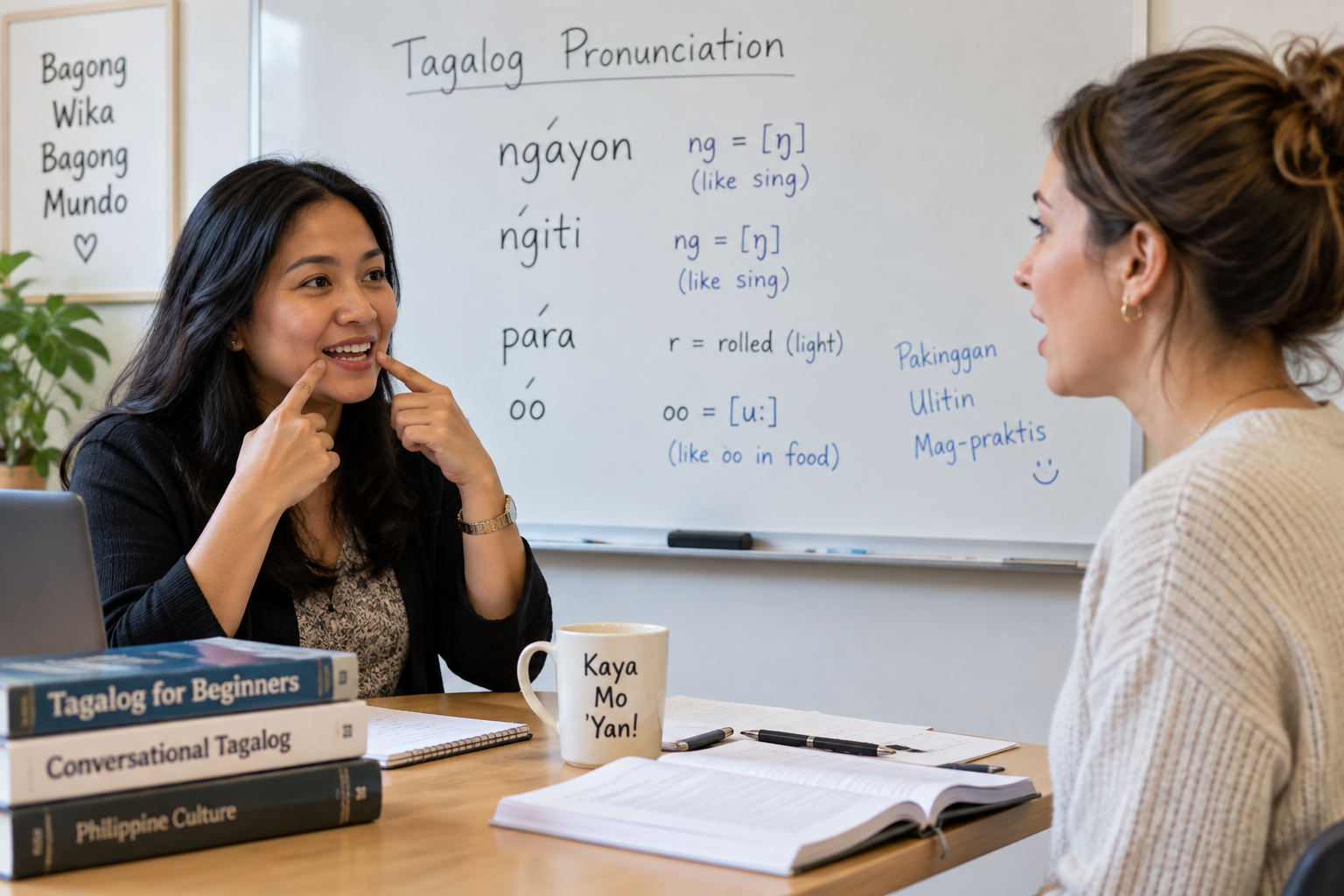
Words such as ngayon (“now”) and ngiti (“smile”) begin with the same /ŋ/ sound that English normally reserves for the middle or end of a syllable.
Beginners often insert an extra sound and say something like “n-gayon” because the spelling makes them feel that n and g must be pronounced separately.
They are not separate in this case.
A practical trick is to say English “sing,” hold the final ng sound for a moment, and then attach the next vowel:
sing … ng … ngayon
Once your mouth accepts that /ŋ/ can start a syllable, the word becomes much easier.
The Tagalog r is usually not the American English r
In many forms of Tagalog, r is produced with a quick tap of the tongue, similar to the sound many American English speakers make in the middle of butter or city.
That makes it much closer to a Spanish-style single r than to the heavy American English r in red.
Try a word such as para. If you use a strong American r, the word may still be understood, but it sounds noticeably English. A light tap makes a large difference.
Some speakers use stronger trills in certain environments or speaking styles, and regional accents vary. Beginners do not need a dramatic rolled r. The first goal is simply to stop pulling the tongue backward in the English way.
Glottal stops are real consonants even when the spelling does not show them
A glottal stop is the brief closure in the throat that English speakers often make in “uh-oh.” Tagalog uses this sound systematically.
A word that begins with a written vowel typically begins phonetically with a glottal stop. Oo (“yes”), for example, is not one smooth English-like “oo.” It contains separate vowel onsets and is often heard as something closer to two clearly separated syllables.
More importantly, some Tagalog words end in a glottal stop even though ordinary spelling does not mark it. That means two words can look identical in everyday writing but differ in stress and/or final glottal closure.
Teaching dictionaries sometimes add accent marks to show these distinctions. Everyday messages, menus, and social media usually do not.
This is one reason vocabulary should be learned with audio whenever possible.
Stress can change the word
English speakers sometimes treat stress as an accent feature: if the syllables are basically correct, putting the emphasis in the wrong place seems like a small mistake.
In Tagalog, stress can distinguish words.
A familiar example is basa, which can refer to reading or to being wet depending on how it is pronounced, including the stress pattern and final glottal behavior. Ordinary writing often leaves those distinctions unmarked.
That creates an important study habit: do not memorize a Tagalog word only as letters.
When you write new vocabulary, mark the stressed syllable in your personal notes even if standard spelling does not. You can underline it, capitalize it temporarily, or add an accent mark. The notation is for you, not for formal writing.
Students who do this early save themselves months of guessing later.
English speakers often aspirate p, t, and k too strongly
Put your hand in front of your mouth and say the English word pin. You will probably feel a puff of air after p.
Now say spin. The p usually has much less aspiration.
Tagalog p, t, and k are generally closer to the cleaner, less strongly aspirated versions. An English speaker who releases a large burst of air after every p, t, or k will still be understandable, but the accent becomes much heavier.
You do not need to obsess over this during your first lesson. It is a refinement that becomes useful once your vowels and stress are under control.
Do not turn every written y or combination into an English syllable
Real spoken Tagalog also contains natural sound compression. Combinations involving iy or sy may sound more compact in fast speech than a beginner expects. Siya, for example, can sound much closer to “sha” in casual conversation than a careful textbook reading suggests.
Beginners do not need to force these reductions. In fact, exaggerated imitation can sound strange. The useful skill is recognition: when a native speaker says a familiar word faster than the spelling seems to predict, do not assume you learned the wrong vocabulary.
Careful speech and casual speech are not always acoustically identical.
Pronunciation is easier when you learn whole phrases
A pronunciation list is useful, but conversation adds rhythm.
Practice:
Kumusta ka? — How are you?
Nasaan ka ngayon? — Where are you now?
Maraming salamat. — Thank you very much.
Oo, sige. — Yes, okay / go ahead.
Whole phrases force you to connect vowels, stress words naturally, and produce difficult sounds without stopping to prepare for them.
Teachers often notice that a student can pronounce ng perfectly in isolation and still hesitate when it appears in a real sentence. That is normal. Knowing the sound and retrieving it automatically are different stages of learning.
A structured Tagalog class is especially useful for pronunciation because an instructor can correct what you cannot hear in your own speech: misplaced stress, an English-style r, a missing glottal stop, or vowels that are drifting into English diphthongs.
Tagalog spelling is genuinely learner-friendly. The mistake is assuming that this makes listening unnecessary. The letters get you close; careful listening teaches you where the language actually lives between them.