
How to Read Russian in 7 Days: A Step-by-Step Plan for Absolute Beginners
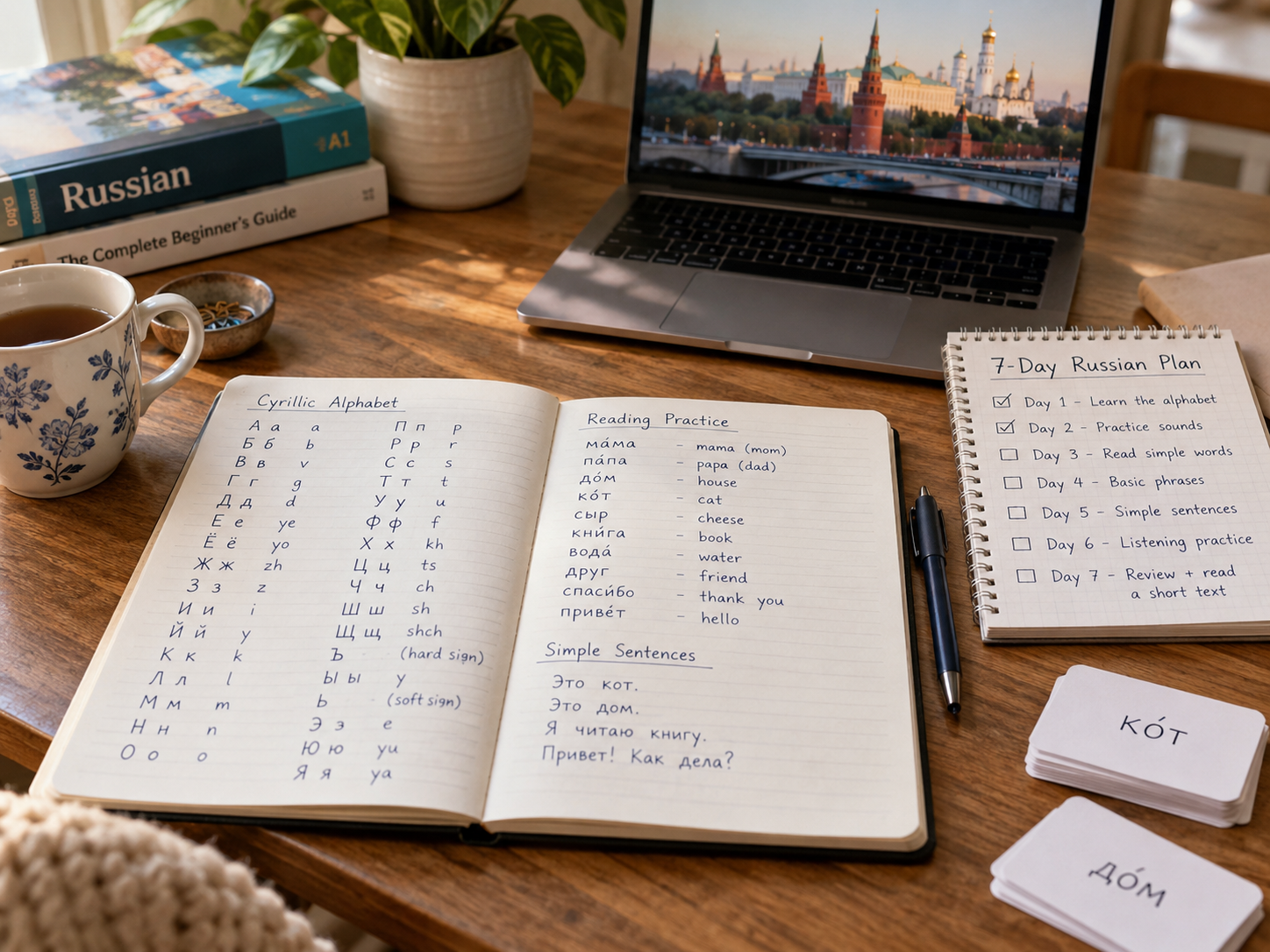
You can learn to decode Russian Cyrillic in a week. You cannot become a fluent Russian reader in a week.
That distinction matters. By day seven, a complete beginner can reasonably recognize the alphabet, avoid the most dangerous look-alike letters, sound out short words, and read familiar signs or simple sentences slowly. Speed, vocabulary, stress, and comprehension take much longer.
The plan below assumes about 25 to 40 focused minutes per day.
Day 1: Learn the letters that are already your friends
Start with Cyrillic letters that look and sound roughly like familiar Latin letters:
А а, К к, М м, О о, Т т
Then add a few easy sounds whose shapes are different but uncomplicated:
Б б = b
Д д = d
Ф ф = f
Л л = l
Read short combinations rather than chanting the alphabet: мама, там, дом, кот.
Your goal is to make reading feel like decoding speech, not reciting letter names.
Day 2: Defeat the false friends
These are the letters that cause the most beginner mistakes because they look familiar but represent different sounds:
В в = v, not b
Н н = n, not h
Р р = r, not p
С с = s, not c
У у = u/oo, not y
Х х = kh, not x
Add Е е, which often represents ye at the beginning of a word or after a vowel and also interacts with consonant softness.
Make a page titled “Letters that lie to English speakers.” Read real words such as метро, ресторан, Россия, университет and circle every false friend.
Day 3: Learn the genuinely new shapes
Now tackle letters that do not give you a misleading Latin association:
Г г = g
П п = p
Ч ч = ch
Ш ш = sh
Ж ж = zh
Ц ц = ts
Я я = ya
Ю ю = yu
Do not worry about perfect pronunciation yet. Your first job is recognition.
Use short words: чай (tea), школа (school), журнал (magazine/journal), я (I).
Day 4: Add Й, Ы, Э, Ё, and Щ
These letters need more attention because English does not provide simple one-letter equivalents.
Й й is a short y-like sound.
Ы ы is a Russian vowel with no exact English equivalent.
Э э is an open e sound.
Ё ё is pronounced yo when written, though printed Russian often replaces ё with е.
Щ щ is a long soft sh-like sound, distinct from Ш.
This is a good day to listen to native audio while reading. You are connecting symbols to sounds that spelling explanations alone cannot fully teach.
Day 5: Understand Ь and Ъ
The soft sign ь and hard sign ъ do not represent ordinary standalone sounds. They affect how surrounding letters behave.
The soft sign often tells you that the preceding consonant is soft: день (“day”). The hard sign separates a consonant from a following iotated vowel in words such as объект.
Beginners frequently try to “pronounce” these signs. Do not. Treat them as instructions to the reader.
Also begin noticing that е, ё, ю, я, и often signal softness in the preceding consonant.
Day 6: Learn to read stressed and unstressed vowels
At this point, you can identify most letters, but Russian spelling does not tell you everything about pronunciation. Unstressed vowels are reduced.
The classic example is молоко (“milk”). All three written о letters are not pronounced with the same full o quality in standard Russian speech.
Stress therefore matters early. When learning a new word, learn where the stress falls. Dictionaries and beginner materials often mark it: молокó.
Read ten to twenty familiar words aloud with stress marked. Accuracy matters more than speed.
Day 7: Read real Russian, slowly
Your final day should not introduce more alphabet material. Use the system.
Try signs and common words:
метро — metro
ресторан — restaurant
банк — bank
аптека — pharmacy
музей — museum
выход — exit
вход — entrance
Москва — Moscow
Then attempt a few beginner sentences:
Это Москва. — This is Moscow.
Это мой дом. — This is my house.
Где метро? — Where is the metro?
Read once without transliteration. If you need help, check the word after your attempt rather than before it.
A day-seven self-test
Take a Russian menu, map, transit screenshot, or beginner paragraph you have never seen. Give yourself five minutes.
Can you identify most letters without looking at a chart? Can you avoid reading Р as p and Н as h? Can you sound out an unfamiliar word even when you do not know what it means? Can you notice Ь without trying to pronounce it as a separate sound?
If yes, you have learned to decode Cyrillic.
You are not yet reading Russian in the full sense. Fluent reading requires vocabulary, grammar, automatic word recognition, and an instinct for stress. But the alphabet has stopped being a wall.
One mistake to avoid now is staying dependent on transliteration. Once you know Cyrillic, Latin-letter Russian slows you down because it forces the brain to maintain two systems.
Polyglottist Language Academy’s Russian classes move students from decoding into actual reading, pronunciation, vocabulary, and conversation. Cyrillic is usually the shortest part of the beginner journey; the important thing is to cross it efficiently and keep going.
Seven days is enough to make the alphabet familiar. The proof is not that you can recite А to Я. It is that you can look at ресторан, метро, or выход and start reading Russian directly.