
Japanese Classes in Las Vegas: The Best Ways for Adults to Start Learning Japanese
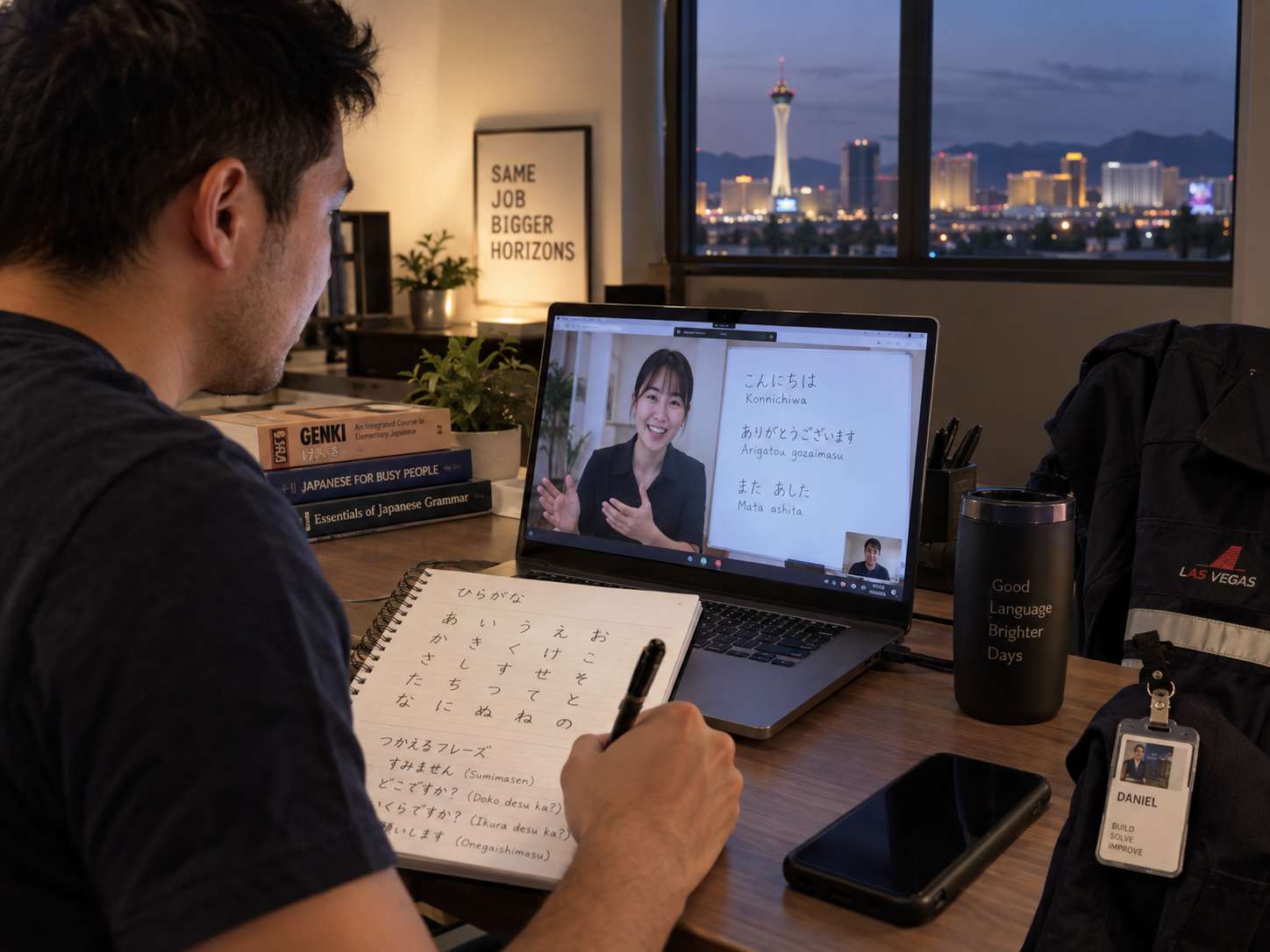
Las Vegas has a habit of looking like an unlikely place for things that are actually happening quite seriously beneath the surface.
Japanese study is one of them. Someone searching for Japanese classes in Las Vegas can currently find a university language sequence, community-college Japanese, an adult beginner conversation course, cultural organizations, library resources, private tutors, and enough online instruction to make geography almost irrelevant.
The difficulty is not really finding something.
It is figuring out which kind of Japanese class makes sense for an adult.
A nineteen-year-old university student who wants a Japanese minor, a casino manager planning a trip to Tokyo, a 45-year-old anime fan who has finally decided to stop relying on subtitles, and someone who studied Japanese ten years ago and remembers only こんにちは do not need the same course.
Japanese is also unusually sensitive to how it is taught. A beginner can spend months memorizing hiragana, isolated vocabulary, and kanji without becoming particularly capable of saying anything. At the opposite extreme, a purely conversational course can leave students speaking memorized phrases while remaining unable to read even a simple menu.
The useful middle ground is structured Japanese that begins communicating early while gradually introducing the writing system and grammar that make the language work.
Las Vegas actually gives adults several ways to find it.
Las Vegas Has a Real Adult Japanese Class
The most straightforward local option for a working adult may currently be UNLV Lifelong Learning.
As of fall 2026, UNLV is offering a new Basic Japanese Conversation course specifically designed for people with little or no previous Japanese. The class emphasizes everyday communication for situations such as travel, restaurants, and social interactions, along with pronunciation, vocabulary, etiquette, and cultural practices.
The current session runs from October 5 through October 28, 2026, meeting Mondays and Wednesdays from 5:30 to 7:30 p.m. on the UNLV campus. It consists of eight sessions, totaling sixteen instructional hours, and currently costs $199.
That is noteworthy because adult Japanese education often falls into an awkward gap.
Universities teach Japanese—but primarily for enrolled students.
Private tutors teach adults—but usually at a much higher hourly price.
Apps are cheap—but there is nobody on the other side of the screen noticing that the learner has been pronouncing the same word incorrectly for six weeks.
A short evening continuing-education course gives beginners a relatively low-risk way to find out whether Japanese is something they genuinely want to pursue.
The limitation is equally important: a short conversation class is an introduction, not a complete Japanese program.
Sixteen hours can get someone speaking.
It cannot make Japanese uncomplicated.
UNLV Also Has a Serious Academic Japanese Sequence
For learners who want something more substantial, the University of Nevada, Las Vegas maintains a genuine Japanese academic program.
UNLV currently lists:
JPN 113 — Elementary Japanese I
JPN 114 — Elementary Japanese II
JPN 213 — Intermediate Japanese I
JPN 214 — Intermediate Japanese II
JPN 301 — Third-Year Japanese I
JPN 302 — Third-Year Japanese II
and further advanced coursework within its Japanese Studies offerings.
The university also offers a Minor in Japanese Studies and a Japanese-language undergraduate certificate.
For someone seeking sustained study, this is an important distinction.
A lot of cities have a beginner Japanese course.
Far fewer provide somewhere to go after the beginner course ends.
Japanese is not a language that rewards repeatedly restarting at lesson one.
Eventually students need to move beyond greetings and learn how particles interact, how verb forms connect, how casual Japanese differs from polite Japanese, and how written Japanese becomes progressively more kanji-heavy.
A multi-year academic sequence provides that continuity.
But University Japanese Is Still University Japanese
A strong academic program does not automatically make it the best choice for every adult.
University courses are designed around semesters.
There will be assignments.
There will be deadlines.
Reading and writing will matter.
The pace assumes students are taking a formal course rather than casually attending when work permits.
That can be excellent for the learner who needs external structure. Some adults study much more effectively when there is an exam next Thursday.
Others have jobs in hospitality, healthcare, entertainment, technology, or the enormous 24-hour service economy that defines Las Vegas.
For them, "Tuesday and Thursday at exactly this time for sixteen weeks" may be harder than the Japanese grammar itself.
That is where community education, private instruction, and live online classes begin making more sense.
College of Southern Nevada Is Another Serious Option
The College of Southern Nevada also maintains Japanese within its World Languages program.
CSN's current program includes Japanese alongside Arabic, Chinese, French, German, Italian, Korean, Russian, Spanish, Portuguese, and other languages. Its Japanese program describes a progression designed to build both spoken and written communication.
CSN also notes that students can participate in a Japanese language club and that its learners have taken part in Southern Nevada Japanese speech competitions. Graduates have transferred into further Japanese study at universities including UNLV and UNR.
This makes CSN especially worth investigating for adults who want structured college-level Japanese without necessarily beginning at a four-year university.
But here again, check the actual semester schedule, not merely the course catalog.
A catalog proves that a course exists.
It does not prove that the particular level needed is running next Tuesday at 7 p.m.
CSN currently directs students to its live course-search system for real-time schedules and enrollment availability.
That distinction sounds bureaucratic until one has reorganized an entire work schedule around a class that was last offered eighteen months ago.
So Which Local Option Is Best for a Complete Beginner?
For someone beginning from zero, the decision is less complicated than it first appears.
If the goal is to try Japanese without committing to a semester, an adult continuing-education class such as UNLV Lifelong Learning's Basic Japanese Conversation course is a sensible starting point.
If the goal is serious, multi-semester study, investigate UNLV or CSN.
If a fixed college schedule does not fit, a live online small-group class may provide more flexibility without sacrificing teacher interaction.
If the learner has unusual previous experience, irregular working hours, or a very specific objective, private instructionmay be worth the extra cost.
What I would not recommend is spending six months "getting ready" before entering any class at all.
Japanese beginners are particularly good at this.
The Beginner Who Is Always Preparing to Begin
There is an entire Japanese-learning industry built around preparation.
First learn hiragana.
Then katakana.
Then the 100 most important kanji.
Then choose between three textbooks.
Then research spaced repetition.
Then redesign the flash-card system.
Then watch a video entitled "Why You Are Learning Japanese Wrong."
At some point it may be useful to learn some Japanese.
A complete beginner can begin communicating almost immediately.
For example:
はじめまして。
Hajimemashite.
Nice to meet you.
ラスベガスに住んでいます。
Rasu Begasu ni sunde imasu.
I live in Las Vegas.
日本語を勉強しています。
Nihongo o benkyō shite imasu.
I'm studying Japanese.
日本に行きたいです。
Nihon ni ikitai desu.
I want to go to Japan.
There is no reason to wait until every hiragana character has been mastered before learning sentences like these.
The writing system and spoken language should grow together.
Yes, You Should Learn Hiragana
The other extreme is the learner who says:
"I only want to speak. I don't care about reading."
That seems reasonable for approximately three weeks.
Japanese uses three interlocking writing systems:
ひらがな — hiragana
カタカナ — katakana
漢字 — kanji
Hiragana represents Japanese syllables and much grammatical information.
Katakana is heavily used for foreign words, names, sound symbolism, and stylistic purposes.
Kanji represent lexical meaning and form a major part of ordinary written Japanese.
A beginner should generally learn hiragana early.
But it should not become a month-long entrance examination before anything enjoyable can happen.
Learn:
あ — a
い — i
う — u
え — e
お — o
and continue.
Read words.
Learn sentences.
Come back to the characters tomorrow.
The goal is not to achieve calligraphic perfection before being allowed to ask where the bathroom is.
Katakana Is More Useful in Las Vegas Than Beginners May Expect
Katakana often gets less attention than hiragana.
That is unfortunate because a Las Vegas learner already knows an enormous number of Japanese katakana words without realizing it.
Consider:
ホテル — hoteru — hotel
レストラン — resutoran — restaurant
カジノ — kajino — casino
ショー — shō — show
コーヒー — kōhī — coffee
ビール — bīru — beer
タクシー — takushī — taxi
The catch is that Japanese does not simply preserve the original English pronunciation.
Words are reshaped to fit Japanese sound patterns.
This is why katakana is more than a strange alternative alphabet. It teaches something fundamental about Japanese pronunciation.
An English speaker who sees restaurant may pronounce "restaurant."
A learner who reads レストラン has to hear the word as Japanese.
That difference matters.
Japanese Pronunciation Is Easier Than It Looks—Until It Isn't
Japanese pronunciation is relatively systematic compared with English spelling.
The five basic vowels are stable.
Most kana represent predictable sounds.
There are fewer consonant combinations than English learners are used to.
This is good news.
The difficulty lies in details that English spelling does a poor job representing.
Vowel length matters.
A doubled consonant matters.
Japanese rhythm matters.
The Japanese ら, り, る, れ, ろ sounds do not correspond neatly to an American English R.
And words that look easy in romanization can develop bad habits if learners pronounce them as though they were English.
This is one area where even occasional teacher feedback pays for itself.
A teacher hears instantly what the learner cannot hear yet.
The Grammar Looks Backward Until It Stops Feeling Backward
English normally says:
I drink coffee.
Japanese can say:
私はコーヒーを飲みます。
Watashi wa kōhī o nomimasu.
The verb comes at the end.
Japanese also uses particles such as:
は — wa
が — ga
を — o
に — ni
で — de
to indicate how pieces of the sentence relate to one another.
At first, this can make Japanese seem like English that has been dismantled and reassembled in an inconvenient order.
Then something strange happens.
The pattern starts feeling normal.
A learner stops mentally rearranging every sentence and begins expecting the verb to arrive at the end.
This is one of the most satisfying stages in language learning: not knowing more vocabulary, but noticing that the language has stopped feeling structurally bizarre.
Japanese Has a Gift for Leaving Things Unsaid
English likes subjects.
Japanese often does not.
A textbook introduces:
私は日本語を勉強しています。
Watashi wa nihongo o benkyō shite imasu.
I am studying Japanese.
In an actual conversation, once everyone knows who is speaking, 私は — watashi wa may disappear.
Japanese relies heavily on context.
The result can feel alarmingly incomplete to an English-speaking beginner.
Someone may ask:
行く?
Iku?
Literally:
"Go?"
Depending on context, that may mean:
"Are you going?"
"Shall we go?"
"Will he go?"
"Are we going?"
English wants the missing information restored.
Japanese often assumes everyone in the room can already work it out.
Good classes should expose students to this fairly early. Otherwise, learners become excellent at understanding textbook sentences that nobody would naturally bother saying in full.
Polite Japanese Is Important—but It Isn't All Japanese
Most beginner courses introduce the です / ます — desu / masu style.
That is sensible.
It gives learners a polite, broadly usable way to communicate.
For example:
食べます — tabemasu — eat / will eat
Later comes:
食べる — taberu
The second form is not simply a shorter version to memorize for a grammar test.
It belongs to a different style of communication.
Japanese changes according to social relationship, setting, and degree of formality.
A person does not speak to a close friend exactly the way they speak to a customer.
That is particularly relevant in Las Vegas, where someone may be learning Japanese partly because they work in hospitality.
A hotel employee interacting with Japanese guests needs a different register from someone chatting with friends in Osaka.
This is where cultural knowledge stops being an optional extra.
The grammar itself is social.
Las Vegas Is Actually an Interesting Place to Learn Japanese for Hospitality
This deserves more attention than it usually gets.
Las Vegas has one of the world's largest hospitality economies.
Hotels, restaurants, casinos, conventions, luxury retail, entertainment venues, and tourism businesses routinely interact with international visitors.
Someone does not need to achieve advanced fluency before Japanese becomes professionally useful.
Being able to greet a guest appropriately, understand a basic request, explain directions, recognize a name, apologize naturally, or notice when English communication has failed can already change an interaction.
Useful phrases might include:
いらっしゃいませ。
Irasshaimase.
Welcome.
少々お待ちください。
Shōshō omachi kudasai.
Please wait a moment.
こちらです。
Kochira desu.
It's this way / Here it is.
大丈夫ですか。
Daijōbu desu ka?
Are you okay? / Is everything all right?
But hospitality Japanese also demonstrates why phrasebooks have limits.
いらっしゃいませ is useful in a service setting.
It is not a general-purpose version of "hello."
Context decides what sounds natural.
Las Vegas Library Cardholders Have a Useful Free Supplement
The Las Vegas-Clark County Library District currently provides access to Transparent Language, including Japanese, through its online learning resources.
That is worth using.
Not as the entire Japanese-learning strategy.
As the repetitive part of it.
A teacher should ideally be used for things that require another human:
conversation,
pronunciation correction,
explaining confusing grammar,
responding unpredictably,
and noticing recurring mistakes.
An online library resource can handle vocabulary repetition and additional listening practice perfectly well.
This is one of the easiest ways to make a weekly class more productive.
Fifteen minutes several times during the week changes what happens when the next lesson begins.
Without review, the teacher spends twenty minutes excavating last week's vocabulary.
With review, the class can move forward.
Look for Cultural Opportunities Too—but Check the Date
Japanese learning becomes much more interesting when it occasionally leaves the textbook.
CSN, for example, is currently hosting a Japanese Activity Series through its Global Programs and Japan Outreach Initiative. A September 2026 event focuses on Japanese calligraphy at the Charleston campus.
UNLV also has Japanese-oriented student organizations. Its Japanese Language and Culture Club historically welcomed members of the Las Vegas community as well as students, although UNLV currently says that particular club is not active in Fall 2026. Its Japanese Students Alliance remains listed as a separate cultural organization.
That is a useful example of why local language guides should be checked rather than copied indefinitely from old websites.
A Japanese club that existed three years ago may not meet this semester.
A class that disappeared may return next year.
Community language infrastructure is fluid.
The safest approach is to treat these opportunities as bonuses rather than the foundation of a study plan.
Live Online Japanese May Be the Best Fit for Many Las Vegas Adults
Las Vegas creates a scheduling problem that conventional adult education does not always handle well.
A large number of people work evenings.
Others work weekends.
Hospitality schedules rotate.
Healthcare schedules rotate.
Casino operations do not politely stop at 5 p.m.
A fixed local class can therefore be excellent academically and impossible practically.
Live online instruction solves much of this without reducing Japanese to self-study.
A good small online group still gives learners:
a live teacher,
scheduled accountability,
other adults to interact with,
pronunciation feedback,
real-time questions,
and the uncomfortable but useful experience of having to answer without consulting Google.
That last part is crucial.
Reading:
週末に何をしましたか。
Shūmatsu ni nani o shimashita ka?
What did you do over the weekend?
and understanding it is one skill.
Hearing a teacher ask it and having to answer:
友達とレストランに行きました。
Tomodachi to resutoran ni ikimashita.
I went to a restaurant with friends.
is another.
The second is what conversation requires.
Private Japanese Lessons Are Best When the Learner Doesn't Fit a Level
Private instruction makes particular sense for adults whose Japanese is uneven.
Someone may have watched Japanese media for fifteen years and have surprisingly good listening instincts but almost no grammar.
Another person studied two years in college and can still read hiragana but freezes when speaking.
Someone else may have a Japanese spouse or relatives and know an odd collection of family expressions that never appear in chapter one of a textbook.
Putting all of them into "Beginner Japanese" because they cannot pass an intermediate exam is not necessarily useful.
A private teacher can diagnose the actual gaps.
Private lessons also work well for adults preparing for a specific trip or professional situation.
The disadvantage is cost.
There is also something useful about having classmates.
Students hear different accents.
They listen to other people's mistakes.
They discover that another learner misunderstood the same grammar point for an entirely different reason.
Small groups create useful unpredictability.
Anime Is a Good Reason to Learn Japanese
Adults sometimes apologize for this.
There is no need.
Anime, manga, games, Japanese cinema, food, travel, history, music, martial arts, and simple curiosity are all perfectly legitimate reasons to learn a language.
Motivation matters because Japanese takes a long time.
The problem comes when media becomes the curriculum.
Anime dialogue can include extremely casual language, deliberately exaggerated masculinity or femininity, regional speech, archaic expressions, fantasy vocabulary, and character-specific verbal habits.
Copying everything produces interesting results.
A learner may eventually discover that the sentence they have been proudly using sounds less like an ordinary adult in Tokyo and more like an enraged teenage swordsman announcing the destruction of his enemy.
Keep watching.
Just have another source of Japanese telling you which phrases belong outside the television.
Don't Measure Progress Only in Kanji
Kanji has a dangerous psychological advantage.
It can be counted.
"I learned 200 characters."
"I know 600 kanji."
"I studied 25 this week."
Conversation is less cooperative.
There is no satisfying number for:
"I can now survive a conversation even when I don't understand everything."
Yet that is often more meaningful progress.
Kanji is essential for Japanese literacy.
But learn characters in words.
Instead of memorizing 食 as an isolated unit meaning vaguely "food/eat," encounter it through:
食べる — taberu — to eat
食事 — shokuji — meal
食堂 — shokudō — cafeteria / dining hall
The character begins participating in a network.
That is easier to remember and considerably more useful.
What Should the First Six Months Look Like?
A reasonable beginner program does not need to consume every evening.
One live class each week can provide the structure.
Several short review sessions can keep the material alive.
During the first months, a learner might work toward:
reading hiragana confidently;
beginning to read katakana without translating every symbol;
recognizing useful kanji in real vocabulary;
introducing themselves and describing basic personal information;
asking and answering everyday questions;
discussing routines, preferences, simple plans, and past activities;
understanding the basic roles of particles such as は, を, に, and で;
using common polite verb forms;
beginning to recognize casual Japanese;
hearing basic sentence patterns without translating each word into English.
The key word is beginning.
Six months is enough for Japanese to stop looking completely opaque.
It is generally not enough for anime to become mysteriously subtitle-free.
That is fine.
How to Choose a Japanese Class in Las Vegas
When comparing programs, ignore vague promises that the class is “immersive,” “interactive,” or “conversation-based” for a moment.
Ask concrete questions.
How many students are there?
How often does each person actually speak?
Does the instructor teach hiragana and katakana?
When does kanji begin?
Is grammar explained?
Will students hear natural Japanese as well as carefully scripted textbook dialogue?
Does the program continue beyond the first level?
Does the teacher explain differences between polite and casual Japanese?
And for adults, perhaps the most important question:
Can I realistically attend this class for the entire term?
Las Vegas has enough strange working hours that this should not be treated as an afterthought.
A slightly less perfect class that someone actually attends is considerably more useful than an academically ideal class missed every third week.
Learning Japanese Online from Las Vegas with Polyglottist Language Academy
For Las Vegas adults who want structured live instruction but need more flexibility than a university schedule provides, Polyglottist Language Academy offers live online Japanese classes for adults.
The classes are instructor-led rather than self-paced and are designed around small groups, practical communication, grammar, listening, pronunciation, reading, and understanding how Japanese actually changes according to social situation.
Polyglottist also offers selected in-person classes at its Berkeley, California location, while Las Vegas students can join remotely.
Because Nevada and California both use Pacific Time, scheduling is straightforward: a 6:00 p.m. Pacific class is also 6:00 p.m. in Las Vegas.
That sounds like a minor detail until one compares it with joining a class from New York at 9 p.m.
Las Vegas learners are in an unusually good position overall.
There is an adult beginner option through UNLV Lifelong Learning.
There is a deeper academic sequence at UNLV.
CSN offers another route into structured Japanese study.
The library provides free digital practice.
And online instruction removes most of the remaining scheduling and geographic limits.
The challenge is therefore less about finding Japanese somewhere in Las Vegas and more about choosing a format that survives contact with adult life.
That matters because Japanese is learned over time.
The first victory may simply be reading レストラン without romanization.
Then understanding why 私は disappeared from a sentence.
Then recognizing a phrase before the subtitles appear.
Eventually someone asks a question in Japanese, and instead of translating it into English, composing an English response, translating that response back into Japanese, and hoping the conversation has not moved on—
the answer simply arrives.
That is when the language begins to feel like something other than studying.
Frequently Asked Questions About Japanese Classes in Las Vegas
Are there in-person Japanese classes for adults in Las Vegas?
Yes. UNLV Lifelong Learning currently offers a Basic Japanese Conversation course for beginners, and both UNLV and the College of Southern Nevada maintain academic Japanese programs. Availability changes by term, so current schedules should always be checked.
Does UNLV teach Japanese?
Yes. UNLV currently offers Japanese from elementary through intermediate and third-year levels, as well as a Japanese Studies minor and Japanese-language certificate.
Does CSN offer Japanese?
Yes. Japanese is part of CSN's World Languages program, which emphasizes both spoken and written communication. Specific classes and schedules vary by semester.
Can I learn Japanese online from Las Vegas?
Yes. Live online group classes and private instruction can be especially practical for adults with evening, weekend, hospitality, or rotating work schedules.
Should I learn hiragana before joining a beginner class?
It can help, but a true complete-beginner course should not require it. Learn hiragana early, but do not postpone speaking Japanese until the entire writing system has been mastered.
Is Japanese difficult for English speakers?
Japanese differs significantly from English in sentence order, particles, writing, levels of politeness, and reliance on context. At the same time, pronunciation is relatively systematic and verbs do not change according to grammatical person in the way many European languages do.
Are there free Japanese-learning resources in Las Vegas?
The Las Vegas-Clark County Library District currently offers Transparent Language, including Japanese, through its online learning resources.