
Cherry Blossom Season in Japan: When It Happens, Where to See It, and What It Means
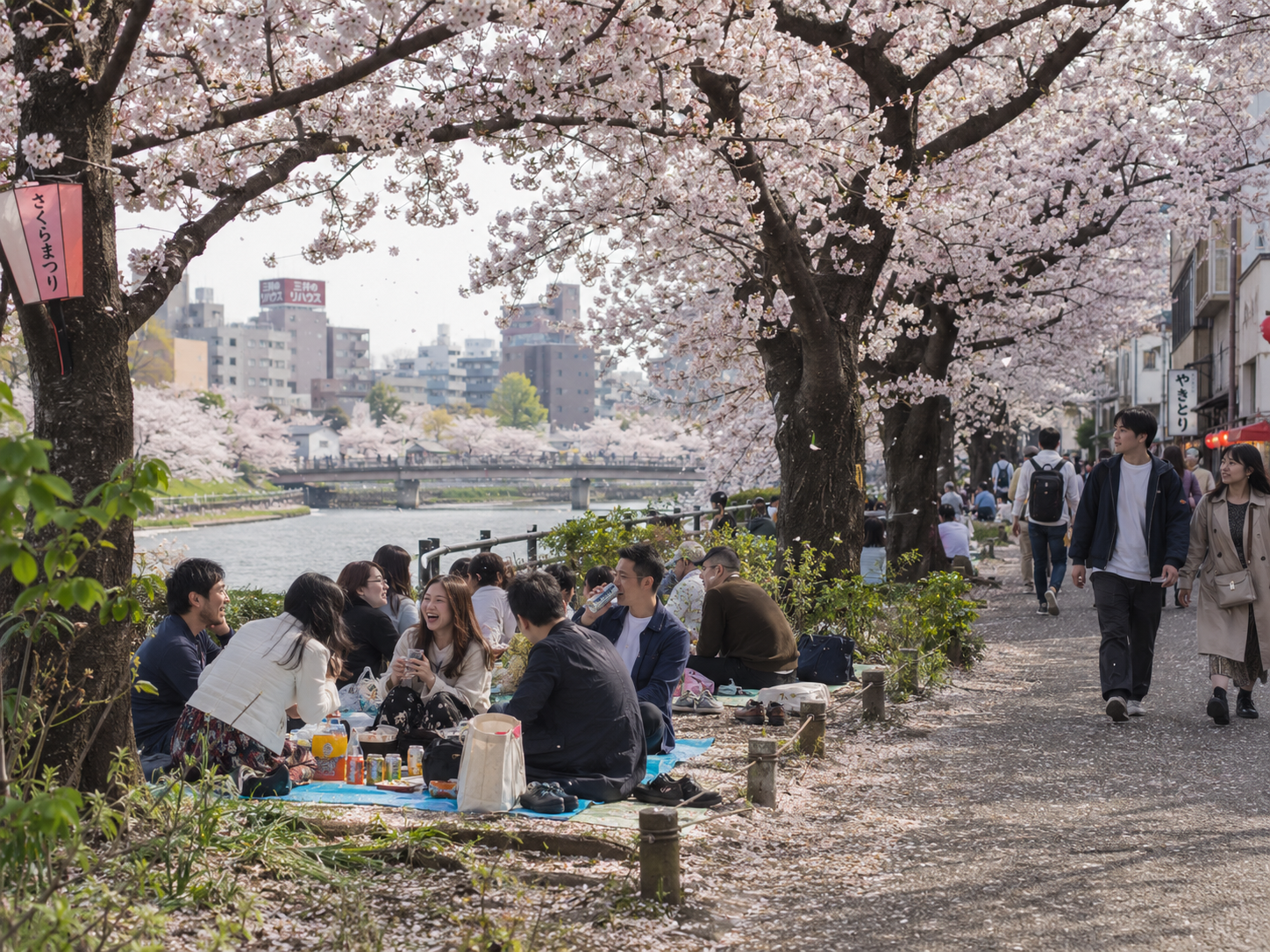
A surprisingly large number of trips to Japan are planned around a flower that may cooperate for about a week.
Flights are booked months ahead. Hotels fill. Travelers construct itineraries around dates that do not yet exist on any reliable forecast. Then spring turns unusually warm, the trees bloom early, and the carefully timed arrival in Kyoto coincides with thousands of petals already floating down a canal.
This is the first thing to understand about cherry blossom season in Japan:
It is not a fixed holiday.
It is weather.
Japan's cherry blossoms—桜 (さくら, sakura)—move gradually through the country as temperatures rise, producing what is commonly called the 桜前線 (sakura zensen), or cherry blossom front. The season may begin with early varieties in Okinawa in January, reach Tokyo and Kyoto around late March or early April in many years, and continue into northern Japan and Hokkaido well into April and May.
And even within one city, “cherry blossom season” does not describe a single day.
There is first bloom.
There is full bloom.
There are several days when the trees are spectacular.
And then, often almost immediately, there is wind.
The petals fall.
Everyone starts talking about next year.
That brevity is not an inconvenience sitting outside the meaning of sakura season. In many ways, it is the meaning.
When is cherry blossom season in Japan?
For the route most first-time visitors take—Tokyo, Kyoto, Osaka, perhaps Hiroshima—the safest mental picture is late March through early April.
But “Japan in early April” is nowhere near precise enough if sakura are the main reason for the trip.
A useful rough guide looks like this:
AreaTypical viewing periodOkinawaJanuary into February, with earlier cherry varietiesKyushu and western JapanLate March to early AprilTokyo, Kyoto, OsakaLate March to early AprilHigher elevations such as YoshinoEarly to mid-AprilTohokuApril, often later than Tokyo and KyotoHirosaki and northern TohokuCommonly late April into early MaySouthern HokkaidoLate April into early MayMore northerly HokkaidoInto May
These are planning ranges, not promises. JNTO describes the nationwide season as moving from the warmer south toward cooler northern regions from roughly March into early May, while Okinawa has much earlier blooms.
The completed 2026 season shows how much the calendar can move. Best viewing in Tokyo was approximately March 28–April 4 and Kyoto March 29–April 5, while Hirosaki's peak arrived around April 16–21 and Sapporo around April 21–28. Northern Japan was notably early that year after unusually warm conditions.
This is why anyone planning specifically for blossoms should treat historical averages as a starting point and then watch forecasts as the trip approaches.
“First bloom” is not the date you actually want
Japanese blossom forecasts often distinguish between:
開花 — kaika — first flowering
and:
満開 — mankai — full bloom
That distinction matters.
The official first-bloom date is based on an observation tree reaching a defined flowering threshold. It does not mean every park in the city has suddenly turned pink.
For travelers, mankai and the days around it are usually more relevant.
There is generally a short interval between first bloom and full bloom, followed by another brief stretch of good viewing. Weather determines how generous that window becomes. Cold temperatures can slow development. Warmth can accelerate it. Heavy rain or strong wind can shorten the spectacle abruptly.
JNTO describes individual peak blossom periods as brief, while its 2026 guidance noted that the nationwide progression itself lasts much longer because the bloom moves north.
This gives travelers a useful strategy: move rather than mourn.
If Kyoto has passed its peak, a higher elevation or more northern destination may still be approaching full bloom.
Climate is quietly changing the old cherry blossom calendar
There is another reason not to rely too heavily on an old guidebook.
Japan's cherry blossoms are flowering earlier over the long term.
The Japan Meteorological Agency's climate monitoring found that first flowering dates advanced by about 1.2 days per decade between 1953 and 2023 across its long-term observational record.
One or two days per decade does not sound dramatic.
Over several decades, it becomes enough to make inherited rules such as “Tokyo blossoms at the beginning of April” increasingly unreliable.
This does not mean every future year will be early. Annual weather still creates large fluctuations.
It means the baseline itself is moving.
Somei Yoshino is only one kind of cherry blossom
The pale, almost white-pink canopy most travelers associate with Japanese sakura often comes from ソメイヨシノ (Somei Yoshino).
It became enormously widespread from the late nineteenth century onward and is now the dominant variety in many Japanese parks, school grounds, embankments, and streets. Because Somei Yoshino is propagated clonally, trees growing under similar conditions tend to flower at roughly the same time, helping produce the extraordinary “everything bloomed at once” effect.
But Japan has many cherry varieties.
There are しだれ桜 (shidare-zakura), or weeping cherries.
There are 山桜 (yamazakura), mountain cherries.
There are double-flowered 八重桜 (yae-zakura).
Okinawa's early spring is associated with darker pink hikan-zakura, while Kawazu in Shizuoka is known for early-blooming Kawazu-zakura.
This matters to travelers because missing Somei Yoshino does not necessarily mean missing sakura.
A city may have finished one variety while another is beginning.
Tokyo: come for the blossoms, stay for the spectacle of everyone else
Tokyo's Ueno Park is not where to go if the dream is solitary contemplation beneath an untouched tree.
It is where to go to understand hanami as a mass social event.
The park has more than 1,000 cherry trees and attracts enormous crowds during the season. Its main avenue becomes a dense stream of visitors, while groups eat, drink, talk, photograph the flowers, and remain after dark for illuminated blossoms.
This is worth experiencing precisely because it undermines one of the clichés surrounding sakura.
Cherry blossoms may symbolize impermanence.
That does not mean Japanese people spend the season silently contemplating mortality.
Hanami can be noisy.
Friends bring food. Coworkers gather. Families picnic. People drink. Children run around. Someone spends twenty minutes taking photographs of a bento.
The philosophical associations and the party are perfectly capable of existing at the same time.
Kyoto: beautiful, yes—and very much not empty
Kyoto in cherry blossom season can look almost suspiciously like the photographs.
The Philosopher's Path, or 哲学の道 (Tetsugaku no Michi), follows a canal lined with cherry trees between temple areas in northern Higashiyama. During blossom season it becomes extremely popular, though JNTO notes that the route becomes quieter toward sunset.
For a more explicitly social hanami atmosphere, Maruyama Park is Kyoto's most famous cherry blossom park, known particularly for its large weeping cherry and evening illumination.
The practical advice here is simple.
Do not plan Kyoto sakura season as though you have discovered a secret.
Everyone else has seen the photographs too.
Early mornings are valuable.
So are less famous neighborhood canals, shrine grounds, riverbanks, and streets.
Sometimes the blossom experience that stays with you is not the famous tree surrounded by several hundred phones. It is the ordinary residential street you walked down on the way back to the hotel.
Mount Yoshino: sakura on the scale of a landscape
If city parks show what hanami looks like socially, Mount Yoshino in Nara Prefecture shows how completely cherry blossoms can alter a landscape.
Around 30,000 cherry trees cover the mountain. Because they grow across different elevations and areas, the blossom period is naturally staggered as spring progresses uphill.
This is not merely an oversized flower garden.
Yoshino has centuries of religious and literary significance and is closely associated with the mountain ascetic tradition of Shugendo. Sakura have appeared in poetry and cultural memory connected to the mountain for generations.
The result feels very different from Ueno.
Instead of standing beneath one avenue of trees, you look across slopes carrying different shades of pale pink.
It also illustrates why elevation matters almost as much as latitude when planning sakura travel.
Spring moves uphill too.
Hirosaki: go north if you arrive late
A traveler who reaches Tokyo after the petals have fallen should not necessarily give up.
Sometimes the correct response is to take a train north.
Hirosaki Park in Aomori Prefecture is one of Japan's great later-season blossom destinations. The park contains roughly 2,600 cherry trees representing more than 50 varieties, surrounding the grounds of Hirosaki Castle.
One of its most famous sights actually comes after perfect full bloom.
Fallen petals accumulate in the castle moat, forming what are called:
花筏 — hana ikada — “flower rafts”
The surface of the water can become almost completely pink.
It is a useful reminder that tourists tend to think too narrowly about the “perfect” blossom moment.
A tree shedding petals is not necessarily a ruined cherry blossom experience.
In Japan, the falling itself is part of what people go to see.
Hokkaido: spring gets a second act
By the time central Japan has turned green again, Hokkaido may still be waiting for its blossoms.
At Goryokaku Park in Hakodate, around 1,500 cherry trees surround the star-shaped nineteenth-century fort. The observation tower above provides the unusual perspective of seeing the entire fort outlined in pink.
Hokkaido therefore offers a useful option for travelers visiting later in spring.
It also makes Japan's scale easier to appreciate.
The same annual event that began months earlier in subtropical Okinawa can still be unfolding in the north.
“Cherry blossom season in Japan” is really several seasons traveling through one country.
What exactly is hanami?
花見 — hanami
literally means “flower viewing.”
花 (hana) means flower.
見 (mi) comes from the idea of seeing or viewing.
Today, hanami overwhelmingly evokes cherry blossom viewing, although early aristocratic flower-viewing traditions in Japan were strongly associated with plum blossoms. In the Heian period, cherry blossoms increasingly became the preferred spring flower, and by the Edo period public hanami had developed into something much closer to the picnicking tradition recognizable today.
One of the great historical examples came in 1598, when Toyotomi Hideyoshi staged an elaborate blossom-viewing celebration at Daigoji in Kyoto.
Later, Tokugawa Yoshimune encouraged the planting of cherry trees in public areas around Edo, helping move blossom viewing beyond aristocratic gardens and into popular leisure culture.
So hanami did not appear fully formed as a blue-tarp picnic.
It evolved.
Like most traditions worth having.
Why do cherry blossoms mean so much in Japan?
Here is where explanations of Japanese culture can become a little too neat.
You will often read:
“Cherry blossoms symbolize the impermanence of life.”
That is true.
It is also incomplete.
Their brief flowering has long made sakura a natural metaphor for transience and fleeting beauty in Japanese literature and culture.
But cherry blossoms also arrive at a particularly charged moment in the Japanese calendar.
Late March marks the end of Japan's fiscal and academic years. Early April brings school entrance ceremonies, new jobs, transfers, and organizational beginnings.
So sakura appear during a season of both farewells and beginnings.
Graduation.
A new school.
Leaving coworkers.
Meeting new coworkers.
Packing.
Starting again.
This is one reason cherry blossoms can feel simultaneously celebratory and melancholy.
The flowers do not simply represent death or impermanence.
They accompany transition.
Mono no aware—and the danger of explaining too much
The idea of もののあわれ (mono no aware) is frequently brought into discussions of sakura.
Very roughly, it involves a sensitivity to the emotional force of things partly because they change and pass away.
Cherry blossoms lend themselves beautifully to that idea.
They become most spectacular immediately before they disappear.
But it would be a mistake to imagine every Japanese person standing beneath a cherry tree consciously thinking about classical aesthetics.
Sometimes someone is looking at petals and contemplating transience.
Sometimes someone is wondering where their friend went with the beer.
Culture is usually both deeper and more ordinary than outsiders want it to be.
The falling petals have their own vocabulary
Japanese has several beautiful expressions for stages of the blossom season.
満開 — mankai
Full bloom.
桜吹雪 — sakura fubuki
A “cherry blossom blizzard,” when large numbers of petals blow through the air.
花筏 — hana ikada
“Flower raft,” for petals gathering and drifting across water.
夜桜 — yozakura
Cherry blossoms viewed at night, often illuminated.
These words tell us something that an obsession with peak-bloom dates can obscure.
There is more than one moment worth seeing.
A petal storm can be more memorable than a perfectly intact tree.
How to plan a sakura trip without losing your mind
If cherry blossoms matter enormously to the trip, build flexibility into the itinerary.
Do not schedule seven nights in one city solely because an average-date chart suggested that Tuesday should be perfect.
A route across several latitudes or elevations gives you more chances.
Tokyo followed by the Fuji or mountain areas, then Tohoku, for example, creates more flexibility than staying entirely within one climate zone.
And once you arrive, check actual blossom reports rather than relying on the forecast you saved two months earlier.
There is also an increasingly important reason to keep checking. Japan's long-term flowering dates have been shifting earlier, even though individual years still vary significantly.
Planning around sakura requires accepting a small amount of uncertainty.
That is inconvenient.
It is also rather appropriate.
Hanami etiquette is mostly ordinary courtesy
Popular blossom sites can become extremely crowded.
JNTO advises using public transportation where possible, keeping picnic spaces no larger than necessary, taking trash away when bins are unavailable, and never breaking branches or pulling blossoms from the trees.
Individual parks may have their own rules about picnics, alcohol, reservations, opening hours, or nighttime viewing, so check locally.
And perhaps most importantly: the branch does not need to be pulled toward the camera.
It looked fine where it was.
You do not need to visit the most famous tree in Japan
There is a strange effect of social media on seasonal travel.
Thousands of cherry trees bloom.
Everyone goes to photograph the same twelve.
Famous locations are famous for good reasons. Yoshino is extraordinary. Hirosaki deserves its reputation. Kyoto under sakura really can be beautiful enough to justify the clichés.
But hanami is not fundamentally a checklist of scenic landmarks.
It is a seasonal habit.
A local park where families are eating lunch beneath six trees can reveal more about contemporary hanami than fighting through a crowd to reproduce a photograph you already saw online.
Walk beside a river.
Look at a schoolyard.
Notice the trees beside an apartment building.
Stay until the light changes.
See the same tree in the morning and again when petals begin falling in the evening.
The famous view is only one version of cherry blossom season.
Sakura are beautiful partly because the schedule never quite belongs to us
Travel culture tends to turn natural phenomena into products.
“See Japan's cherry blossoms.”
As though the blossoms have received your booking confirmation.
They have not.
They may arrive early.
They may arrive late.
The perfect afternoon may rain.
You may miss full bloom and discover instead that sakura fubuki, petals flying through a neighborhood street, is more beautiful than the immaculate canopy you were trying to catch.
That uncertainty is inconvenient for tourism.
It also prevents the season from becoming completely manufactured.
At Polyglottist Language Academy, cultural vocabulary such as sakura, hanami, mankai, and yozakura is interesting precisely because a dictionary translation only gets part of the way there. Polyglottist offers live Japanese classes for adults online and selected in-person classes in Berkeley, California, with an emphasis on practical language and the cultural settings in which people actually use it.
Knowing that 花見 means “flower viewing” is useful.
Understanding why coworkers are sitting on a blue tarp under a tree, why weather reports discuss blossom dates, why a falling petal can feel as important as a newly opened flower, and why the whole country seems briefly preoccupied with pink—that is where the language starts connecting to the place.
The blossoms are worth seeing.
Just don't expect them to wait.
Frequently Asked Questions
When is the best time to see cherry blossoms in Japan?
For Tokyo, Kyoto, and Osaka, late March through early April is the most common range, but timing changes every year. Northern destinations bloom later, while Okinawa has much earlier flowering varieties.
How long do cherry blossoms stay in full bloom?
Peak viewing at a given location is usually brief. JNTO describes the main flowering spectacle as lasting roughly a week or a little longer depending on conditions; wind, rain, and temperature can shorten or extend the useful viewing period.
Is April always the best month for cherry blossoms?
Not everywhere. April works well for many parts of Honshu, but southern varieties can bloom much earlier and northern Japan can continue into May. Elevation also affects timing.
Where are the best places to see cherry blossoms in Japan?
Different places offer different experiences. Ueno Park gives a lively urban hanami atmosphere; Kyoto offers canal walks and illuminated weeping cherries; Mount Yoshino provides a mountain-scale display; Hirosaki combines blossoms with a castle and moat; and Goryokaku offers a later northern season.
What does hanami mean?
Hanami (花見) literally means “flower viewing.” In modern Japan it usually refers to enjoying cherry blossoms, often through walks, picnics, or gatherings with friends, family, or coworkers.
What do cherry blossoms symbolize in Japan?
Sakura are strongly associated with spring, renewal, transition, and the fleeting nature of beauty and life. Their timing also overlaps with the end and beginning of Japan's school and business years, giving the season strong associations with farewells and new starts.
Are cherry blossom dates getting earlier?
Over the long term, yes. Japan's Meteorological Agency found that observed first flowering dates advanced by about 1.2 days per decade from 1953 to 2023, although individual years still vary considerably.