
Learning Japanese in Santa Clara: Classes for Beginners, Travelers, and Japan Enthusiasts
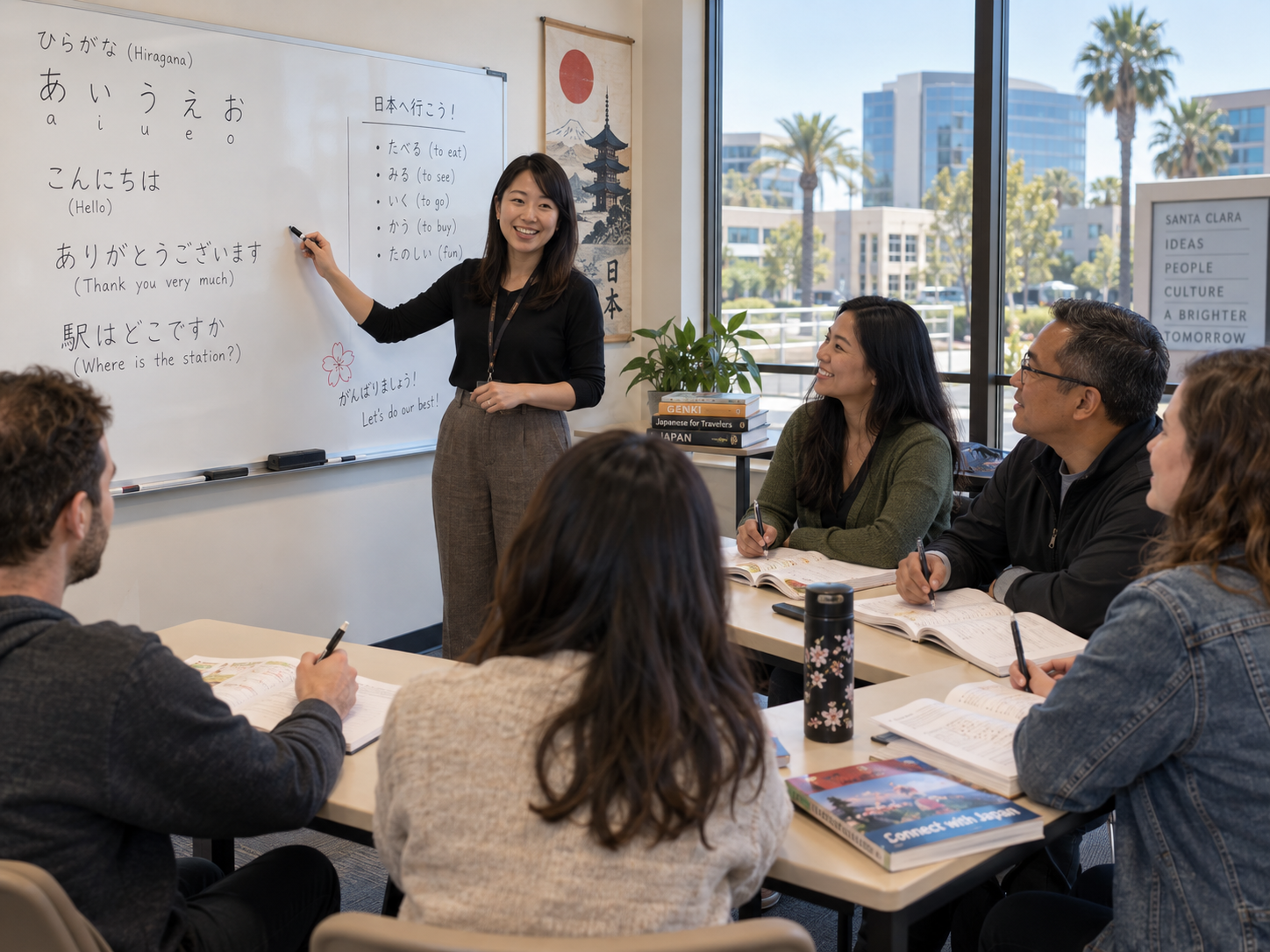
Santa Clara is unusually good territory for an adult Japanese learner because several very different kinds of Japanese study sit close together. You can find a university sequence that runs from elementary through advanced Japanese, a commercial adult program with hybrid beginner classes, community conversation practice, and Japanese cultural institutions a short drive away.
The useful choice depends less on your enthusiasm and more on what you want Japanese to do for you.
If you want a full academic sequence: Santa Clara University
Santa Clara University’s Japanese curriculum is not a one-course introduction. Its published course sequence includes elementary Japanese across the academic year, intermediate levels, and advanced courses. That makes it attractive to students who want systematic progression in reading, writing, grammar, and communication.
For enrolled SCU students, the pathway is clear. Adults outside the university should not assume standard undergraduate courses function like open community classes; contact the university if you are exploring nondegree enrollment.
The strength of an academic sequence is continuity. Japanese punishes stop-start study more than many learners expect because kana, kanji, grammar, and vocabulary accumulate together. A program that expects you to return for the next level can create useful pressure to keep going.
If you are a working adult: San Jose Learning Center in Santa Clara
San Jose Learning Center currently advertises an adult beginner Japanese course at its Santa Clara location on De La Cruz Boulevard. The course is offered in a hybrid format: the teacher is in the classroom, while students may attend in person or through Zoom. The 2026 beginner description includes romaji, hiragana, katakana, numbers, greetings, polite expressions, and simple sentences.
That hybrid format solves a very Silicon Valley problem. A student may want in-person interaction but not be able to guarantee a commute every week. Hybrid attendance lets a class remain part of the calendar even when work gets unpredictable.
When comparing hybrid courses, ask how remote students participate. Watching a classroom through a laptop is not the same as being regularly called on, paired for speaking, and corrected. The technology matters less than the participation design.
If your goal is travel
A traveler does not need the same first ten weeks as someone preparing for advanced reading. If Japan is six months away, prioritize polite requests, numbers, transportation, restaurants, basic listening, and the ability to read kana.
Hiragana and katakana are still worth learning. Katakana, in particular, pays off quickly in travel because it appears in menus, products, signs, and borrowed words. You do not need hundreds of kanji before your trip, but recognizing station-related vocabulary, days, numbers, and common directional characters can reduce dependence on English signage.
Private tutoring or a short focused workshop can complement a general group class if your departure date is fixed.
If you are learning because you love Japan
“Japan enthusiast” can mean anime, literature, food, martial arts, history, games, design, travel, or family connection. The danger is building vocabulary only inside one interest. Anime fans may recognize casual expressions but struggle with polite everyday speech. Martial-arts students may know dojo terminology but not basic conversation. Travelers may know restaurant phrases without understanding ordinary verb forms.
A well-rounded class gives your interest somewhere to attach while filling the gaps around it.
Nearby, the Japanese Art & Cultural Center in San Jose lists Japanese language classes alongside traditional arts and martial arts. The Santa Clara Valley Japanese Christian Church also advertises a Japanese conversation class for adults and youth age 16+, currently offered via Zoom. These are different environments from a formal course, but they can add practice and community context.
Placement matters more than the label on the class
Adult learners arrive with messy histories. Someone may have completed two years in college fifteen years ago. Someone else learned hiragana last month and has listened to Japanese media for years. A third may be a true beginner who knows only arigatō.
Do not choose a class solely because it is called “Beginner 1” or “Japanese 2.” Ask what students are expected to read, what textbook or units they have completed, and whether the instructor offers placement guidance.
A practical Santa Clara plan
For a complete beginner with a full-time job, an adult hybrid or live online course is often the easiest place to start. For someone who can access university study and wants depth, SCU provides a substantial academic sequence. For a traveler, combine a general course with targeted travel practice. For a long-term enthusiast, use community resources to keep Japanese connected to real interests and people.
Polyglottist Language Academy’s online Japanese classes are another Pacific-time option for Santa Clara adults who want small-group instruction and a defined progression without adding another commute. The right class is the one that survives your actual week—not the one that looks most impressive in a search result.
Related Articles
What's Actually Hard About Japanese (And What's Surprisingly Easy)
Can You Learn Japanese in a Year? What's Realistic and How to Maximize Your Progress
"I Want to Live in Japan" — How Much Japanese Do You Actually Need?
Can You Learn Japanese in a Year? What's Realistic and How to Maximize Your Progress
Japanese vs American Culture: 10 Differences That Still Surprise People