
How to Say Hello in Japanese: Every Greeting for Every Situation
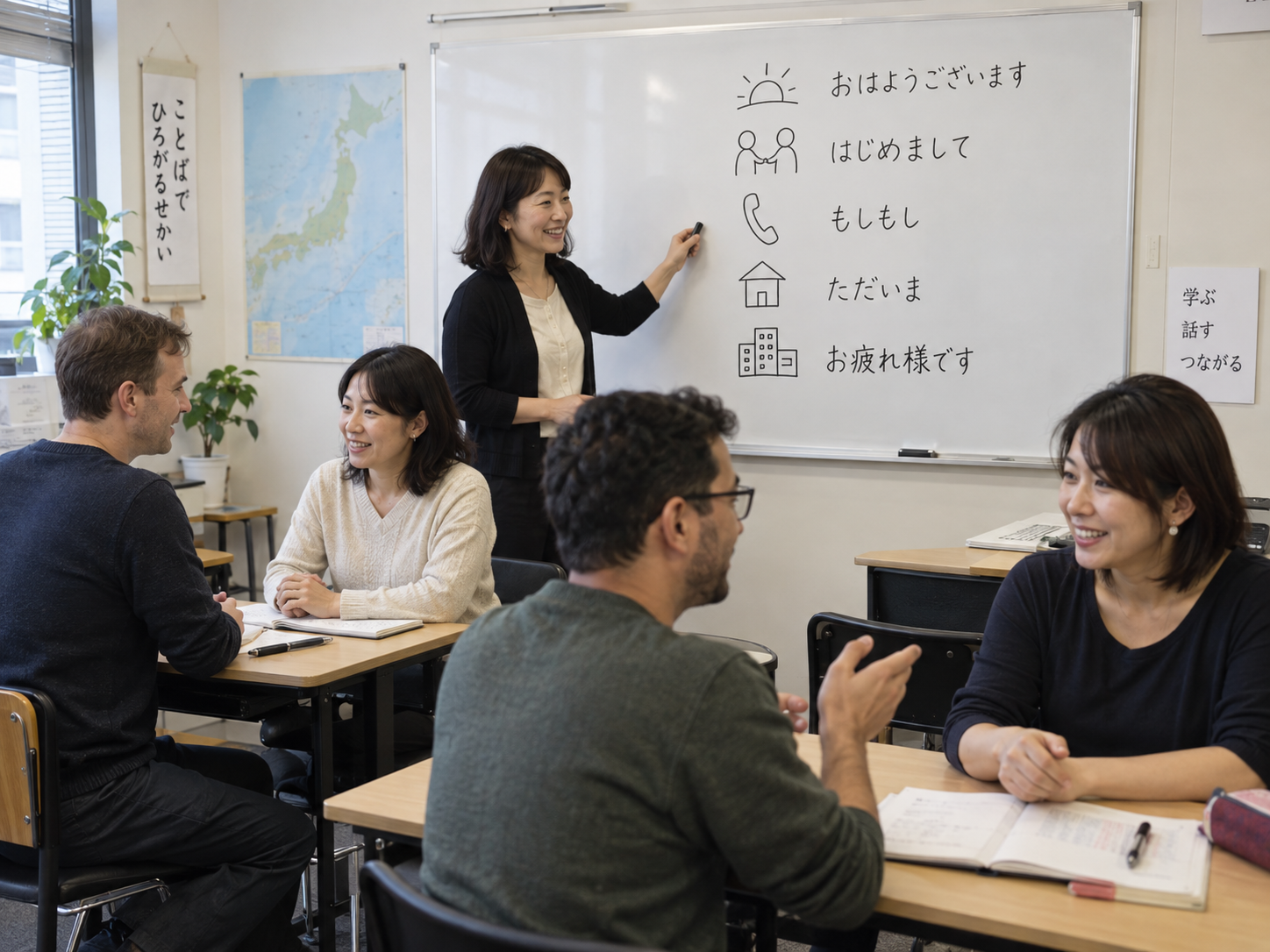
The first surprise in Japanese greetings is that こんにちは (konnichiwa) is not the word native speakers use every time they encounter another human being. It is perfectly normal, but its range is narrower than the English word hello.
Japanese greetings are strongly shaped by time, relationship, workplace role, and whether you are arriving, leaving, answering a phone, or meeting someone for the first time. The vocabulary is not difficult. Choosing the appropriate phrase is the real lesson.
Morning: おはよう and おはようございます
おはよう (ohayō) — Morning.
おはようございます (ohayō gozaimasu) — Good morning, polite.
Among friends and family, おはよう is normal. In a workplace, with a teacher, or with someone you do not know well, おはようございます is safer.
An interesting workplace detail is that some industries use おはようございます as a greeting at the beginning of a work shift even when the shift starts later in the day. That is a register convention, not a new meaning of “morning.”
Daytime: こんにちは
こんにちは (konnichiwa) — Hello / good afternoon.
This is the textbook greeting most beginners know. It works well in many daytime encounters, especially when greeting neighbors, acquaintances, or someone in a moderately polite setting.
It can sound oddly formal if you say it every time you see a close friend. Friends often use shorter, relationship-specific greetings—or simply begin talking.
Evening: こんばんは
こんばんは (konbanwa) — Good evening.
Use it when greeting someone in the evening. Like konnichiwa, it is neutral-polite and safe with people you do not know intimately.
Meeting someone for the first time
はじめまして。 (hajimemashite) — Nice to meet you / We are meeting for the first time.
A standard introduction might continue:
田中です。よろしくお願いします。 (Tanaka desu. Yoroshiku onegaishimasu.) — I’m Tanaka. [Please treat me favorably / I look forward to our relationship.]
There is no elegant one-line English translation of よろしくお願いします. Its meaning changes by context, which is exactly why beginners should learn it as a social expression rather than dissecting each word.
Seeing someone after a long time
久しぶり! (hisashiburi!) — Long time no see! Casual.
お久しぶりです。 (ohisashiburi desu) — It’s been a while. Polite.
This is much more natural than restarting with hajimemashite, which is only for a first meeting.
Phone greetings
もしもし。 (moshi moshi) — Hello? [on the phone]
Beginners sometimes hear this in anime and use it face-to-face. Do not. もしもし is associated with telephone interaction and specific attention-getting uses, not an ordinary in-person greeting.
In business calls, speakers often identify themselves or their organization rather than relying on moshi moshi.
Leaving home and coming back
These paired greetings are extremely common in households.
行ってきます。 (ittekimasu) — I’m leaving and will come back.
行ってらっしゃい。 (itterasshai) — Go and come back safely / See you.
ただいま。 (tadaima) — I’m home.
おかえり。 / おかえりなさい。 (okaeri / okaerinasai) — Welcome home.
They are difficult to translate naturally because English does not organize departures and returns in the same ritualized pairs.
At work: お疲れ様です
お疲れ様です。 (otsukaresama desu) is one of those phrases that reveals why greeting vocabulary is cultural vocabulary.
Literally it contains the idea of tiredness, but in workplaces it can function as acknowledgment, greeting, thanks for effort, or a phrase exchanged when colleagues finish tasks. Translating it as “You must be tired” is usually wrong in context.
A colleague leaving may say:
お先に失礼します。 (osaki ni shitsurei shimasu) — Excuse me for leaving before you.
Others may respond with お疲れ様でした (otsukaresama deshita).
Casual greetings among friends
Japanese has no single casual equivalent of English “hey” that works in every social group. Friends may use a name, おはよう, 久しぶり, 元気? (genki?, doing well?), or a casual interjection shaped by age and relationship.
This is where copying anime blindly becomes risky. Character speech is designed to signal personality. A phrase that sounds perfect for a brash teenage fictional character may sound theatrical from an adult learner in an ordinary conversation.
Customer-service greetings
When you enter a shop or restaurant, staff may say:
いらっしゃいませ。 (irasshaimase) — Welcome.
Customers normally do not repeat it back. You may simply nod, smile, or continue with your request.
This is a good example of why “greeting” does not mean “phrase both people exchange.” Japanese contains many fixed expressions linked to roles.
Saying goodbye
さようなら (sayōnara) is real, but beginners overuse it because textbooks pair it neatly with konnichiwa. In daily life, it can feel more final or formal than English “bye.”
Depending on the situation, you are more likely to hear:
じゃあね。 (jā ne) — See you / bye, casual.
またね。 (mata ne) — See you again, casual.
また明日。 (mata ashita) — See you tomorrow.
失礼します。 (shitsurei shimasu) — Excuse me / I’m leaving, polite and workplace-compatible.
The beginner rule that actually works
Instead of memorizing one English word and looking for one Japanese equivalent, learn greeting pairs by situation. Morning with a teacher: おはようございます. First meeting: はじめまして + introduction + よろしくお願いします. Returning home: ただいま. Answering a friend’s phone call: もしもし.
That situational memory is closer to how the language really works.
In a structured Japanese class, greetings are ideal material for practicing register because the grammar is simple enough that you can focus on social meaning. Polyglottist Language Academy’s Japanese beginner courses emphasize this kind of practical choice: not merely “What phrase is correct?” but “What would sound natural with this person, here, now?”