
Moscow and St. Petersburg contain enough museums, churches, neighborhoods, and history to fill several trips. They can also make Russia feel overwhelmingly monumental. The scale changes completely in smaller historic towns, where a kremlin wall may end beside an ordinary residential street, a monastery bell tower may be visible from a vegetable garden, and the main pleasure is often walking rather than checking off landmarks.
Calling all of these places “hidden” would be misleading. Suzdal, for example, is one of the best-known towns on Russia’s Golden Ring. Yet many are far less familiar to international travelers than the two major capitals, and even the famous ones offer a more intimate view of architecture, provincial life, and regional history.
Suzdal: medieval architecture without a big-city frame
Suzdal is the obvious starting point because the town preserves an extraordinary concentration of old Russian architecture in a landscape that still feels low-rise and open. The UNESCO-listed White Monuments of Vladimir and Suzdal include major 12th- and 13th-century structures, while the wider town contains monasteries, churches, earthen ramparts, wooden buildings, and views over the Kamenka River.
What makes Suzdal memorable is not one single cathedral. It is the relationship between architecture and landscape. Domes appear beyond meadows. Bell towers rise behind small houses. Walking between religious complexes gives you time to notice how old Russian towns were organized around rivers, trade areas, monasteries, and defensive earthworks.
Suzdal is not a secret, but it earns its popularity.
Kolomna: a fortress city with an unexpectedly playful museum culture
Kolomna lies much closer to Moscow and works well for travelers interested in both architecture and everyday cultural history. Its historic center contains sections of the Kolomna Kremlin, monasteries, merchant houses, and museums.
The city is especially good at turning local history into small, specific museum experiences. Visitors can encounter institutions devoted to pastila, traditional kalach bread, blacksmithing, merchant life, trams, and local history rather than only grand national narratives.
That combination makes Kolomna appealing to language learners as well. Menus, museum signs, guided tours, product labels, and conversations revolve around tangible things: food, crafts, buildings, and stories. You do not need advanced Russian to begin noticing useful vocabulary.
Torzhok: river views, gold embroidery, and layers of provincial architecture
Torzhok is one of the oldest towns in the Tver region, with a recorded history reaching back to the medieval period. The Tvertsa River divides a landscape of churches, classical buildings, bridges, and older residential streets.
The town is also associated with gold embroidery, a craft for which Torzhok has long been known. That gives a visit a different focus from the usual cathedral-and-kremlin itinerary. Museums and workshops connect decorative art with local economic history and women’s craft traditions.
Torzhok is the kind of place where the pleasure comes from accumulation: a river bend, a bell tower, a wooden house, an old trading street, then a museum that explains why a particular craft mattered there.
Plyos: the Volga as landscape painting
Plyos is tiny, hilly, and closely associated with the painter Isaac Levitan, who worked there extensively. The town sits on the Volga and is known for views that combine wooden houses, church towers, wooded slopes, and the broad river.
The official regional tourism site emphasizes the town’s artistic identity, including the Levitan house museum and a museum devoted to landscape painting. That history changes how you look at the place. A viewpoint is not merely scenic; it becomes part of a tradition of Russian landscape art.
Plyos is particularly suited to travelers who prefer walking, sketching, photography, museums, and long views over a dense sightseeing schedule.
Rostov Veliky: one of Russia’s great architectural ensembles in a small-town setting
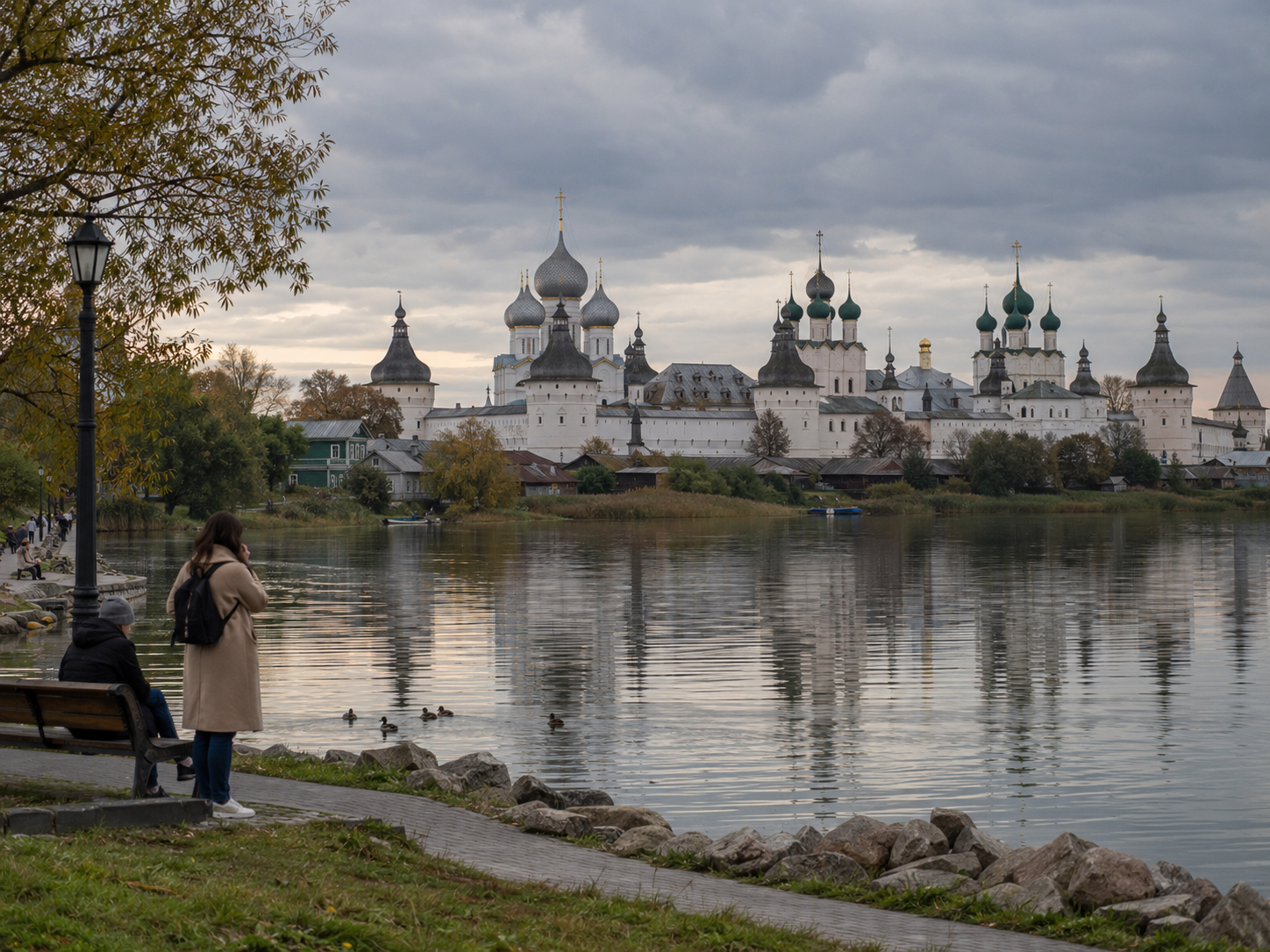
Rostov Veliky’s kremlin is visually spectacular: walls, towers, churches, and domes rise beside Lake Nero. The ensemble developed as a metropolitan residence in the 17th century and remains one of the most recognizable complexes of old Russian architecture.
The contrast is what makes Rostov interesting. The kremlin has the scale and drama of a major historical center, but the surrounding town is much smaller and quieter. Walk a few streets away and the monumental view gives way to low houses and the lake.
For travelers interested in church architecture, bells, icon painting, and the visual language of the Golden Ring, Rostov deserves more than a quick photo stop.
Vyborg: a completely different historical vocabulary
Vyborg does not resemble the central Russian towns above. Its location near the Finnish border gave it Swedish, Finnish, Russian, and Soviet layers, and its architecture reflects that complicated history.
The medieval castle immediately changes the visual mood. Elsewhere, northern European streetscapes, later Russian imperial buildings, and 20th-century architecture sit close together. For someone trying to understand how diverse the historical territories of the Russian state have been, Vyborg is a useful counterweight to the onion-domed image of “old Russia.”
Why small cities are especially good for language learners
Large cities make it easy to function anonymously. In smaller towns, ordinary Russian appears everywhere in a more manageable scale: opening hours, museum descriptions, café menus, bus signs, ticket windows, street names, and brief conversations.
You also hear vocabulary connected to place. In Suzdal, words for churches, monasteries, walls, and rivers become meaningful. In Kolomna, food and craft vocabulary appears repeatedly. In Torzhok, museum language and handicraft terms become part of the visit.
A traveler does not need fluent Russian to benefit. Even recognizing numbers, polite questions, directions, and basic signs makes the environment more legible.
Plan around the realities of the moment
Travel conditions involving Russia can change quickly. Entry requirements, transportation connections, payment methods, consular support, and security guidance may differ significantly depending on nationality and current events. Before arranging a trip, consult current official government guidance and the latest information from transport providers and accommodations rather than relying on an older travel article.
The cultural value of these towns is much more stable than the logistics. Their architecture, museums, landscapes, and local traditions offer a view of Russia that is difficult to get from the capitals alone.
Explore Russian Language Classes
Related Articles
Moscow: The Most Beautiful Winter City I’ve Ever Walked Through
Traveling From St. Petersburg To Moscow By Train: A First-Hand Account
What It’s Like To Take The Saint Petersburg Metro For The First Time
Walking In Saint Petersburg In December: A Winter City That Has Adapted
My First Morning In St. Petersburg: Snow, Silence, And The Smell Of Fresh Bread