
Dutch Modal Verbs: How to Express Wanting, Needing, and Having To
Introduction
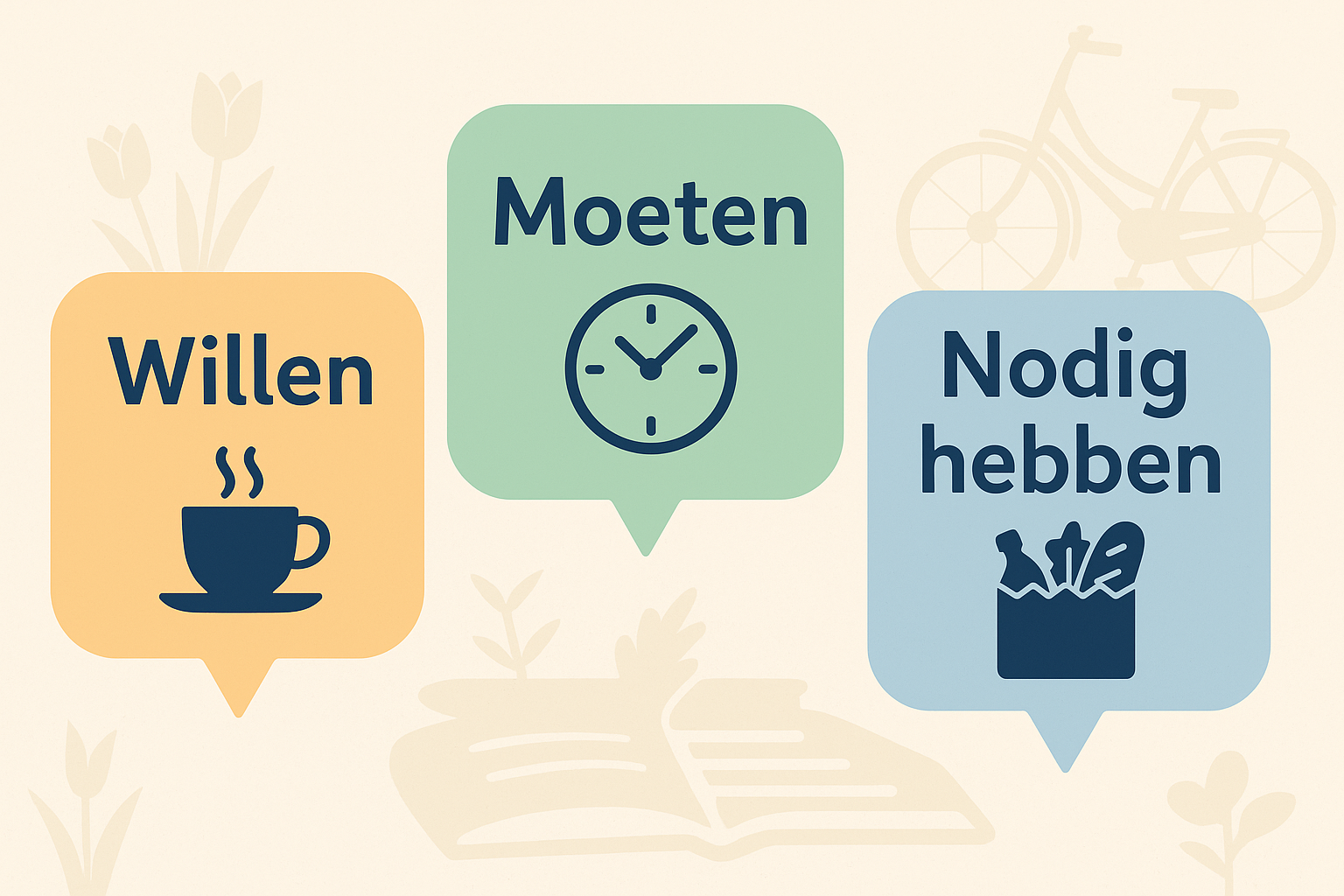
When you start learning Dutch, you quickly realize that knowing nouns and adjectives isn’t enough to have a real conversation—you need to be able to express what you want, what you must, what you can, and what you should do. That’s where modal verbs come in. Modal verbs are small but powerful helpers that completely change the meaning of a sentence. Without them, your Dutch sounds limited and robotic. With them, you can finally say things like “I want to learn Dutch,” “I have to go home,” “You should try this cheese,” or “We can take the train.”
In Dutch, modal verbs (modale werkwoorden) are used all the time, and they are among the first verbs you should master. But here’s the catch: they don’t behave like regular verbs. Their conjugation is a bit irregular, they often push the main verb to the end of the sentence, and their subtle differences in meaning can be confusing. For example, moeten means “must” or “to have to,” but in some cases it softens to “should.” Willen is “to want,” but it can also sound demanding if you don’t use it carefully. Kunnen means “can,” but it also means “to know how to.” And then there’s zullen, which helps form the future tense but also carries nuance about intention and certainty.
Learning modal verbs isn’t just about grammar charts—it’s about communication. They allow you to express desire, obligation, ability, and possibility. In fact, Dutch people rarely speak for more than a few seconds without using one of them. Mastering modals is the difference between saying “I go to school” (Ik ga naar school) and “I have to go to school” (Ik moet naar school), which is what you probably really mean.
In this article, we’ll break down the main Dutch modal verbs, explain how to conjugate them, show how they interact with other verbs, and provide plenty of examples and cultural notes. By the end, you’ll have a clear roadmap for using willen, moeten, kunnen, mogen, and zullen—and you’ll feel much more confident forming sentences that sound natural and expressive.
📌 Key Vocabulary
modale werkwoorden = modal verbs
hoofdwerkwoord = main verb
hulpwerkwoord = auxiliary verb
infinitief = infinitive
Part 1: What Are Modal Verbs in Dutch?
Modal verbs are a small group of helper verbs that express mood, intention, or necessity rather than just action. Unlike normal verbs such as lopen (to walk) or eten (to eat), modal verbs almost always appear alongside another verb in its infinitive form.
Examples:
Ik moet werken. = I have to work.
Zij wil studeren. = She wants to study.
Wij kunnen zwemmen. = We can swim.
Notice that the modal verb is conjugated, but the main verb (werken, studeren, zwemmen) stays in the infinitive and goes to the end of the clause.
Part 2: The Big Five Dutch Modal Verbs
2.1 Willen = To Want
Perhaps the most useful modal verb for beginners is willen, meaning “to want.”
Conjugation (present tense):
ik wil = I want
jij/u wilt = you want
hij/zij/het wil = he/she/it wants
wij willen = we want
jullie willen = you (plural) want
zij willen = they want
Examples:
Ik wil koffie. = I want coffee.
Wil je mee? = Do you want to come along?
Wij willen Nederlands leren. = We want to learn Dutch.
⚠️ Cultural note: Using ik wil directly can sound a bit blunt in Dutch culture, which values politeness. Instead of Ik wil een biertje (I want a beer), people often say Mag ik een biertje? (May I have a beer?) when ordering.
2.2 Moeten = To Have To / Must
Moeten is used for obligation, necessity, or strong recommendations.
Conjugation (present tense):
ik moet = I must / have to
jij/u moet = you must
hij/zij/het moet = he/she/it must
wij moeten = we must
jullie moeten = you (plural) must
zij moeten = they must
Examples:
Ik moet naar school. = I have to go to school.
Moet ik betalen? = Do I have to pay?
Je moet dit proberen! = You should try this!
⚠️ Nuance: Moeten can be strict (“must”) or softer (“should”), depending on tone and context.
2.3 Kunnen = Can / To Be Able To
Kunnen expresses ability, possibility, or permission.
Conjugation (present tense):
ik kan = I can
jij/u kan(t) = you can
hij/zij/het kan = he/she/it can
wij kunnen = we can
jullie kunnen = you (plural) can
zij kunnen = they can
Examples:
Ik kan zwemmen. = I can swim.
Kun je helpen? = Can you help?
We kunnen morgen komen. = We can come tomorrow.
⚠️ Tricky point: Kunnen can also mean “to know how to.” For example: Hij kan piano spelen. = He knows how to play piano.
2.4 Mogen = May / To Be Allowed To
Mogen expresses permission or polite requests.
Conjugation (present tense):
ik mag = I may / am allowed
jij/u mag = you may
hij/zij/het mag = he/she/it may
wij mogen = we may
jullie mogen = you (plural) may
zij mogen = they may
Examples:
Mag ik naar het toilet? = May I go to the bathroom?
Je mag kiezen. = You may choose.
Mag ik vragen? = May I ask?
⚠️ Politeness strategy: Dutch people often use mogen instead of willen when making polite requests, especially in shops, restaurants, and formal situations.
2.5 Zullen = Shall / Will
Zullen is used for making suggestions, offers, or talking about the future.
Conjugation (present tense):
ik zal = I will / shall
jij/u zult = you will
hij/zij/het zal = he/she/it will
wij zullen = we will
jullie zullen = you (plural) will
zij zullen = they will
Examples:
Zullen we gaan? = Shall we go?
Ik zal je morgen bellen. = I will call you tomorrow.
Zullen we afspreken? = Shall we meet?
⚠️ Cultural nuance: Zullen we…? is one of the most Dutch phrases you’ll hear. It’s used constantly to suggest plans in a friendly way.
Part 3: Modal Verbs in the Past
Modal verbs also appear in past tense forms, usually with a main verb in infinitive form at the end.
Examples:
Ik wilde gaan. = I wanted to go.
Hij moest werken. = He had to work.
Wij konden niet komen. = We could not come.
Je mocht kiezen. = You were allowed to choose.
We zouden vertrekken. = We were supposed to leave.
Notice that zullen in the past becomes zouden, which often expresses conditional ideas (would).
Part 4: How Modal Verbs Shape Word Order
Dutch word order is already a challenge, and modal verbs add another layer.
Ik moet vandaag werken. = I have to work today.
Hij wil morgen naar school gaan. = He wants to go to school tomorrow.
Rule: Modal verb = conjugated, goes second. Main verb = infinitive, goes to the end.
In subordinate clauses:
Omdat ik moet werken, blijf ik thuis. = Because I have to work, I’m staying home.
Hij zegt dat hij wil komen. = He says that he wants to come.
Part 5: Subtle Differences Learners Should Notice
Willen vs. Mogen: Wanting vs. being allowed.
Ik wil een biertje. = I want a beer.
Ik mag een biertje. = I’m allowed a beer.
Moeten vs. Zullen: Obligation vs. suggestion.
Ik moet gaan. = I must go.
Zullen we gaan? = Shall we go?
Kunnen vs. Mogen: Ability vs. permission.
Ik kan Nederlands spreken. = I can speak Dutch (ability).
Ik mag Nederlands spreken. = I’m allowed to speak Dutch (permission).
Part 6: Cultural Insights on Modal Verbs
Dutch politeness often avoids directness, so mogen softens demands.
The Dutch love planning, so zullen we… is a core social phrase.
Moeten reflects Dutch practicality and directness—things that must be done are stated clearly.
Part 7: Practice Sentences
Translate into Dutch:
I want to learn Dutch.
You have to pay.
We can come tomorrow.
May I sit here?
Shall we eat together?
(Answers: Ik wil Nederlands leren. Jij moet betalen. Wij kunnen morgen komen. Mag ik hier zitten? Zullen we samen eten?)
FAQs
1. Which modal verb is most important to learn first?
Willen and moeten, since they appear constantly in daily conversations.
2. Are modal verbs irregular?
Yes, slightly, but their patterns are predictable with practice.
3. Can modal verbs be used without another verb?
Sometimes (Ik wil!, Mag ik?), but usually they accompany an infinitive.
4. How do children learn modal verbs?
They often use willen and moeten first—showing how central they are to communication.
5. Is zullen always about the future?
Not always. It’s also used for suggestions and polite offers.
6. Do Dutch people use modal verbs often in casual speech?
All the time. They are unavoidable in everyday conversations.
7. What’s the difference between zullen and gaan for the future?
Both can indicate future, but gaan (going to) is more immediate, while zullen can feel more formal or planned.
8. Do modal verbs affect pronunciation?
Yes, some are shortened in speech: Ik wil → k’ wil, Ik heb → k’ heb.
Conclusion: Small Verbs, Big Power
Modal verbs may look short and unassuming, but they are among the most powerful tools in Dutch. They let you express wants, needs, abilities, and obligations—the backbone of real-life communication. Once you master willen, moeten, kunnen, mogen, and zullen, you’ll notice your Dutch conversations become smoother, more natural, and far more expressive.
At Polyglottist Language Academy, we believe that mastering Dutch means more than memorizing vocabulary—it means learning how to use the right structures in real situations. Our Dutch classes give you the skills to use modal verbs confidently, while also exploring the culture and nuances that make Dutch communication unique.
🌍 Ready to say what you want, what you must, and what you can do in Dutch? Sign up today for our Dutch classes and unlock real conversational fluency.
And if you enjoyed this article, check out more of our in-depth guides:
A Brief History Of The Dutch Language (And Why It Matters Today)
Is Dutch Easier To Learn If You Already Speak German Or Afrikaans?
Why Dutch Pronunciation Trips Up So Many Learners (And How To Master It)
How Similar Is Dutch To English? Surprising Linguistic Overlaps
Dutch Classes In Oakland: Learn Dutch Online With Local Instructors
How Long Does It Take To Learn Dutch – Realistic Timelines By Level