
Introduction
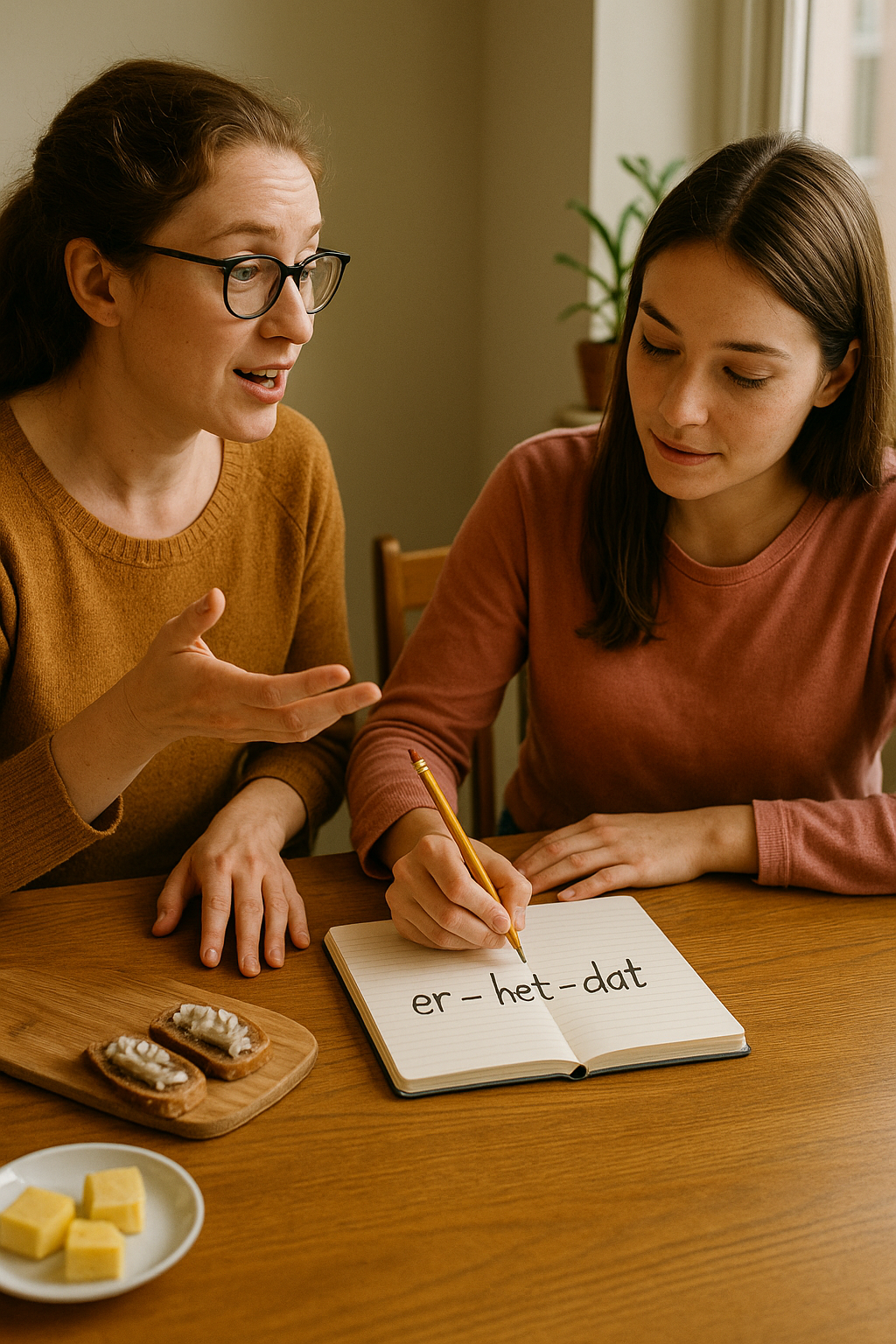
One of the biggest surprises for learners of Dutch is that fluency isn’t just about knowing nouns, verbs, and adjectives—it’s about mastering the small, seemingly invisible words that glue sentences together. Among the most common (and most confusing) of these are er, het, and dat. They are short, they appear constantly, and they often carry no direct English translation. For beginners, they feel slippery, as if they appear and disappear without rules. For advanced learners, they remain one of the last hurdles to sounding truly natural in Dutch.
Why are these words so challenging? Because they don’t always “mean” something concrete. Instead, they function as dummy subjects, reference words, or sentence placeholders. They make Dutch sentences feel balanced and complete, and they allow speakers to avoid repetition, create nuance, or emphasize the right part of a sentence. In fact, Dutch would feel incomplete and robotic without them. Native speakers lean on these little words constantly, often without realizing it.
Understanding er, het, and dat is like learning the secret code of Dutch sentence-building. Once you know when and why to use them, you unlock a new level of fluency. You’ll suddenly understand why Dutch people say Er is een probleem(literally, “There is a problem”) instead of just Een probleem is. You’ll see why Het regent is the only natural way to say “It’s raining,” and why Ik denk dat het goed is is more than just “I think that it is good.”
In this article, we’ll break down how each of these words works, why they exist, and how to use them correctly. We’ll explore er as a dummy subject and pronoun, het as both “it” and a formal placeholder, and dat as both “that” and a linking word. With dozens of examples, cultural insights, and learner-friendly tips, you’ll finally get clarity on these tricky but essential words.
By the end, you’ll see er, het, and dat not as confusing mysteries but as helpful tools that give Dutch its rhythm, efficiency, and precision.
📌 Dutch Vocabulary Key
dummy subject = a subject word used when there is no real subject
verwijzingswoord = reference word
bijzin = subordinate clause
aanwijzend voornaamwoord = demonstrative pronoun
Part 1: The Many Faces of ER
1.1 Er as a Dummy Subject
Dutch sentences often require a subject, even if there isn’t really one. That’s where er comes in.
Er is een probleem. = There is a problem.
Er staat een man bij de deur. = There is a man at the door.
Here, er doesn’t mean “there” in the sense of a location. It’s just a dummy subject that fills the subject slot so the verb can appear second, as Dutch grammar demands.
👉 Compare:
❌ Is een probleem.
✅ Er is een probleem.
Without er, the sentence feels incomplete.
1.2 Er for Existence and Quantity
Er often introduces existence or presence.
Er zijn veel mensen in het park. = There are many people in the park.
Er waren geen stoelen. = There were no chairs.
It’s almost always required when talking about numbers, amounts, or the existence of something.
1.3 Er with Prepositions
Dutch often avoids repeating objects by combining er with prepositions.
Ik denk aan het examen. = I think of the exam.
Ik denk eraan. = I think of it.
Zij wacht op de bus. = She waits for the bus.
Zij wacht erop. = She waits for it.
This er + preposition structure is one of the hardest for learners, but once you see it as a replacement for “of it / about it / on it,” it starts to click.
1.4 Er for Location
Sometimes er does mean “there” in a physical sense.
Ik ben er geweest. = I have been there.
Ga jij erheen? = Are you going there?
The difference between er as a dummy subject and er as a location is context.
1.5 Cultural Note: Why Dutch Needs Er
The Dutch love order. Their grammar reflects that by insisting on a subject, even if one doesn’t really exist. Er ensures sentences remain structurally sound, just as Dutch waterworks keep the land safe.
✍️ Practice with er
Translate: There are three books on the table.
Rewrite: Ik praat over het probleem. → Use er.
Translate: I was there yesterday.
Part 2: The Workhorse HET
2.1 Het as “It”
The most straightforward use: het as the neutral pronoun for “it.”
Ik heb een boek. Het is nieuw. = I have a book. It is new.
Het huis is groot. Het = the house (neutral pronoun).
2.2 Het as a Dummy Subject
Dutch uses het when there is no clear subject—especially with weather, time, and distance.
Het regent. = It’s raining.
Het is laat. = It is late.
Het duurt lang. = It takes a long time.
👉 Here, het doesn’t refer to anything specific—it’s a grammatical placeholder.
2.3 Het with Infinitives and Clauses
Dutch often uses het as a reference to a whole clause or action.
Het is moeilijk Nederlands te leren. = It is difficult to learn Dutch.
Het is goed dat je hier bent. = It is good that you are here.
Here, het points not to a thing but to an entire idea.
2.4 Cultural Insight: The Efficiency of Het
Instead of building long, clunky sentences, Dutch uses het to keep ideas short and efficient. This mirrors the Dutch cultural preference for clarity and simplicity.
✍️ Practice with het
Translate: It’s snowing.
Translate: It’s strange to be here.
Translate: It is important that we start now.
Part 3: The Connector DAT
3.1 Dat as “That” (Demonstrative)
Dat is used to point to something specific.
Dat boek is interessant. = That book is interesting.
Ik vind dat leuk. = I like that.
3.2 Dat as a Conjunction
Dat is also one of the most common words introducing subordinate clauses.
Ik denk dat het goed is. = I think that it is good.
Hij zegt dat hij komt. = He says that he is coming.
Rule: When dat introduces a clause, the verb goes to the end.
3.3 Dat vs. Dit
Both mean “this/that,” but dat refers to something further away, while dit refers to something close.
Dit huis is mooi. = This house is beautiful.
Dat huis is groot. = That house is big.
3.4 Cultural Note: Dutch Directness and Dat
Because Dutch communication values directness, dat is used frequently to point out specific ideas or facts without hesitation.
✍️ Practice with dat
Translate: I know that she is here.
Translate: That movie is good.
Rewrite: Ik denk het is goed. → Correct it with dat.
Part 4: Comparing Er, Het, and Dat
Let’s see them side by side.
Er is een probleem. = There is a problem. (er as dummy subject)
Het is een probleem. = It is a problem. (het as reference to situation)
Ik weet dat het een probleem is. = I know that it is a problem. (dat as conjunction)
Each word plays a different structural role, but together they make Dutch sentences flow.
Part 5: Common Mistakes Learners Make
Leaving out er: saying Is een probleem instead of Er is een probleem.
Forgetting dummy het: saying Regen instead of Het regent.
Misusing dat: saying Ik denk het is goed instead of Ik denk dat het goed is.
Confusing er with location vs. dummy subject.
Avoiding these words altogether, leading to robotic-sounding Dutch.
Part 6: Strategies for Mastery
Learn er, het, and dat in real chunks (e.g., Er is…, Het regent, Ik denk dat…).
Practice rewriting sentences both with and without these words.
Pay attention to how natives use them in everyday speech.
Remember that they are about structure, not meaning.
FAQs
1. Is er always necessary?
Not always, but in sentences about existence, amounts, or dummy subjects, yes.
2. What’s the difference between er is and het is?
Er is = there is (introduces something).
Het is = it is (describes something already known).
3. Can I say Regen instead of Het regent?
No. Dutch requires a subject, so het is mandatory.
4. Is dat always translated as “that”?
Often, but as a conjunction it’s more structural than meaningful.
5. Why do Dutch people use these words so much?
Because Dutch grammar requires subjects and connectors for clarity.
6. Do children learn er, het, and dat late?
Yes, even native children master them gradually, which shows how tricky they are.
7. Is Dutch easier than German in this respect?
Yes, because Dutch doesn’t add complicated case endings to prepositions and pronouns.
8. Should I memorize all uses separately?
Better to learn in phrases: Er is, Het is, Ik denk dat…
Conclusion: Small Words, Big Difference
If verbs are the muscles of Dutch and nouns are the bones, then er, het, and dat are the ligaments holding everything together. They may look small, but they shape sentences in profound ways. They allow Dutch speakers to talk about existence, abstract ideas, and subordinate thoughts smoothly and naturally. For learners, mastering these little words is one of the clearest signs of progress from “textbook Dutch” to real-world fluency.
And if you enjoyed this article, check out more of our in-depth guides:
A Brief History Of The Dutch Language (And Why It Matters Today)
Is Dutch Easier To Learn If You Already Speak German Or Afrikaans?
Why Dutch Pronunciation Trips Up So Many Learners (And How To Master It)
How Similar Is Dutch To English? Surprising Linguistic Overlaps
Dutch Classes In Oakland: Learn Dutch Online With Local Instructors
How Long Does It Take To Learn Dutch – Realistic Timelines By Level