
How Similar Is Dutch to English? Surprising Linguistic Overlaps
Introduction
If you’ve ever glanced at a Dutch sign, menu, or newspaper headline and thought, “Hey, I can sort of understand that,” you’re not imagining it. Dutch and English are linguistic cousins—born from the same Germanic family tree—and their shared roots make them far closer than most people realize. In fact, many Dutch words look and sound so much like their English equivalents that you could be forgiven for thinking Dutch is just English with a quirky spelling makeover and a few throat-clearing sounds thrown in for good measure.
But the similarities go deeper than the occasional lookalike word. English and Dutch share common grammar structures, vocabulary patterns, and even certain idiomatic turns of phrase that trace back to a shared linguistic ancestry. This means that for English speakers, learning Dutch is often far less intimidating than tackling a Romance language like French or Spanish, or a non-Indo-European language like Japanese. And while Dutch does have its fair share of curveballs—word order gymnastics, compound nouns that can stretch across an entire line of text—it’s also full of “aha!” moments where you recognize a familiar word or grammatical pattern.
Linguists often describe Dutch as sitting somewhere between English and German, both in vocabulary and in structure. That’s because English, although heavily influenced by French and Latin over the centuries, still retains much of its Germanic core—an inheritance it shares with Dutch. This overlap makes Dutch one of the most accessible foreign languages for English speakers to learn.
In this article, we’ll explore exactly how Dutch and English are related, why they have so much in common, and how you can use these overlaps to your advantage when learning Dutch. We’ll look at vocabulary similarities, shared grammar features, pronunciation parallels, and even cultural factors that make the two languages feel familiar. By the end, you’ll not only understand the depth of the connection—you’ll also know how to leverage it to learn Dutch faster.
1. Shared Ancestry: The West Germanic Connection
Both English and Dutch are part of the West Germanic branch of the Indo-European language family. This means they descended from a common ancestor language spoken more than 1,500 years ago in what is now northern Germany and the Netherlands.
Historically, Anglo-Saxon (Old English) and Old Dutch (also called Old Low Franconian) were so similar that speakers might have understood each other without much trouble. Over time, English absorbed massive amounts of French and Latin vocabulary, while Dutch retained more of its Germanic core—but the structural similarities remained.
2. Vocabulary Twins: Cognates You Already Know
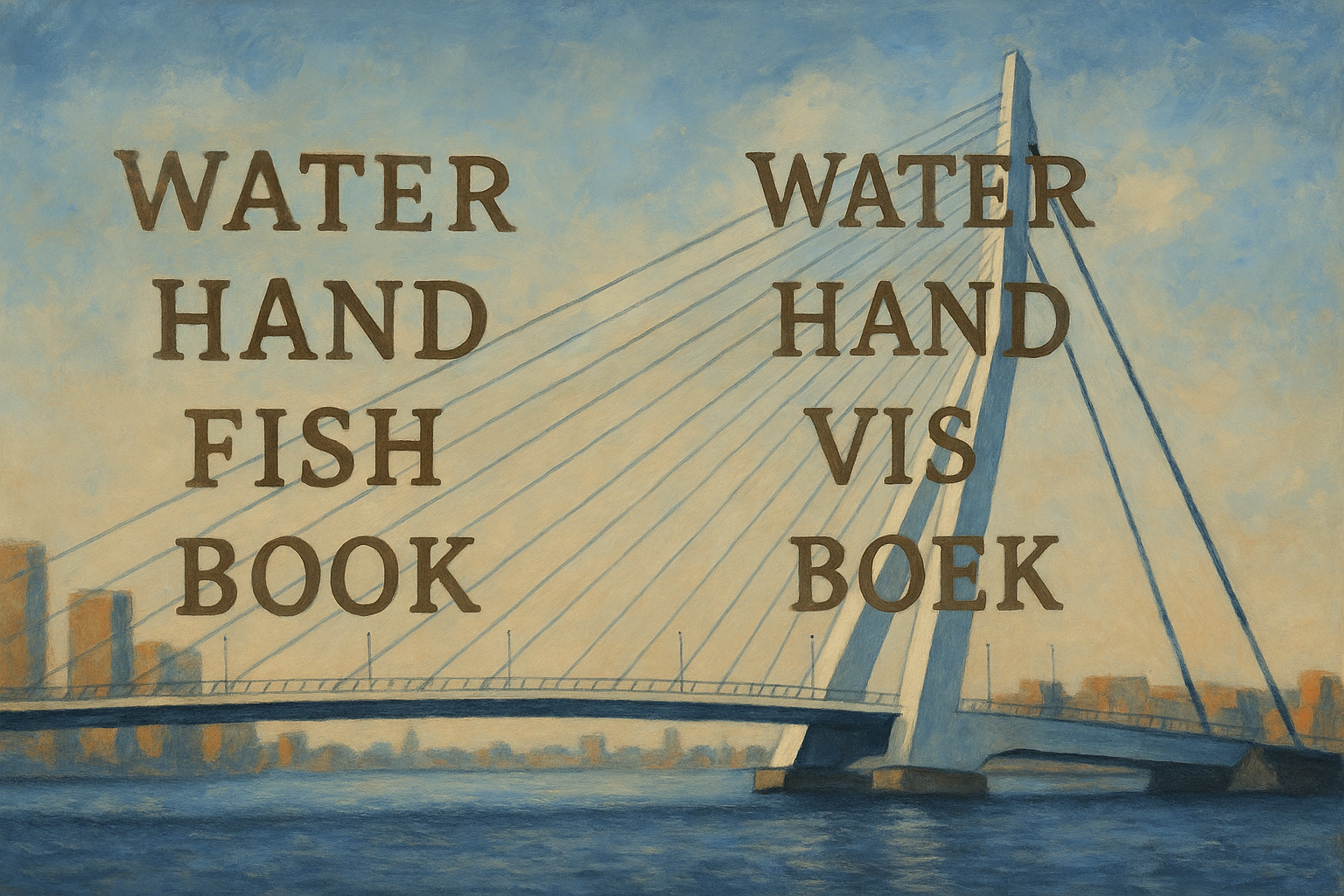
One of the most striking similarities between Dutch and English is the large number of cognates—words that have the same origin and similar meanings in both languages.
Examples include:
Water – water
Hand – hand
Fish – vis
Book – boek
Apple – appel
Many of these words are spelled almost identically, and while pronunciation can differ, the meaning is instantly recognizable. These cognates can give learners a quick confidence boost—something that doesn’t happen as much when learning languages with fewer shared words.
3. False Friends: When Similar Words Mislead
Of course, not every lookalike word is a true friend. Some are false friends—words that look or sound similar but mean something completely different.
For example:
Slim in Dutch means “smart” or “clever,” not “thin.”
Winkel means “shop,” not “small angle.”
Gift means “poison,” not “present.”
While these can be tricky, most learners quickly memorize them—often after a funny or slightly embarrassing misunderstanding.
4. Similar Sentence Structures
Both Dutch and English use a Subject-Verb-Object structure in simple sentences:
English: I eat bread.
Dutch: Ik eet brood.
This parallel makes it easy to grasp the basics of Dutch sentence construction. However, Dutch also uses inversion(changing word order) in certain contexts—something English does less frequently:
Morgen ga ik naar school. (Tomorrow I go to school.)
Here, the time expression morgen comes first, which pushes the subject ik after the verb ga—a feature Dutch shares with German.
5. Verb Conjugations: Simple Beginnings
Another similarity is the relatively straightforward way Dutch conjugates verbs in the present tense. While there are differences, English speakers are already used to adjusting verbs slightly for third person singular (I go vs. he goes), so the concept isn’t foreign:
Ik werk (I work)
Jij werkt (You work)
Hij werkt (He works)
The endings change slightly, but the overall structure feels familiar.
6. Pronouns and Common Words
Dutch pronouns often resemble English ones:
ik (I)
jij / je (you)
hij (he)
wij / we (we)
These resemblances make early learning smoother—you spend less time memorizing entirely new words and more time practicing pronunciation and usage.
7. Compound Words: Dutch Takes It Further
English uses compound words (toothbrush, sunflower), but Dutch elevates this to an art form. You’ll encounter long strings of words fused together, like:
ziekenhuis (hospital – literally “sick house”)
werkgelegenheid (employment – literally “work opportunity”)
While this can be intimidating, recognizing the component parts—many of which are English cognates—helps you decode meaning quickly.
8. Pronunciation: Some Familiar Sounds, Some Challenges
English speakers will recognize many Dutch sounds, but a few will feel exotic at first:
The guttural g and ch, like in goed (“good”) or acht (“eight”)
The vowel ui, found in words like huis (“house”)
Still, Dutch doesn’t have the tonal complexity of Mandarin or the pitch accents of Swedish, and its overall sound system is relatively approachable once you get past the throat-clearing consonants.
9. Idioms and Expressions with Shared Logic
Even idiomatic expressions sometimes overlap in logic, if not in exact wording.
For example:
English: “To have your hands full”
Dutch: Je handen vol hebben (literally the same)
These parallels often make learning idioms in Dutch more intuitive for English speakers.
10. Cultural and Linguistic Proximity
Because the Netherlands has a long history of trade, cultural exchange, and bilingualism, Dutch people often incorporate English words and expressions into their speech. This creates a kind of linguistic comfort zone for learners—many Dutch speakers will naturally code-switch, and exposure to English loanwords in Dutch media can accelerate comprehension.
FAQs
1. Is Dutch easier to learn than French or German for English speakers?
Generally, yes. Dutch shares more vocabulary with English than French does and has simpler grammar than German.
2. Can English speakers understand Dutch without studying it?
You might recognize some words and guess meanings from context, but full comprehension requires study.
3. Are Dutch and English mutually intelligible?
Not exactly. They share many words, but pronunciation and grammar differences mean mutual understanding without prior exposure is limited.
4. Why do Dutch people speak such good English?
High exposure to English media, strong emphasis on English in education, and a cultural openness to other languages.
5. What’s the hardest part of Dutch for English speakers?
Pronunciation of certain sounds (g, ch, ui) and mastering word order in complex sentences.
6. What are some of the easiest Dutch words for English speakers?
Words like water, hand, kat (cat), brood (bread), and school are easy due to their similarity.
7. Do Dutch people use the same alphabet as English?
Yes, but with a few additional combinations and digraphs like ij.
8. Does knowing Dutch help you learn German?
Absolutely—Dutch acts as a stepping stone to German because of shared vocabulary and structure.
Learn Dutch Faster with Polyglottist Language Academy
If the similarities between Dutch and English have piqued your interest, why not turn that curiosity into real language skills? At Polyglottist Language Academy, we offer Dutch classes designed specifically for English speakers, leveraging these natural overlaps to accelerate your learning. Our native-speaking instructors know exactly which elements will feel familiar—and which will require extra practice—so you can progress quickly and confidently.
Whether you’re moving to the Netherlands, preparing for the inburgering exam, or simply want to connect with Dutch friends and culture, our tailored courses will help you get there faster.
📅 Start your Dutch journey today—sign up for our next session and see how much you already know before you even open the textbook.
Check Out Our Other Articles on Dutch Language and Culture
The Fastest Way To Learn Dutch According To Language Teachers
Do You Really Need To Learn Dutch If You Live In The Netherlands?
Dutch Classes In Oakland: Learn Dutch Online With Local Instructors
How Long Does It Take To Learn Dutch – Realistic Timelines By Level
Best Online Dutch Classes In The Bay Area: Oakland, Berkeley, San Francisco & San Jose