
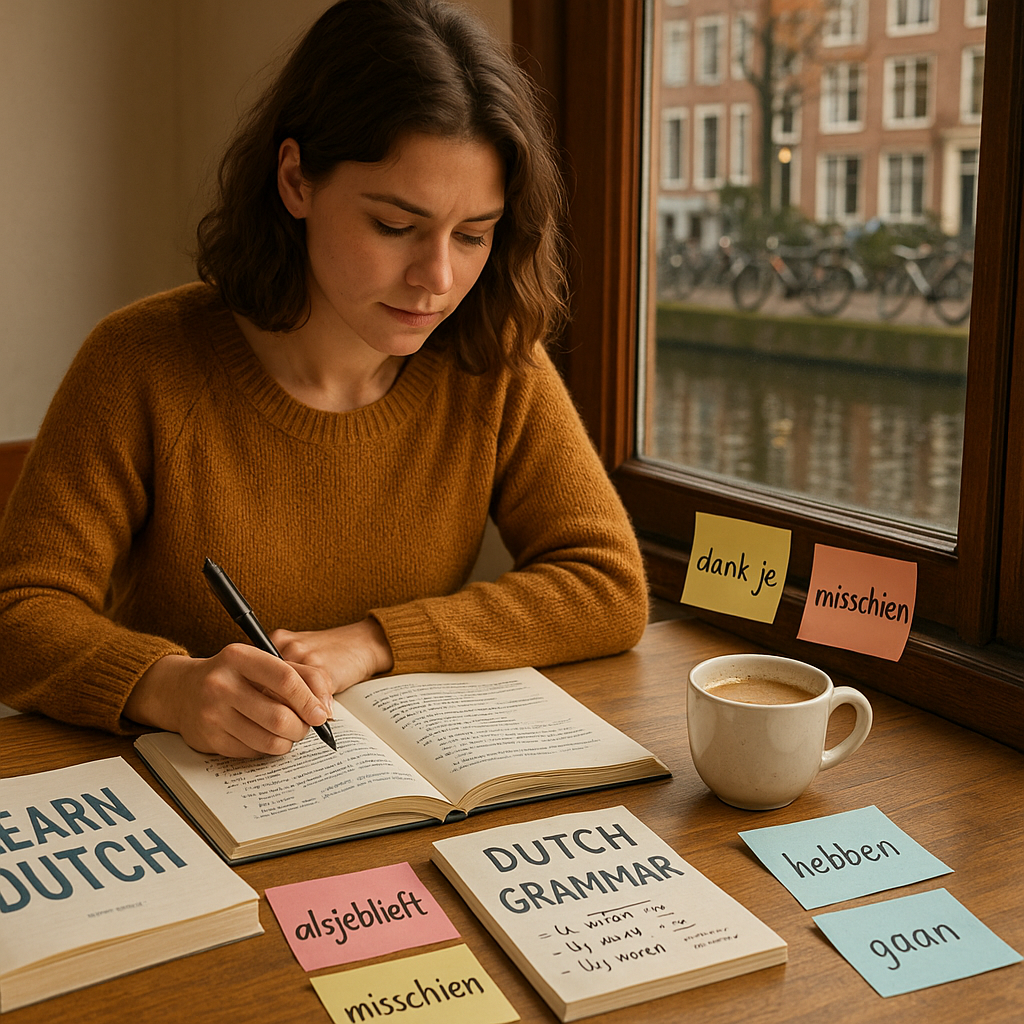
The first few weeks of learning Dutch can feel deceptively easy. You recognize words like water, appel, and school, and phrases such as Hoe gaat het? (How are you?) seem friendly and manageable. You start to think: “Hey, I’ve got this.” But just when you’re getting comfortable, Dutch grammar pulls the rug out from under you—with sentence structures that flip verbs to the end, articles that make no logical sense, and compound words that seem to go on forever.
If you’ve ever found yourself staring blankly at a sentence like Ik denk dat hij morgen niet zal komen and wondering why on earth the verb is hiding at the end, you’re not alone. Dutch grammar is full of subtle traps and rules that don't always follow the logic English speakers are used to. Some of them are relics of the language's Germanic roots, while others are uniquely Dutch quirks. But for beginners, the challenge isn’t just in understanding individual rules—it’s in figuring out how all the pieces fit together when you’re trying to say something simple.
The good news? Every confusing rule you encounter in Dutch has a reason behind it—even if it doesn’t seem like it at first. Once you begin to spot the patterns, the rules become easier to predict, and Dutch starts to feel less like a puzzle and more like a system you can master.
In this article, we’ll walk you through the most confusing Dutch grammar rules that trip up beginners. We’ll break them down one by one, explain why they’re confusing, show how they actually work, and offer tips on how to internalize them. Whether you’re learning Dutch on your own, taking a class, or just getting started, this guide will help you make sense of the chaos and gain more confidence when constructing Dutch sentences.
1. DE VS. HET – THE INFAMOUS ARTICLE RULE
What’s the Rule?
Dutch has two definite articles: de and het, both meaning “the.”
de is used for common gender nouns (masculine and feminine)
het is used for neuter gender nouns
But here’s the catch: there’s no easy way to tell which noun gets which article. You simply have to memorize it.
Why It’s Confusing
English uses just one word: the. So having to memorize the article for every single noun is already annoying. Add to that the fact that there are no hard-and-fast rules for guessing which article to use—and mistakes here make you sound like a beginner fast.
Tips to Master It
Memorize nouns with their articles from the start (het huis, not just huis)
Use flashcards or spaced repetition apps like Anki to drill de/het combos
Remember that diminutives always use het (e.g., het meisje, het tafeltje)
2. WORD ORDER IN MAIN VS. SUBORDINATE CLAUSES
What’s the Rule?
In main (independent) clauses, Dutch word order looks pretty familiar:
Ik eet een appel.
(I eat an apple.)
But in subordinate clauses, the verb moves to the end:
Ik denk dat hij een appel eet.
(I think that he eats an apple.)
Why It’s Confusing
Beginners expect Dutch to behave like English, where word order stays mostly consistent. But in Dutch, the moment you add a conjunction like omdat (because), terwijl (while), or dat (that), you suddenly have to reshuffle the sentence.
Tips to Master It
Learn common subordinating conjunctions (dat, omdat, terwijl, toen, als)
Practice with short sentences using the same pattern over and over
Think of subordinate clauses as “verb buckets”—the verb goes last
3. SEPARABLE VERBS
What’s the Rule?
Some Dutch verbs are made up of a prefix + a base verb, and the prefix gets “separated” in main clauses:
Ik neem deel aan de vergadering.
(I participate in the meeting.)
→ Separable verb: deelnemen
When used in different tenses or sentence types, the prefix reattaches:
Ik wil deelnemen aan de vergadering.
(I want to participate in the meeting.)
Why It’s Confusing
The prefix can float far from the main verb, especially in long sentences. Beginners often miss it altogether and don’t even realize a verb has been split.
Tips to Master It
Memorize common separable verbs (e.g., aandoen, opbellen, meedoen)
Watch for verb parts at the end of the sentence—they often belong together
When in doubt, look up the base verb and check if it’s separable
4. THE POSITION OF MODAL VERBS AND INFINITIVES
What’s the Rule?
In Dutch, modal verbs (like kunnen, moeten, willen) are often paired with a bare infinitive. The word order changes based on sentence type:
Ik kan Nederlands spreken.
(I can speak Dutch.)
But in subordinate clauses:
Ik weet dat ik Nederlands kan spreken.
(I know that I can speak Dutch.)
Now the modal verb is sandwiched between other elements—confusing!
Why It’s Confusing
There’s a stacking of verbs at the end of the sentence in subordinate clauses that takes time to get used to. English doesn’t require this level of gymnastics.
Tips to Master It
Get familiar with “verb clusters” at the ends of sentences
Read example sentences out loud to get the rhythm
Learn fixed expressions to build muscle memory
5. ADJECTIVE INFLECTIONS
What’s the Rule?
In Dutch, adjectives take different endings depending on whether the noun is definite or indefinite and whether it’s a “de” or “het” word:
een mooie dag (a beautiful day — de word, indefinite)
de mooie dag (the beautiful day — de word, definite)
een mooi huis (a beautiful house — het word, indefinite)
het mooie huis (the beautiful house — het word, definite)
Why It’s Confusing
There are too many variables:
Is it “de” or “het”?
Is it definite or indefinite?
Is there an article at all?
It’s easy to default to one form and use it everywhere (often incorrectly).
Tips to Master It
Learn article + adjective + noun as one unit
Use color and visuals to group “de” vs. “het” words
Don’t worry about perfection—fluency comes with time
6. INVERSION AFTER TIME EXPRESSIONS
What’s the Rule?
When you begin a sentence with a time expression, the verb comes before the subject:
Vandaag ga ik naar school.
(Today I go to school.)
Why It’s Confusing
It feels backwards. English allows fronting time expressions too (“Today, I go to school”), but keeps the subject-verb order intact. Dutch flips them.
Tips to Master It
Practice common sentence starters: Vandaag, Morgen, Toen, Gisteren
Write out 10 variations daily to train your brain
Repeat the word order rhythm like a mantra
7. DOUBLE NEGATION AND “GEEN” VS. “NIET”
What’s the Rule?
Dutch uses geen to negate nouns and niet to negate everything else:
Ik heb geen geld. (I don’t have any money.)
Ik werk niet vandaag. (I’m not working today.)
Why It’s Confusing
Knowing when to use geen vs. niet can be a nightmare for beginners. There are no perfect equivalents in English, so it feels arbitrary.
Tips to Master It
Use geen for negating nouns without articles
Use niet for verbs, adjectives, adverbs, and prepositions
Keep a notebook of sample sentences
8. WORD ORDER WITH MULTIPLE VERBS
What’s the Rule?
In complex sentences with multiple verbs, they all go to the end in reverse order:
Ik denk dat hij had willen gaan.
(I think that he had wanted to go.)
Why It’s Confusing
Suddenly there are three verbs sitting at the end of the sentence, and beginners forget which came from where. This can make comprehension difficult, too.
Tips to Master It
Break down long sentences into parts
Practice “verb stacking” drills
Recognize modal + auxiliary combinations
9. PLURAL NOUN ENDINGS
What’s the Rule?
Dutch nouns usually form plurals by adding -en or -s, but there’s no consistent rule:
tafel → tafels
huis → huizen
vrouw → vrouwen
Why It’s Confusing
There are some general tendencies (e.g., words ending in vowels take -’s), but lots of exceptions. The plural form must simply be memorized.
Tips to Master It
Add plural forms to your vocabulary list
Use apps that test singular/plural pairs
Read children’s books—they use lots of plurals!
10. “ER” – THE MOST SLIPPERY WORD IN DUTCH
What’s the Rule?
The word er is used in Dutch for so many things—location, existence, quantity, and emphasis:
Er is een probleem. (There is a problem.)
Ik ben er geweest. (I have been there.)
Er zitten vijf mensen in de kamer. (There are five people in the room.)
Why It’s Confusing
Er doesn’t translate cleanly into English, and it appears all over the place in Dutch. Beginners often don’t know when or why to use it.
Tips to Master It
Learn fixed expressions that use er
Focus on hearing er in context through podcasts and dialogues
Practice replacing “there” in English with er in Dutch
FREQUENTLY ASKED QUESTIONS (FAQ)
❓Do I need to master all Dutch grammar rules right away?
Not at all! Focus on the most common patterns first. Fluency grows gradually, and perfection isn't necessary to communicate effectively.
❓What’s the single hardest Dutch grammar rule for beginners?
Most learners agree that the word order in subordinate clauses is the trickiest, followed closely by the de vs. het article problem.
❓Should I worry about adjective endings in the beginning?
Not much. Understanding them helps, but using the wrong ending won’t prevent you from being understood. Refine this skill as you advance.
❓Is it better to speak with mistakes or wait until I get it right?
Speak—even with mistakes! You’ll learn more through trial and error, and Dutch speakers are usually supportive of learners.