
How Russian Immigrants Have Shaped American Food, Culture, and Language
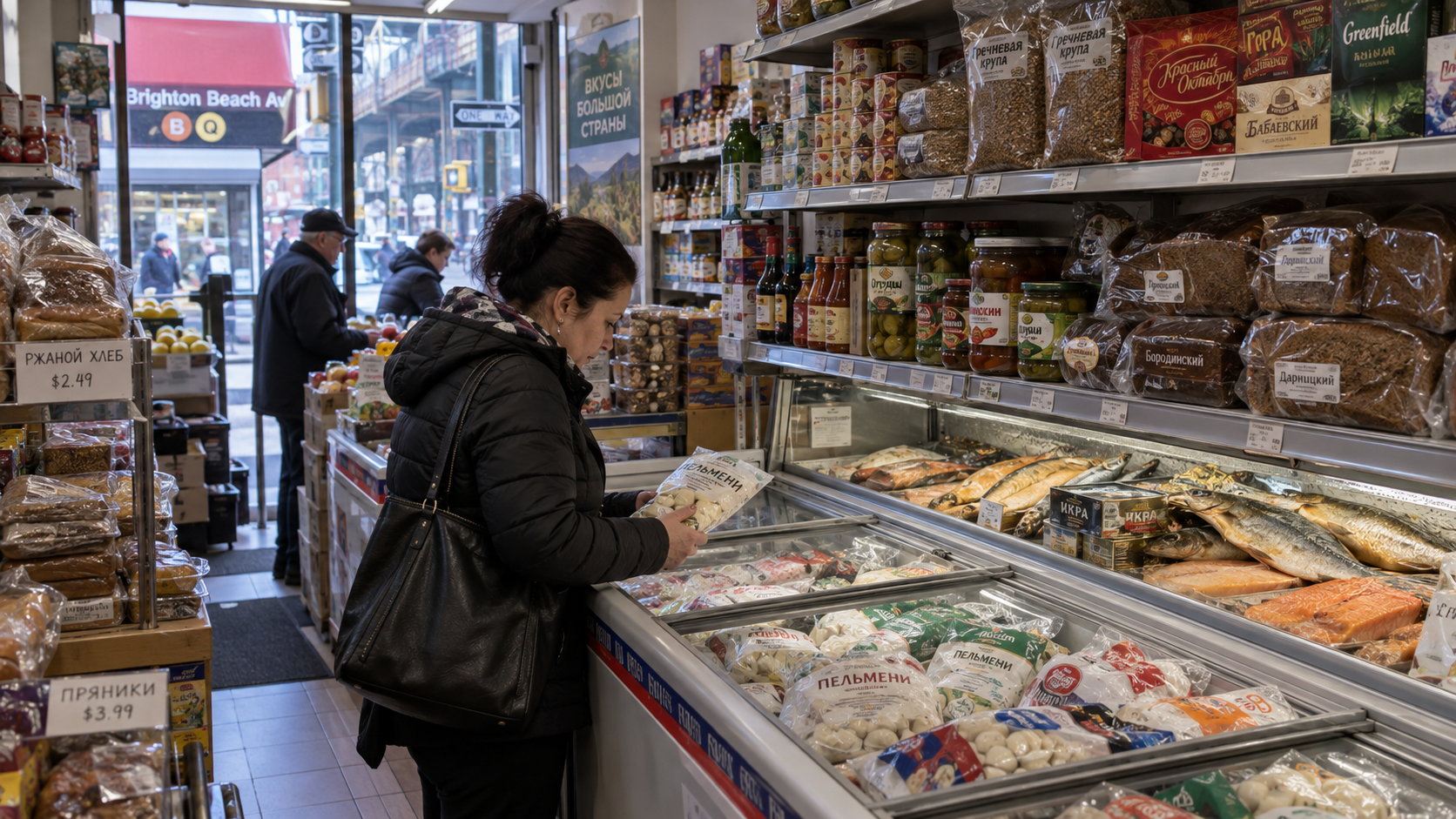
Walk into a Russian-speaking grocery store in Brighton Beach and the shelves tell a more complicated story than the sign outside. You may find pelmeni and buckwheat beside Georgian mineral water, Ukrainian sweets, Armenian products, Central Asian breads, smoked fish, Soviet-era candies, and foods whose origins are debated across several countries. Russian may be the language shoppers use with the cashier, but the food itself comes from a much wider cultural map.
That is a useful place to begin thinking about Russian influence in the United States, because there has never been one simple Russian-American experience.
People arrived from the Russian Empire before there was a Soviet Union. Others fled the Revolution and Civil War. Soviet Jews emigrated in large numbers later in the twentieth century. Artists and intellectuals defected or went into exile. After 1991, new immigrants came from Russia and from other former Soviet republics, often sharing Russian as a common language even when they did not identify as Russian.
Food, language, religion, literature, neighborhood businesses, theater, dance, publishing, and family traditions all traveled along different routes.
Russian Immigration Did Not Happen All at Once
The phrase “Russian immigrant” can be misleading when applied to the nineteenth and early twentieth centuries.
The Russian Empire contained dozens of ethnic, linguistic, and religious groups. Large numbers of people arriving in the United States from territories ruled by the czars were Polish, Ukrainian, Belarusian, Lithuanian, Jewish, Armenian, or members of other communities. The Library of Congress notes that ethnic Russians themselves were comparatively limited in their ability to emigrate before the Revolution; the 1910 U.S. census counted only about 65,000 Russians in the country.
This is especially important when discussing Jewish immigration. Between 1880 and the restrictions imposed in the 1920s, millions of Eastern European Jews came to the United States from territories that included parts of the Russian Empire. Most did not consider themselves Russian. They had their own languages, religious institutions, food traditions, political organizations, and community life, even though American documents might record their birthplace as “Russia.”
A different group arrived after the Russian Revolution of 1917. More than two million people fled the upheaval following the collapse of the empire and the Civil War, and more than 30,000 eventually reached the United States. Many of these so-called White émigrés had been professionals, officials, members of the aristocracy, or other opponents of the new Soviet regime.
Later waves looked different again. Soviet-era emigrants included Jewish families, political dissidents, writers, musicians, and artists. By the 1970s, Soviet emigration had begun to open somewhat, and the final years of the USSR brought much larger numbers abroad.
After 1991, Russian-speaking immigration became even harder to describe with a single national label. A person arriving from Ukraine, Belarus, Kazakhstan, Moldova, Georgia, or another former Soviet republic might speak Russian as a first or dominant language without being ethnically Russian.
That is why an American “Russian” grocery, restaurant, newspaper, or neighborhood often represents something broader than Russia itself.
The Complicated Meaning of “Russian Food”
Food is probably the easiest place to see this overlap. Consider borscht. For decades, American menus and cookbooks often grouped it under the broad heading of Russian or Eastern European food. Yet borscht has a particularly strong place in Ukrainian cultural identity; UNESCO inscribed the culture of Ukrainian borscht cooking on its Intangible Cultural Heritage list in 2022 while also noting that versions of borscht are prepared across the broader region.
The point is not that Russians do not eat borscht. They do. It is that migration frequently changes labels. A dish that crossed several borders, languages, and communities could arrive in an American restaurant and simply be called “Russian” because that was the category customers recognized.
The same thing happened on a larger scale in Soviet life. Foods from Georgia, Ukraine, Central Asia, Armenia, and elsewhere circulated throughout the USSR. A family in Moscow might eat foods whose origins were hundreds or thousands of miles away. When Soviet immigrants later opened stores in the United States, they often stocked the foods their customers remembered from this shared world.
One Brighton Beach grocery provides a good example. Brooklyn Public Library's historical collection describes M & I International Food, a well-known market that operated in the neighborhood for decades. Its prepared foods included red and green borscht, Georgian kharcho, and Bukharian lagman, a Central Asian noodle dish. The store was serving a Russian-speaking clientele, but its menu was plainly not an exclusively ethnic Russian one.
That mixture is still characteristic of many post-Soviet food stores in America. Russian may be the shared language, while the recipes come from several different culinary traditions.
Jewish Immigration and American Food
The food story becomes even more complicated when the enormous Jewish migration from the Russian Empire is included.
At the turn of the twentieth century, New York's Lower East Side became one of the centers of Jewish immigrant life in America. The neighborhood developed synagogues, stores, bakeries, restaurants, markets, mutual-aid organizations, and a dense street economy serving people who had arrived from Eastern Europe.
It would be inaccurate to describe Jewish delicatessen culture simply as Russian food. Much of it came from a broader Ashkenazi world stretching through territories that today belong to Poland, Ukraine, Lithuania, Belarus, and other countries.
But the Russian Empire is still part of the history because so many of the immigrants who helped build this food culture came from lands governed by it.
This is where immigration labels can be misleading. An American historian may know that someone arrived from “Russia” in 1905. That does not tell us whether the person spoke Russian, Yiddish, Polish, Ukrainian, Lithuanian, or another language at home, or what cultural identity that person would have claimed.
Brighton Beach and the Russian-Speaking Neighborhood
If there is one American neighborhood most closely associated with Russian-speaking immigration, it is Brighton Beach in Brooklyn.
Its modern Russian-speaking identity developed particularly strongly after Soviet immigrants began settling there in the 1970s. Many were Jewish, and many came from different parts of the Soviet Union. A significant number came from Ukraine, especially Odessa, which helped give Brighton Beach its enduring nickname, “Little Odessa.”
The neighborhood did more than provide housing.
Brighton Beach Avenue developed Russian-speaking groceries, restaurants, newsstands, entertainment venues, and other businesses. Even today, Brooklyn Public Library describes the avenue as lined with Russian shops, groceries, restaurants, newsstands, and nightclubs, while the neighborhood library continues to see especially strong demand for Russian-language materials.
That infrastructure helps explain why a community language can remain visible for decades.
An immigrant who can buy groceries in Russian, read a Russian-language newspaper, visit a Russian-speaking doctor, attend a religious service, eat at a familiar restaurant, and socialize with other Russian speakers can continue using the language in public rather than confining it to the home.
Russian-language publishing in the United States has an even longer history. The Library of Congress identifies the Alaska Herald, first published in 1868, as the first Russian-language newspaper in the country. By the 1890s, Russian-language periodicals were appearing alongside increased migration and political activity.
A community language survives not simply because parents speak it to their children. It survives because there are places to use it.
Russian Influence Beyond Food
Food may be the most visible legacy, but Russian and Russian-trained émigrés also left a substantial mark on American artistic life.
Ballet provides one of the clearest examples. In 1934, Lincoln Kirstein and George Balanchine founded the School of American Ballet in New York. Balanchine had been trained in the Russian imperial ballet tradition, but the goal was not to reproduce Russian ballet unchanged. He wanted to build an American school and eventually an American company. The result was the New York City Ballet, founded in 1948, and a distinctive style that grew from Russian classical training while developing into something identifiably American.
The early faculty reflected migration across borders. Russian and Russian-trained dancers and teachers worked alongside instructors from other European traditions. Balanchine's choreography emphasized speed, clarity, precision, and musicality, and the school describes the resulting approach as an American ballet tradition rooted partly in Russian classical technique.
Theater followed a different route. Konstantin Stanislavski himself was not an immigrant who settled in America, but his ideas about acting traveled across the Atlantic and deeply affected American training. Lee Strasberg studied with Richard Boleslavsky and Maria Ouspenskaya, both connected to the Moscow Art Theatre tradition, and later developed Method acting in the United States. Library of Congress collections document how Russian writings on Stanislavski and the Moscow Art Theatre were translated and studied by members of the Group Theatre as they tried to transform American acting.
Strasberg eventually taught generations of major American actors at the Actors Studio, helping make psychologically oriented Method acting one of the most influential traditions in twentieth-century American theater and film.
Russian Literature in American Life
Russian literature influenced American readers long before most Americans personally knew Russian immigrants.
Tolstoy, Dostoevsky, Chekhov, and other Russian writers became part of American literary and university culture through translation. That is cultural influence, but it is different from immigration.
Émigré writers added another layer. Vladimir Nabokov eventually settled in the United States and wrote some of his most famous work in English. Joseph Brodsky, expelled from the Soviet Union in 1972, later lived and taught in the United States and became an American citizen. The Library of Congress places both Nabokov and Brodsky within the larger story of Russian émigrés contributing to American intellectual and cultural life.
For Russian learners, writers such as these also raise an interesting question about what happens when culture moves between languages. Translation allows literature to travel widely, but anyone who learns enough Russian to begin reading the originals soon encounters humor, rhythm, word choice, and cultural references that do not move perfectly into English.
The Russian Words Americans Already Use
English has borrowed far fewer words from Russian than from French or Spanish, but a handful are now completely familiar to American speakers.
Vodka is an obvious example. English has used the word since at least the early nineteenth century; it comes from Russian and is related to вода — voda, meaning “water.”
Intelligentsia entered English in the late nineteenth century and was initially used largely in discussions of Russian intellectual life. By the early twentieth century, English speakers were using it much more broadly for intellectual or cultural elites in other societies as well.
Other borrowings arrived because of politics rather than immigration.
Sputnik entered English almost instantly in 1957 after the Soviet Union launched the first of its famous satellites; the Russian word literally carries the idea of a traveling companion.
Samizdat, glasnost, perestroika, and gulag became familiar because Americans encountered them through Soviet history, journalism, diplomacy, and Cold War politics. They are Russian words in English, but their route into the language was not primarily through Russian-American neighborhoods.
Then there is babushka, which shows what can happen when a borrowed word develops a life of its own.
In Russian, бабушка — babushka means “grandmother.” American English has also used babushka for a headscarf tied under the chin, presumably through association with the style worn by older Eastern European women. Merriam-Webster lists both meanings, even though a Russian speaker would not normally use бабушка as the name of a scarf.
For a Russian learner, this is a small but revealing lesson: knowing a borrowed Russian word in English does not necessarily mean you know how the word works in Russian.
What Happens to Russian Across Generations
Language preservation inside immigrant families rarely follows a neat pattern. First-generation adults may continue speaking almost entirely Russian at home. Their children may understand everything but answer in English. Another child may speak easily but read Cyrillic slowly. Someone else may know family vocabulary, jokes, food names, and expressions used by grandparents but struggle to discuss work or politics in Russian.
Researchers studying Russian heritage speakers in the United States encounter exactly this kind of linguistic mixture, including speakers whose families originated not only in Russia but also in Ukraine, Belarus, and other former Soviet republics.
The language may also preserve an older layer of vocabulary. A person whose grandparents emigrated decades ago can grow up hearing expressions associated with their generation while contemporary speakers elsewhere have adopted newer slang or different habits. That is not necessarily incorrect Russian. It is one of the normal effects of maintaining a language outside the country where it is dominant.
Food often survives longer than fluency. A family may stop using Russian regularly with children while continuing to make Olivier salad for holidays, buy buckwheat from an Eastern European market, prepare pelmeni, or call a grandmother babushka.
Cultural inheritance and linguistic inheritance do not always fade at the same speed.
Russian-American Culture Is Still Changing
It is tempting to imagine immigrant neighborhoods as preserved fragments of another country. Brighton Beach itself shows why that picture is too simple.
The Russian-speaking immigrants who arrived in the 1970s were not identical to the White émigrés who came after the Revolution. The people who arrived after the collapse of the Soviet Union brought different experiences again. Today's Russian-speaking immigrants may come from very different national backgrounds, political histories, and generations.
The neighborhood around them changes too. Brighton Beach remains strongly associated with Russian-speaking life, but it is also home to significant immigrant populations from other parts of the world. New York City's 2026 demographic analysis found that 71 percent of Brighton Beach residents were foreign-born, making it one of the city's most heavily immigrant neighborhoods overall rather than simply a Russian enclave.
A grocery store changes its inventory. A restaurant begins attracting people who did not grow up with the food. Children understand the language but answer in English. New immigrants arrive with foods that older immigrants did not know. A Russian word enters American English and acquires a new meaning.
The culture survives, but it does not stand still.
Learning Russian Can Reveal Another Layer
For complete beginners, studying Russian means learning a new alphabet, unfamiliar grammar, pronunciation, and eventually enough vocabulary to begin participating in conversation.
Heritage learners often have a different task. They may already understand family members and pronounce Russian naturally but have gaps in grammar, reading, or vocabulary that become obvious only when they try to speak outside familiar situations.
Polyglottist Language Academy offers small-group Russian classes for adults, both in Berkeley and online, with levels ranging from complete beginner through more advanced study. Readers interested in learning the language or strengthening heritage Russian can explore the current program on the Polyglottist Language Academy Russian classes page.
Learning the language also makes the cultural history more precise. Babushka stops being a scarf. A Russian grocery label becomes readable. A family expression that never translated particularly well into English suddenly has a grammatical structure you can explain.
And sometimes it becomes easier to see how many different histories have been grouped under the same familiar word: “Russian.”
Return to that grocery store in Brighton Beach. The shelves may contain Russian labels beside Ukrainian sweets, Georgian mineral water, Armenian products, Central Asian dishes, Soviet childhood favorites, and American brands. The shoppers may all use Russian with one another, even though their families came from several different countries.
That store tells the immigration story better than a list of Russian contributions ever could.
Culture does not cross an ocean unchanged. It gets translated, mixed with neighboring traditions, renamed for American customers, preserved by one generation and altered by the next. Some parts become broadly American. Others remain meaningful mainly inside families and immigrant neighborhoods.
Russian-American culture is not a copy of Russia transplanted to the United States. It is something that developed here, out of several migrations and several identities, with Russian often serving as the language connecting them.