
How to Learn Katakana: The Complete Beginner's Guide (With Tricky Characters Explained)
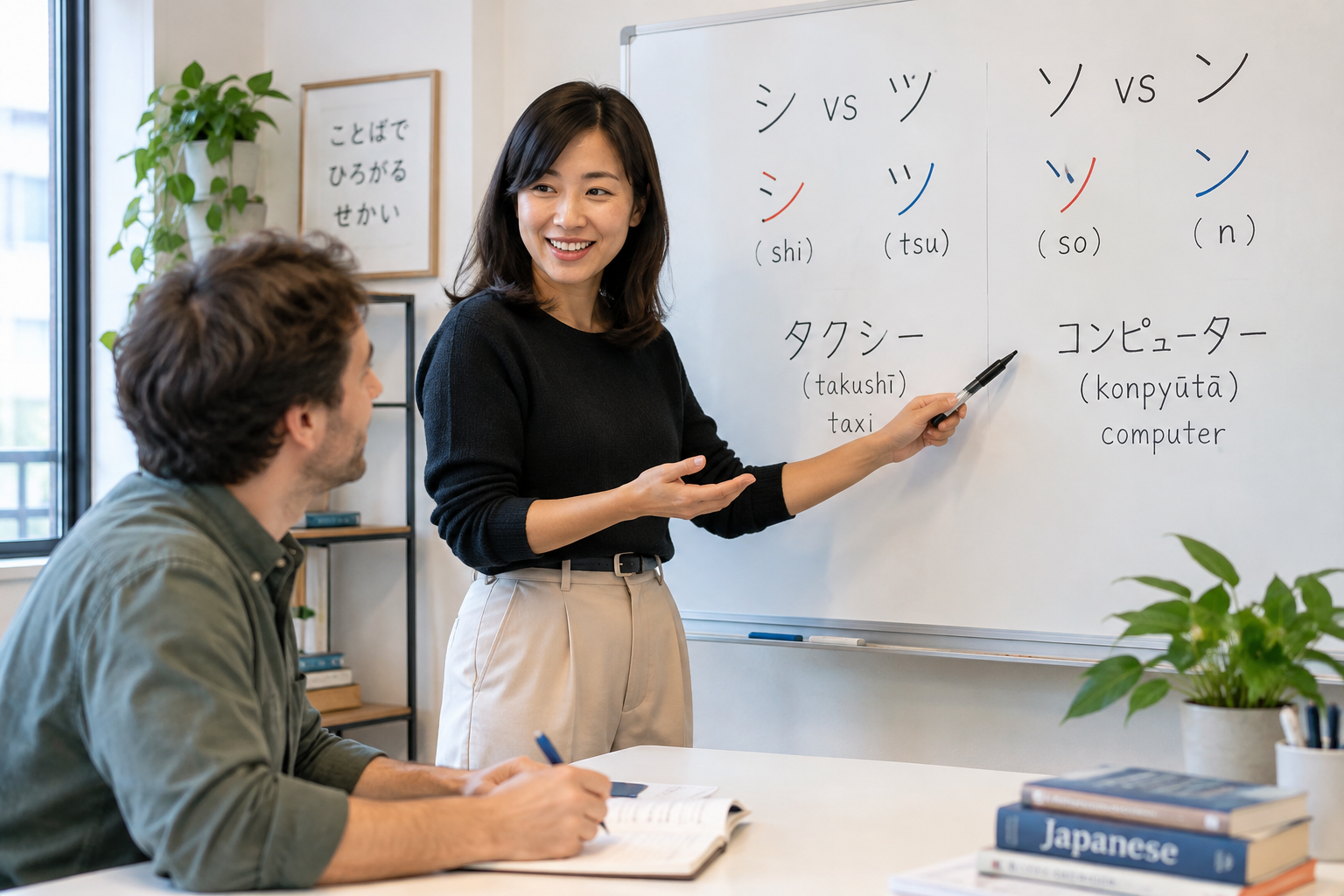
Many beginners expect katakana to be easier than hiragana. There are the same basic sounds, most students have already learned the idea of kana, and the characters look angular and relatively simple. Then, a week later, シ and ツ have somehow become the same symbol, ソ and ン keep trading places, and a word such as コンピューター takes far longer to read than it seems it should.
That reaction is normal. Katakana is not inherently more complicated than hiragana. It is often harder because learners encounter it less frequently at the beginning, so the shapes have fewer chances to become automatic. The solution is not to stare at the chart longer. It is to learn katakana as a reading system attached to real words.
First, understand what katakana actually does
Modern Japanese uses katakana for several jobs. The one beginners notice first is foreign loanwords: ホテル for “hotel,” カメラ for “camera,” and コンピューター for “computer.” Katakana also appears in foreign names, company and product names, scientific terminology, animal and plant names in some contexts, sound effects, and words that a writer wants to emphasize visually.
That matters because katakana is not an optional second alphabet that can be postponed indefinitely. Even an elementary menu, station sign, advertisement, or convenience-store label can contain it.
Start with the 46 basic symbols, but do not make “memorize all 46” your only goal. You need three abilities: see a symbol and know its sound, hear a sound and write the symbol, and read several symbols together without decoding them one by one. The third ability is where real reading begins.
Learn in small sound families
A sensible first pass is to learn katakana in the same sound rows used for hiragana: ア・イ・ウ・エ・オ, then カ・キ・ク・ケ・コ, and so on. Five to ten characters at a time is enough. After each group, read actual short words rather than moving immediately to the next row.
For example, after you know ア, イ, ス, and ク, words such as アイス (“ice cream”) become useful reading practice. Once you add テ and キ, テキスト (“text”) gives you another recognizable word. Familiar vocabulary helps because you can tell when your reading has gone wrong.
Handwriting is useful here even if you expect to type most Japanese. Writing a character a few times forces you to notice stroke direction and proportion. Twenty pages of copying, however, is not automatically better than five attentive repetitions followed by reading.
The pair that causes the most trouble: シ and ツ
シ is shi. ツ is tsu.
They differ mainly in the direction and placement of the short strokes. With シ, the small marks sit more horizontally to the left and the long stroke rises upward. With ツ, the small marks are positioned more vertically from the top and the long stroke begins lower and sweeps downward.
A useful habit is to stop memorizing the characters as whole pictures. Look at where the short strokes begin. When reading シ, imagine the small strokes “looking sideways.” When reading ツ, notice that they drop more from above.
Practice them in words rather than in isolation:
システム — system
タクシー — taxi
ツアー — tour
スーツ — suit
If you can identify the character in a word at normal reading speed, you know it more securely than if you can choose it correctly from a flashcard pair.
Then deal with ソ and ン
ソ is so. ン is n.
These confuse learners for the same reason: their shapes are almost identical if you do not pay attention to stroke direction. In ソ, the short stroke tends to fall from the top, while the longer stroke rises more vertically. In ン, the short stroke is more sideways and the long stroke sweeps upward from the lower left.
The exact handwritten shape varies by font and person, so the deeper skill is becoming comfortable with the family resemblance while noticing orientation. Compare words such as ソフト (“soft”) and パン (“bread”). In printed Japanese, repeated exposure eventually does what mnemonics cannot: the correct character begins to look right automatically.
Small ッ is not a normal ツ
A full-sized ツ is tsu. A small ッ marks a doubled consonant or brief pause before the next consonant.
Compare:
サカ — an invented simple sequence, saka
サッカー — soccer, sakkā
The small ッ before カ tells you to hold the k momentarily. English speakers often see ッ but fail to change the rhythm, which can make a word sound surprisingly different from Japanese pronunciation.
When you practice a word containing ッ, say it aloud. Katakana should never become a silent visual exercise, because much of what it represents is pronunciation.
The long vowel mark ー is part of the word
Katakana uses ー constantly. It lengthens the previous vowel:
コーヒー — coffee
ケーキ — cake
スーパー — supermarket
タクシー — taxi
Beginners sometimes treat the line as punctuation and skip it. That changes the rhythm of the word. Japanese distinguishes vowel length, so train yourself to see ー as a sound instruction, not decoration.
Small ャ, ュ, and ョ work the same way as in hiragana
A small ャ, ュ, or ョ combines with the preceding kana:
キャ — kya
シュ — shu
チョ — cho
Katakana adds another complication because foreign words often need sound combinations that traditional Japanese did not use frequently. That is why you will also see combinations such as:
ティ — ti
ディ — di
ファ — fa
フィ — fi
チェ — che
Do not try to memorize every extended combination on day one. Once the basic katakana are automatic, these become much easier to decode.
Dakuten and handakuten are easy points if you learn them as sound changes
Just as in hiragana, two small marks can change a consonant:
カ → ガ (*ka → ga*)
サ → ザ (*sa → za*)
タ → ダ (*ta → da*)
ハ → バ (*ha → ba*)
The small circle changes the h row to p:
ハ → パ (*ha → pa*)
It is more efficient to learn these as transformations than as dozens of entirely new characters.
Why loanwords are both helpful and dangerous
Loanwords are excellent katakana practice because they often give you a clue about meaning. レストラン resembles “restaurant,” テレビ comes from “television,” and アメリカ is immediately useful.
The trap is assuming that you can pronounce the English word and simply make it sound vaguely Japanese. Katakana represents the Japanese adaptation of the word. English consonant clusters are broken into Japanese morae, vowels may be added, and vowel length matters. “Computer” becomes コンピューター, not a Japanese-accented version of the English sound sequence.
Reading the katakana exactly as written is usually a better habit than trying to reverse-engineer the English first.
A seven-day katakana plan that is actually manageable
On days one and two, learn the basic vowel, K, S, T, and N rows and read short words after every group. On days three and four, add the H, M, Y, R, and W rows and begin mixing everything together. On day five, focus specifically on シ/ツ and ソ/ン, then add dakuten and handakuten. On day six, practice small ッ, ー, and small ャュョ. On day seven, read menus, product labels, simple Japanese websites, or a list of common gairaigo without using romaji.
After that week, do not declare katakana “finished.” Spend five minutes a day reading it in context. A student who reviews a kana chart for a month can still read slowly; a student who reads dozens of real words begins recognizing chunks automatically.
One of the best milestones is the moment you see コンビニ and read konbini immediately instead of mentally identifying コ, then ン, then ビ, then ニ. That shift from character decoding to word recognition is the real goal.
At Polyglottist Language Academy, beginner Japanese classes treat kana as part of speaking and vocabulary rather than as a separate calligraphy unit. If you want structured practice with reading, pronunciation, and conversation, you can explore current Japanese classes on the school’s Japanese course page.
Katakana becomes easier when it stops being a chart. Once the characters begin appearing inside words you already understand, the shapes gain a job, and that is usually when they finally stick.