
What Do Russians Actually Eat for Breakfast, Lunch, and Dinner?
If you learned about Russian food primarily from restaurant menus, travel articles, or holiday photographs, you could easily come away with the impression that an ordinary day begins with blini and caviar, continues with an enormous bowl of borscht, and ends around a table covered with Olivier salad, smoked fish, pickles, and vodka. Those foods certainly belong to Russian culinary culture, but they do not tell you very much about what someone might eat before work on a Tuesday morning or prepare after getting home tired in the evening.
Everyday Russian food is usually much less ceremonial. It might be porridge with butter, eggs and a sandwich in the morning; soup and a meat dish with buckwheat at lunch; and leftover potatoes, chicken, pasta, or something quickly assembled for dinner. Tea may appear several times during the day, sometimes with nothing more elaborate than a cookie or a piece of chocolate.
There is also no single modern “Russian diet.” People in Moscow do not necessarily eat like people in Siberia, younger professionals do not necessarily eat like their grandparents, and a family that cooks every evening has a very different routine from someone who works late and orders dinner. Russia's regional food traditions are themselves extremely varied, with culinary exchange among Russian, Tatar, Ukrainian, Caucasian, Central Asian, Siberian, Far Eastern, and other traditions extending over centuries.
Still, there are recognizable patterns, and understanding them gives a much more realistic picture of Russian daily life than a list of national dishes ever could.
Breakfast is often simpler than foreigners expect
The Russian word for breakfast is завтрак (zavtrak), and a traditional breakfast can be substantial, although modern habits vary considerably.
One of the most familiar breakfast foods is каша (kasha), a general word for cooked grain or porridge. Oatmeal may be familiar to an American learner, but Russian childhood memories are just as likely to involve semolina, millet, rice, or buckwheat porridge, often cooked with milk and served with butter. Porridge became deeply associated with home, school, kindergarten, and the idea of a proper breakfast, particularly for generations who grew up during the Soviet period.
That does not mean Russians wake up every morning and dutifully eat a bowl of kasha. Someone rushing to work may have coffee and a sandwich. Another person might make fried eggs, an omelet, yogurt, or toast with cheese. Bread with butter, cheese, or sliced sausage has long been a practical breakfast option, and tea or coffee may be all that accompanies it.
Another food that foreigners often encounter is творог (tvorog). English translations frequently call it cottage cheese, farmer's cheese, or curd cheese, but none of those terms captures it perfectly. It is firmer and drier than the wet cottage cheese commonly sold in American supermarkets and appears in both sweet and savory dishes.
From tvorog come сырники (syrniki), small fried cheese pancakes that may be served with sour cream, jam, honey, or condensed milk. Syrniki have become fashionable on modern café menus, but they are also a familiar home food with strong childhood associations.
What matters more than identifying one “typical Russian breakfast” is recognizing the range. A grandmother's idea of breakfast, a university student's breakfast, and a young professional buying coffee on the way to work may have very little in common.
Buckwheat is far more ordinary in Russia than it is in the United States
One food deserves special attention because Americans often experience it as unusually Russian while Russians may regard it as almost aggressively ordinary: гречка (grechka), or buckwheat.
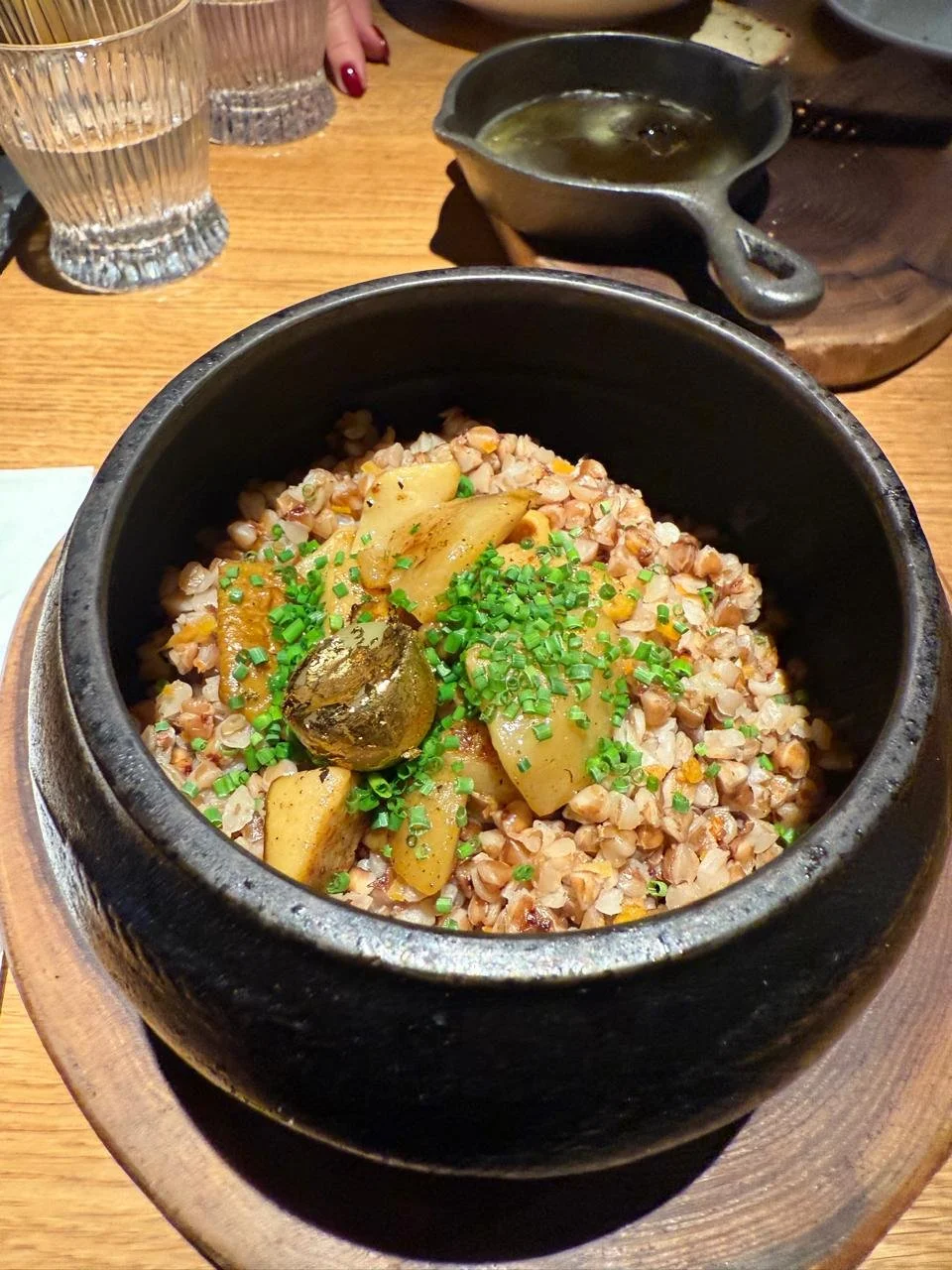
Buckwheat can appear at almost any point in the day. It may be served as porridge, but it is perhaps even more familiar as a savory side dish alongside chicken, meat, mushrooms, or котлеты. Russian food writing regularly describes buckwheat as something that can appear at breakfast, lunch, or dinner rather than belonging to one particular meal.
This is a useful example of how food culture works. What feels “ethnic” or distinctive from outside a culture can feel completely unremarkable from within it. Asking a Russian person to become excited about grechka may be a little like asking an American to marvel at toast.
Lunch traditionally carries more weight
The Russian word обед (obed) is usually translated as “lunch,” but the cultural idea behind it has traditionally been more substantial than the quick American sandwich eaten at a desk.
A classic обед might begin with soup, followed by a main course consisting of meat or fish with potatoes, buckwheat, rice, pasta, or another side dish. Bread may accompany the meal, and tea or компот may follow. This multi-course model became strongly embedded in Soviet schools, workplaces, cafeterias, and domestic expectations, although real modern lunches are often much simpler.
The distinction between the cultural idea of a “proper lunch” and what someone actually eats during a busy workday is important. An older relative may still feel that lunch without something hot is barely lunch at all, while a younger office worker may be perfectly satisfied with a café meal, takeout, or whatever is practical.
That difference between ideal and reality exists in every food culture. Americans may describe dinner as a cooked family meal while eating cereal over the sink; Russians are no exception.
Soup is important, but Russians do not necessarily eat borscht every day
Soup occupies a prominent place in Russian home cooking, particularly as part of lunch. Борщ is internationally famous, but it is only one possibility. A family might make щи (cabbage soup), chicken soup, pea soup, mushroom soup, рассольник, солянка, or something improvised from whatever ingredients are available.
The cultural importance of soup is especially noticeable across generations. For many older people, a hot first course carries associations with a complete, nourishing lunch, and Soviet meal patterns reinforced the idea of soup followed by a main dish.
But saying “Russians eat soup every day” would be misleading. Some households make a large pot and eat it for several days. Others rarely make soup at all. Younger urban Russians, irregular work schedules, restaurant culture, and the sheer variety of food available have made everyday habits much less uniform.
So if you visit a Russian family and are served soup at lunch, that is perfectly ordinary. If you spend a week with another family and never see borscht once, that is equally possible.
The real everyday classics are often much less glamorous
If you want to imagine an ordinary home meal, think less about caviar and more about котлеты.
A Russian котлета (kotleta) is not quite what an English speaker may picture when seeing the word “cutlet.” In everyday Russian home cooking, it commonly means a patty made from minced meat, perhaps beef, pork, chicken, or a mixture, seasoned and cooked in a pan or oven.
Kotleta with mashed potatoes is the sort of combination that can evoke school cafeterias, home kitchens, and uncomplicated family dinners. It may be accompanied by buckwheat instead, or by rice, pasta, cabbage, vegetables, or a simple salad.
Other perfectly ordinary meals include roasted chicken and potatoes, fried potatoes with onions, pasta with meat, pelmeni taken from the freezer after a long day, fish with a side dish, stewed cabbage, or leftovers from yesterday's lunch.
None of this looks particularly exotic when written in English, which is exactly the point. Much of everyday Russian food is recognizable home cooking made from familiar ingredients. The difference lies in which combinations become habitual and emotionally familiar.
Dinner depends heavily on what happened earlier in the day
Dinner is ужин (uzhin), but there is no universal rule about how substantial it should be.
Someone who ate soup and a full main course at lunch may prefer a relatively light dinner. Another person who barely managed to eat during the workday may come home and make dinner the largest meal of the day.
Dinner might be leftovers, chicken and potatoes, fish, pasta, buckwheat, vegetables, soup from the refrigerator, or simply sandwiches and tea when nobody wants to cook.
This is why neat descriptions such as “Russians eat a large lunch and a light dinner” should be treated as tendencies rather than rules. Household schedules shape meals as much as tradition does.
Everyday salad is not necessarily Olivier
Russian food articles aimed at foreigners often devote enormous attention to Olivier salad, селёдка под шубой (herring under a fur coat), and other mayonnaise-heavy dishes. These are culturally important foods, but many of them belong much more naturally to holiday tables and celebrations than to an average weekday lunch.
A simple everyday salad might consist of tomatoes and cucumbers with herbs, cabbage, grated carrots, beets, or seasonal vegetables dressed with oil or sour cream.
Olivier, by contrast, has particularly strong associations with celebrations such as New Year's Eve. The same is true of elaborate appetizer spreads, special fish, caviar, and many dishes foreigners come to think of as “what Russians eat.”
This distinction matters because holiday cuisine is disproportionately visible from the outside. People photograph festive tables. They rarely photograph the bowl of buckwheat they reheated on Wednesday.
Sour cream is not merely decoration
If there is one ingredient that appears across an impressive range of Russian foods, it is сметана (smetana), or sour cream.
It may accompany soup, pelmeni, blini, syrniki, potatoes, vegetables, and various other dishes. Depending on the household, it functions less like an optional restaurant garnish and more like a normal condiment kept in the refrigerator and brought out whenever it seems appropriate.
This is another place where language students begin noticing culture through vocabulary. Learning the word сметана is easy. Understanding why it keeps appearing beside completely different foods tells you something about actual eating habits.
Tea may be more revealing than vodka
Few stereotypes about Russia are as persistent as vodka, but vodka tells you much less about ordinary daily meals than чай (chai), tea.
Tea is woven into Russian domestic and social life. It may appear at breakfast, after lunch, in the evening, when guests arrive, or simply because two people have decided to sit down and talk. It is often accompanied by cookies, chocolates, jam, cake, sandwiches, or whatever sweet thing happens to be in the house. Russian tea culture has historically been broad enough that tea can function as a drink, a pause, or an excuse to prolong conversation.
Coffee, of course, is now part of everyday urban life as well, particularly among younger city residents. Modern Russian café culture includes the same espresso drinks and specialty-coffee habits found in many other large cities.
That coexistence is more realistic than imagining contemporary Russians choosing between an antique samovar and a bottle of vodka.
Kompot and mors are worth knowing too
Two drinks that often puzzle learners are компот (kompot) and морс (mors).
Kompot is made by cooking fruit or berries in water, usually with sugar, producing a lightly sweet fruit drink. It has strong associations with home cooking, cafeterias, childhood, and traditional meals.
Mors is a berry drink, often made from cranberries, lingonberries, or other berries. Both are examples of foods that can seem distinctly Russian to a visitor precisely because they occupy an everyday category that does not have an exact equivalent in many American households.
Modern Russians also eat sushi, pizza, khachapuri, and everything else
One of the easiest mistakes when asking what Russians eat is assuming that people living in Russia eat only food classified as “Russian cuisine.”
They do not.
Russia's food culture has always been shaped by exchange among the many peoples living within the country and the wider region. Culture.ru's overview of regional cuisines, for example, traces how recipes and techniques moved among Russian, Tatar, Ukrainian, Caucasian, Siberian, Far Eastern, Kazakh, Korean, and other culinary traditions.
In major cities, Georgian cuisine has long been deeply familiar, while Uzbek and other Central Asian dishes are also widely known. Pizza and sushi became mainstream parts of urban restaurant and takeout culture rather than unusual foreign novelties.
A visitor looking for “real food in Russia” therefore does not need to eat borscht at every meal. Eating khinkali at a Georgian restaurant, grabbing coffee and a pastry, ordering sushi, or having plov can be just as much a part of contemporary Russian urban life.
Food vocabulary teaches you more than the names of dishes
For Russian learners, meals are particularly useful because they introduce language that appears constantly in ordinary conversation.
завтрак — breakfast
обед — lunch / midday meal
ужин — dinner
каша — porridge
гречка — buckwheat
творог — curd cheese / farmer's cheese
сырники — curd-cheese pancakes
котлеты — minced-meat patties or cutlets
сметана — sour cream
компот — fruit drink
морс — berry drink
But the more interesting language appears once people begin talking around the table.
Что ты обычно ешь на завтрак?
What do you usually eat for breakfast?
Что будем на ужин?
What are we having for dinner?
Будешь чай?
Want some tea?
The last example is especially useful because a beginner may expect something longer and more grammatically complete. Real conversational Russian often relies on context, and food provides countless opportunities to hear these shortened, natural exchanges. Basic Russian teaching materials themselves commonly use breakfast, lunch, and dinner to introduce everyday verbs and meal vocabulary.
And then someone will almost certainly offer you more food
Hospitality adds another layer.
In many Russian-speaking families, particularly among older generations, feeding a guest generously remains an important way of showing care. That does not mean every Russian host behaves identically, but visitors may encounter repeated offers:
Попробуйте.
Try some.
Возьмите ещё.
Have some more.
Ешьте, ешьте.
Please, eat.
Sometimes the guest has already eaten enough. This does not always end the negotiation.
The interesting point for language learners is that food vocabulary quickly turns into social language. You are no longer merely identifying potatoes or asking for tea; you are interpreting hospitality, refusing politely, accepting another serving, and understanding why “No, thank you” may be followed by another offer anyway.
What an ordinary Russian day might actually look like
There is no menu that represents millions of people, but a completely plausible weekday could look something like this: porridge or eggs with tea in the morning; soup and chicken with buckwheat or potatoes for lunch; and something simple at home in the evening, perhaps leftovers, pelmeni, pasta, vegetables, or a sandwich.
Another person might skip breakfast, buy coffee, eat sushi for lunch, and order Georgian food for dinner.
Both are living perfectly believable Russian days.
That is why asking what Russians “actually eat” becomes more interesting once we stop searching for the single traditional menu. The most culturally revealing foods are often not the spectacular ones. They are the foods people stopped noticing because they grew up with them: grechka with butter, soup reheated from yesterday, kotleta with mashed potatoes, tea after dinner, or syrniki that taste the way someone remembers from childhood.
If learning about everyday Russian life makes you curious about the language spoken around those meals, Polyglottist Language Academy offers Russian classes for adult learners, with small-group online and in-person options depending on the current schedule.