
Russian Orthodox Church: History, Beliefs, and Role in Russian Culture Today
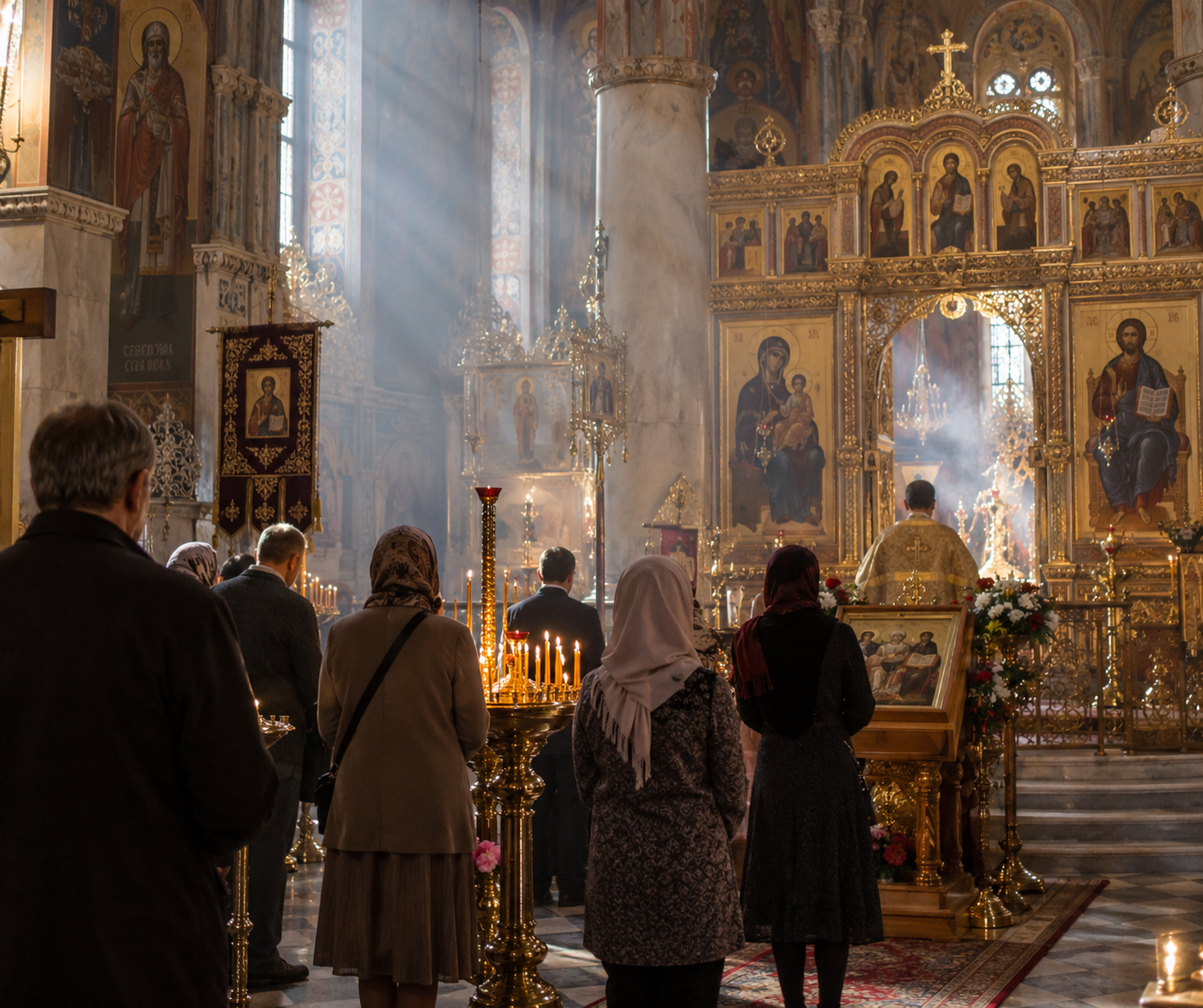
A visitor who enters a Russian Orthodox church for the first time may notice what is missing before understanding what is present. There are usually few or no pews in the central part of the church. People stand, move, cross themselves, light candles, approach icons, and sometimes come and go during a service that can last for hours. The priest may disappear behind the iconostasis and return through one of its doors. Incense fills the space. Much of the liturgy is sung.
For someone raised in a Western Christian tradition, the experience can feel both recognizably Christian and structurally unfamiliar.
That mixture of familiarity and difference is a useful way to approach the Russian Orthodox Church itself. It belongs to Eastern Orthodox Christianity, a global religious tradition shared by churches in Greece, Serbia, Romania, Georgia, the Middle East, and many other places. At the same time, the Russian Orthodox Church has been shaped by a particular history of empire, reform, persecution, national identity, and state power.
Understanding its role in Russian culture requires keeping religion, institution, history, and politics connected without treating them as the same thing.
From the baptism of Rus' to a Russian church tradition
The conventional starting point is 988, when Prince Vladimir of Kyiv adopted Byzantine Christianity and the Christianization of Kyivan Rus' accelerated. The date is symbolically important, although the process of conversion was gradual and Christianity was already present in the region.
The early church of Rus' was linked to Constantinople. Worship, theology, architecture, and religious art developed within the Byzantine Christian world. Church Slavonic became the principal liturgical language, and Orthodox Christianity helped shape written culture, political symbolism, and artistic traditions across the East Slavic lands.
It is important not to project the modern Russian state backward onto this period. Kyivan Rus' is part of the historical inheritance claimed by several modern peoples and states, especially Ukrainians, Belarusians, and Russians.
After the Mongol invasions and the political fragmentation of Rus', Moscow gradually became a major center of ecclesiastical and political power. In 1448 the church in Moscow effectively became self-governing, and in 1589 the head of the Russian Church received the title of patriarch.
By then, religious identity and the growing Moscow state were becoming deeply intertwined.
Icons are not simply religious paintings
To understand Orthodox culture, it helps to understand what an icon is supposed to do.
An icon is not treated merely as decoration or as an illustration of a biblical scene. In Orthodox theology, icons participate in prayer by directing attention toward the holy person or event represented. Worshippers may bow, cross themselves, kiss an icon, or light a candle before it.
This is not understood as worship of wood and paint. Orthodox teaching distinguishes veneration from the worship due to God alone.
The visual style can look deliberately unlike Western Renaissance painting. Traditional icons are not primarily trying to create the illusion that the viewer is looking through a window into ordinary physical space. Perspective, scale, gesture, color, and facial expression follow theological and artistic conventions developed over centuries.
For someone learning Russian culture, icons matter far beyond church walls. They appear in literature, art history, family memory, museums, political symbolism, and everyday expressions. Andrei Rublev, the medieval icon painter, became both a saint and a major cultural figure, while Tarkovsky’s film Andrei Rublev turned the problem of sacred art into a twentieth-century meditation on artistic responsibility.
Why Orthodox services feel different
The central act of Orthodox worship is the Divine Liturgy, especially the Eucharist. Russian Orthodox services are highly sung and ritualized. The congregation usually stands for much of the service, although practices vary by parish and individual ability.
The iconostasis, a screen covered with icons, separates the sanctuary from the main worship space. Its doors open and close at particular moments in the liturgy, making space itself part of the religious action.
Orthodox Christians cross themselves from right to left rather than left to right, typically using three fingers together to symbolize the Trinity. Candles, incense, processions, chanting, and repeated bodily gestures make worship strongly sensory.
For outsiders, these practices can look formal. For regular worshippers, repetition is part of the point. The liturgy is not designed around constant novelty or a sermon as the central event. It places the individual inside a pattern shared with generations before them.
What Russian Orthodox Christians believe
The Russian Orthodox Church shares the core doctrines of Eastern Orthodoxy: belief in the Trinity, the divinity and humanity of Christ, his death and resurrection, the sacraments or mysteries, the authority of Scripture within the life of the Church, and the importance of tradition.
Orthodox spirituality places strong emphasis on the Incarnation and Resurrection, on human transformation through participation in divine life, and on continuity with the early Church.
The Virgin Mary, usually called Богородица, “Mother of God” or more literally “God-bearer,” is deeply venerated. Saints are understood as intercessors and examples of holy life. Relics may be venerated, pilgrimages remain important, and monasteries have historically played major religious and cultural roles.
Fasting is also more prominent in Orthodox practice than many secular observers realize. The church calendar includes several fasting periods, most importantly Great Lent before Easter, as well as many individual fast days. Observance varies enormously. Some believers follow dietary rules closely; others identify culturally as Orthodox while rarely fasting or attending church.
That variation is essential. “Orthodox” can describe active religious practice, family identity, cultural affiliation, or a mixture of all three.
Easter matters more than Christmas in the liturgical calendar
Russian Christmas, celebrated on January 7 by the Russian Orthodox Church under the Julian-calendar reckoning used for fixed feasts, is culturally visible. Yet Pascha, Easter, is the central feast of the Orthodox year.
The Easter service begins late at night. A procession, repeated proclamation of Christ’s resurrection, bells, candles, and the greeting Христос воскрес! — “Christ is risen!” — create one of the most recognizable moments of Orthodox religious life. The traditional response is Воистину воскрес! — “Indeed He is risen!”
Foods such as кулич, a tall Easter bread, and пасха, a sweet cheese dessert, connect religious observance with family custom. Even people who are not regular churchgoers may recognize or participate in some of these traditions.
The seventeenth-century schism still matters
In the 1650s, Patriarch Nikon introduced reforms intended to bring Russian liturgical practice into closer alignment with contemporary Greek practice. The changes touched texts and rituals, including the way believers made the sign of the cross.
Opposition was fierce. Those who rejected the reforms became known as Old Believers, старообрядцы.
The resulting schism, раскол, was not a minor dispute over ceremony. It produced persecution, communities of resistance, and a lasting religious subculture. Old Believer merchants and communities later played important roles in Russian economic and cultural life.
For readers of Russian literature and history, the schism explains references that otherwise seem obscure. It also shows how deeply ritual practice can be tied to identity.
Peter the Great abolished the patriarchate for two centuries
After Patriarch Adrian died in 1700, Peter the Great did not allow a new patriarch to be elected. In 1721 he established the Holy Governing Synod, bringing church administration under a system closely supervised by the imperial state.
The arrangement lasted until 1917.
This long period is important because modern discussions of church-state relations in Russia often sound as if closeness between religious hierarchy and political power were new. The forms have changed radically, but the relationship has a deep institutional history.
At the same time, the imperial Church was not simply a government department in religious clothing. Monastic life, theology, pilgrimage, parish practice, missionary work, and popular devotion had their own dynamics. Russian religious thought in the nineteenth and early twentieth centuries was intellectually diverse and sometimes sharply critical of official structures.
Revolution brought persecution and institutional collapse
The Bolshevik Revolution transformed the Church’s position dramatically. The new Soviet state was officially atheist and treated organized religion as an ideological opponent.
Church property was confiscated. Clergy and believers were arrested, exiled, or executed. Churches and monasteries were closed, destroyed, or repurposed. Anti-religious campaigns varied in intensity across the Soviet period, but the institutional Church suffered enormous losses.
During World War II, Stalin partially relaxed the pressure on the Church as the Soviet government mobilized patriotic feeling and sought social unity. The Moscow Patriarchate was allowed to function more openly, although under heavy state control.
Religious life never disappeared. Baptisms, funerals, pilgrimages, domestic icons, and private belief continued, sometimes quietly and sometimes in tension with official Soviet expectations.
The post-Soviet revival changed the visual landscape of Russia
After 1991, the Russian Orthodox Church regained a public role at extraordinary speed. Churches were restored or rebuilt. Monasteries reopened. Religious broadcasting, schools, publishing, pilgrimages, and public ceremonies expanded. Cathedrals that had been demolished in the Soviet period were reconstructed, most famously Moscow’s Cathedral of Christ the Saviour.
For many Russians, this revival represented restitution after decades of repression. Orthodoxy also became a language through which people could reconnect with family history, pre-Soviet culture, or a broader idea of Russian tradition.
But the revival was never only spiritual. The Church also became increasingly visible in state ceremonies, education debates, military symbolism, public morality, and national identity.
That is where contemporary discussions become more contested.
The Church in Russian culture today
Today the Russian Orthodox Church, headed by Patriarch Kirill of Moscow, is one of the country’s most prominent public institutions. Its cathedrals, feast days, clergy, television appearances, and ceremonial presence make it culturally visible even to Russians who rarely attend services.
It also maintains a close relationship with the Russian state. Scholars have described the Church as an important participant in official “traditional values” discourse, particularly on family, gender, sexuality, national history, and Russia’s relationship with the West.
Since Russia’s full-scale invasion of Ukraine in 2022, the hierarchy’s role has become still more controversial. Patriarch Kirill has publicly supported the war and framed it in religious and civilizational terms, while the Church has provided clergy and religious symbolism connected with the military effort. In September 2026, for example, Reuters reported that the Church sent relics believed to be from the medieval prince Dmitry Donskoy to Russian forces in occupied Donetsk as a morale-building religious symbol.
That political alignment has drawn criticism from Orthodox Christians inside and outside Russia, other Christian bodies, scholars, and clergy. It has also intensified tensions within the wider Orthodox world, especially around Ukraine.
The important distinction is that the position of the institutional hierarchy should not be treated as proof that every Russian Orthodox believer shares the same political views. Religious practice, cultural identity, personal faith, nationalism, and loyalty to church leadership overlap for some people and diverge sharply for others.
Orthodoxy is part of Russian culture, but Russia is not religiously uniform
Russian literature, painting, music, architecture, family ritual, and historical vocabulary are full of Orthodox references. A reader of Dostoevsky, Tolstoy, Leskov, Bulgakov, or Solzhenitsyn repeatedly encounters questions shaped by Orthodox thought even when the author’s relationship with the Church is conflicted.
The same is true of everyday language. Words connected with Easter, saints’ days, blessings, sin, fasting, icons, and church architecture appear in cultural contexts that are difficult to understand through dictionary definitions alone.
Yet Russia also includes Muslims, Buddhists, Jews, Protestants, Catholics, other religious communities, atheists, and large numbers of people whose identity is secular or only loosely religious. Even among those who call themselves Orthodox, levels of belief and participation vary greatly.
For a language learner, that makes Orthodoxy best approached neither as “what Russians believe” nor as a purely historical institution. It is one of the major traditions through which Russian culture has developed and one of the powerful institutions through which Russian politics and identity are being argued today.
Polyglottist Language Academy’s Russian classes introduce cultural context alongside the language, including the historical and everyday references that appear in conversation, literature, film, and holidays.