
How to Make Olivier Salad: Russia's Favorite Party Dish (Step-by-Step Recipe)
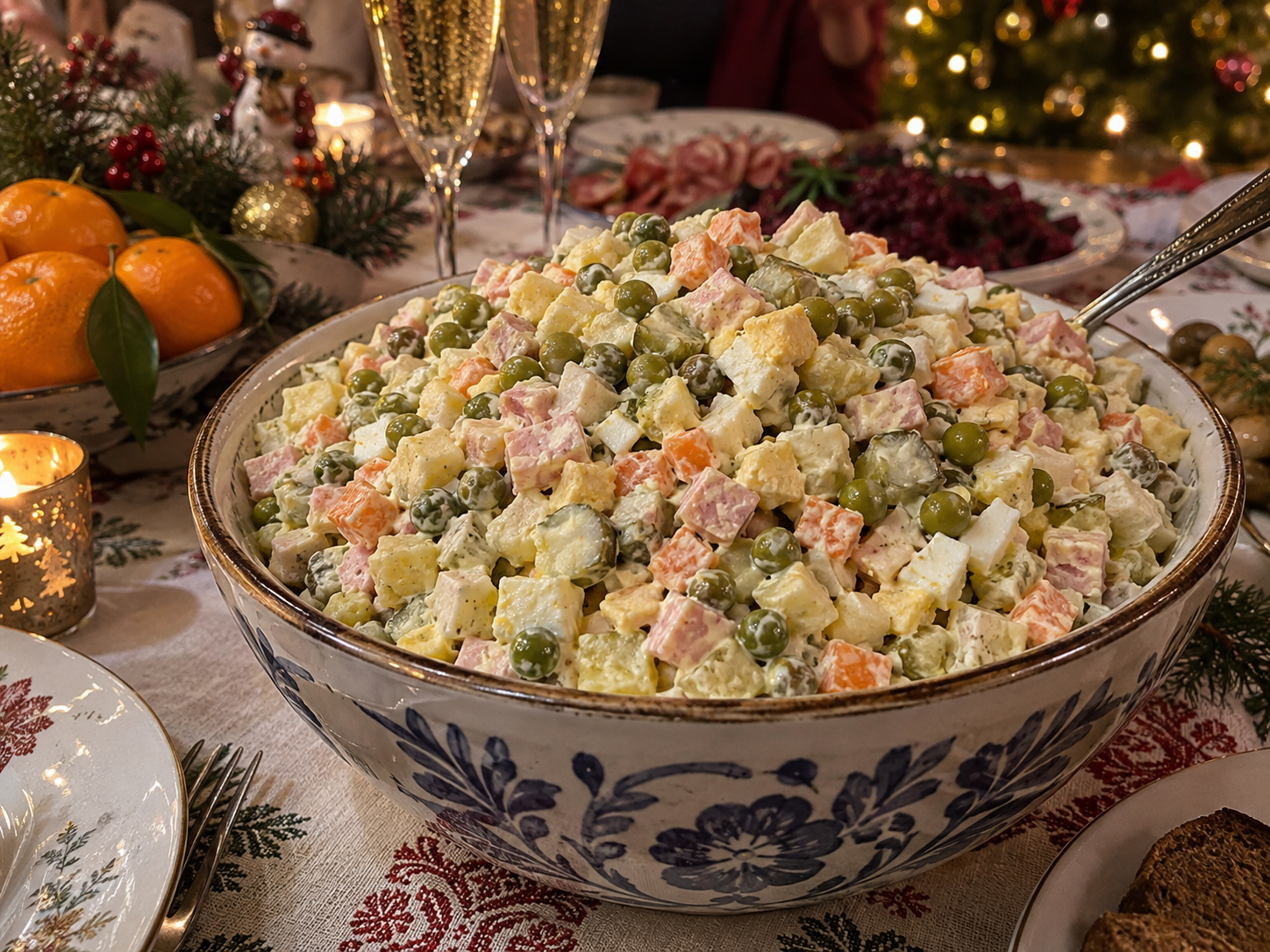
Ask several Russian families what belongs in Olivier salad and you may get several different answers. One family uses cooked sausage, another insists on chicken, someone adds fresh cucumber, and someone else is convinced that a little apple is essential. Mention the apple to the wrong person and you may start an argument.
The basic method, however, is remarkably consistent. Potatoes, carrots, eggs, pickles, peas, and meat or cooked sausage are diced into small pieces and lightly bound with mayonnaise. The ingredients are ordinary. The difference between very good Olivier and a bowl of mushy potato salad usually comes down to how those ingredients are cooked, cooled, cut, drained, and mixed.
This recipe uses the familiar Soviet and modern Russian home-style version with Doktorskaya-style cooked sausage, potatoes, carrots, hard-boiled eggs, peas, pickles, and mayonnaise. It makes a generous bowl suitable for about eight people when Olivier is served as part of a larger holiday or party table.
Olivier Salad Recipe
Prep time: 30 minutes
Cook time: about 30 minutes
Cooling and chilling time: about 1½ hours
Total time: about 2½ hours
Servings: approximately 8 as a side dish
Ingredients
4 medium waxy or all-purpose potatoes, about 1½ pounds / 700 g
2 medium carrots, about 8–9 ounces / 250 g
5 large eggs
12 ounces / 340 g Doktorskaya-style cooked sausage, or plain mild bologna
4 medium dill or sour pickles, about 8–9 ounces / 250 g after draining
1 can green peas, about 15 ounces / 425 g, drained well
¾ cup / about 180 g mayonnaise, plus a little more if needed
¼ teaspoon freshly ground black pepper, or to taste
¼ teaspoon salt, then more only if needed
You may find that you need less salt than expected. The pickles, sausage, and mayonnaise are already seasoned.
What can I use instead of Doktorskaya sausage?
Doktorskaya kolbasa is a mild cooked sausage closely associated with the Soviet and modern home-style version of Olivier. It is closer to a smooth, mild bologna than to a strongly smoked or heavily spiced sausage.
If you cannot find it in the United States, plain good-quality bologna is the easiest substitute. Mild cooked ham also works, although it changes the flavor slightly. Chicken and boiled beef are both established Olivier variations and are discussed later in the article.
Avoid strongly smoked sausage, peppery salami, or heavily seasoned deli meat if you are trying to reproduce the familiar Russian flavor.
Step-by-Step Instructions
1. Cook the potatoes and carrots
Wash the potatoes and carrots but leave them whole and unpeeled. Place them in a large pot and cover with cold water.
Bring the water to a boil, then reduce it to a steady simmer.
Begin checking the carrots after about 15–20 minutes and the potatoes after about 20 minutes. Depending on their size, the potatoes may need closer to 25–30 minutes.
A thin knife should enter without much resistance, but the vegetables should still feel firm. If a potato begins splitting or collapsing in the water, it has gone too far.
Remove each vegetable as soon as it is ready rather than waiting for everything to finish at exactly the same time.
Drain and allow them to cool completely.
2. Hard-boil the eggs
While the vegetables are cooking, place the eggs in a saucepan and cover them with water.
Bring to a boil, then cook until hard-boiled, approximately 10–11 minutes. Transfer them to cold or ice water to stop the cooking.
Once completely cool, peel the eggs.
3. Cool everything before cutting
This step is easy to rush and worth resisting.
The potatoes and carrots should be completely cool before you dice them. Warm potatoes are softer and much more likely to break apart when the salad is mixed. They also do not combine particularly well with mayonnaise.
If you are not in a hurry, you can cook the vegetables and eggs several hours ahead or even the day before and refrigerate them.
4. Peel and dice the vegetables
Peel the cooled potatoes and carrots.
Cut them into small cubes, roughly ¼ to ⅜ inch / 6–10 mm. You do not need a ruler. Aim for pieces roughly similar in size to the peas.
Transfer them to a large mixing bowl.
Uniform cutting makes a noticeable difference. Ideally, one spoonful should contain potato, carrot, pickle, egg, sausage, and peas rather than one enormous potato cube surrounded by tiny ingredients.
5. Dice the eggs, sausage, and pickles
Cut the eggs and sausage into cubes approximately the same size as the vegetables.
Drain the pickles well before cutting them. If they are particularly wet, pat them lightly with paper towel after dicing.
Add everything to the bowl.
The pickles are important because they provide the acidity that keeps the salad from tasting like potatoes covered in mayonnaise. Dill, sour, or Eastern European-style pickles work much better here than sweet pickles.
6. Drain the peas thoroughly
Open the peas and drain them very well.
Add them to the bowl only after excess liquid has drained away. Liquid from canned peas and pickles is one of the easiest ways to end up with watery Olivier.
7. Add the mayonnaise gradually
Very gently combine the potatoes, carrots, eggs, sausage, pickles, and peas.
Start with about ½ cup / 120 g mayonnaise rather than adding the full amount immediately.
Fold it through the ingredients with a large spoon or spatula. Try not to mash the potatoes.
Add more mayonnaise gradually until everything is lightly coated and the salad holds together. You may use the full ¾ cup, but you may find that you prefer slightly less.
Olivier should be creamy. It should not look as though the ingredients are floating in mayonnaise.
8. Taste before adding salt
Add the black pepper and taste the salad.
Only then decide how much salt it needs.
The amount will depend heavily on your sausage, pickles, and mayonnaise, all of which can already contain considerable salt.
Add a small amount, mix, taste again, and stop as soon as the flavors feel balanced.
9. Chill before serving
Cover the bowl and refrigerate the Olivier for at least one hour before serving.
The ingredients settle together during this time, and the salad generally tastes better slightly chilled than immediately after mixing.
Give it one gentle stir before transferring it to a serving bowl.
A Few Details That Matter
The ingredient list is forgiving, but a few small choices affect the texture considerably.
Choose potatoes that hold their shape
Very floury potatoes can become crumbly or mealy when boiled and then fall apart during mixing.
A waxy or all-purpose potato is easier to work with because the cubes stay recognizable.
The potatoes should be fully cooked, but you should still be able to cut them cleanly.
Do not overcook the carrots
Carrots should be tender but firm.
If they become extremely soft, they smear when diced and lose the little bit of texture and sweetness they are supposed to contribute.
Use sour pickles, not sweet relish
American sweet pickle relish may provide acidity, but it moves the flavor in a noticeably sweeter direction.
For a more familiar Russian-style Olivier, use dill pickles, sour pickles, or salted Eastern European cucumbers.
Drain everything
Wet pickles and poorly drained canned peas are small problems that become noticeable once mayonnaise is added.
Olivier should be moist and creamy, not watery.
Add mayonnaise gradually
It is much easier to add another spoonful of mayonnaise than to remove it.
The vegetables, meat, eggs, and pickles should all remain visible in the finished salad.
Common Olivier Mistakes
Most disappointing Olivier salads suffer from one of a few predictable problems.
The potatoes were overcooked. Once they become very soft, they collapse during mixing and turn the salad pasty.
The ingredients were still warm. Warm potatoes and carrots are easier to damage, and mixing warm ingredients with mayonnaise produces a heavier texture.
Everything was cut too large. Olivier has a characteristic small-diced texture. Large chunks make it feel more like an ordinary potato salad.
The pickles or peas were too wet. Drain both thoroughly.
Too much mayonnaise was added at once. The dressing should coat and connect the ingredients rather than bury them.
The salad was salted before it was tasted. Depending on the pickle and sausage, the salad may already be quite salty.
Most problems with Olivier come from rushing one of these fairly simple steps.
Can You Make Olivier Ahead of Time?
Yes, and for a party it is often easier that way.
You can boil the potatoes, carrots, and eggs the day before, let them cool, and refrigerate them in covered containers. Dice them when you are ready to assemble the salad.
You can also prepare the entire salad several hours before serving and refrigerate it covered.
For the best texture, I would generally make Olivier either the same day or the evening before rather than several days in advance.
From a food-safety standpoint, keep it refrigerated at 40°F / 4.4°C or below, and do not leave it at room temperature for more than two hours. USDA guidance recommends using most cooked leftovers within three to four days; mayonnaise-based salads also belong in the refrigerator rather than sitting for long periods on a buffet.
Olivier also does not freeze particularly well. Potatoes and mayonnaise-based salads can lose their texture after freezing and thawing.
Why Olivier Is a New Year's Dish
Olivier is eaten at birthdays, family celebrations, and other gatherings, but its strongest modern association is with Новый год — Novy god, New Year.
That connection developed primarily during the Soviet period.
Modern Olivier bears relatively little resemblance to the nineteenth-century restaurant dish that carried the same name. By the late 1940s, Soviet cookbooks contained much simpler salads resembling the version familiar today. Ingredients such as cooked sausage, green peas, and mayonnaise could also be relatively desirable or difficult to obtain, which helped make them appropriate for a holiday table. New Year became the major secular celebration of the Soviet calendar, and Olivier settled comfortably into it.
The result is a dish that many families make in quantities that seem excessive until everyone starts eating it.
Olivier usually shares the New Year's table with other cold appetizers and celebratory foods. Depending on the family, that may include селёдка под шубой—herring under a fur coat—caviar sandwiches, cold meats, pickles, mandarins, and sparkling wine. The exact menu varies, but Olivier remains one of the dishes most strongly associated with New Year's celebrations across Russia and many families from the former Soviet Union.
How the Recipe Changed Over Time
The name comes from Lucien Olivier, associated with Moscow's fashionable Hermitage restaurant in the nineteenth century.
Olivier is traditionally credited with creating the restaurant salad that became famous under his name. The exact original formula was not reliably preserved, and later accounts disagree about some details. What is clear is that the nineteenth-century restaurant preparation was much more elaborate than today's home salad and was associated with expensive ingredients rather than potatoes, canned peas, and cooked sausage alone.
Over time, the dish changed dramatically.
Versions resembling modern Olivier appeared in Soviet cookbooks by the late 1940s. The restaurant luxury dish eventually became a practical home salad built around inexpensive vegetables, eggs, mayonnaise, and readily portioned meat or sausage.
That history makes it difficult to talk about one single “authentic” Olivier recipe.
Outside Russia and the former Soviet Union, related versions are often called Russian salad. Recipes under that name can vary substantially from country to country, so ordering “Russian salad” abroad does not necessarily produce the same dish a Russian family would call салат Оливье.
Sausage, Chicken, Beef—and Apple
Once the basic method is understood, family versions begin to diverge.
Olivier with sausage
The recipe above uses the familiar Soviet-style version with cooked sausage.
For many people, this is the version most strongly associated with New Year's Eve and childhood holiday tables.
Olivier with chicken
Cooked chicken is another common choice.
Use simply poached or roasted chicken rather than heavily seasoned or smoked meat. Let it cool completely and dice it to the same size as the vegetables.
Olivier with beef
Boiled or gently cooked beef produces a slightly richer version.
Again, cool the meat completely before cutting and mixing it into the salad.
Fresh cucumber
Some families add fresh cucumber alongside or instead of part of the pickles. It gives the salad more freshness and crunch, although it also releases water, so it is best added relatively close to serving.
Apple
And then there is the apple.
Some families add a small amount of tart apple, cut into the same tiny cubes as everything else. It introduces sweetness and acidity.
Other families regard this as an inexplicable act of culinary sabotage.
Both groups have probably been making Olivier for decades.
There are also versions with onion, green onion, dill, or other small adjustments. The important distinction is between a family variation and a completely different salad. Corn, cheddar, ranch dressing, hot sauce, or sweet relish may produce something enjoyable, but they move well beyond the familiar Russian home version.
A Few Russian Words From the Recipe
Cooking Olivier gives Russian learners a small collection of useful kitchen vocabulary:
салат Оливье — Olivier salad
картофель — potato
картошка — potato, common everyday form
морковь — carrot
огурец — cucumber
солёный огурец — salted or pickled cucumber
горошек — peas
яйцо — egg
майонез — mayonnaise
колбаса — sausage
Heritage learners often recognize kitchen words like these long before they can explain the grammar surrounding them. Someone may have heard картошка, огурцы, or колбаса at home for years without ever having formally studied Russian.
For complete beginners, food vocabulary has a different advantage: it is attached to something concrete and familiar, which often makes it easier to remember.
Readers who would like to study Russian more systematically can explore Polyglottist Language Academy's adult Russian classes, including beginner and continuing levels offered in small groups.
Once you know the basic Olivier method, you will probably change something eventually. You may prefer chicken to sausage, add more pickles, use fresh cucumber, or discover that your family has extremely strong opinions about apple.
The important part is the texture. In the finished bowl, you should still be able to see potato, carrot, peas, pickles, egg, and sausage, all cut into small, roughly even pieces and lightly held together with mayonnaise.
If it looks like a bowl of mayonnaise with potatoes somewhere inside it, add less mayonnaise next time.
If someone at the table tells you their family's Olivier is completely different, that may be the most traditional part of the recipe.
Related Articles
What Do Russians Actually Eat For Breakfast, Lunch, And Dinner?
Russian Blini: History, Recipes, And Why They're More Than Just Pancakes
Russian Black Bread: What It Is And Why Russians Are So Proud Of It
Traditional Russian Winter Breakfast: What Russians Really Eat
Russian Birthday Traditions: Why Russians Celebrate Differently From Americans