
Russian Days, Months, and Seasons: Essential Time Vocabulary for Beginners
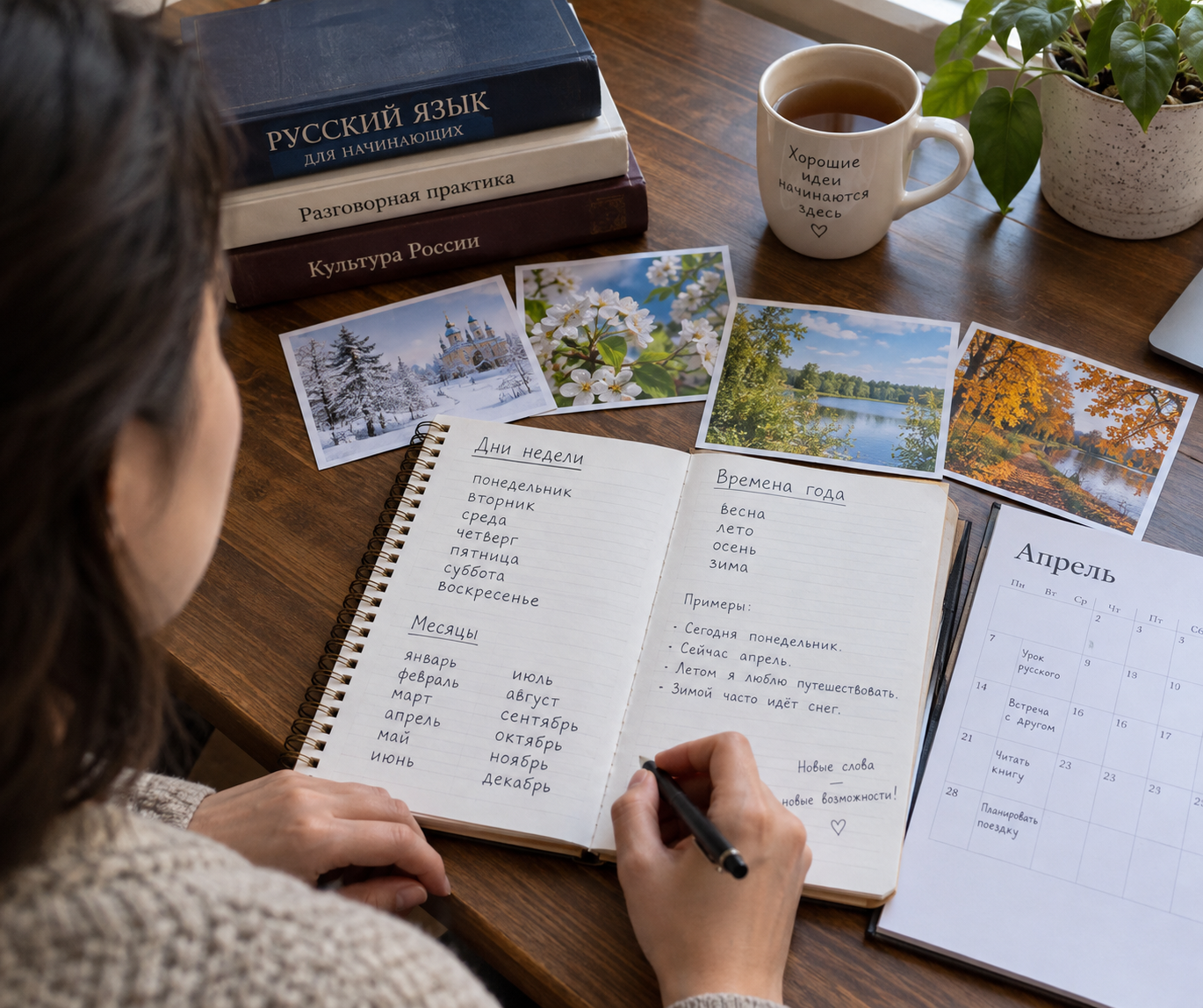
Russian days, months, and seasons look like a simple vocabulary lesson until you try to use them in a sentence. A beginner may memorize понедельник for Monday, январь for January, and зима for winter, then discover that Russians often say в понедельник, в январе, and зимой.
Three time expressions, three grammatical patterns.
This is why calendar vocabulary is worth learning together with the phrases it actually appears in. The words themselves are not especially difficult. The useful part is learning how Russian packages time.
Days of the week
Russian calendars normally begin with Monday. The seven days are:
понедельник — Monday
вторник — Tuesday
среда — Wednesday
четверг — Thursday
пятница — Friday
суббота — Saturday
воскресенье — Sunday
Unlike English, Russian does not capitalize days of the week unless the word begins a sentence.
A few of the names contain clues. Понедельник is historically connected with неделя and the idea of the day after Sunday. Воскресенье is also the ordinary Russian word connected with resurrection, which is why learners who later encounter religious vocabulary often recognize it.
For practical speaking, however, the first thing to learn is not etymology but the pattern for saying “on” a day.
“On Monday” uses в + the accusative
For most days, Russian uses в before the day:
в понедельник — on Monday
во вторник — on Tuesday
в четверг — on Thursday
в субботу — on Saturday
Notice во вторник rather than в вторник. Russian sometimes uses во when it makes pronunciation smoother.
The feminine days change visibly in the accusative:
среда → в среду
пятница → в пятницу
суббота → в субботу
Masculine days such as понедельник, вторник, and четверг look unchanged in the accusative because they are inanimate masculine nouns.
A beginner does not need to recite that grammatical explanation every time. What matters is learning the whole phrase: not simply среда, but в среду.
Try these:
У меня урок в понедельник. — I have a lesson on Monday.
Мы работаем во вторник. — We work on Tuesday.
В пятницу я встречаюсь с друзьями. — On Friday I am meeting friends.
Months of the year
The months are close enough to their English and European counterparts that most learners recognize them quickly:
январь — January
февраль — February
март — March
апрель — April
май — May
июнь — June
июль — July
август — August
сентябрь — September
октябрь — October
ноябрь — November
декабрь — December
Again, Russian normally writes month names with lowercase letters.
Two words deserve special listening attention: июнь and июль. They look similar, occur next to each other in the calendar, and can blur together for beginners. The final consonants are different: июнь ends with a soft n sound, while июль ends with a soft l sound.
“In January” uses в + the prepositional
When you mean “in” a month, Russian uses в with the prepositional case:
в январе — in January
в марте — in March
в мае — in May
в июле — in July
в декабре — in December
For learners, this is one of the nicest Russian patterns because the forms are predictable. You will usually see an -е ending.
Compare the day and month constructions:
в понедельник — on Monday
в январе — in January
The same preposition appears, but the noun form is different.
That is the kind of feature that makes Russian grammar feel arbitrary if you memorize individual rules and much more manageable if you learn phrases in families.
Seasons behave differently again
The four seasons are:
весна — spring
лето — summer
осень — autumn/fall
зима — winter
If you simply name the season, use the basic form: Сейчас зима. — It is winter now.
But to say “in winter,” “in summer,” and so on, Russian commonly uses instrumental forms without a preposition:
весной — in spring
летом — in summer
осенью — in autumn
зимой — in winter
Examples:
Весной часто идёт дождь. — It often rains in spring.
Летом мы много путешествуем. — We travel a lot in summer.
Осенью дети идут в школу. — Children go to school in autumn.
Зимой темнеет рано. — It gets dark early in winter.
This pattern is worth learning as four complete vocabulary items. Beginners sometimes try to build в зиме or в лете by analogy with в январе. That is understandable, but it is not the normal way to express the season.
Dates introduce another useful form
Month names also change when you give a calendar date.
Compare:
январь — January
в январе — in January
первого января — on the first of January
In dates, the month appears in the genitive:
пятого февраля — on February 5
восьмого марта — on March 8
двадцать первого июня — on June 21
The number changes too because Russian expresses the date with an ordinal form. You do not need to master all ordinal declension at the same time you memorize the months, but you should recognize why the month suddenly looks different.
This is a good example of why beginners sometimes think they are seeing multiple unrelated words when they are actually seeing one word in different cases:
март — March
в марте — in March
пятого марта — on March 5
Once you know that, the forms stop looking random.
Asking what day or date it is
Two questions that look similar in English are different in Russian:
Какой сегодня день? — What day is it today?
Сегодня среда. — Today is Wednesday.
Какое сегодня число? — What is today’s date?
Сегодня тринадцатое сентября. — Today is September 13.
A learner who knows only день may ask the first question when they really want the calendar date. Both are correct questions; they simply request different information.
Yesterday, today, and tomorrow make the vocabulary useful
Calendar words become much easier to remember when you connect them to daily time words:
вчера — yesterday
сегодня — today
завтра — tomorrow
позавчера — the day before yesterday
послезавтра — the day after tomorrow
Then practice combinations rather than isolated vocabulary:
Сегодня воскресенье. — Today is Sunday.
Завтра понедельник. — Tomorrow is Monday.
Во вторник у меня встреча. — I have a meeting on Tuesday.
В октябре я еду в отпуск. — I am going on vacation in October.
Зимой я редко путешествую. — I rarely travel in winter.
A student who can build these small sentences is already doing more useful work than someone who can recite all twelve months in order but cannot answer Когда? — When?
One small pronunciation problem: stress is part of the word
Russian spelling does not normally show stress, and calendar words are no exception. Beginners should learn stressed syllables from audio rather than assuming stress will fall where English would place it.
Words such as понедельник and воскресенье are long enough that guessed stress can distort them. The same applies to months such as сентябрь and декабрь.
This does not mean you need a phonetics course before using the words. It means vocabulary study should include sound. Read, listen, repeat, and then use the word in a phrase.
A better way to memorize the calendar
Instead of learning seven days, then twelve months, then four seasons as three disconnected lists, use your real schedule.
Write your weekly commitments in Russian. Put birthdays and travel dates on a calendar using Russian month names. Write one sentence about each season that is actually true for you.
For example:
В понедельник у меня работа.
В четверг у меня урок русского.
Мой день рождения в мае.
Летом я люблю плавать.
Зимой я чаще остаюсь дома.
The vocabulary sticks because it now answers real questions about your life.
In structured Russian classes at Polyglottist Language Academy, this kind of vocabulary is practiced together with the grammar patterns needed to use it in conversation. That matters because cases become much less abstract when they are attached to phrases you say every week. Explore current Russian class options.
The calendar is one of the first places where Russian shows beginners an important principle: learning the dictionary form is only the beginning. Once you learn понедельник together with в понедельник, январь together with в январе, and зима together with зимой, the grammar begins to feel like part of the vocabulary rather than an extra burden added later.
Related Articles
Why Russian Feels Hard At First (And Why It Gets Easier After 6 Months)
Why Russian Is A Critical Language — And What That Means For Your Career
Can You Learn Russian In A Year? What's Actually Possible And How To Do It
Why Learn Russian? 7 Surprisingly Good Reasons Americans Are Studying It In 2026
How Long Does It Take To Learn Russian? A Realistic Breakdown By Level (A1 To C1)
The Russian Alphabet In 2 Hours: A Complete Beginner's Guide To Cyrillic