
Best Vietnamese Classes for Adults in San Jose and the Bay Area
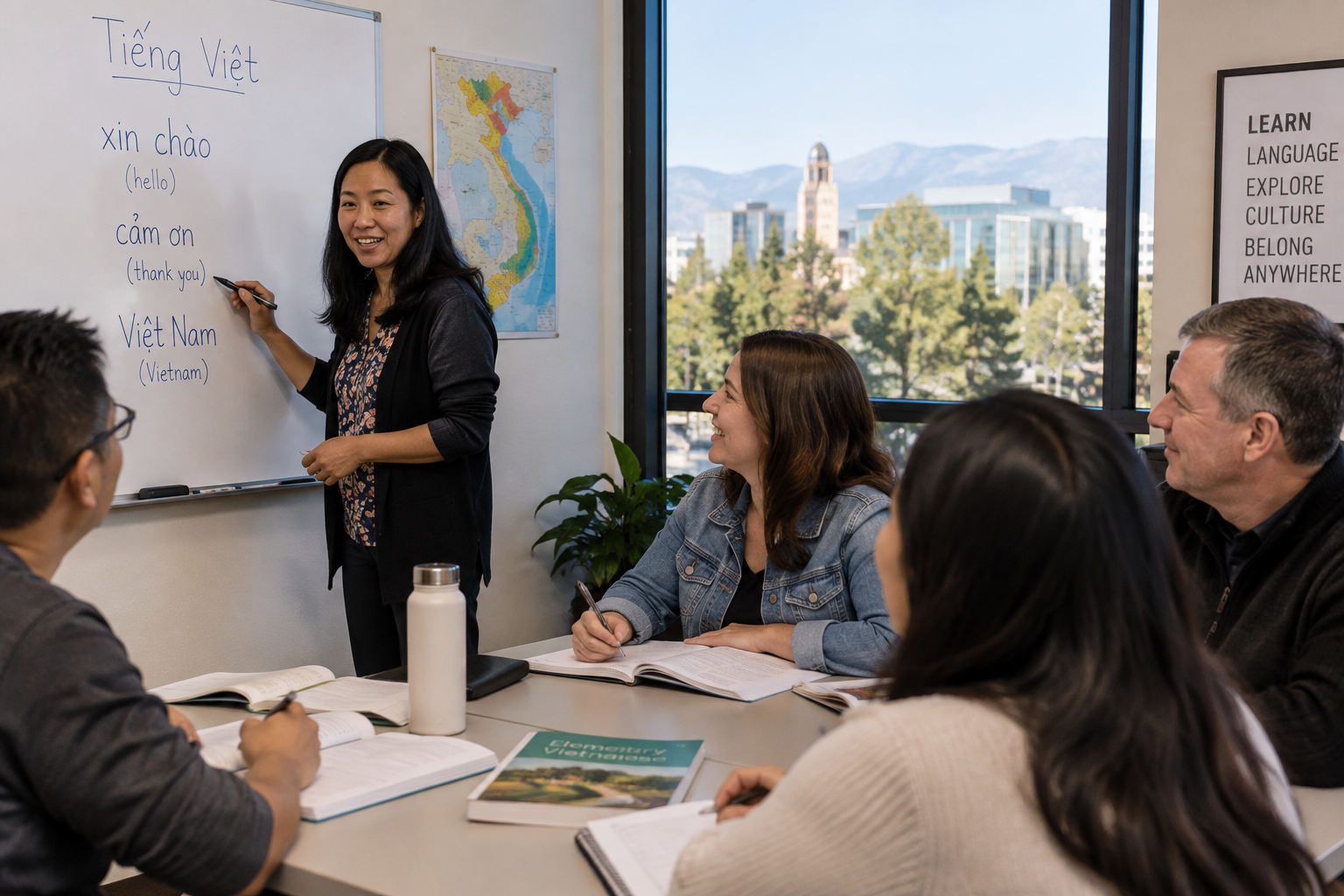
San Jose is one of the few places in the United States where Vietnamese can feel like part of the everyday landscape. Along Story Road and around Little Saigon, it appears on storefronts, restaurant menus, advertisements, community notices, and newspapers. You hear it in markets, cafés, medical offices, and conversations between generations.
Adults who decide they actually want to learn Vietnamese, however, often discover that finding the right class is less straightforward than expected.
A large share of Vietnamese language education in the Bay Area developed through heritage programs for children. Other courses are offered through colleges and come with the workload of a regular academic class. Private language schools and online programs fill some of the gaps, but their formats vary considerably.
As a result, a search for Vietnamese classes in San Jose can turn up everything from Saturday heritage schools to five-unit college courses. The important question is not simply which program has the best reviews or the longest curriculum. It is which kind of class makes sense for the learner.
A complete beginner who has never heard Vietnamese at home needs something very different from a heritage speaker who understands most of what relatives say but responds in English. Someone who wants to study seriously several days a week will also have different priorities from someone looking for a manageable evening class around a full-time job.
Fortunately, the Bay Area has options for all of them.
Before choosing a class, think about what kind of learner you are
The label “beginner” can be misleading with Vietnamese.
Someone who has never studied the language is obviously a beginner. But an adult who grew up hearing Vietnamese from parents or grandparents may also describe themselves that way because they cannot read comfortably or do not feel confident speaking.
Those two learners may have almost opposite strengths.
A complete beginner needs systematic work on pronunciation, tones, listening, basic sentence patterns, and everyday vocabulary. A heritage learner may already pronounce words naturally but lack reading skills, grammatical confidence, or vocabulary outside family life.
This matters particularly in San Jose, where many adults interested in Vietnamese have some connection to a Vietnamese-speaking family or community.
Vietnamese also presents an interesting challenge for English speakers because the writing system looks more familiar than the spoken language initially sounds. The Latin alphabet gives beginners the impression that they should be able to read words fairly easily, but recognizing the letters is only the beginning.
Tones are important, of course, but they are not the only issue. Vietnamese also contains vowel and consonant distinctions that may initially sound very close to an English-speaking ear. A learner can remember the correct vocabulary and still not be understood when saying it.
That is why pronunciation feedback is so valuable at the beginning. When looking at a class, it is worth asking how much students actually speak and whether the instructor regularly corrects pronunciation rather than leaving it to develop on its own.
Evergreen Valley College offers unusually substantial Vietnamese study in San Jose
For adults who want serious Vietnamese study without leaving San Jose, Evergreen Valley College is one of the strongest places to investigate.
Its program goes beyond a single introductory class. Elementary Vietnamese develops speaking, listening, reading, and writing while also covering pronunciation, grammar, vocabulary, and Vietnamese culture. Evergreen also offers Conversational Vietnamese and Culture, with greater emphasis on speaking and vocabulary and less emphasis on formal grammar.
The distinction makes the program useful to different kinds of adult learners.
Someone who wants a full academic foundation may prefer Elementary Vietnamese. A learner mainly interested in becoming more comfortable speaking with relatives, friends, or people in the local community may find the conversational course more appealing.
Recent schedules have included several Elementary Vietnamese sections, including evening options, along with a Saturday-morning conversational course.
The main consideration is time. Elementary Vietnamese is a five-unit college class. This is not a once-a-week hobby course that requires little attention between meetings. For a motivated learner, that intensity can be an advantage because Vietnamese becomes a regular part of the week. For someone with a demanding work schedule, it may be more difficult to sustain.
Evergreen also offers something considerably more advanced: a Vietnamese-English Translation and Interpreting certificate for people who already have strong proficiency in both languages and want professional preparation for fields such as healthcare, education, law, and public services.
It should not be confused with ordinary language study, but for bilingual adults in San Jose, it is a distinctive local resource.
De Anza College combines academic structure with online study
De Anza College is another strong option for students who want a serious course, particularly those who prefer not to commute several evenings each week.
Its Vietnamese sequence includes college-level courses in speaking, listening, reading, and writing within a broader cultural context. Recent Vietnamese 1 offerings have included fully online evening sections.
The word “online” can sometimes suggest a self-paced course built around recorded lessons. That is not the case here. De Anza's Vietnamese classes follow the structure of a regular college language course, with scheduled meetings and a corresponding workload.
For some learners, that is exactly the appeal.
Someone who wants Vietnamese to become a substantial academic project but lives in San Jose, Sunnyvale, Santa Clara, or elsewhere in the South Bay may appreciate being able to take a rigorous course without adding repeated trips to campus.
De Anza has also offered Vietnamese 2 and Vietnamese 3, which gives students a clearer path beyond the first term.
That continuation matters more than it might seem. Adult language programs often have no trouble filling a beginner class but struggle to maintain enough enrollment for later levels. Students can spend months building a foundation only to discover that the next class they need is not available.
A college sequence is more attractive when the learner wants to keep going for several terms.
San Jose Learning Center offers a more manageable commitment
Not everyone who wants to learn Vietnamese wants to enroll in college.
San Jose Learning Center in Santa Clara is closer to the format most adults probably imagine when they begin searching for a local language class. It offers Vietnamese instruction for adults through group and private lessons, with online and in-person formats depending on the course.
The terms are shorter than a college semester, which can make the program easier to fit around work and other responsibilities.
That also makes it a reasonable choice for someone who is curious about Vietnamese but is not yet ready to commit to a five-unit academic course.
The most useful question to ask before registering is how much speaking and pronunciation correction happens during class.
Vietnamese beginners benefit from hearing explanations, but they also need to produce the language themselves. A student can understand perfectly well how a tone is supposed to work and still discover that the sound coming out of their mouth is not the one they intended.
A shorter course can provide a solid introduction if students get regular opportunities to speak and receive feedback. That may matter more than how many grammar points appear on the syllabus.
Polyglottist Language Academy offers small live online groups
Polyglottist Language Academy takes another approach, offering small live online Vietnamese classes for adults.
The program uses six-week terms meeting once a week for one hour. Complete Beginner and Low Beginner courses are offered in groups of three to six students, with individual instruction also available.
For Vietnamese, the small group size has a practical advantage. Students have more time to speak, and the instructor has more opportunity to hear and correct each person rather than simply presenting material to a larger class.
Polyglottist's Vietnamese instructor, Thuy Tu, was born and raised in Hanoi and holds a doctorate in Multilingual/Multicultural Education from George Mason University, along with extensive experience in language education and curriculum development.
Her background also points to a question Vietnamese learners in San Jose may eventually want to consider: regional pronunciation.
Northern and Southern Vietnamese differ in pronunciation and some vocabulary. Neither is more correct, but the distinction can matter depending on why someone is learning the language.
San Jose has a particularly strong community with roots in southern Vietnam. An adult studying Vietnamese mainly to communicate with a partner's family or local relatives may want plenty of exposure to Southern pronunciation. Someone preparing to live or work in Hanoi may have different priorities.
This does not mean beginners need to choose one variety and avoid all others. Over time, learners become better at understanding regional differences. It is simply useful to know which variety an instructor primarily speaks and to discuss your goals openly.
For Bay Area students, the online format solves another practical problem: distance. A classroom may look close enough on a map, but a weekly class at 6 p.m. can become much less appealing once Bay Area traffic is involved.
A live online class avoids the commute while still giving students direct interaction with an instructor.
The tradeoff is that one hour a week is a relatively light schedule. Students who want faster progress will need to supplement class with listening, vocabulary review, and practice between lessons.
Au Co Vietnamese Cultural Center connects language with community
Au Co Vietnamese Cultural Center in San Francisco is somewhat different from the college and private-school options.
The organization grew out of Vietnamese language education in San Francisco and places language within a broader cultural setting that includes Vietnamese history, arts, and community life. Its programming includes an adult Vietnamese class in addition to programs for younger students.
That adult option is significant because many Vietnamese community schools in the Bay Area primarily serve children.
A school can offer excellent Vietnamese instruction and still be the wrong environment for a forty-year-old complete beginner. Community heritage programs often have different goals, assumptions, and teaching methods because they were created for children growing up around Vietnamese.
Au Co is worth considering for adults who want their language learning connected to a broader Vietnamese cultural environment rather than treated purely as a classroom subject.
For someone living in San Jose, however, the location is an obvious consideration. Traveling to San Francisco regularly requires much more effort than attending something in Santa Clara or East San Jose.
Some learners may consider the cultural environment worth the trip. Others will quite reasonably decide that a class closer to home, or online, is more sustainable.
This is one reason the phrase “Bay Area Vietnamese classes” can be misleading. San Jose and San Francisco belong to the same region, but they do not necessarily function as the same local market when a student has to make the trip every week.
Heritage speakers often need a different kind of placement
Heritage learners rarely fit neatly into conventional language levels.
An adult who heard Vietnamese throughout childhood may understand parents almost effortlessly while struggling with unfamiliar speakers. Another person may speak naturally but read slowly. Someone else may know all the vocabulary needed for meals, family gatherings, and household life but feel surprisingly limited when the subject turns to work, politics, medicine, or education.
This unevenness is normal.
Heritage language develops around the situations in which someone actually used it. If Vietnamese was mainly the language of home, then home vocabulary and family conversations are often where the learner is strongest.
That is why a heritage speaker should not choose a level based only on accent or listening comprehension.
When contacting a school, it helps to describe different skills separately. Can you understand relatives? Can you answer them comfortably? Can you read Vietnamese? Can you write a message without switching into English? Are unfamiliar speakers much harder to follow than your own family?
The answers may reveal a learner who is advanced in one area and quite basic in another.
A good program should recognize that rather than forcing every heritage speaker into either Beginner 1 or an advanced conversation class.
Northern or Southern Vietnamese?
Beginners sometimes become anxious about learning the “wrong” Vietnamese, but the issue is usually less dramatic than it first appears.
Vietnamese has major regional varieties, broadly described as Northern, Central, and Southern. Pronunciation differs, and some vocabulary and usage differ as well.
For many adult learners, the most useful starting point is the variety spoken by the people they expect to talk with.
Someone learning Vietnamese because their spouse's family is from Ho Chi Minh City has a practical reason to become comfortable with Southern speech. A person preparing to spend an extended period in Hanoi may naturally focus more on Northern pronunciation.
Learners are not permanently limited to the variety they encounter first. As their listening improves, regional accents become easier to recognize.
Still, early consistency can make things less confusing. Before enrolling, it is reasonable to ask an instructor which variety they primarily speak and how they approach regional differences in class.
A class should provide something self-study cannot
There is no reason to choose between classes and independent learning as if the two were competitors.
Vietnamese learners now have access to an enormous range of useful resources: podcasts, pronunciation recordings, flashcards, videos, dictionaries, graded reading, and online listening material. Using these between lessons can accelerate progress considerably.
What self-study does not always provide is reliable feedback.
A beginner can listen to a recording, repeat a word several times, and believe the pronunciation is correct. Another Vietnamese speaker may hear something noticeably different.
This is where live instruction earns its place. A teacher can hear patterns the learner cannot yet hear and correct them before they become established habits.
That feedback is particularly valuable during the first months of Vietnamese, when the learner is still training the ear to notice distinctions that initially seem very small.
It does not mean someone needs hours of private instruction every week. It simply means that regular opportunities to speak to a person who can actually hear what you are saying are worth having.
So which option makes the most sense?
For someone looking for substantial in-person Vietnamese study in San Jose, Evergreen Valley College is probably the first program to investigate. It offers both comprehensive and conversation-oriented study and has enough depth for students who want to continue.
De Anza makes more sense for learners who want a similarly serious academic approach but prefer online classes.
San Jose Learning Center is easier to approach if the goal is a shorter adult course without the commitment of a college semester, while Polyglottist Language Academy offers a particularly small live online format for students who value speaking time and flexibility.
Au Co Vietnamese Cultural Center is distinctive for adults who want language study connected to Vietnamese cultural and community life and are willing to travel to San Francisco for it.
None of these is automatically the best choice.
A rigorous college course can be excellent and still be unrealistic for someone who works late. A one-hour weekly class can fit easily into a busy schedule but feel too slow for a learner who wants rapid progress. A heritage speaker may care far more about placement and literacy than a true beginner does.
The useful comparison is not simply between schools. It is between the way each program teaches and what the learner actually needs.
Learning Vietnamese in San Jose has an unusual advantage
Once class ends, San Jose gives Vietnamese learners something that many students elsewhere have to work much harder to find: contact with the language in ordinary life.
A beginner may start recognizing words on storefronts long before following a full conversation. A phrase learned in class may turn up on a menu a few days later. Forms of address that seem complicated when explained as a grammar topic begin to make more sense after hearing people use them naturally.
None of this replaces structured study. Living near Vietnamese speakers does not automatically teach someone Vietnamese.
What it provides is context.
The language does not have to remain confined to a textbook or an app. It appears in real situations where the learner can gradually connect sounds and words with people, places, and everyday routines.
For adults looking for a smaller live format, Polyglottist Language Academy offers online Vietnamese classes for complete and continuing beginners, with small-group and individual instruction available. Explore Vietnamese classes at Polyglottist Language Academy