
What Is Manga? A Beginner's Guide to Japanese Comics
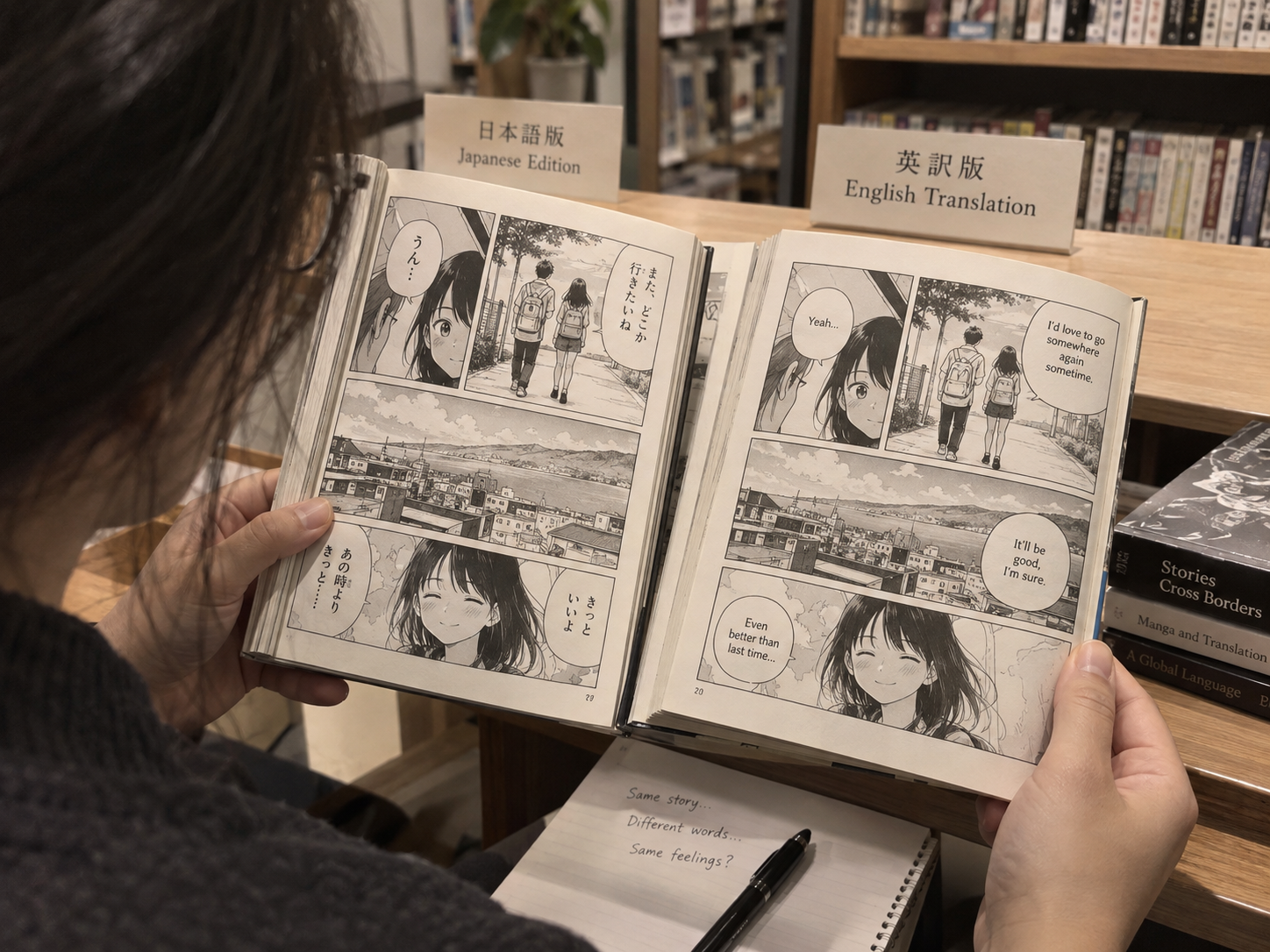
If your first encounter with manga is a shelf in an American bookstore, it can look like a genre: one section, one label, a recognizable black-and-white style. In Japan, manga is much closer to a medium. It can be romance, sports journalism, historical drama, horror, comedy, cooking instruction, office satire, memoir, political commentary, or a story about a middle-aged person quietly running a neighborhood shop.
That distinction explains almost everything else about manga.
Manga means comics — not one particular kind of story
The Japanese word 漫画 (manga) refers broadly to comics and cartoon storytelling. Outside Japan, “manga” usually means Japanese comics or comics strongly influenced by Japanese conventions.
Because manga is a medium rather than a single genre, it is published for many different readerships. Terms such as shōnen, shōjo, seinen, and josei originally describe target demographics more than strict genres. Shōnen manga, for example, is marketed primarily to younger male readers, but it may include sports, fantasy, school comedy, mystery, or romance. Adults can enjoy it, and they do.
The same is true in the other direction: a manga marketed to adults is not automatically “serious” or realistic. Marketing category and story type are separate questions.
Why many manga books read from right to left
Traditional Japanese text can be written vertically, with columns progressing from right to left. Manga inherited this reading direction. In Japanese editions, you normally begin at what an English reader might instinctively call the “back” of the book. Panels, speech bubbles, and page flow then move primarily from right to left.
Most English-language publishers now preserve the original orientation rather than flipping the artwork. It feels strange for a few pages and then becomes surprisingly automatic.
Reading order is only one part of manga's visual grammar. Artists use panel size, empty space, repeated close-ups, sound effects, exaggerated expressions, and shifts in drawing style to control pace and emotion. A silent panel of a train platform may do as much narrative work as several lines of dialogue.
Magazines first, collected volumes later
Many well-known manga begin as serialized works. Chapters appear periodically in magazines or digital platforms, often alongside many other series. Successful works are later collected into tankōbon, the compact paperback volumes readers commonly see in bookstores.
This system helps explain the rhythm of many long-running manga. A chapter may end with a reveal or unresolved moment because it originally needed to bring a reader back the following week or month. A collected volume can therefore feel more episodic than a novel even when it tells one continuous story.
Today, digital publication has changed the industry considerably, but serialization remains central to how manga is created and consumed.
Manga is not simply “anime on paper”
Anime and manga overlap, but neither is merely a version of the other. Some anime adapt manga closely; others rearrange scenes, remove storylines, add original material, or end before the manga does. Many manga never become anime at all. Some anime are based on novels, games, or original screenplays.
The two forms also handle time differently. An anime episode controls exactly how long you look at a scene. Manga lets the reader control the pace. You can rush through an action sequence, stop on a detailed background, or reread a facial expression that changes the meaning of a conversation.
What are furigana?
Japanese learners often notice small kana printed next to kanji. These are furigana, pronunciation guides that show how a character or word is read. Manga aimed at younger readers often uses extensive furigana, making it more approachable for language learners who know kana but have limited kanji.
This does not make manga beginner Japanese. A page with furigana can still contain slang, contractions, dialect, unfinished sentences, jokes, or vocabulary far beyond an introductory textbook.
That is why a learner who has studied Japanese for only a few weeks may be able to pronounce a line without understanding what it means.
Spoken Japanese in manga can be useful — and misleading
Manga is appealing to learners because dialogue often looks closer to conversation than textbook sentences do. Readers encounter contractions, sentence-ending particles, casual pronouns, sound-symbolic words, and shortened forms such as てる instead of ている.
That exposure is valuable, but context matters. A villain, samurai, schoolgirl, elderly shopkeeper, and fantasy creature may be deliberately written with different speech styles. Copying a memorable line without understanding the character's register can make a learner sound theatrical, rude, childish, or simply odd.
Teachers often see the same issue with anime: students recognize phrases that are grammatically possible but socially mismatched to ordinary adult conversation.
Onomatopoeia is much bigger than “sound effects”
Japanese manga makes heavy use of giongo and gitaigo, words that represent sounds, movements, textures, emotional states, and manners of action. Some imitate literal sounds, while others describe things that do not make a sound at all.
For example, ドキドキ (dokidoki) can represent a pounding heartbeat or nervous excitement. しーん (shiin) conveys deep silence. キラキラ (kirakira) suggests sparkling or glittering. These words may appear dramatically integrated into the artwork rather than sitting in a conventional caption box.
Learning them helps readers understand why manga can feel difficult even when the dialogue itself is simple.
Where should a beginner start?
Choose a subject you actually enjoy and a difficulty level you can tolerate. Slice-of-life stories with everyday settings are often more useful for language learners than historical fantasy or science fiction because the vocabulary overlaps more with ordinary life.
Using a Japanese edition alongside an official English translation can be especially helpful. Read a short section in Japanese first, make your best guess, then compare. Avoid looking up every unknown word. If a page contains twenty unfamiliar items, the book may simply be too difficult for your current level.
Manga works best as a supplement, not as your entire Japanese curriculum. Structured study gives you grammar and core vocabulary; manga shows you what writers and characters do with that language once it leaves the textbook.
That is part of manga's appeal even for people who never plan to study Japanese seriously. It is not one aesthetic, one audience, or one genre. It is a vast publishing culture, and the more you understand its conventions, the less it looks like a special category of “Japanese entertainment” and the more it looks like what it is: one of Japan's major forms of storytelling.
Explore Japanese Classes at Polyglottist Languge Academy