
The Logic Behind Russian Word Order
Languages reveal how people organize reality, and few languages demonstrate this more vividly than Russian, where sentences seem to rearrange themselves freely, verbs migrate across clauses, subjects appear to vanish entirely, and yet native speakers understand each other with remarkable precision — not despite this flexibility, but because of a deeper logical system that governs emphasis, meaning, and emotional nuance beneath the surface.
For English speakers, Russian word order can feel unsettling at first. You open a textbook expecting familiar rules — subject first, verb second, object last — only to discover that Russian appears to ignore them entirely. A single sentence can be rearranged five different ways, and every version is technically correct. Students often ask:
“Is Russian word order random?”
The answer is a decisive no.
Russian word order is not chaotic; it is purposeful, expressive, and deeply logical. What looks like freedom is actually structure operating on a different level — not grammatical necessity, as in English, but information structure, emphasis, and communication intent.
Understanding this shift is one of the most important breakthroughs for Russian learners. Once you grasp the logic behind word order, Russian stops feeling unpredictable and begins to feel elegant — almost musical.
This article will guide you through the hidden system behind Russian sentence structure, explaining why words move, what those movements mean, and how mastering word order can dramatically improve your fluency and comprehension.
Why English Depends on Word Order (And Russian Doesn’t)
To understand Russian, we must first understand English.
English relies heavily on word order because it has lost most of its grammatical case system. Consider:
The dog bites the man.
The man bites the dog.
The words are identical, but meaning changes completely because English uses position to signal who performs the action.
Russian works differently because nouns change form depending on their grammatical role.
Example:
Собака кусает человека.
Человека кусает собака.
Both sentences mean:
The dog bites the man.
Why? Because endings show relationships:
собака (nominative) = subject
человека (accusative) = object
Russian grammar already tells us who does what. Word order becomes free to serve another purpose.
The Core Principle: Old Information → New Information
The most important rule of Russian word order is not grammatical but informational.
Russian typically moves from:
👉 Known information → New or emphasized information
This is sometimes called theme → rheme (topic → comment).
Example:
Я купил книгу.
“I bought a book.”
Neutral statement. Nothing special emphasized.
But:
Книгу я купил.
Now the focus shifts:
“The book — I bought (it).”
Perhaps someone doubted it. The object moves forward to highlight contrast or emphasis.
Word order becomes a storytelling tool.
Neutral Russian Word Order (SVO)
Although Russian allows flexibility, there is a default pattern:
Subject – Verb – Object (SVO)
Example:
Мария читает письмо.
Maria reads a letter.
This structure sounds neutral and informational — like reporting facts.
Learners should start here because it feels closest to English and avoids unintended emotional coloring.
But native speakers rarely stay neutral for long.
Why Russians Move Words Around
Russian speakers rearrange sentences for several communicative reasons:
1. Emphasis
2. Contrast
3. Emotional tone
4. Context continuity
5. Rhythm and style
Let’s explore each.
Emphasis Through Position
Russian places the most important information toward the end of a sentence.
Compare:
Я встретил Анну вчера.
I met Anna yesterday.
Neutral.
Вчера я встретил Анну.
Yesterday I met Anna.
Time emphasized.
Анну я встретил вчера.
It was Anna I met yesterday.
Focus shifts again.
English uses stress or extra words. Russian uses movement.
Contrast and Correction
Word order becomes especially powerful when correcting assumptions.
Imagine someone thinks you met Ivan.
You respond:
Анну я встретил.
Meaning:
“No — it was Anna I met.”
The fronted object signals correction without needing additional vocabulary.
Russian speakers often communicate subtle disagreement purely through syntax.
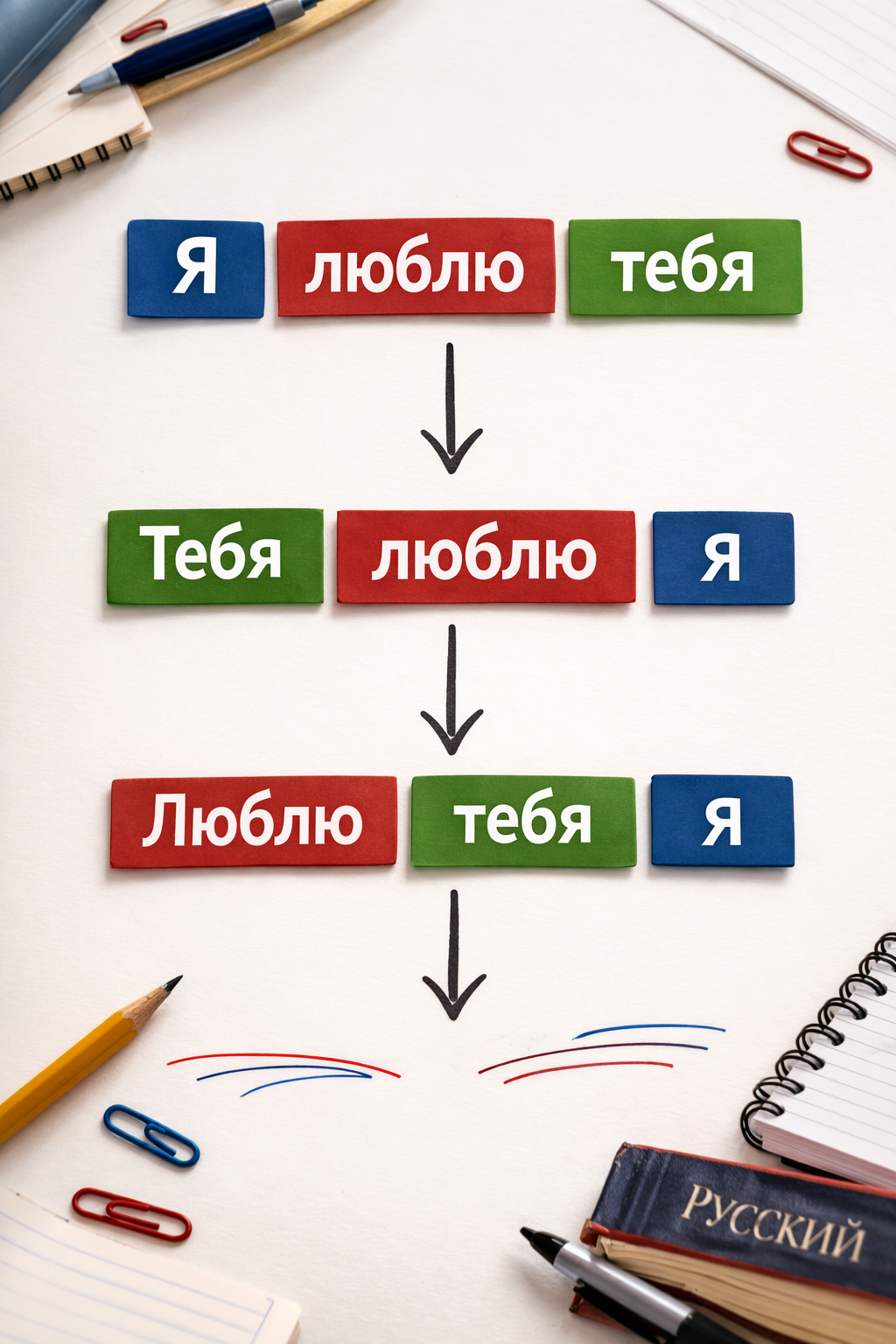
Emotional Coloring in Russian Sentences
Russian word order carries emotional nuance.
Consider:
Я тебя люблю.
I love you. (neutral)
Тебя я люблю.
You — I love. (emotional emphasis)
Люблю тебя.
Love you. (intimate, poetic)
Same words. Different emotional worlds.
Russian literature relies heavily on this flexibility, which allows writers to shape tone with extraordinary precision.
The Role of Context
Russian assumes shared context between speakers.
Once a topic is introduced, it often moves earlier in sentences or disappears entirely.
Example dialogue:
— Где книга?
Where is the book?
— Я её положил на стол.
I put it on the table.
Later:
— Положил на стол.
(Put [it] on the table.)
Subject omitted because context supplies it.
Word order adapts dynamically to conversation flow.
Verb Placement in Russian
Unlike German, Russian verbs are not locked into strict positions.
However, placement still signals meaning.
Verb Early = Action Focus
Я быстро написал письмо.
Focus on completing action.
Verb Late = Result Focus
Письмо я написал быстро.
Focus on the letter as outcome.
Subtle difference — but meaningful.
Questions and Word Order
Russian often keeps normal order in questions.
English:
Do you know him?
Russian:
Ты его знаешь?
Only intonation changes.
You may also see:
Его ты знаешь?
Meaning:
Him — do you know?
Adds surprise or specificity.
Russian Word Order in Storytelling
Russian narratives frequently shift order to guide attention.
Example progression:
Neutral introduction
Topic established
Focus shifts through rearrangement
This creates rhythm similar to cinematic camera movement — zooming in and out through syntax.
That is why Russian prose feels dynamic even in simple scenes.
Poetry and Literary Russian
Russian poetry thrives on flexible word order.
Writers like Pushkin and Akhmatova rearranged sentences to maintain meter and emotional emphasis while preserving clarity thanks to grammatical endings.
Example poetic inversion:
Люблю я пышное природы увяданье…
Literally:
“Love I nature’s splendid fading…”
Unnatural in English — perfectly natural in Russian poetry.
Common Beginner Mistakes
1. Copying English Structure Too Rigidly
Learners overuse SVO and sound robotic.
2. Moving Words Randomly
Flexibility does not equal randomness.
3. Ignoring Emphasis
Word order always communicates intention.
How to Learn Russian Word Order Naturally
Step 1: Start Neutral
Use SVO sentences.
Step 2: Listen Actively
Notice what speakers emphasize.
Step 3: Compare Variations
Rewrite sentences in multiple orders.
Step 4: Read Dialogues
Conversation teaches natural flow faster than grammar drills.
Step 5: Speak Early
Word order intuition develops through use, not memorization.
The Psychological Shift Learners Must Make
English trains speakers to think:
Grammar first → meaning second.
Russian reverses this:
Meaning first → grammar supports it.
You choose word order based on what you want the listener to notice.
Once learners internalize this idea, Russian suddenly feels logical.
Why Russian Word Order Feels Expressive
Russian gives speakers tools English often lacks:
Emphasis without extra words
Emotional nuance through structure
Flexible storytelling
Efficient correction and contrast
Instead of adding vocabulary, Russian reshapes sentences.
This economy is part of the language’s beauty.
When Word Order Really Matters
Although flexible, some contexts prefer stability:
Academic writing → more neutral order
News reporting → clarity first
Beginner speech → safer structure
Advanced speech introduces variation gradually.
A Practical Comparison
English:
I only told him yesterday.
Russian may express nuances through placement:
Я только вчера сказал ему.
Только вчера я сказал ему.
Ему я сказал только вчера.
Each version highlights a different element.
Russian distributes emphasis spatially across the sentence.
The Hidden Rule of Russian Fluency
Fluent Russian speakers do not memorize word order rules consciously.
They develop information instinct:
What is already known?
What is surprising?
What deserves attention?
Word order answers these questions automatically.
Why Mastering Word Order Changes Everything
Students often plateau because they know vocabulary and grammar but still sound foreign.
The missing piece is frequently word order.
Once mastered, learners notice:
Speech sounds natural
Listening becomes easier
Literature opens up
Conversations flow faster
Word order transforms competence into fluency.
FAQs About Russian Word Order
Is Russian word order completely free?
No. It is flexible but guided by emphasis, context, and communication goals.
What is the safest word order for beginners?
Subject–Verb–Object (SVO).
Do Russians notice incorrect word order?
Yes. The sentence may still be understood but can sound unnatural or emotionally odd.
Why do Russian sentences sometimes omit subjects?
Verb endings already indicate the subject, and context fills gaps.
Does word order change meaning?
Often it changes emphasis rather than literal meaning.
Is word order important for fluency?
Extremely. It is one of the biggest markers of advanced Russian.
Should beginners study word order rules deeply?
Focus first on exposure and examples rather than memorizing theory.
How long does it take to develop intuition?
Usually after consistent listening and speaking practice for several months.
Learn Russian Naturally with Polyglottist Language Academy
Understanding Russian word order is one of the moments when learners realize that Russian is not difficult — it is simply different. With the right guidance, what once felt confusing becomes intuitive and even enjoyable.
At Polyglottist Language Academy, our Russian classes are designed to teach not only grammar and vocabulary but the deeper logic behind how the language actually works in real conversations. Our experienced instructors help students move beyond textbook Russian and develop natural speaking patterns from the very beginning.
We offer:
Online Russian classes for all levels
Small group lessons and private instruction
Conversation-focused learning
Structured grammar explained clearly
Cultural insights that accelerate fluency
Whether you are starting from zero or refining advanced skills, our courses help you understand Russian the way native speakers use it.
👉 Ready to start learning Russian with confidence?
Sign up for classes today and begin your journey toward real fluency.
Continue Reading: Explore More Russian Language Articles
If you enjoyed this article, you may also like: