
Is Japanese Food Healthy? What Science (and Japanese Longevity) Says
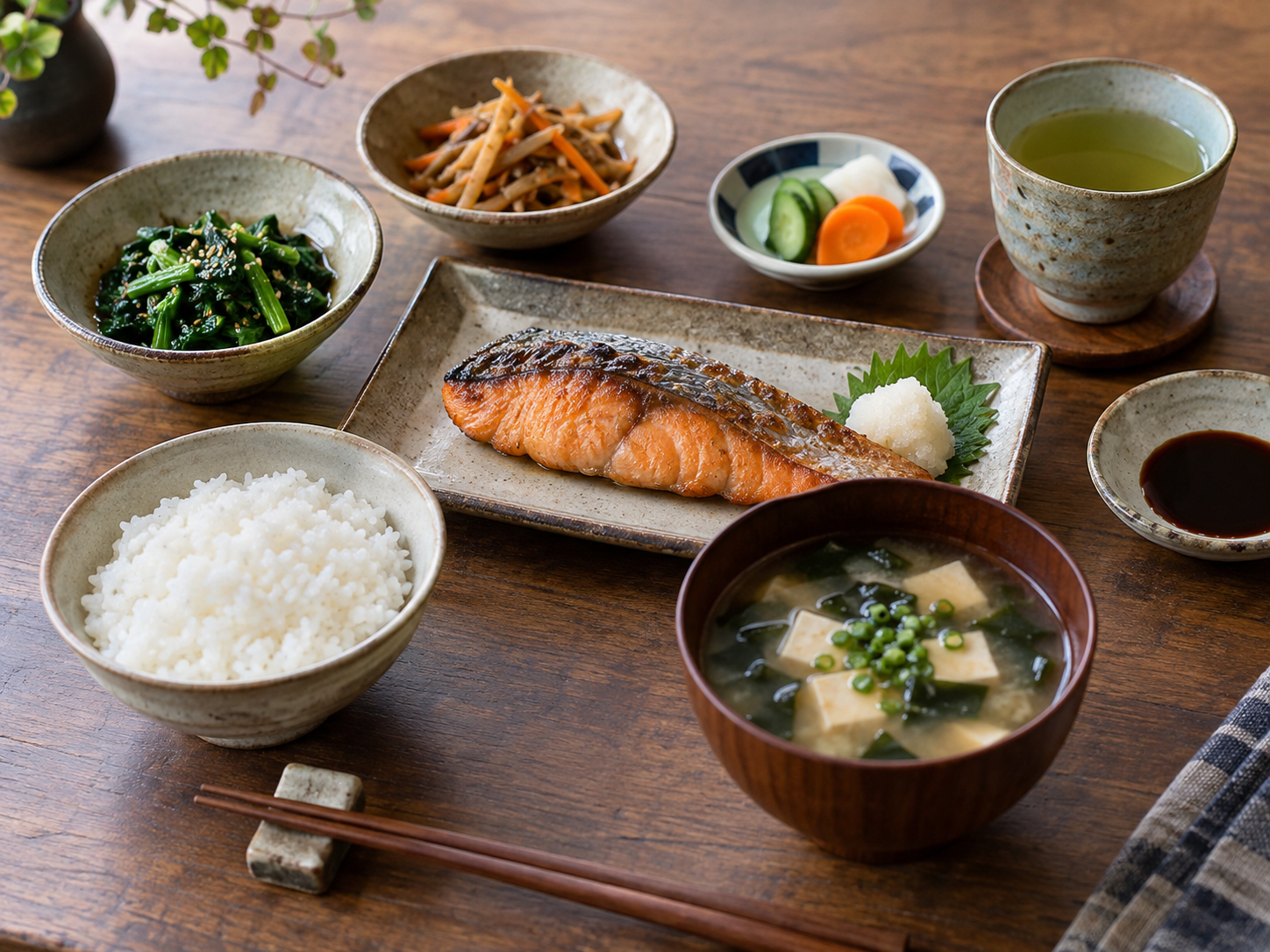
Japanese food has acquired an unusually healthy reputation.
Sushi appears on “clean eating” menus. Miso soup sounds virtuous simply because it contains fermented soybeans. Matcha is sold with the atmosphere of medicine. Seaweed becomes a superfood. Somewhere in the discussion, Japanese longevity usually appears as supporting evidence.
There is some truth underneath all of this.
There is also a rather large bowl of salty ramen sitting in the corner.
Asking whether Japanese food is healthy is a little like asking whether European food is healthy. A grilled piece of fish with vegetables, rice, tofu, and miso soup is Japanese food. So are tempura, tonkatsu, curry rice, mayonnaise-heavy convenience-store sandwiches, sweet pastries, fried chicken, and an enormous bowl of noodles in intensely seasoned pork broth.
The useful question is not:
Is Japanese food healthy?
It is:
Which parts of Japanese eating patterns seem to be associated with good health—and which parts are probably better enjoyed with some restraint?
The scientific answer is surprisingly nuanced.
First, there is no single “Japanese diet”
The phrase Japanese diet creates an image that may have little to do with what an actual person in Japan eats on Tuesday night.
Japan has regional cuisines, generational differences, home cooking, convenience foods, restaurant meals, Western-influenced dishes, elaborate traditional cuisine, fast food, school lunches, and increasingly global eating habits.
Even researchers have to decide what they mean when they study a “Japanese dietary pattern.”
One influential Japanese cohort study defined greater adherence partly through higher consumption of rice, miso soup, seaweed, pickles, green and yellow vegetables, fish, and green tea, along with lower consumption of beef and pork. Among more than 90,000 middle-aged Japanese adults followed for nearly 19 years, people with higher scores on this pattern had lower all-cause and cardiovascular mortality. But this was an observational study: it found an association, not proof that seaweed and miso were individually causing people to live longer.
That distinction matters throughout this subject.
Healthy people do not eat nutrients in isolation. They have entire diets, lifestyles, incomes, occupations, habits, healthcare systems, smoking histories, exercise patterns, and genes.
Nutrition research tries to separate those variables.
It never does so perfectly.
The strongest case is for the pattern, not a miracle ingredient
Japanese food becomes easiest to understand when we stop searching for the ingredient responsible for Japanese longevity.
There probably isn't one.
Japan's official Food Guide Spinning Top is notably unromantic about the matter. It emphasizes balance among grain dishes; vegetable dishes; fish, meat, egg, and soybean dishes; dairy; and fruit, with water or tea and physical activity also represented. Snacks, confectionery, and sweetened beverages are treated as foods to enjoy moderately.
That sounds less exciting than:
SECRET JAPANESE LONGEVITY FOOD REVEALED
It is also much closer to what nutrition science usually finds.
In a large Japanese prospective study, better adherence to the national food guide was associated with lower overall mortality and lower cardiovascular mortality during about 15 years of follow-up.
Another study using a Japanese food score based on beans and soy products, fresh fish, vegetables, pickles, mushrooms, seaweed, and fruit found lower cardiovascular and all-cause mortality particularly among women with higher scores.
Again: associations, not guarantees.
But the pattern is not mysterious.
It contains quite a lot of plants, fish, soy, mushrooms, and varied foods, while traditionally relying less heavily on large portions of red meat.
Fish is useful, but “Japanese people eat fish” is too simple
Fish occupies an important place in many Japanese diets.
It can provide protein without requiring enormous portions, and fatty fish contribute long-chain omega-3 fats. Japanese meals also use fish in remarkably varied forms: grilled, simmered, raw, dried, broiled, incorporated into soups, or served in small portions alongside several other dishes.
But even here, “fish = healthy” is not a sufficient rule.
A grilled fillet of mackerel is not nutritionally identical to a heavily salted preserved fish.
A piece of sashimi is not the same meal as a giant specialty sushi roll covered in mayonnaise and fried toppings.
And eating fish does not somehow cancel whatever else is on the plate.
One useful theme in Japanese-style eating is not merely which protein is chosen, but how it fits into a meal containing several other foods.
A modest piece of fish beside vegetables, rice, soup, and perhaps tofu is a very different nutritional proposition from making the protein portion the entire center of the meal.
Soy is valuable, but natto is not a longevity potion
Tofu, miso, natto, soy milk, and various forms of prepared soy appear frequently in Japanese cooking.
Soy provides protein, and whole or minimally processed soy foods can fit easily into a nutritionally strong diet.
There is also intriguing epidemiological evidence around fermented soy.
A major Japanese cohort study involving more than 92,000 adults found that higher consumption of fermented soy products, particularly foods including natto and miso, was associated with lower all-cause mortality. Natto intake was also inversely associated with cardiovascular mortality. Importantly, total soy intake itself was not significantly associated with overall mortality, and the researchers explicitly warned that residual confounding could partly explain the fermented-soy findings.
This is precisely the sort of result that becomes distorted online.
The study did not prove:
“Eat natto and you will live longer.”
It suggested that fermented soy consumption was associated with favorable outcomes within a particular Japanese population.
Natto remains interesting.
It does not need to become a supplement.
Seaweed, mushrooms, vegetables—and the advantage of eating many things
A traditional Japanese meal can contain a striking number of ingredients without containing a huge quantity of any one of them.
A little spinach.
Some daikon.
Mushrooms in soup.
Seaweed.
A few pieces of pickled vegetable.
Tofu.
Fish.
Rice.
That diversity is nutritionally useful because different foods bring different nutrients and types of fiber.
It also makes meals more interesting without requiring everything to be covered in heavy sauce or enormous amounts of fat.
Japan's own food guide recommends multiple vegetable servings daily and explicitly groups vegetables with mushrooms, potatoes, seaweed, beans, and related side dishes.
But there is a trap hidden inside this attractive picture.
Some traditional ways of preparing vegetables—especially pickling—can introduce a great deal of salt.
Which brings us to the least glamorous part of the Japanese diet.
The biggest nutritional weakness is salt
If there is one problem that should appear in every serious discussion of Japanese food and health, it is sodium.
It often doesn't.
Japanese cooking uses soy sauce, miso, salted fish, pickles, dipping sauces, noodle broths, and other salty seasonings. None of these foods is inherently disastrous, but together they can produce quite a high sodium intake.
Japan's Ministry of Health reported that average salt consumption in the 2024 National Health and Nutrition Survey was 9.6 grams per day. That was the lowest level recorded across the previous 12 years, but it remained well above Japan's own public-health target of 7 grams.
The World Health Organization recommends that adults consume less than 5 grams of salt per day, equivalent to less than 2,000 mg of sodium. High sodium intake raises blood pressure and contributes to cardiovascular disease risk.
So the popular picture of Japanese cuisine presents an interesting contradiction.
A diet can contain fish, vegetables, soy, seaweed, and reasonable portions—and still contain too much sodium.
Both things can be true.
Miso soup illustrates the problem beautifully
Miso soup often appears on lists of “healthy Japanese foods.”
That is not unreasonable.
Depending on how it is prepared, a bowl may contain fermented soybean paste, tofu, seaweed, mushrooms, vegetables, and dashi.
That is a respectable collection of ingredients.
It also contains salt.
This is why classifying foods as simply “healthy” and “unhealthy” becomes frustrating.
Miso does not suddenly become bad because it contains sodium.
Nor does fermentation cancel the sodium.
Context matters.
One bowl accompanying a largely fresh meal is different from eating miso soup alongside salted fish, pickles, soy-sauce-heavy side dishes, and another salty broth.
Nutrition happens at the level of the day and the dietary pattern, not the Instagram ingredient.
Pickles are vegetables, but that doesn't make salt disappear
漬物 (tsukemono)—Japanese pickles—can be wonderful.
They add acidity, texture, color, and strong flavor in a very small portion.
Traditionally, preservation with salt was also practical in a world without modern refrigeration.
But preserved vegetables do not have exactly the same nutritional implications as eating unlimited fresh vegetables.
Japanese epidemiological research has repeatedly examined high salt and salted-food consumption in relation to stomach cancer. One large Japanese cohort found that people reporting a strong preference for salty foods had higher gastric cancer risk, while earlier Japanese prospective research also identified associations between heavily salted foods and gastric cancer.
That does not mean a small dish of Japanese pickles causes cancer.
It means that “traditional” is not synonymous with “health-promoting in unlimited quantities.”
Sometimes modern nutrition advice involves keeping the vegetables while reducing some of the preservation salt.
Newer research is essentially saying: keep the Japanese pattern, lose some salt
This is one of the more interesting developments in the research.
A 2025 analysis from the Japan Public Health Center-Based Prospective Study compared several versions of a Japanese diet score, including a modified pattern that reduced salty foods and incorporated foods such as dairy and coffee.
Higher adherence to all the Japanese-style diet scores was associated with lower all-cause and cardiovascular mortality. But among men, the newer lower-salt Japanese dietary pattern showed particularly favorable point estimates compared with the more traditional pattern.
That is a useful corrective to romantic ideas about traditional diets.
The healthiest version of a traditional cuisine does not necessarily require preserving every historical eating habit exactly as it existed.
Food cultures evolve.
Sometimes the sensible version is:
keep the fish.
keep the vegetables.
keep the soy.
keep the mushrooms.
keep the seaweed.
keep the pleasure.
Use somewhat less salt.
What about white rice?
Rice presents another interesting case.
A traditional Japanese meal often revolves around ご飯 (gohan), cooked rice.
White rice is not nutritionally equivalent to a whole grain. Much of its fiber and parts of the grain containing additional nutrients have been removed during milling.
It also occupies an unusually complicated place in Japanese nutrition research.
A large Japanese prospective study found higher white-rice intake was associated with increased type 2 diabetes risk in women. The relationship was much less clear in men, although researchers saw a suggestion of increased risk among less physically active men.
That does not mean rice must be removed from a healthy Japanese diet.
It means the familiar equation:
Japanese people eat rice + Japanese people live a long time = white rice must be exceptionally healthy
doesn't hold.
A modest bowl of rice accompanied by vegetables, fish, tofu, and soup is one meal.
A giant bowl of rice topped with fried meat and sauce is another.
Quantity and context matter.
Sushi ranges from extraordinarily simple to barely recognizable
Sushi is where Western ideas of “healthy Japanese food” become particularly entertaining.
At its simplest, sushi can consist of a modest piece of fish over a small amount of seasoned rice.
That gives you protein, carbohydrate, and—in the case of oily fish—useful fats.
Then sushi traveled.
Now a roll may contain tempura shrimp, cream cheese, spicy mayonnaise, sweet sauce, avocado, and another fried item placed on top for architectural interest.
There is nothing wrong with enjoying that.
But calling it automatically healthy because chopsticks are involved is optimistic.
Even traditional sushi rice is seasoned with vinegar, salt, and sugar. Soy sauce adds more sodium. Restaurant portions can also involve considerably more rice than diners realize.
If nutritional quality matters, simpler sushi and sashimi arrangements tend to make it easier to see what is actually being eaten.
Ramen is Japanese. So is grilled fish.
A steaming bowl of ramen contains one of the central problems in asking whether “Japanese food” is healthy.
Ramen can include protein, noodles, seaweed, egg, vegetables, and an intensely flavorful broth.
It can also deliver a great deal of sodium, refined carbohydrate, and—depending on the style—substantial fat.
That does not make ramen a bad food.
It makes ramen ramen.
Japanese people do not spend every day eating the meal outsiders imagine when someone says “traditional Japanese diet.”
The same cuisine includes:
焼き魚 — yakizakana — grilled fish
冷奴 — hiyayakko — chilled tofu
野菜の煮物 — yasai no nimono — simmered vegetables
and also:
ラーメン — rāmen
とんかつ — tonkatsu — breaded fried pork cutlet
唐揚げ — karaage — fried chicken
カレーライス — karē raisu — Japanese curry with rice
A cuisine does not need every dish to be nutritionally optimal to have a healthy dietary pattern available within it.
Italian food contains lentil soup and tiramisu.
No contradiction is required.
Tempura is still fried food
Tempura acquired an oddly healthy halo outside Japan, perhaps because it often contains vegetables and the batter looks delicate.
But frying remains frying.
Eggplant does not become nutritionally identical to steamed eggplant because the batter is Japanese.
The more useful observation is that traditional meals may serve a few pieces of tempura alongside other foods rather than requiring an enormous platter of fried food to constitute dinner.
Portion and frequency can matter more than whether a particular dish receives a health label.
A few excellent pieces of tempura once in a while can fit comfortably into an otherwise strong diet.
Healthy eating becomes much less miserable when it stops demanding that every individual food justify its existence nutritionally.
Japanese longevity is real. It does not prove that sushi causes longevity.
Japan does have exceptional longevity.
OECD data published in 2025 put Japanese life expectancy at 84.1 years, around three years above the OECD average.
That is worth noticing.
It is not proof of a single dietary explanation.
Japan also differs from other countries in healthcare access, smoking history, alcohol consumption, urban design, social patterns, body weight, genetics, infectious disease exposure, socioeconomic structure, and many other variables.
Even diet itself cannot be reduced to sushi and green tea.
The impressive life expectancy is compatible with the idea that Japanese dietary patterns contain useful lessons.
It cannot tell us that copying someone's breakfast will reproduce the country's mortality statistics.
The Japanese government does not recommend eating “traditional Japanese food” exclusively
Japan's own dietary guidance is revealing.
The Food Guide does not instruct people to consume unlimited seaweed, natto, sashimi, matcha, and miso because they are culturally Japanese.
It recommends balance.
Daily food categories include grains, several vegetable dishes, protein-containing dishes from fish, meat, eggs and soy, dairy, and fruit. Water or tea and physical activity are represented as well.
That is surprisingly ordinary nutrition advice.
And perhaps that is the lesson.
The most useful part of Japanese food culture is not an exotic ingredient.
It may be the ability to build a meal from several modest components.
Ichiju-sansai is more interesting than “eat seaweed”
One traditional meal structure is 一汁三菜 (ichijū-sansai):
一汁 — ichijū — one soup
三菜 — sansai — three dishes
This generally implies rice accompanied by soup plus a main dish and smaller side dishes.
The exact practice varies, and contemporary households do not necessarily arrange every dinner according to this formula. But as a way of thinking about a plate, it has an advantage.
No single food has to do everything.
Fish can provide protein.
Vegetables provide volume, fiber, and micronutrients.
Rice provides carbohydrate.
Soup adds warmth and flavor.
A small side dish introduces another ingredient or texture.
Compare that with the tendency to build a meal around one enormous entrée occupying most of the plate.
The Japanese approach is not automatically healthier—remember the sodium—but it offers a useful structural idea.
A healthier Japanese meal is not difficult to construct
Someone who enjoys Japanese food does not need to reproduce a historical village diet or eat natto at dawn.
A practical meal might be:
a moderate bowl of rice;
grilled salmon or tofu;
two vegetable preparations;
a modest bowl of soup;
and fruit later.
Or:
soba noodles with vegetables and mushrooms;
tofu;
a cucumber salad;
and some fish.
The point is not purity.
It is proportion.
If sodium is a concern, use less soy sauce rather than drowning sushi in it. Do not feel obliged to finish every drop of ramen broth. Treat strongly salted pickles as a condiment rather than as the primary vegetable. Choose unsalted or less-salted preparations elsewhere in the meal.
WHO specifically recommends limiting commercial sauces and salty processed foods as part of reducing sodium intake.
Those small changes preserve almost everything enjoyable about Japanese food.
The healthiest lesson from Japan may be variety without excess
Japanese cuisine is sometimes described with words such as balance, seasonality, and moderation until they become lifestyle clichés.
But there is something useful underneath them.
A meal does not need three enormous things.
It can contain seven small things.
A vegetable does not have to be a raw salad.
It can be simmered, steamed, grilled, dressed with sesame, cooked into soup, or mixed with tofu.
Protein does not have to mean a large steak.
Fish, tofu, egg, soybeans, and smaller portions of meat can all occupy that role.
Flavor does not have to come from sugar and fat alone.
Dashi, mushrooms, fermented ingredients, ginger, citrus, sesame, seaweed, scallions, and other seasonings create plenty of interest.
The caution, again, is salt.
Japanese cuisine's great ability to create flavor from small quantities of intensely savory ingredients is an advantage—until those intensely savory ingredients all arrive in the same sodium-heavy meal.
So, is Japanese food healthy?
Often, yes.
Automatically, no.
The strongest research does not tell us that sushi is a health food, miso prevents disease, or green tea explains Japanese longevity.
It suggests that certain Japanese dietary patterns—rich in vegetables, fish, soy foods, seaweed, mushrooms, fruit, and other varied foods—are associated with favorable long-term health outcomes. Better adherence to Japanese dietary guidance has likewise been associated with lower mortality in large prospective cohorts.
At the same time, Japan continues to struggle with excessive salt consumption, and some traditional foods contribute to that problem. Very high white-rice intake is not necessarily advantageous either.
The interesting answer is therefore not that Japanese food possesses some mysterious nutritional superiority.
It is that Japanese cuisine contains an unusually useful collection of habits when chosen intelligently: lots of different foods, vegetables prepared in many ways, fish and soy as regular protein sources, modest portions, and meals built from several components rather than one oversized entrée.
At Polyglottist Language Academy, food is one of the places where language and culture become difficult to separate. Japanese words such as ご飯 (gohan) can mean cooked rice but also, depending on context, a meal itself. Understanding what people actually eat—and the assumptions surrounding those foods—reveals considerably more than memorizing restaurant vocabulary. Polyglottist offers live Japanese classes for adults online and selected in-person classes in Berkeley, California, with an emphasis on practical language and the cultural context in which it is used.
Perhaps the healthiest way to approach Japanese food is the same way we should approach most cuisines.
Keep the vegetables.
Enjoy the fish and tofu.
Eat the tempura when you want the tempura.
And maybe don't drink every last drop of the ramen broth.
Frequently Asked Questions
Is traditional Japanese food healthy?
Many traditional Japanese dietary patterns contain vegetables, fish, soy foods, seaweed, mushrooms, rice, and relatively modest portions of meat. Large observational studies in Japan have associated stronger adherence to Japanese-style dietary patterns with lower all-cause and cardiovascular mortality. That does not mean every traditional Japanese food is healthy or that the diet itself has been proven to cause longer life.
Why do Japanese people have such high life expectancy?
Japan had a life expectancy of 84.1 years in OECD data published in 2025, among the highest in the OECD. Diet may contribute, but longevity reflects many influences including healthcare, lifestyle, socioeconomic conditions, physical activity, smoking, alcohol use, and other factors.
Is sushi healthy?
Simple sushi containing fish and moderate amounts of rice can fit easily into a healthy diet. Large specialty rolls containing fried ingredients, mayonnaise, cream cheese, sweet sauces, and large quantities of rice are nutritionally different. Soy sauce can also add substantial sodium.
Is miso soup healthy?
Miso soup can provide soy, seaweed, vegetables, tofu, and other nutritious ingredients, but miso is salty. Its health value therefore depends partly on portion size and the sodium content of the rest of the diet.
Is Japanese food high in sodium?
It can be. Japan's 2024 National Health and Nutrition Survey reported average salt intake of 9.6 grams per day, above Japan's public-health target of 7 grams and well above the WHO recommendation of less than 5 grams per day for adults.
Is white rice unhealthy?
White rice is a refined grain and has less fiber than whole-grain alternatives. A large Japanese cohort study found higher rice intake was associated with greater type 2 diabetes risk among women, though the relationship was less clear in men. A moderate portion of rice can still fit within a balanced diet.
Is natto actually good for you?
Natto is a fermented soybean food that provides protein and other nutrients. In a large Japanese observational study, greater natto consumption was associated with lower cardiovascular mortality, but that association does not prove natto itself prevents cardiovascular disease.