
Learning Tagalog in Chicago: Classes and Online Options for Adults
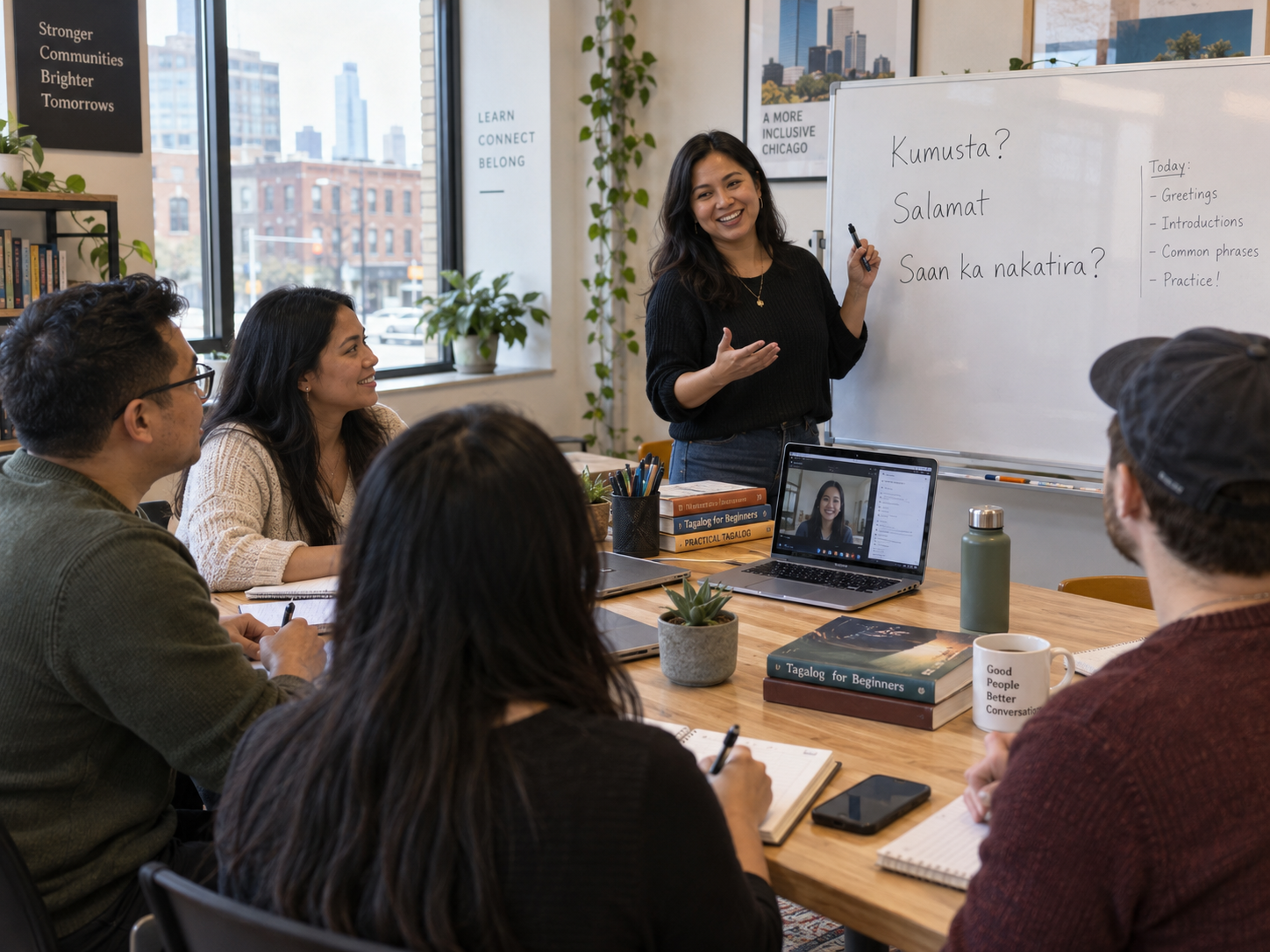
Chicago is one of those cities where it is easy to find Filipino food, organizations, festivals, churches, and community events, but surprisingly easy for an adult learner to ask a simpler question and get a complicated answer: where can I actually study Tagalog in a structured way?
The answer in 2026 is better than it was a few years ago. Chicago has community-based classes, university activity around Filipino language, and online courses that remove the problem of crossing the city after work. The more important question is not simply which option exists, but which one fits the kind of learner you are.
That distinction matters especially for Tagalog. A complete beginner who knows only salamat is not starting in the same place as someone who grew up hearing grandparents speak Tagalog every weekend, understands most family conversation, and still freezes when asked a question directly. Both may call themselves “beginners,” but they need different instruction.
The Rizal Center has become an important adult option
The Rizal Center on Chicago’s North Side has recently run adult Tagalog classes built around regular evening meetings rather than occasional cultural workshops. Its 2025 and 2026 announcements describe multiweek courses designed for Filipinos, Filipino Americans, and non-Filipinos who want sustained language study.
That community setting has a real advantage. Language is not treated as a detached grammar exercise. Family relationships, food, social habits, and cultural expectations can enter the lesson naturally because the class is anchored in a Filipino community institution.
For heritage learners, that can be particularly useful. Someone may know that a phrase sounds right without being able to explain why. Another person may pronounce familiar household words beautifully but struggle with verb forms or sentence construction. A community class can make those uneven skills feel normal rather than like evidence that the learner is somehow “bad at Tagalog.”
Schedules can change from term to term, so it is worth checking the Rizal Center directly rather than relying on an old announcement. Recent programs, however, show that adults in Chicago have had a genuine in-person evening option.
UIC has also been building Filipino-language activity
The University of Illinois Chicago is another place worth watching. In summer 2026, UIC offered Tagalog through its less commonly taught languages program, and its Language and Culture Learning Center hosted a Tagalog Conversation Hour during spring 2026. The conversation hour welcomed multiple levels and combined language practice with informal cultural activities.
University-based options are useful for learners who like an academic structure and do not mind following a campus calendar. They can also be valuable for students who want to connect language study with Asian American studies, linguistics, migration, or Filipino American history.
The practical limitation is access. A university course or campus conversation hour is not automatically designed for a working adult who is not enrolled at the university. Before building a schedule around it, check who is eligible to participate and whether the activity is running in the current term.
The Filipino School of Chicago serves a different audience
The Filipino School of Chicago is another prominent cultural organization, but adults should look carefully at the individual program rather than assuming that every Tagalog offering is an adult course. Its recent scheduled Tagalog sessions have primarily focused on children and families.
That does not make the organization irrelevant to adult learners. Its events and cultural programming can be excellent places to hear Filipino languages, meet families, and participate in the broader community. It simply means that an adult looking for a structured weekly language course should verify the age range before registering.
This is a useful general rule when searching for Tagalog instruction. Many Filipino cultural organizations offer language programming, but “Tagalog class” may mean a children’s heritage program, a summer workshop, a conversation circle, or a full adult course. The label alone does not tell you what kind of instruction you will receive.
Online classes solve a very Chicago-specific problem
A class that looks close on a map can become inconvenient at 5:30 on a weekday. Chicago learners have to factor in commute time, parking, CTA transfers, winter weather, and the reality that missing one lesson in a small language course matters more than missing one lecture in a large class.
For that reason, live online instruction can be a better fit than it first appears. A good online class still gives you an instructor, classmates, scheduled speaking time, correction, and a coherent curriculum. What it removes is the commute.
The important word is live. Self-paced videos and vocabulary apps can help, but Tagalog contains features that are difficult to teach through isolated drills alone. Learners need to hear how pronouns shift with relationships, how particles change the tone of a sentence, and how verbs behave in actual conversation. They also need someone to notice when an English sentence pattern is being transferred directly into Tagalog.
Heritage learners should ask about placement before enrolling
Adult Tagalog programs often include people with very different profiles. One student may be a true beginner. Another may understand an aunt perfectly but have difficulty reading. A third may speak informally with family but never learned why forms such as ako, ko, sa akin, tayo, and kami are not interchangeable.
Putting all three into exactly the same beginner experience can be frustrating.
If you grew up around Tagalog, ask whether placement includes speaking and listening rather than relying only on a written grammar test. Heritage ability is often strongest in the areas that ordinary placement tests measure least well. You may need beginner grammar but intermediate listening practice, or strong pronunciation with weak reading and writing.
A good instructor will treat that as a profile to work with, not a contradiction.
What a strong adult Tagalog course should actually teach
A useful beginner course should move beyond lists of greetings fairly quickly. You need pronunciation, common sentence patterns, pronouns, question words, markers such as ang, ng, and sa, and a gradual introduction to the verb system. You also need high-frequency conversational language: asking what something is, talking about family, ordering food, giving simple descriptions, and responding naturally rather than translating English word for word.
Politeness should appear early as well. Po and opo matter, but they are only part of the picture. Tagalog also uses family and social titles such as ate, kuya, tita, tito, lola, and lolo in ways that tell you something about the relationship between speakers. Learning those patterns early makes real conversation much easier to understand.
For adults who want a structured live class without a Chicago commute, Polyglottist Language Academy offers online Tagalog instruction in small groups, with placement that can also accommodate learners who have prior family exposure to the language.
Chicago gives you something that online study alone cannot: a large Filipino community in which the language is connected to restaurants, churches, cultural events, family networks, and public life. The best arrangement may therefore be a combination rather than a single resource: structured instruction for the language itself, plus local community contact that gives you a reason to use it.