
What Is Umami? The 5th Taste That Japan Gave the World
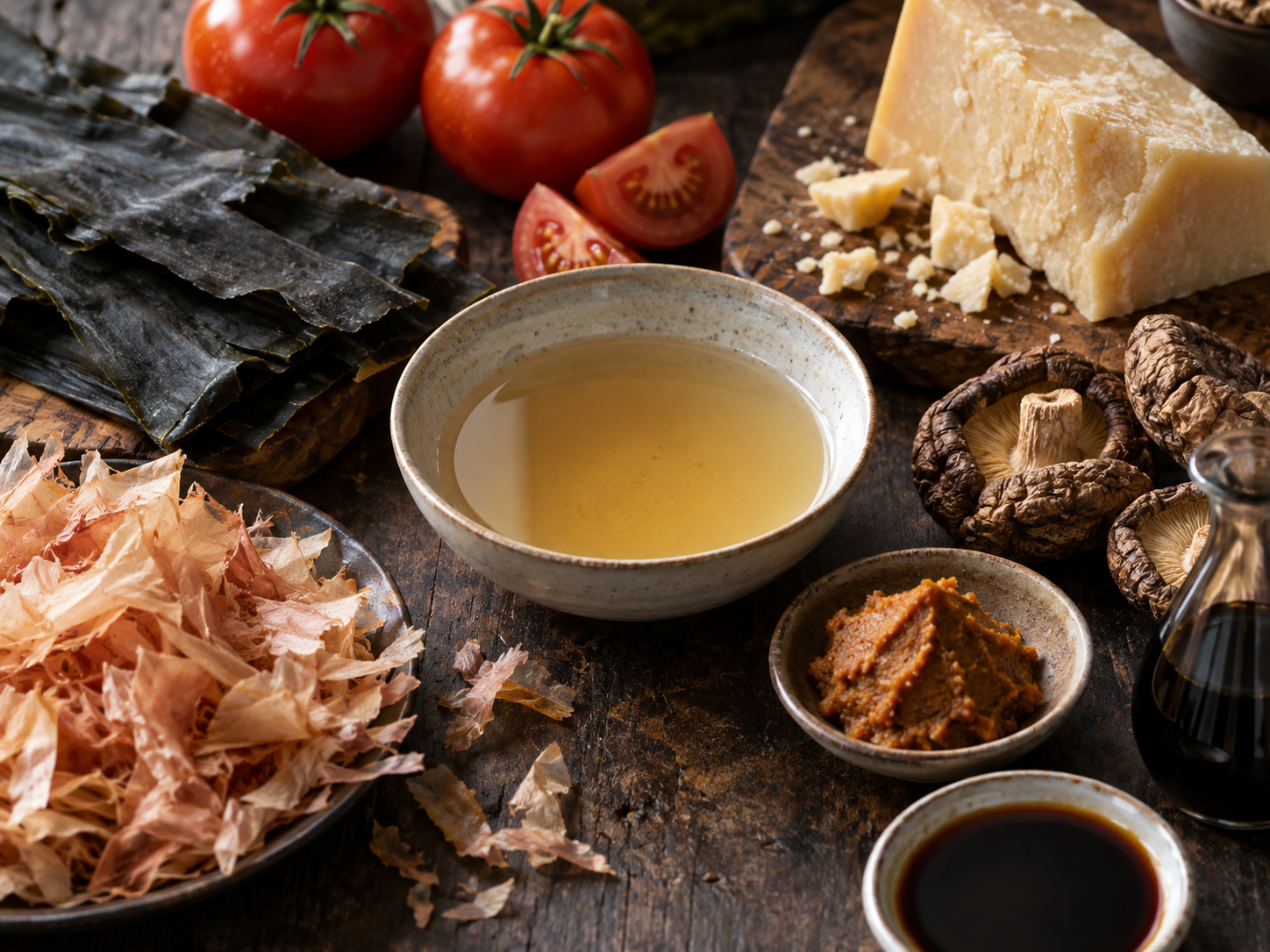
There is a moment when the word umami starts to seem suspiciously vague.
A restaurant describes mushrooms as umami-rich.
A bag of chips promises “deep umami.”
Someone adds Parmesan to pasta and announces that it needs more umami.
Then soy sauce appears. Tomatoes. Miso. Anchovies. Steak. Seaweed.
At some point, umami begins to sound less like a taste and more like a fashionable synonym for “delicious.”
It isn't.
Umami is a distinct basic taste, alongside sweet, sour, salty, and bitter. Its most important trigger is glutamate, an amino acid naturally present in many foods. Certain nucleotides—particularly inosinate and guanylate—can create or dramatically intensify the same taste. Scientists have identified taste receptors involved in detecting these compounds, providing physiological evidence that umami is not simply a poetic culinary idea.
But there is a useful correction to the title of this article.
Japan did not give the world the taste of umami.
Humans had been eating Parmesan, cured ham, fermented sauces, mushrooms, meat broths, ripe tomatoes, and other glutamate-rich foods long before anyone had a scientific name for what connected them.
What Japan gave the world was the word—and, crucially, the explanation.
Umami does not simply mean “savory”
The Japanese word is usually written:
うま味 — umami
It is often translated as “savory taste” or sometimes “deliciousness.”
Those translations are useful, but neither is completely satisfactory.
Savory is too broad. A food can feel savory because of salt, fat, smoke, aroma, spices, browning, or some combination of them without necessarily having much umami.
“Delicious,” meanwhile, is obviously too broad. Chocolate cake can be delicious. So can a peach. Neither is a classic example of umami.
In scientific terms, umami is a taste quality, not a general compliment.
That distinction between taste and flavor matters.
Taste refers to sensations detected through the taste system: sweet, sour, salty, bitter, and umami.
Flavor is the much larger experience produced by taste, smell, temperature, texture, and other sensations interacting.
The smell of roasted garlic is not “umami.”
The smoky aroma of grilled meat is not umami either.
But the glutamate and other compounds in the food may be producing umami at the same time.
That is why describing umami can be frustrating. We rarely encounter it in isolation.
We experience it inside foods.
The discovery began with a bowl of dashi
The story usually begins with 昆布だし (kombu dashi), Japanese stock made from kelp.
In 1908, Tokyo Imperial University chemist Kikunae Ikeda identified glutamate as the substance responsible for a taste in kombu broth that did not fit neatly into the four basic taste categories then commonly recognized: sweet, sour, salty, and bitter. He called this additional taste umami.
The story is interesting because Ikeda was not searching for an obscure laboratory sensation.
He was trying to explain something cooks already knew.
Dashi tasted satisfying in a way that ordinary salt water did not.
Ikeda recognized a similar quality in other foods he had encountered, including tomatoes, asparagus, meat, and cheese. His contribution was to ask what these apparently unrelated foods had in common.
He eventually isolated glutamate from kombu.
The taste had existed forever.
Now it had a name.
Dashi is almost a laboratory demonstration of umami
Japanese dashi happens to be an unusually elegant way of understanding how umami works.
One classic version combines:
昆布 — kombu — kelp
with:
鰹節 — katsuobushi — dried bonito flakes
Kombu is rich in glutamate.
Katsuobushi is rich in inosinate, often abbreviated IMP.
Either contributes umami.
Together, something more interesting happens.
Glutamate and inosinate interact so that the perceived umami becomes considerably stronger than either ingredient produces on its own. This synergistic effect is one of the defining characteristics of umami perception and has been demonstrated both physiologically and at the receptor level.
So a traditional cook combining kombu and bonito was taking advantage of molecular synergy long before anyone described it in those terms.
This is one of those occasions when culinary tradition and chemistry turn out to be describing the same phenomenon from opposite directions.
Japanese scientists found two more pieces of the puzzle
Ikeda's discovery was followed by others.
In 1913, Shintaro Kodama identified inosinate as an important umami component of katsuobushi.
Then in 1957, Akira Kuninaka identified guanylate, another nucleotide associated particularly with dried shiitake mushrooms.
Those three compounds—glutamate, inosinate, and guanylate—still provide a very useful basic framework for understanding umami.
Very roughly:
Glutamate appears prominently in foods such as kombu, tomatoes, aged cheeses, soy sauce, and many fermented foods.
Inosinate is associated especially with meat and fish.
Guanylate is particularly important in mushrooms, especially dried mushrooms.
The really interesting part is what happens when foods from these categories meet.
That explains why certain combinations taste disproportionately satisfying.
Kombu + bonito.
Tomato + Parmesan.
Mushrooms + meat.
Beef + tomato.
Chicken + vegetables.
Humans did not need receptor biology to discover these combinations.
We found them by cooking.
Umami is not uniquely Japanese at all
This is probably the biggest misconception created by the Japanese name.
Once a concept keeps its original Japanese word in English, it can begin to sound as though the thing itself belongs exclusively to Japan.
But umami is everywhere.
A ripe tomato contains naturally occurring glutamate.
So does aged Parmesan.
Fermentation can increase free glutamate, which helps explain the deep savory character of foods such as soy sauce, miso, and mature cheeses. Meat and fish contain nucleotides associated with umami, while mushrooms can contribute guanylate.
Italian cooking has plenty of umami.
So does Chinese cooking.
French stocks can be full of it.
A cheeseburger can be an umami-heavy food whether or not anyone involved uses the word.
The Japanese achievement was not inventing the sensation.
It was recognizing that these foods shared something specific enough to deserve its own category.
Why did it take so long for the West to accept a fifth taste?
For decades after Ikeda's work, the familiar Western model remained four basic tastes.
Umami was sometimes treated as a cultural curiosity or merely as a flavor-enhancing effect rather than a genuinely distinct taste.
That changed gradually as sensory research, nerve-response studies, molecular biology, and receptor research accumulated. Scientists eventually identified receptors responsive to glutamate, including the T1R1/T1R3 receptor system associated strongly with human umami perception. Research also demonstrated the characteristic enhancement that occurs when glutamate is combined with nucleotides such as inosinate or guanylate.
By the late twentieth century, umami had gained broad international recognition as a fifth basic taste.
This history is worth remembering whenever food traditions are described as though science “discovered” what cooks were doing.
Japanese cooks did not need a receptor study to know dashi tasted good.
The science explained why.
So what does umami actually taste like?
This is annoyingly difficult to answer.
Sweet has sugar.
Salty has salt.
Sour has lemon.
Bitter has black coffee or tonic water.
Umami does not have such an obvious English sensory shortcut.
Try tasting a little clear dashi.
Or compare plain hot water with broth.
Taste a ripe tomato.
Then taste a less ripe one.
Try a small piece of Parmesan and pay attention not just to the salt but to the lingering, mouth-filling savory quality.
Umami tends to feel less sharp than saltiness and less immediately obvious than sweetness.
Scientific and sensory descriptions often mention qualities such as mouthfulness, persistence, and a lingering savory sensation.
But a useful experiment is to stop trying to describe it intellectually.
Taste foods that contain a lot of it side by side.
Eventually the resemblance becomes surprisingly obvious.
Tomato and Parmesan explain the idea rather well
Imagine plain pasta.
Now add tomato sauce.
Then add aged Parmesan.
Of course many things have changed: acidity, salt, fat, aroma, texture.
But something else has happened.
Tomatoes can contain substantial free glutamate. Mature cheeses can contain a great deal of it as proteins break down during aging.
The finished dish tastes deeper and more complete partly because it has acquired more umami.
Italian cooks did not arrive at tomato and Parmesan by reading Japanese chemistry journals.
That is exactly what makes umami so interesting.
Once named, it reveals patterns across cuisines that previously seemed unrelated.
Drying, aging, and fermentation often make umami more noticeable
Fresh ingredients and aged ingredients do not necessarily taste the same.
A fresh tomato and a concentrated tomato paste are obviously related, but the second can deliver a much denser savory impression.
Fresh mushrooms taste different from dried shiitake.
Young cheese tastes different from Parmesan.
Soybeans taste different from soy sauce or miso.
Part of what is happening in many fermented and aged foods is the breakdown of proteins, which can increase the amount of free glutamate available to stimulate taste receptors. Reviews of umami chemistry note particularly high glutamate levels in many fermented foods.
Dried mushrooms provide another interesting case. Processing can increase the availability of guanylate, helping dried shiitake contribute powerful umami to broths.
So when cooks age, ferment, dry, or concentrate food, they are not merely preserving it.
They can also be changing the chemistry of how it tastes.
MSG and umami are related—but they are not synonyms
This is where discussions often become unnecessarily confused.
MSG stands for monosodium glutamate.
It is the sodium salt of glutamic acid.
When dissolved in food, MSG provides glutamate—the same basic umami-triggering ion present naturally in foods such as tomatoes and cheese. The FDA notes that the body does not distinguish chemically between glutamate from added MSG and free glutamate naturally present in foods.
But umami is not another word for MSG.
MSG is one ingredient that produces umami.
A tomato can taste umami-rich without anyone adding MSG.
So can Parmesan.
So can kombu.
Saying “umami means MSG” is rather like saying “sweet means table sugar.”
Sugar creates sweetness.
It is not the entire concept of sweet.
Is MSG safe?
This subject accumulated an unusual amount of cultural baggage in the United States.
The FDA classifies added MSG as generally recognized as safe (GRAS). It also notes that controlled studies have not consistently reproduced reactions in people who identify themselves as MSG-sensitive. Large amounts—around three grams or more consumed without food—may produce short-lived symptoms in some people, but this is considerably more than the MSG normally present in a serving of food.
That does not mean an individual cannot dislike MSG or feel unwell after a particular meal.
It means that the broad idea that MSG itself is inherently dangerous is not supported by the evidence used by food-safety authorities.
There is also an odd contradiction in the way the ingredient has sometimes been discussed.
A diner may worry about “MSG” in one dish while enthusiastically adding Parmesan, tomatoes, mushrooms, or soy sauce to another.
The molecules are less interested in culinary prejudice than humans are.
Umami explains why certain food pairings work so well
One of the most practical things to understand about umami is synergy.
Foods high in glutamate can combine with foods rich in inosinate or guanylate to create a stronger umami perception.
Traditional dashi gives the cleanest Japanese example:
kombu + katsuobushi
glutamate + inosinate.
But the same basic principle appears far outside Japan.
Beef with mushrooms.
Chicken with tomato.
Meat with aged cheese.
Vegetable stock with dried mushrooms.
The biochemical explanation is particularly elegant. The human T1R1/T1R3 receptor responds to glutamate, while IMP and GMP can bind nearby and amplify the receptor's response.
So “these ingredients taste good together” can occasionally be translated into something close to:
“Your receptor is being unusually enthusiastic about this combination.”
Less romantic, perhaps.
But useful.
Dashi is a good lesson in Japanese cooking generally
Western descriptions of Japanese food sometimes focus heavily on visible ingredients.
Sushi.
Tempura.
Ramen.
Yakitori.
But dashi is quieter.
It often sits underneath the dish rather than announcing itself.
It appears in soups, simmered dishes, sauces, noodle broths, and countless other preparations.
The point is frequently not for the diner to say, “Ah, I can strongly taste the seaweed.”
Good dashi can make other ingredients taste fuller and more coherent.
That restraint is part of why umami became so connected with Japanese cuisine.
Salt tends to announce itself when there is too much of it.
Sweetness does too.
Umami can work more quietly in the background.
Can you taste pure umami?
More or less.
Dissolving a small amount of MSG in water creates an umami sensation without many of the aromas and textures associated with food.
It can actually be a useful sensory exercise.
But many people find pure umami less appealing than umami inside a complete dish. Research literature notes that glutamate itself is not necessarily especially pleasant in isolation; much of its culinary value comes from how it interacts with the rest of a food.
This explains why the phrase “umami bomb” can be somewhat misleading.
More is not automatically better.
Food still needs balance.
A dish overloaded with glutamate, salt, fat, smoke, and fermented ingredients can become exhausting rather than delicious.
Umami is a taste.
It is not a substitute for cooking.
A few Japanese words help make sense of the subject
The vocabulary around umami reveals a useful distinction.
うま味 — umami
The fifth basic taste.
旨い / うまい — umai
Delicious, tasty, good.
They are related historically and conceptually, but they are not interchangeable in ordinary usage.
Someone can say:
このラーメン、うまい。
Kono rāmen, umai.
“This ramen is delicious.”
That does not mean:
“This ramen is the fifth basic taste.”
Similarly:
だし — dashi
Japanese stock, commonly made from ingredients such as kombu, katsuobushi, dried sardines, or shiitake.
昆布 — kombu
Kelp used extensively in Japanese cooking and especially important in the history of umami research.
鰹節 — katsuobushi
Dried, processed bonito, one of the classic ingredients of Japanese dashi.
味噌 — miso
Fermented soybean paste, often rich in savory flavor and free glutamate.
Learning food vocabulary this way is more useful than memorizing “umami = savory,” because it shows the network of ingredients and practices around the word.
Why “the fifth taste” is more than a trivia fact
At first glance, the discovery of umami sounds like something suitable for a pub quiz.
“How many basic tastes are there?”
“Five!”
But the more interesting story is linguistic.
People had the sensation before they had the category.
Japanese gave that category a name.
Once a culture names something clearly, other people can begin noticing it more consciously.
English ultimately borrowed umami directly rather than inventing a new native word.
That has happened with many Japanese terms:
sushi
karaoke
tsunami
emoji
haiku
Sometimes borrowing a word is easier than repeatedly translating the concept.
Umami has now traveled so thoroughly that an English-speaking chef can say “this needs more umami” without necessarily thinking of Japan at all.
That may be the clearest sign that the word succeeded.
Japan named something the rest of the world was already tasting
A bowl of Italian tomato sauce does not become Japanese because it contains glutamate.
Parmesan is not secretly Japanese food.
Neither are mushrooms, roast beef, fish sauce, cured ham, or fermented vegetables.
Yet the word umami gives us a useful way to see what some of these foods share.
That is more interesting than claiming Japan somehow invented a fifth human taste.
Ikeda's insight was essentially an act of noticing.
There was a sensory experience that did not fit comfortably into the existing categories. Instead of dismissing that mismatch, he investigated it.
More than a century later, English speakers casually use his Japanese word at restaurants, in cookbooks, on food packaging, and in home kitchens.
At Polyglottist Language Academy, this is exactly the sort of cultural detail that makes language learning more rewarding. Japanese vocabulary is not simply a list of English equivalents. Words such as umami carry histories, habits, scientific discoveries, and ways of categorizing experience. Polyglottist offers live Japanese classes for adults online and selected in-person classes in Berkeley, California, with an emphasis on practical communication and understanding how Japanese is actually used.
Learning that うま味 means “umami” takes a moment.
Understanding why the world needed to borrow the word takes a little longer.
And the next time tomato, Parmesan, mushrooms, miso, or a bowl of dashi tastes mysteriously complete, there is now a name for at least part of what is happening.
Frequently Asked Questions
What exactly is umami?
Umami is one of the five generally recognized basic tastes, along with sweet, sour, salty, and bitter. It is strongly associated with glutamate and is enhanced by certain nucleotides, particularly inosinate and guanylate.
What does umami taste like?
It is usually described as savory, mouth-filling, and lingering. Foods such as broth, ripe tomatoes, Parmesan, mushrooms, soy sauce, and meat can provide recognizable examples, although their overall flavors also include aroma, salt, fat, acidity, and other sensations.
Who discovered umami?
Japanese chemist Kikunae Ikeda identified glutamate as the source of the distinctive taste of kombu dashi in 1908 and named the taste umami.
Is umami the same thing as MSG?
No. MSG, or monosodium glutamate, is an ingredient that supplies glutamate and therefore produces umami. Naturally occurring free glutamate in foods such as tomatoes and cheese stimulates the same basic taste system.
Is MSG safe?
The U.S. FDA considers added MSG generally recognized as safe. Controlled research has not consistently reproduced reported reactions in people who identify themselves as MSG-sensitive, although large doses consumed without food can produce temporary symptoms in some individuals.
Why are kombu and bonito used together in dashi?
Kombu supplies glutamate, while katsuobushi supplies inosinate. The two compounds interact synergistically, producing substantially stronger umami than either can provide alone.
Is umami only found in Japanese food?
Not at all. Umami-producing compounds occur naturally in foods across cuisines, including tomatoes, cheeses, meats, fish, mushrooms, and fermented products. Japan provided the word and much of the early scientific explanation, not the taste itself.