
Tagalog Classes in Seattle: A Guide for Adult and Heritage Learners
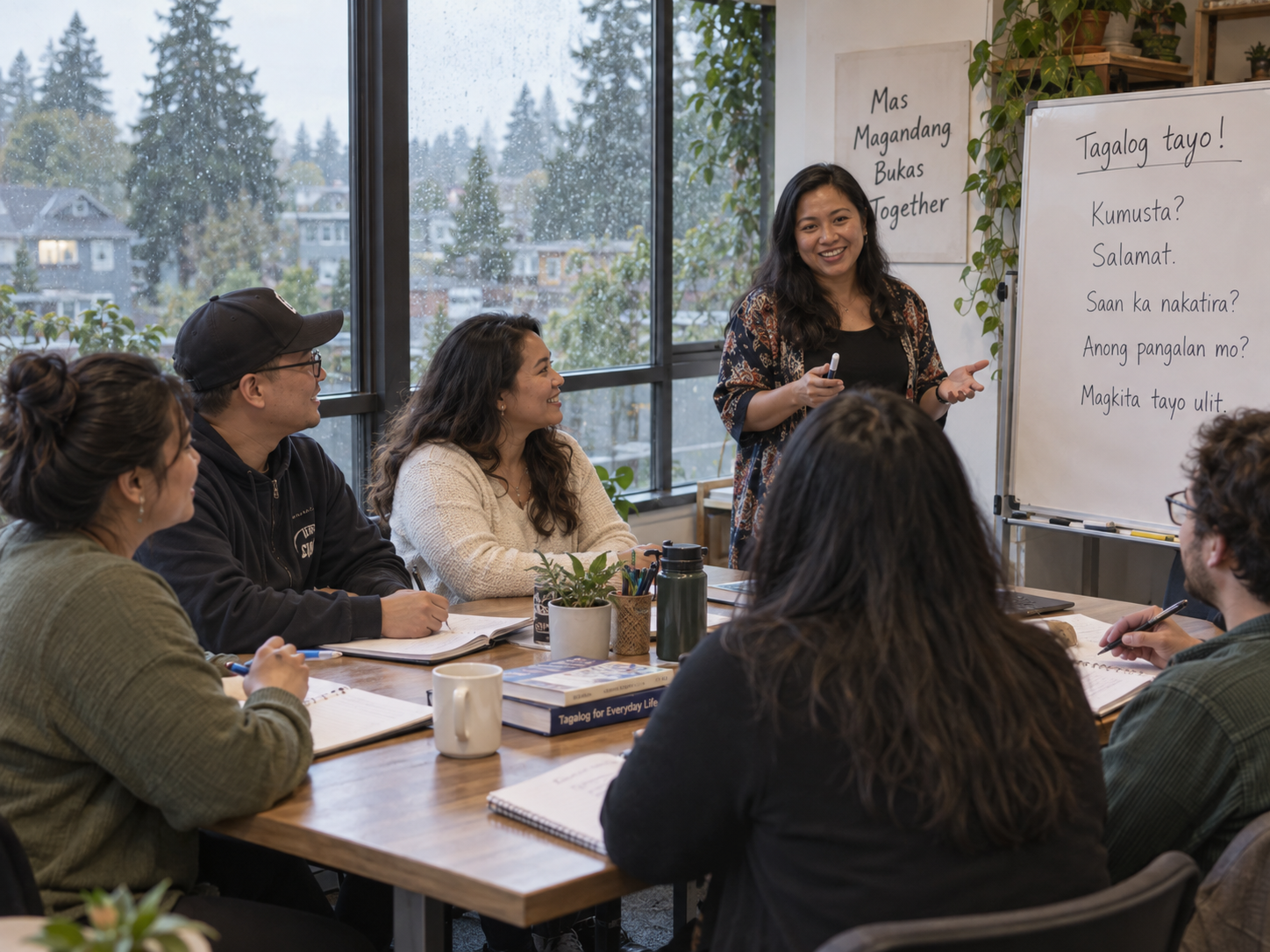
Seattle has one of the oldest organized Filipino community institutions in the United States, a visible Filipino cultural presence, and a long history of community-based language and heritage education. Yet an adult searching specifically for “Tagalog classes in Seattle” may still find fewer continuously scheduled adult courses than expected.
That contrast is important. A strong Filipino community does not automatically produce a permanent adult evening language sequence. For Seattle learners, the most useful plan may combine community participation with live structured instruction rather than expect one institution to do everything.
Start with the Filipino Community of Seattle
The Filipino Community of Seattle has served the region since 1935 and remains a major cultural and social institution in Southeast Seattle. Its current Culture & Arts programming explicitly centers Philippine language, dance, literature, music, food, events, and history, and its family and youth programs have long incorporated language and heritage education.
For a learner, this is valuable even when a formal adult Tagalog class is not posted on the current calendar.
Community institutions give language a social home. They create events, intergenerational relationships, cultural context, and opportunities to hear how Filipino Americans in the region actually communicate.
What they do not necessarily provide at every moment is a sequential adult grammar-and-conversation course from complete beginner through intermediate.
That distinction prevents a common disappointment: arriving at a cultural program expecting the equivalent of a college language course.
Seattle heritage learners often need activation, not introduction
A large share of adults interested in Tagalog are not starting from zero. They heard it from parents or grandparents, understand familiar family conversation, and may have strong pronunciation while struggling to produce longer sentences.
This can make a conventional complete-beginner class feel both too easy and too hard. Greetings are familiar, but explaining verb patterns is new. Food vocabulary is automatic, but describing work or politics is difficult. Listening feels intermediate, while speaking feels beginner.
That uneven profile is normal.
A good instructor should place heritage learners according to actual skills rather than family background.
Community participation helps with the parts textbooks cannot teach
The Filipino Community of Seattle hosts cultural events and programs that connect learners with food, music, dance, history, and community life. Seattle Center’s broader Filipino cultural events and regional celebrations provide additional opportunities to hear Tagalog and Taglish around real social interaction.
A beginner should approach these spaces as opportunities, not tests.
You do not need to sustain a long conversation. Listen for a greeting you know. Ask one simple question. Notice when people switch between Tagalog and English. Pay attention to forms of address and particles such as po.
For heritage learners, the task may be different: answer one family-style question in Tagalog rather than English, or ask an elder for a story and prepare the vocabulary beforehand.
Live online instruction can fill the scheduling gap
Seattle’s geography makes “in-person” a bigger commitment than the map sometimes suggests. A class in Southeast Seattle may be convenient for one learner and a difficult evening commute for someone on the Eastside or farther north.
When the exact local level you need is not running, live online instruction can be more consistent.
Polyglottist Language Academy offers live online Tagalog classes for adults in small groups. Because Seattle and California share Pacific Time, scheduling is simpler than it is for East Coast learners.
The advantage over a self-paced course is interaction. You have to answer. You have to build a sentence while someone is listening. An instructor can hear where English sentence structure is influencing your Tagalog and correct it before the pattern becomes habitual.
Private lessons are especially useful for heritage speakers
A heritage learner may not need a standard syllabus from lesson one. Private instruction can focus directly on speaking gaps, reading, grammar, or vocabulary expansion.
For example, a learner who understands parents fluently but cannot speak might spend more time on retrieval and spontaneous response. A learner who speaks casually but wants professional vocabulary may focus on reading and formal structures.
The weakness of private study is that conversation becomes predictable because the same teacher knows your habits. Adding a group, family practice, or community setting keeps the language less controlled.
Apps can support Seattle learners, but they cannot create community
Apps are useful for vocabulary and short daily review. Videos and podcasts increase listening exposure. None of these tools can replace the social reason to use a heritage language.
Seattle gives learners a real advantage here. The region has Filipino organizations, food businesses, cultural events, intergenerational community networks, and people using Tagalog and Taglish in ordinary life.
The strongest learning plan uses digital tools for repetition, formal instruction for structure, and community for meaning.
What adult learners should ask before joining a class
Is the class designed for complete beginners or heritage learners?
How much speaking happens each session?
Does the instructor explain verb focus, markers, and sentence structure clearly?
Is Filipino culture treated as real contemporary life rather than a decorative add-on?
How large is the group?
Can a student move levels if the placement is wrong?
Those questions matter more than whether the class happens in a building or on a screen.
Seattle may not always have a continuous menu of adult Tagalog courses publicly listed, but it offers something equally important: a living Filipino community with deep institutional roots. Structured classes can teach you how the language works. Seattle’s Filipino community can give you a reason to keep using it after class ends.