
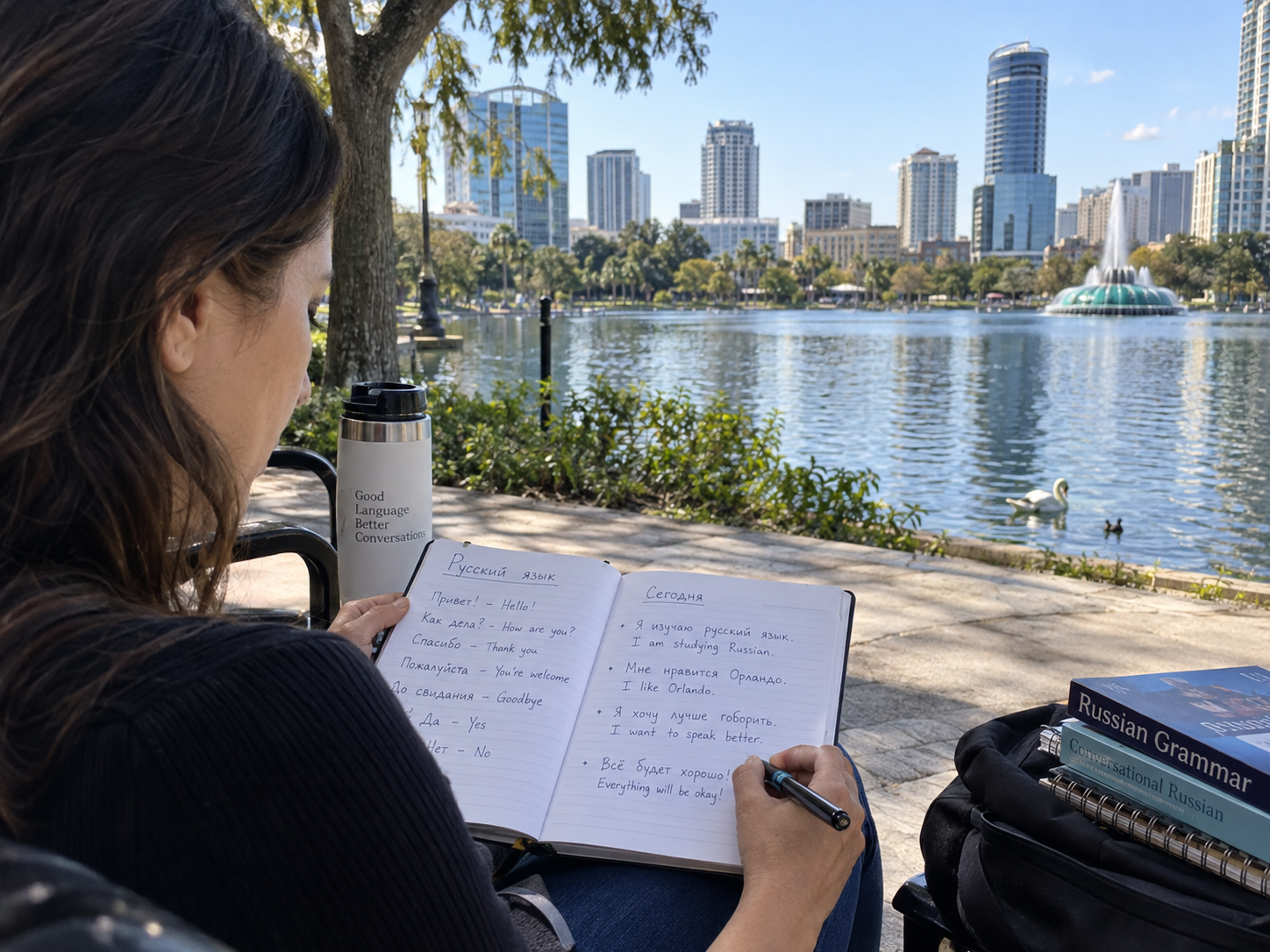
Orlando is actually a slightly odd place to look for Russian classes.
Search for Spanish, French, or even Japanese lessons and the choices are fairly easy to find. Russian is different. There is a serious Russian program at the University of Central Florida, some community and cultural activity, private teachers, and an enormous number of online options—but there is not necessarily a neat menu of evening adult Russian classes scattered around the city.
That does not mean Orlando is a bad place to learn Russian. In some respects, it is better supplied than many American cities of a similar size. The problem is that the options belong to different worlds: university study, community events, private tutoring, online classes, and independent study resources. An adult learner has to figure out which combination actually makes sense.
And that is worth doing, because Russian is a language where the type of instruction matters quite a bit.
An app can teach that дом means "house." It is less good at explaining why the same word suddenly becomes дома, дому, домом, or доме—and, more importantly, at helping someone use those forms without mentally consulting a grammar chart every time they open their mouth.
So rather than simply compiling places that mention Russian somewhere on their websites, this guide looks at the realistic choices for adults learning Russian in Orlando and what each one is actually good for.
Orlando Has a More Serious Russian-Language Presence Than You Might Expect
The most substantial local institution for Russian is the University of Central Florida.
UCF's Department of Modern Languages and Literatures currently offers Russian from beginning through intermediate and advanced levels, alongside a Russian Studies minor and a Russian as a Critical Language certificate. Its Russian program has also organized cultural activities, conversation opportunities, and intensive language programs.
That is unusual enough to matter.
In many American cities, someone searching for Russian discovers that the local college offers Spanish, French, German, and perhaps Chinese or Japanese—but Russian disappeared from the catalog years ago. Orlando has retained an actual progression.
For Fall 2026, for example, UCF's Russian program lists in-person Elementary Russian I, Intermediate Russian I, and Advanced Russian Oral Communication courses.
For a traditional student, that is excellent.
For a 42-year-old accountant who works until 5:30, it presents a different problem.
The current courses listed by UCF meet during the day. University classes also operate within an academic system: semesters, admissions requirements, credits, prerequisites, tuition structures, and a pace designed primarily around students rather than working adults.
So UCF deserves to be the first place mentioned in a guide to Russian classes in Orlando—but not automatically the first choice for every adult learner.
Option 1: University Russian at UCF
For adults who want a rigorous academic approach, UCF is worth investigating.
The attraction is not simply that Russian happens to be available. There is enough of a program to continue beyond the introductory stage. UCF describes offerings in beginning, intermediate, and advanced Russian language and culture, and the program includes dedicated faculty and Russian-related academic activities.
A university course can be particularly good for the learner who likes structure.
There will be a syllabus. Grammar will not be quietly skipped because it is inconvenient. Reading and writing matter alongside speaking. Progress generally builds from one course into the next.
That approach suits Russian rather well.
Russian grammar is not something that needs to dominate every lesson, but eventually it has to be organized. There are six cases. Adjectives change with nouns. Verbs have aspect. Verbs of motion develop into a subject of their own. A learner can survive for a surprisingly long time by collecting phrases, but there comes a point when the machinery behind those phrases needs to make sense.
The disadvantage is obvious: university Russian is university Russian.
Before assuming that a UCF course is available to a non-degree adult learner, check current enrollment rules, tuition, prerequisites, and scheduling directly with the university. Even where enrollment is possible, a class meeting in the middle of a weekday may simply not work for someone with a conventional job.
UCF is therefore best viewed as Orlando's strongest academic Russian option rather than its universal adult-education solution.
Don't Overlook UCF's Russian Community Activities
There is another reason local adult learners should keep an eye on UCF even if they never enroll in a course.
The university has historically supported Russian conversation and cultural activities. UCF Global describes Russian Conversation Hours, Russian Tea Hours, and Russian Club activities and states that these have included community members as well as students. Because schedules and access can change, anyone outside UCF should confirm the current arrangements before attending.
This kind of activity becomes much more useful after a few months of Russian.
A complete beginner walking into a Russian conversation hour may hear something like:
Ну, да, я вообще-то думал, что мы встретимся позже…
…and reconsider every life choice that led to that moment.
That is normal.
After some structured study, however, informal exposure becomes valuable precisely because it is not a lesson. People interrupt each other. Familiar words disappear inside fast speech. A phrase that looked perfectly manageable in a textbook suddenly sounds quite different when someone says it naturally.
Classes build the language. Environments like these test whether the language has begun to become real.
Option 2: Live Online Russian Classes
For many working adults in Orlando, the strongest alternative is now a live online course.
That phrase needs a distinction.
There is a major difference between online learning and self-paced learning.
Watching recorded grammar explanations, completing app exercises, or working through an online course independently can all be useful. But they do not reproduce the most valuable part of a small language class: being required to formulate an answer while another human being waits for it.
That slight pressure matters.
Suppose a teacher asks:
Что вы обычно делаете в выходные?
What do you usually do on weekends?
Recognizing the sentence is one skill.
Constructing an answer—perhaps Обычно я встречаюсь с друзьями ("Usually I meet with friends")—is another.
The second requires retrieval. The learner has to find the vocabulary, choose a verb form, deal with endings, pronounce the sentence, and continue even when it is not perfect.
That is where much of language acquisition actually becomes visible.
A live online class can provide that interaction while considerably expanding the options available to someone in Central Florida. Instead of being limited to whichever Russian instructor happens to be teaching within driving distance of Orlando at a convenient hour, students can choose by level and teaching style.
For a less commonly taught language, that is a substantial advantage.
Orlando Learners Should Pay Attention to Time Zones
There is one very practical detail people overlook when choosing an online class: Orlando is on Eastern Time.
An online course based elsewhere in the United States may list its schedule in Pacific, Mountain, or Central Time.
A 6:00 p.m. Pacific class, for example, begins at 9:00 p.m. in Orlando.
For some adults, that is perfect. Work is over, dinner is finished, and the house is quieter. For someone who gets up at 5:30 every morning, it may be a terrible idea.
This sounds trivial compared with choosing a curriculum or instructor, but scheduling is one of the main reasons adults abandon otherwise good classes. A course that fits normal life is usually more useful than a theoretically perfect course that creates a weekly logistical battle.
Before registering, convert the time and imagine an ordinary Tuesday rather than an unusually motivated one.
Option 3: Private Russian Lessons
Private instruction deserves consideration, particularly for learners whose background does not fit neatly into a level.
Russian produces quite a few of these learners.
Someone may have studied two semesters twenty years ago and remember Cyrillic surprisingly well but almost nothing else.
Another person may have a Russian-speaking parent and understand conversations at home while being unable to explain noun cases or write accurately.
Another may know a considerable amount of grammar from independent study but freeze whenever somebody actually speaks Russian.
Calling all three "beginner" is not very useful.
A private instructor can build lessons around the actual imbalance.
This is particularly valuable for heritage speakers. A heritage learner might have very natural pronunciation and strong listening comprehension while having enormous gaps in literacy and formal grammar. Starting from page one of an ordinary beginner textbook can feel absurd; jumping into an intermediate class may expose weaknesses just as quickly.
Private lessons are also sensible for adults with a narrow goal: preparing for travel, communicating with relatives, reading literature, working with Russian-speaking clients, or improving pronunciation.
The obvious disadvantage is cost. One-to-one instruction is generally more expensive per hour than a group course.
There is also less peer interaction. A teacher can ask questions all evening, but classmates create another kind of unpredictability. They phrase things differently. They make mistakes. They ask questions nobody else thought of. Listening to other learners struggle toward meaning is surprisingly useful.
For that reason, private instruction is not automatically superior simply because it is private.
A Small Group Is Often the Sweet Spot
Russian benefits especially from small-group teaching.
A class of three to six adults is large enough for dialogue, pair work, and varied conversation but small enough that disappearing into the back row is difficult.
That matters more than it sounds.
In a large language class, a student can understand a great deal while producing very little. Russian makes this particularly tempting because learners often want a few extra seconds to work out the correct ending before speaking.
Small classes remove some of that hiding space.
Eventually, someone has to answer.
And imperfect Russian spoken in real time is usually more educational than immaculate Russian assembled silently in one's head.
What Should a Complete Beginner Actually Learn First?
One of the stranger things about Russian is that its most intimidating feature is not necessarily its hardest one.
The Cyrillic alphabet looks formidable:
Здравствуйте.
To someone who has never studied Russian, that does not immediately suggest a friendly greeting.
Yet Cyrillic is usually one of the quicker hurdles. Several letters behave approximately as English speakers expect:
А, К, М, О
Others are visual traps:
В = V
Н = N
Р = R
С = S
У = U
Х = kh
Once the brain stops insisting that Р must mean P, reading begins to accelerate surprisingly quickly.
A good beginner Russian course should therefore teach Cyrillic immediately but should not spend weeks treating the alphabet as a preliminary exam that must be completed before "real Russian" begins.
Students can read and communicate from the beginning.
Useful early patterns include:
Меня зовут… — Menyá zovút… — My name is…
Я живу в Орландо. — Ya zhivú v Orlándo. — I live in Orlando.
Я учу русский. — Ya uchú rússkiy. — I'm learning Russian.
Я не понимаю. — Ya ne ponimáyu. — I don't understand.
Можно ещё раз? — Mózhno eshchó raz? — Could you say that again?
That last phrase is considerably more useful in a beginner class than knowing the Russian word for "squirrel."
The Alphabet Isn't the Part I Would Worry About
Adults considering Russian often ask about Cyrillic first.
The more consequential challenge is what happens after they can read it.
Russian word stress is not reliably predictable from spelling. Unstressed vowels change their sound. Consonants can be hard or soft. Then the grammar starts moving word endings around.
Take a very simple idea:
Я живу в Орландо.
I live in Orlando.
Russian uses в for "in," but with many Russian place names the noun following it changes into the prepositional case.
A learner does not need to memorize every possible ending immediately. What matters is gradually noticing recurring structures rather than treating every sentence as an isolated phrase.
This is why a decent Russian class should sit somewhere between two extremes.
One extreme is the old-fashioned grammar course where students spend an evening declining nouns without saying anything useful.
The other is a supposedly "natural" conversation course that avoids explaining grammar at all.
Russian needs both structure and use.
Learn a pattern. Hear it. Say it. Change one piece. Encounter it again next week.
Eventually, something that once required conscious calculation starts simply sounding right.
Use Orlando's Library Resources as a Supplement
Adult learners in Orange County also have a useful resource that costs considerably less than private tutoring: the library.
The Orange County Library System provides language-learning resources, including access to Mango Languages, and has described its digital language collection as covering more than 70 languages.
Resources like this are particularly good for the less glamorous part of language learning: repetition.
A weekly class is not enough exposure by itself.
If a student attends Russian for sixty or ninety minutes and then does absolutely nothing until the following week, the first part of every lesson becomes archaeological work.
Ten or fifteen minutes on several days between classes works differently. Review vocabulary. Listen to a short dialogue. Read a few lines of Cyrillic. Repeat phrases aloud.
The goal is not to create a second Russian course at home.
It is simply to keep the language warm.
Apps Are Useful—Just Don't Ask Them to Do Everything
Language apps have become strangely polarizing. People either credit them with teaching an entire language or dismiss them as useless games.
Neither view is particularly sensible.
Apps are good at giving adults something productive to do for ten minutes while drinking coffee, waiting for an appointment, or sitting on the sofa.
They are often good for:
vocabulary repetition
alphabet recognition
basic listening
reviewing familiar structures
maintaining daily contact with Russian
They are much less reliable at noticing why a learner keeps stressing a word incorrectly, explaining why a noun has unexpectedly changed ending, or conducting the sort of unpredictable conversation that forces someone to retrieve language rather than recognize it.
Use an app the way one might use flash cards, not as a replacement for every other form of instruction.
Build an Orlando Russian Routine, Not Just a Russian Class
The adults who make steady progress tend to create a small ecosystem around their course.
It does not need to consume their lives.
A workable week might look something like this:
One live class.
Two or three short review sessions.
A little listening while driving.
Ten minutes of reading Cyrillic aloud.
One film, video, podcast segment, or interview where the goal is simply to notice familiar words.
Occasional conversation or cultural events when available.
That combination solves a problem that classrooms cannot solve alone: frequency.
Russian becomes easier when the interval between encounters with Russian gets shorter.
At first, every sentence feels newly constructed. Eventually certain combinations begin arriving as units:
Я думаю, что… — I think that…
Мне кажется… — It seems to me…
Я не знаю. — I don't know.
Потому что… — Because…
На самом деле… — Actually / in fact…
That is a meaningful stage in learning. The brain is no longer assembling every Russian sentence from individual components.
What to Look for in a Russian Teacher
Native fluency alone does not guarantee that someone can teach Russian.
A native speaker knows instinctively that something sounds wrong. A good teacher also needs to explain what is happening at the appropriate level.
With Russian, this distinction becomes obvious fairly quickly.
Ask how the instructor handles grammar.
If the answer is essentially "we memorize all six cases first," a complete beginner may spend too long studying the architecture before entering the building.
If the answer is "don't worry about grammar; just speak," the student may enjoy the first few weeks and then encounter a wall.
A stronger approach introduces grammar as it becomes communicatively useful.
The accusative case can appear because students want to say what they like, see, read, or buy. The prepositional emerges naturally when talking about where people live or where something happens. Verb aspect becomes more intelligible once learners already have enough verbs to compare completed and ongoing actions.
Also ask how much students actually speak.
"Conversation-focused" has become such a universal marketing phrase that it sometimes means very little.
In a good adult language class, students should regularly have to produce language themselves rather than simply listen to explanations about it.
How Long Before Russian Starts Feeling Like Russian?
The first gratifying milestone is usually reading.
A sign in Cyrillic that once looked decorative suddenly contains words.
Then comes phrase recognition.
Then short responses.
Grammar tends to lag behind. Students can understand a concept perfectly on paper and still choose the wrong ending while speaking. That is not evidence that the grammar explanation failed. Conscious knowledge simply becomes automatic more slowly.
Listening may be slower still.
Real Russian compresses sounds, reduces vowels, drops predictable information, and moves much faster than beginner audio.
This leads to a peculiar stage where someone can read a paragraph but understand very little when the same material is spoken naturally.
That stage is not a reason to restart from the beginning.
It is a reason to listen more.
So, Which Kind of Russian Class Makes Sense in Orlando?
For an Orlando adult learner, the answer depends less on which provider has the fanciest website and more on what kind of structure is needed.
Someone who wants a rigorous academic sequence and can accommodate university scheduling should investigate UCF.
Someone who wants weekly interaction around a full-time job may be better served by a live online small-group class.
Someone with irregular hours, previous Russian, heritage exposure, or a specific goal may benefit from private instruction.
And someone who already has a course should take advantage of inexpensive supplementary resources rather than paying a teacher to provide every minute of Russian exposure.
The mistake is assuming one resource has to do everything.
It rarely does.
Learning Russian Online from Orlando with Polyglottist Language Academy
For Orlando adults who want structured instruction but do not need a physical classroom in Central Florida, Polyglottist Language Academy offers live online Russian classes for adults.
These are instructor-led classes rather than prerecorded courses. Russian offerings include different levels according to the current schedule, with small groups designed to give students enough time to speak, ask questions, and receive individual feedback. Polyglottist's Russian program currently describes groups of approximately three to six students and a progression from complete beginner into continuing levels. (Polyglottist Language Academy)
The emphasis is on learning the grammar rather than pretending it does not exist, while still connecting that grammar to actual communication, pronunciation, listening, vocabulary, and cultural context.
Because Orlando is three hours ahead of Pacific Time, Florida students should check the listed class time carefully when selecting a course.
For learners who prefer in-person study, Polyglottist's physical classroom is in Berkeley, California; Orlando students would join the live online program. (Polyglottist Language Academy)
More than anything, the useful question is not "What's the easiest way to learn Russian?"
Russian is not particularly interested in being easy.
A better question is: What arrangement will keep me reading, listening, speaking, and coming back to Russian long enough for all these strange endings to stop feeling quite so strange?
Find that arrangement, and Orlando turns out to be a perfectly reasonable place to begin.
Frequently Asked Questions About Russian Classes in Orlando
Are there in-person Russian classes in Orlando?
The University of Central Florida currently maintains a Russian program with beginning, intermediate, and advanced coursework. Availability and eligibility vary by term, so adult learners should check directly with UCF. Private tutors and community opportunities may also be available locally.
Can adults take Russian classes online from Orlando?
Yes. Live online classes allow Orlando students to study with an instructor and classmates without relying on the relatively limited number of local adult Russian courses. Check the time zone carefully when a school is based outside Florida.
Is Russian difficult for English speakers?
Russian presents genuine challenges, particularly noun cases, verb aspect, word stress, listening comprehension, and hard versus soft consonants. Cyrillic usually becomes manageable considerably sooner than beginners expect.
Should I learn Cyrillic before taking a Russian class?
No. A genuine complete-beginner course should teach Cyrillic from the beginning. Learning some letters beforehand can be useful, but it should not be an admission requirement for a zero-level class.
Is a private tutor better than a group Russian class?
Not necessarily. Private lessons offer customization and more individual speaking time. Small groups provide interaction with several speakers and are usually less expensive. Heritage learners and students with unusual backgrounds often benefit particularly from individual instruction.
How often should I study Russian?
One weekly class can provide structure, but Russian becomes much easier to retain when it appears several times during the week. Short review, listening, and reading sessions between classes are generally more useful than saving everything for one long weekend study session.