
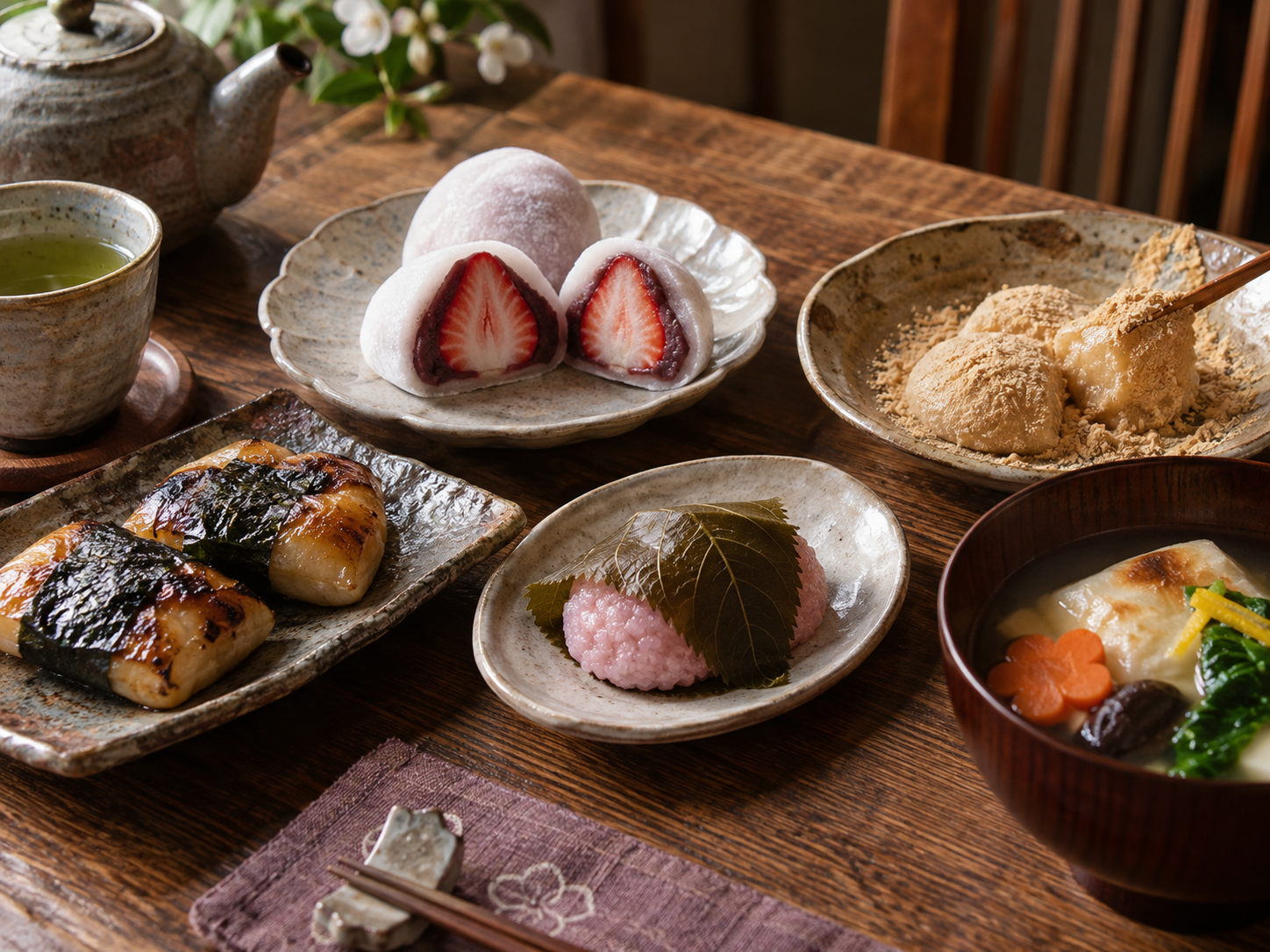
For many people outside Japan, mochi means one very specific thing: a small pastel-colored ball with ice cream inside.
That is mochi—or at least one modern form of it. But if that is the only mochi you know, the word becomes a little like defining “bread” as “a hamburger bun.”
In Japan, 餅 (もち, mochi) belongs to a much larger food tradition. It can be freshly pounded and almost impossibly soft, grilled until crisp on the outside, simmered in soup, coated with roasted soybean flour, filled with sweet red bean paste, wrapped in a salted cherry leaf, offered at New Year, or incorporated into regional dishes that barely resemble one another.
Some mochi is sweet.
Some is savory.
Some isn't technically made from rice at all.
And despite the usual English translation of “rice cake,” it bears little resemblance to what an English speaker normally imagines when hearing the word cake.
So what exactly is mochi?
At its simplest, mochi is pounded sticky rice
Traditional mochi begins with もち米 (mochigome), a particularly sticky variety of short-grain rice.
The rice is soaked, steamed, and then pounded until the individual grains disappear into a smooth, elastic mass. The traditional process is called 餅つき (mochitsuki). One person pounds the hot rice with a heavy wooden mallet while another repeatedly turns and moistens it between strikes—a piece of culinary choreography that requires considerably better timing than most cooking techniques. Japan's national tourism organization describes mochitsuki as a longstanding part of Japanese food culture, particularly around New Year.
Freshly made mochi is soft, warm, stretchy, and extremely sticky.
Leave it to cool, however, and its personality changes completely. It firms up and can be shaped into cakes that are later grilled, toasted, boiled, or added to soup.
Incidentally, “glutinous rice” does not mean the rice contains gluten. The term refers to its glue-like stickiness.
And “rice cake” is mostly a convenient translation. Mochi is not cake in the Western baking sense. There is no flour-and-butter crumb, no sponge, and usually no oven involved in making the basic food.
The mochi many foreigners know is actually daifuku
Picture a soft white ball of mochi with sweet red bean paste in the middle.
That is more specifically:
大福 — daifuku
Daifuku consists of a soft mochi-like outer layer wrapped around a filling, traditionally あんこ (anko), sweet paste made from azuki beans. Modern versions can contain strawberries, chestnuts, cream, chocolate, fruit, matcha fillings, and all sorts of other combinations.
This distinction is useful because English-language menus frequently use mochi for almost any small chewy Japanese sweet.
In Japanese, someone looking at a strawberry wrapped in mochi and red bean paste would normally recognize it as:
いちご大福 — ichigo daifuku — strawberry daifuku
rather than simply calling it “mochi.”
That may seem like a small vocabulary distinction, but it points to something larger: mochi is an ingredient, a preparation, and a category of foods—not one single dessert.
Mochi is not supposed to be sweet
This may be the biggest surprise for someone whose introduction came from a supermarket freezer.
Plain mochi itself is quite neutral in flavor. Much of its appeal comes from texture and from whatever accompanies it.
A piece of mochi can be grilled until the surface puffs and browns, then eaten with soy sauce and nori. It can be covered in きなこ (kinako), roasted soybean flour. It can be served with sweet azuki beans. It can be incorporated into savory soups.
In some regions, the variety becomes extraordinary.
The Ichinoseki-Hiraizumi area of Iwate Prefecture has a particularly elaborate mochi tradition. Japan's Ministry of Agriculture describes a local “mochi calendar” with more than 60 occasions for eating mochi during the year and notes that local preparations can involve sesame, walnuts, mushrooms, edamame, seafood, natto, vegetables, and many other ingredients. Around 300 variations are said to exist in the area.
Mochi, in other words, is not Japan's answer to marshmallows.
It is closer to a foundational rice food that happens to have an unusually broad range of sweet and savory lives.
New Year is when mochi becomes especially important
Mochi is available throughout the year, but its cultural importance becomes particularly visible around お正月 (oshōgatsu), the Japanese New Year.
One of the most recognizable New Year decorations is 鏡餅 (kagami mochi): traditionally two round cakes of mochi stacked on top of one another and presented as an offering.
Mochi is also central to 雑煮 (zōni or ozōni), a New Year soup eaten across Japan.
There is no single definitive zōni.
The broth changes by region. So do the vegetables, accompaniments, and even the shape of the mochi. Some places favor round mochi; others use rectangular pieces. Some versions use clear dashi-based broth, while others use miso. Families can have their own versions as well. Japan's Ministry of Agriculture describes zōni as a nationwide New Year food whose ingredients and preparation differ substantially between regions and households.
That regional variation is part of the point.
Asking a Japanese person what goes into zōni can produce the culinary equivalent of asking an American what belongs in barbecue sauce: the answer may immediately reveal where someone grew up.
Kinako mochi: simplicity works surprisingly well
One of the easiest ways to eat mochi is with きなこ (kinako).
Kinako is roasted soybean flour, usually pale golden brown, with a nutty flavor. It is often mixed with sugar and sprinkled generously over soft mochi.
There is nothing elaborate about it.
That is exactly why it works.
The warm, neutral chewiness of mochi and the dry, almost peanut-like flavor of kinako make a particularly satisfying combination. For someone trying Japanese sweets for the first time, kinako mochi is worth seeking out precisely because it does not depend on frosting-level sweetness.
Japanese confectionery often works with subtler contrasts than many Western desserts.
Isobeyaki: mochi goes savory
Another common preparation is 磯辺焼き (isobeyaki).
Mochi is grilled, seasoned with soy sauce, and commonly wrapped with 海苔 (nori), dried seaweed.
The result is completely different from daifuku: smoky, salty, crisp in places and stretchy inside.
This is the form of mochi that often resets a visitor's understanding of the food.
The same basic ingredient that appeared beside green tea as a delicate sweet can suddenly feel like a salty grilled snack.
That versatility is one reason mochi has endured so well.
Sakura mochi: one name, two surprisingly different sweets
桜餅 — sakura mochi — cherry blossom mochi
sounds straightforward.
It isn't.
There are two major styles, and ordering sakura mochi in Tokyo and Osaka may produce noticeably different sweets.
In the Kanto style, historically associated with Tokyo, the bean paste is wrapped in a thin, crepe-like pink wrapper and then surrounded by a salted cherry leaf. The form is traditionally associated with Chōmeiji near the Sumida River and dates to the Edo period.
In Kansai, sakura mochi typically uses 道明寺粉 (dōmyōjiko), coarsely processed glutinous rice, producing a much more visibly grainy, chewy exterior around the sweet bean filling.
Both are sakura mochi.
Both are pink.
Both usually involve anko and salted cherry leaves.
Yet visually and texturally they can seem like different desserts.
The leaf is another small cultural surprise. With sakura mochi, it can be eaten, and many people enjoy the salty leaf against the sweet filling—though eating it is not obligatory.
The result does not taste much like the artificial “cherry blossom flavor” found in some seasonal drinks. The appeal is the combination of sweetness, salt, leaf aroma, and texture.
Kashiwa mochi arrives with Children's Day
Another seasonal form is 柏餅 (kashiwa mochi), associated particularly with Children's Day on May 5.
It typically consists of a rice-based cake containing sweet bean paste and wrapped in a leaf.
The leaf traditionally has symbolic significance. Kashiwa oak leaves remain on the tree until new growth emerges, which helped create an association with continuity between generations and family prosperity.
Unlike the salted leaf around sakura mochi, the leaf around kashiwa mochi is generally functioning as a wrapper rather than as part of the sweet itself.
Regional adaptations complicate the story, as they often do with Japanese food. In areas where the appropriate oak leaves were not readily available, other local leaves came to be used instead.
A food with one nationally recognizable name can therefore have local ingredients, local terminology, and local history underneath it.
Kusa mochi: the green one is not necessarily matcha
A green Japanese sweet is often automatically labeled “matcha” outside Japan.
That can be a mistake.
草餅 (kusa mochi) traditionally gets its green color from よもぎ (yomogi), Japanese mugwort.
The herb gives the mochi a grassy, aromatic flavor quite different from tea. Kusa mochi may be eaten as it is or filled with anko, depending on the preparation.
This is worth remembering in Japanese confectionery shops generally: green does not automatically equal green tea.
Yomogi has a long history in Japanese foods, including regional forms of mochi and other sweets. In Kagoshima's Amami region, for example, local kasha mochi combines mugwort with glutinous rice flour, sweet potato and brown sugar before being steamed in aromatic leaves.
That is a long way from supermarket mochi ice cream.
Warabi mochi contains no traditional mochi rice at all
Then we reach one of the most useful complications:
わらび餅 — warabi mochi
Despite the name, traditional warabi mochi is not made from pounded mochigome.
It is made from warabi starch, derived from the roots of the bracken plant, combined with water and sugar. The resulting confection is translucent, cool, jiggly, and elastic, commonly served with kinako and sometimes 黒蜜 (kuromitsu), a dark sugar syrup.
True warabi starch is difficult and expensive to produce, so many commercial versions use other starches such as sweet potato, tapioca, or kudzu instead.
This demonstrates something important about food vocabulary.
Names do not always behave like scientific categories.
Mochi can describe foods linked by texture, culinary tradition, or resemblance even when the underlying ingredients differ.
Trying to create a perfectly logical definition can become less useful than learning how Japanese speakers actually use the word.
What about dango?
Mochi and 団子 (dango) are also regularly confused outside Japan.
Both can be round.
Both can be chewy.
Both may be served as Japanese sweets.
But they are not simply two names for the same food.
Traditional mochi is made by pounding cooked glutinous rice—or, in modern confectionery, may be prepared from related rice flours.
Dango is generally made by forming a dough from rice flour and water into small dumplings, which are then cooked. Three or more may appear on a skewer, perhaps covered with a sweet soy glaze in みたらし団子 (mitarashi dango).
The distinction may not matter much while choosing a snack.
It matters quite a lot if you're trying to understand what you are eating.
And yes, mochi ice cream counts—but it is modern
Mochi ice cream is now so familiar internationally that it can seem like an old Japanese standard.
Its history is much more modern.
Japan already had frozen daifuku-style products by the early 1980s, including Lotte's Yukimi Daifuku, which paired an ice-cream-like filling with a soft rice-based outer layer. In the United States, Los Angeles confectionery Mikawaya helped establish the format now commonly called mochi ice cream in the early 1990s.
That makes mochi ice cream interesting in its own right.
It is not “fake mochi” simply because it is modern, nor is it a timeless traditional Japanese confection. It belongs to the continuing evolution of Japanese and Japanese-American food.
Food cultures do not stop developing when someone writes a tradition down.
Ohagi and botamochi live somewhere nearby
Another sweet worth knowing is おはぎ (ohagi), also called ぼたもち (botamochi) depending on season and tradition.
Here the rice is generally only partially pounded rather than transformed into the completely smooth mass associated with conventional mochi. It is often formed and covered generously with anko, kinako, sesame, or other coatings.
The names have seasonal associations: botamochi is traditionally linked with the spring equinox and peony season, while ohagi is associated with the autumn equinox and bush clover. In practice, terminology can vary.
This is another reason Japanese sweets become more interesting once you stop trying to classify everything as “a type of mochi.”
The boundaries overlap.
History, season, ingredients and local language all matter.
Texture is not a side effect—it is the point
Someone who grew up eating brownies, cookies and cakes may initially judge Japanese sweets mostly by flavor.
With mochi, that misses half the experience.
Japanese food vocabulary pays considerable attention to texture, and the elasticity of mochi is one of its defining pleasures.
Fresh mochi resists slightly and stretches.
Grilled mochi develops a dry or crisp exterior before giving way to a sticky center.
Warabi mochi has a cooler, trembling softness.
Dōmyōji-style sakura mochi retains a slightly granular rice texture.
Daifuku contrasts a soft outer layer with dense bean paste or another filling.
If someone says they “don't like mochi” after trying one supermarket strawberry ice cream ball, it is worth trying another form before reaching a lifetime decision.
There is no single mochi texture.
One genuine caution: mochi can be difficult to swallow
The famous stickiness is not entirely benign.
Because mochi is dense and adhesive, it can present a choking risk, particularly for older adults and people who have difficulty chewing or swallowing. Japan's Consumer Affairs Agency specifically warns about mochi-related choking around New Year and recommends cutting it into small pieces, taking manageable bites, and chewing thoroughly before swallowing.
This is not a reason to fear mochi.
It is a reason not to treat a large, sticky piece as though it were an ordinary cookie.
Small bites are sensible.
A few Japanese words make a wagashi shop much easier
Travelers in Japan do not need advanced Japanese to explore mochi, but several words help.
餅 — もち — mochi
Mochi / rice cake
大福 — だいふく — daifuku
Soft mochi confection containing a filling
あんこ — anko
Sweet bean paste
こしあん — koshian
Smooth strained bean paste
つぶあん — tsubuan
Chunkier bean paste with some bean texture remaining
きなこ — kinako
Roasted soybean flour
よもぎ — yomogi
Japanese mugwort
A particularly useful question is:
中に何が入っていますか。
Naka ni nani ga haitte imasu ka?
“What's inside?”
Or:
これは何の餅ですか。
Kore wa nan no mochi desu ka?
“What kind of mochi is this?”
Those questions can lead somewhere much more interesting than simply choosing the prettiest thing in the display case.
Mochi makes more sense when you stop looking for one definition
Mochi is sticky rice pounded until the grains disappear.
Except when it is made with rice flour.
Except when warabi mochi contains no rice at all.
It is a ceremonial New Year food.
And an everyday snack.
And something grilled with soy sauce.
And a delicate seasonal confection wrapped in a cherry leaf.
And, now, something filled with mango ice cream and sold from a supermarket freezer thousands of miles from Japan.
That apparent messiness is not a problem to solve.
It is what happens when a food has been part of a culture for a very long time.
The word accumulates regional traditions, seasonal meanings, cooking techniques, modern inventions, and foods that resemble older foods enough to inherit their names.
For Japanese learners, food vocabulary like this is particularly useful because it exposes something textbooks cannot always show clearly: words belong to cultural categories, and cultural categories rarely line up perfectly between languages.
“Rice cake” gets you started.
It does not quite get you to mochi.
At Polyglottist Language Academy, we teach Japanese as a living language connected to the situations and culture in which people actually use it. Our live Japanese classes for adults are offered online, along with selected in-person classes in Berkeley, California, with an emphasis on practical communication rather than vocabulary lists alone.
Learning the word 餅 takes a few seconds.
Learning why sakura mochi in Osaka may look different from sakura mochi in Tokyo, why green mochi is not necessarily matcha, or why someone expects mochi in their New Year soup is the part that makes knowing the language worthwhile.
Frequently Asked Questions
What is mochi made from?
Traditional mochi is made from mochigome, a sticky variety of Japanese rice that is steamed and pounded into a smooth, elastic mass. Some modern sweets use glutinous rice flour instead.
Is mochi always sweet?
No. Plain mochi has a relatively neutral flavor and can be eaten in both sweet and savory dishes. It may be grilled with soy sauce and nori, added to soup, or served with sweet ingredients such as red bean paste or kinako.
What is the difference between mochi and daifuku?
Mochi is the broader rice-cake category. Daifuku is a confection in which a soft mochi exterior surrounds a filling, traditionally sweet red bean paste.
Is mochi ice cream traditional Japanese mochi?
It is a modern development based on the idea of filled mochi and daifuku. Frozen daifuku products developed in Japan in the twentieth century, while mochi ice cream became especially prominent in the United States through Japanese-American confectionery in the 1990s.
Is warabi mochi made from rice?
Traditionally, no. Warabi mochi is made using starch derived from bracken roots. Because genuine warabi starch is expensive and scarce, many commercial versions use other starches.
What is the difference between mochi and dango?
Traditional mochi is made by pounding cooked sticky rice, while dango is typically formed from rice-flour dough and cooked as dumplings. Their textures and appearances can overlap, but they are distinct foods.
When do Japanese people traditionally eat mochi?
Mochi is eaten throughout the year, but it has an especially important role around Japanese New Year. It appears in decorations such as kagami mochi and in regional New Year soups called zōni.